Photo by FlippingBook on Unsplash
Choosing in-house vs agency for paid social doesn’t lock you into one model permanently. You can move from an agency to an internal team later, with a typical agency notice period of 30 to 60 days. The stronger choice now depends on how much platform expertise, creative capacity and day-to-day control your business needs.
It’s reasonable to weigh an in-house salary against an agency fee, but headline costs don’t show the full trade-off. Compare the capabilities behind each model, assess retainer and performance-based fees, and plan any future switch without losing strategic continuity. The right choice depends on your team, workload and growth priorities.
Key Takeaways
- Compare the full cost of an employee, including hiring and management demands, with the scope of an agency retainer.
- Set one clear owner for strategy before combining internal expertise with agency support.
- Weigh the value of brand knowledge against the broader platform experience an agency can bring.
- Assess how advertising spend, workload and specialist needs affect the right operating model.
- Map the skills your team needs to retain so a future change in delivery model is easier to manage.
Is an agency more expensive than hiring in-house?
There’s no universal cheaper option: compare the complete employment cost with the agency’s fee and the work included. In an agency contract, check the fee basis, what advertising spend is separate, who owns accounts and creative assets, and the notice period; agency notice commonly runs 30 to 60 days.
In-house salary and hiring costs
An in-house hire creates a fixed salary commitment, even when campaign demand shifts. First-year employment costs also include recruitment, onboarding, management time and the tools needed for the role. A new employee needs time to learn the brand and account structure, and their skills or capacity may not match the business’s needs.
Assess the workload before recruiting. List the tasks the role must own, such as campaign planning, creative testing, tracking and reporting. Then decide which skills must sit inside the business and which can be brought in as needed. A typical in-house employee gives 2 to 4 weeks’ notice, so a departure can leave a capability gap while a replacement is recruited.
Agency retainers and advertising spend
An agency retainer buys agreed work and specialist capacity without adding a permanent employee. Compare the scope with your actual needs: campaign management, creative input, measurement and reporting should be clearly described. Advertising spend is a separate budget line unless the agreement explicitly includes it.
At different spend levels, the key question is whether the workload justifies a fixed internal role or a defined external scope. A performance-based fee can link payment to agreed outcomes, while a retainer gives the agency a recurring fee for its work. The contract should define the performance measure, reporting method and how fees change if the scope changes.
For either model, put account access and asset ownership in writing. The business should retain clear control of its advertising accounts, data and creative files, with handover responsibilities set out for termination. Also define who approves budgets and campaigns, how work is reported and what happens to unfinished work when the agreement ends.
| Option | Cost structure | Capacity | Key risk |
|---|---|---|---|
| In-house hire | Fixed employment and operating costs | Dedicated to one business | Recruitment, retention and capacity gaps |
| Agency retainer | Recurring fee for agreed scope; ad spend separate | External specialist resource | Scope or ownership terms may be unclear |
| Performance-based agency | Fee tied to a defined outcome | External delivery against agreed measures | Disputes if measurement rules are vague |
Choose the option whose defined responsibilities match your steady workload, and make fees, ownership and notice terms explicit before signing.
Can I switch from agency to in-house later?
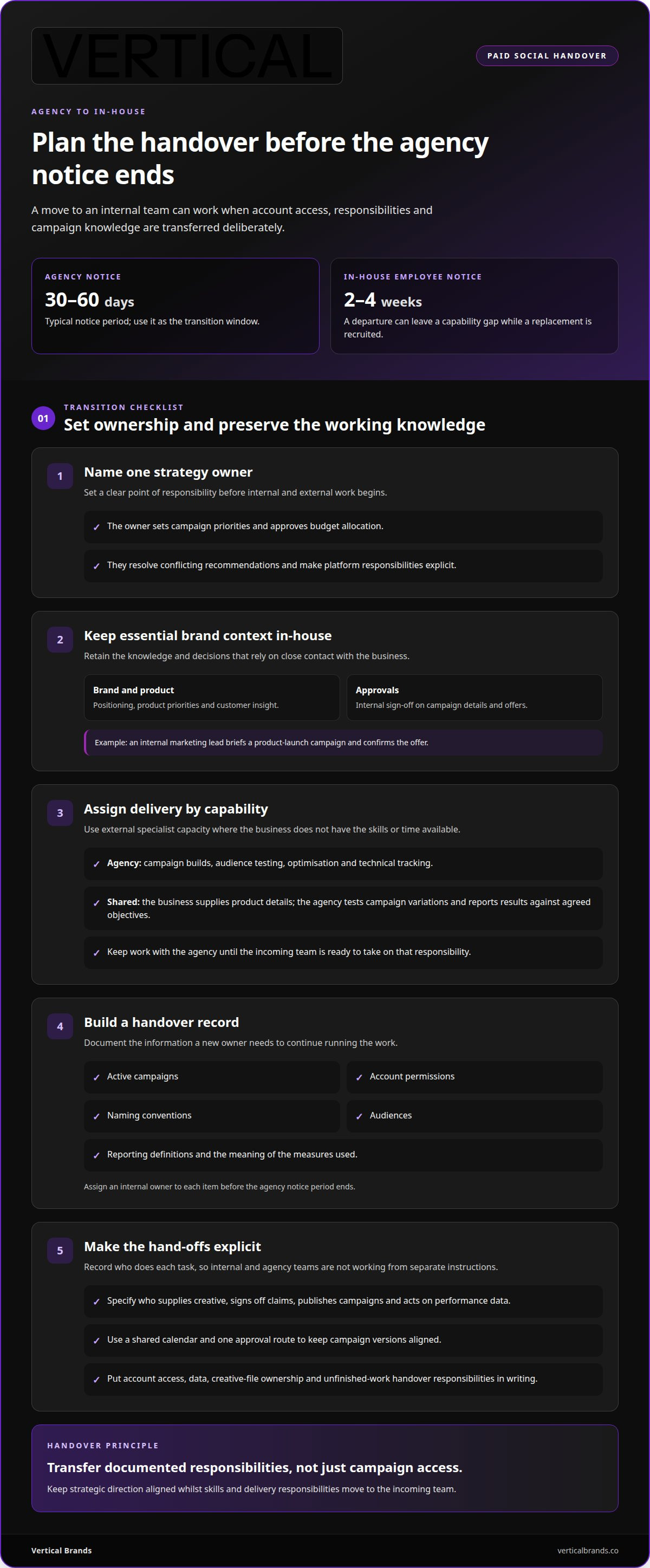
Yes. A business can move paid social in-house later, provided it plans the handover and preserves account access. An agency’s typical notice period is 30 to 60 days, giving the business a defined transition window.
Keep customer insight, product knowledge and fast internal approvals close to the business. An agency can handle specialist campaign execution, testing and technical tracking when those skills or capacity are unavailable internally.
Choose an in-house, agency or hybrid model by mapping the workload, available skills and need for control. If your team can own daily decisions but needs external execution support, a hybrid structure can divide responsibilities while keeping strategic direction aligned.
Assign one owner for paid social strategy before work begins. That person sets campaign priorities, approves budget allocation and resolves conflicting recommendations. The owner can be within the business or at the agency, but responsibilities for each platform need to be explicit.
- Keep in-house: brand positioning, product priorities, customer insight and approvals. For example, an internal marketing lead can brief a campaign around a product launch and confirm the offer.
- Assign to the agency: campaign builds, audience testing, optimisation and technical tracking when the business needs specialist delivery capacity.
- Share with boundaries: creative development and reporting. The internal team supplies product details; the agency tests campaign variations and presents results against agreed objectives.
A hybrid model works only when hand-offs are clear. Document who supplies creative, signs off claims, publishes campaigns and acts on performance data. A shared calendar and a single approval route can prevent the internal team and agency from briefing separate versions of the same campaign.
For a full transition, document active campaigns, account permissions, naming conventions, audiences and reporting definitions. Then assign an internal owner to each item before the agency’s notice period ends. This gives a new hire a working record rather than a collection of undocumented decisions.
Use the transition window to identify capability gaps. If the incoming team can manage reporting but lacks experience with campaign setup, keep that work assigned to the agency until responsibilities transfer. A written handover tied to specific tasks makes the change easier to manage. A clear paid social operating model can also define how internal and external teams work together.
Is It Cheaper to Hire In-House or Use an Agency for Social Media?
Cost depends on the capabilities your business needs and how consistently it needs them. Compare the value of brand knowledge, delivery capacity and campaign learning, not just the fee or salary.
In-house expertise and brand knowledge
An in-house specialist works closely with product, sales and customer teams, building context through daily decisions. That access can sharpen briefs and keep campaign messaging aligned with customer priorities. An agency brings experience from varied projects, but its team must learn your positioning, products and approval process. Internal knowledge is valuable, but it doesn’t automatically provide every paid social skill.
Map the work before choosing: identify who owns strategy, creative testing, tracking, reporting and approvals. If one employee must cover every task, capability gaps can slow execution. If your team understands the audience but needs external campaign expertise, an agency or hybrid arrangement can fill specific gaps.
Outsourcing risks and account access
Outsourcing can create dependency if campaign history, account permissions or reporting definitions sit only with the agency. Keep business-controlled access to advertising accounts and document who can change settings, approve spend and retrieve campaign data. Include handover duties in the agreement so a transition doesn’t interrupt access to active campaigns.
For UK GDPR and PECR considerations, document which party handles audience data and consent settings, then review the arrangement against those rules. Set clear responsibilities for data access, retention and campaign implementation before activity begins.
Building an in-house team and seeing results
Building an internal function takes more than filling a job title. Define the role, recruit for the required platform skills, then provide access to account history, creative assets and reporting. Campaign results depend on tracking quality, audience data, the offer and the testing process, so a new hire needs reliable measurement before performance can be assessed.
Agency onboarding also takes calibration. Allow 60 to 90 days for brand-voice consistency to narrow through content calibration. Use that period to share approved examples, product language, customer objections and feedback from internal teams. A documented review cycle helps the agency apply those lessons to future creative.
Compare the models by asking what must stay close to the business and what requires specialist execution. For example, an internal team could own product messaging and approvals, while an agency manages campaign builds and testing. The division of tasks depends on your team’s skills, available capacity and need for direct control.
Agency expertise across platforms
Platform expertise is more than familiarity with an advertising dashboard. It includes understanding how each platform’s formats, auction environment and campaign objectives shape execution. The in-house vs agency for paid social decision should account for where that experience is needed and how often platform requirements change.
Agency models differ. Some specialise in particular products, while others focus on campaign delivery across channels. A product-focused team may have deeper knowledge of a specific platform’s tools and conventions. A campaign-focused team may be structured around planning and delivery across several channels. Match the model to your media mix and operating requirements.
Look beyond platform names in a credentials deck. Review whether the proposed team can explain why a campaign structure fits your objective, how it will adapt creative to placements and which signals will guide optimisation. A useful discussion connects platform features to the commercial task rather than treating every channel as interchangeable.
- Platform fit: map the channels you use against the campaign objectives each must support.
- Specialist depth: distinguish hands-on platform expertise from broad familiarity with channel terminology.
- Learning process: establish how platform changes and campaign findings are captured and applied.
- Delivery model: clarify whether specialists work directly on campaigns or advise the people executing them.
Platform recommendations should reflect the customer journey. For example, a campaign designed to introduce a product plays a different role from one intended to prompt a purchase. The agency or internal lead should explain how the selected platform supports that role and how its contribution will be assessed.
Ask for a practical walkthrough based on a real business objective. Have the proposed team outline its channel rationale, the assumptions it would test and how it would interpret results. This reveals whether platform knowledge informs decisions or simply appears in presentation language. The in-house vs agency for paid social choice becomes clearer when expertise is tied to specific work.
Keep platform learning accessible to the wider marketing team. Record the rationale behind channel choices, notable campaign changes and implications for future planning. This helps the business retain useful knowledge if responsibilities shift. Platform capabilities change over time, so a documented learning process matters as much as initial familiarity.
Working across a range of agency clients can give newcomers a broader understanding of marketing, media and advertising. The agency described manages paid social across 20+ brands. The page describes paid social in 2026 as requiring multiple skills, including media buying, creative strategy, production and technical tracking.
Agency fees vs in-house costs by advertising spend levels
Advertising spend affects the workload, but it doesn’t determine which model is cheaper on its own. Compare the fee structure with the work required to manage each channel, produce creative and measure results.
At lower or variable spend, a retainer can provide defined campaign support without creating a permanent salary commitment. The business still pays advertising spend separately, so assess the total budget in two parts: platform investment and management. A percentage-of-spend fee may rise as media investment grows, even if the workload stays similar.
At higher spend, more campaigns can mean more creative testing, optimisation and reporting. A fixed retainer may then be easier to forecast, provided its scope covers the work. An in-house specialist’s salary remains a fixed employment cost as spend changes. Compare both models against actual campaign tasks, not assumptions based on budget alone.
For example, a business running one steady campaign may need less operational support than a brand testing several audiences, offers and creative formats. The latter can require more production coordination and analysis. A retainer should specify how those tasks are covered; an internal role needs the time and skills to deliver them.
- Retainer: assess the defined work, reporting cadence and process for changing scope.
- Percentage of spend: establish how the fee changes as advertising investment rises or falls.
- Performance-based fee: define the outcome, attribution method and reporting rules before linking payment to results.
- In-house role: compare the ongoing employment commitment with the workload and expertise required.
Performance-based fees can align payment with agreed outcomes, but measurement must be clear. For example, a contract should distinguish platform-reported conversions from the business’s agreed commercial measure. Set out how attribution, reporting periods and campaign changes affect the calculation. Without those definitions, both parties may interpret performance differently.
Build a comparison using the same responsibilities for each model. Include strategy, campaign management, creative testing, tracking, reporting and internal coordination. Then review how each cost structure behaves if spend changes, a campaign pauses or additional channels are added. A fee that seems efficient at launch may fit poorly after the scope expands.
Choose the structure that matches both spend behaviour and workload. The right model depend on how consistently campaigns run, how much execution they require and whether costs need to stay fixed or flex with activity. Discuss your paid social requirements to define a delivery model around your campaign workload.
Vertical Brands: Klaviyo Email Marketing
Vertical Brands can support businesses deciding how paid social fits alongside other growth channels. Its Paid Social offering is relevant when campaigns need external delivery or specialist input; Email Marketing & CRM Management and Klaviyo Email Marketing can support connected customer communications.
Consider this approach when your team has set its priorities but needs help aligning campaign execution with broader acquisition and customer activity. Paid Search is also available when your growth plan includes search campaigns. The right mix depends on your objectives, internal capability and the work you need delivered.
To discuss your paid social requirements, contact Vertical Brands or visit verticalbrands.co.
Set the model around your next stage of growth
A decision on in-house vs agency for paid social should reflect the work your business needs next, not just its current structure. Define who owns strategy, which capabilities must stay internal and where specialist support can remove execution bottlenecks. Then turn those choices into clear responsibilities, account access and measures of success. Revisit the decision as your priorities change, rather than letting it become a permanent operating constraint.
Vertical Brands can help you shape a paid social approach around your business priorities and delivery needs. Your team can use that discussion to clarify where external support fits and how it works alongside internal expertise. Contact Vertical Brands to discuss paid social. A clear operating model gives your next growth decision a stronger foundation.
Frequently Asked Questions
How Many People Does an Agency Assign to My Account?
The number depends on the agreed work, not a universal account staffing rule. A contract may identify a lead contact and specialists responsible for tasks such as campaign management, creative or measurement. For example, ask for a responsibility map showing who builds campaigns, approves changes and reports results. This clarifies delivery better than a team-size figure alone and helps you understand whose input your account receives.
What Happens When an Agency Underperforms?
Start by comparing delivery with the contract’s agreed objectives, responsibilities and reporting measures. Identify whether the issue involves missed work, weak results, delayed approvals or unclear measurement. Record specific examples, then agree corrective actions, owners and review dates in writing. If performance remains below the agreed standard, use the contract’s escalation and termination terms. Maintain access to business accounts and campaign records during any handover.
What if I already have an in-house marketer?
An existing marketer can lead on business context and coordinate external specialists without duplicating their work. Define responsibilities around actual capability: your employee might own positioning, product priorities and approvals, while an agency handles campaign execution or platform-specific analysis. Give one person final responsibility for strategy. This arrangement works best when the internal marketer can make decisions and the agency receives timely briefs, feedback and access.
What are the pros and cons of managing paid social in-house versus using an agency?
In-house management gives your team direct control and close access to product knowledge, but depends on the skills and capacity of the employees you recruit. An agency can bring external specialist input, but needs clear briefs, approvals and coordination with your business. Compare the models against your operating needs: how quickly decisions must be made, where expertise sits and how much oversight your team can provide.
How much does a UK paid social agency charge?
Agency fees vary with the agreed scope, campaign complexity, reporting requirements and fee structure. A retainer, performance-linked arrangement or another model can define payment differently, so compare the work each fee covers. Advertising spend is a separate budget consideration. Vertical Brands’ Paid Social pricing depends on the case and is provided after a quote request; the scope and delivery requirements shape the cost.
What are the typical salaries and employment costs for an in-house paid social team in the UK?
There isn’t one reliable UK figure that applies to every in-house team. Cost depends on role seniority, the skills required and whether you recruit one broad specialist or several focused roles. Include salary alongside recruitment, onboarding, management time and tools when building a budget. Start by listing the responsibilities, then match each to the capability your team needs to employ directly.
What skills and roles are needed to run paid social campaigns in-house?
An in-house operation needs ownership of strategy, media buying, creative development, campaign measurement and reporting. One employee may cover several responsibilities, but accountability for each must remain clear. For example, a marketing lead can set priorities, a paid social specialist can manage campaigns, and creative colleagues can develop assets for testing. Technical tracking and data analysis also help the team interpret results and guide decisions.