Justify Marketing Spend to Your CEO Before Results
A budget request without a business outcome is a cost line waiting to be challenged. Justifying marketing spend to a CEO starts with a clear business goal, a baseline, a measurable objective and the activity intended to move it. Set out the measures, timeframe and review points so progress is visibl...

A budget request without a business outcome is a cost line waiting to be challenged. Justifying marketing spend to a CEO starts with a clear business goal, a baseline, a measurable objective and the activity intended to move it. Set out the measures, timeframe and review points so progress is visible before every result has arrived.
Marketing can take time to influence revenue, which makes clear expectations essential. The proposal should show how the investment supports growth, which early signals you’ll track and how the plan can change if performance falls short.
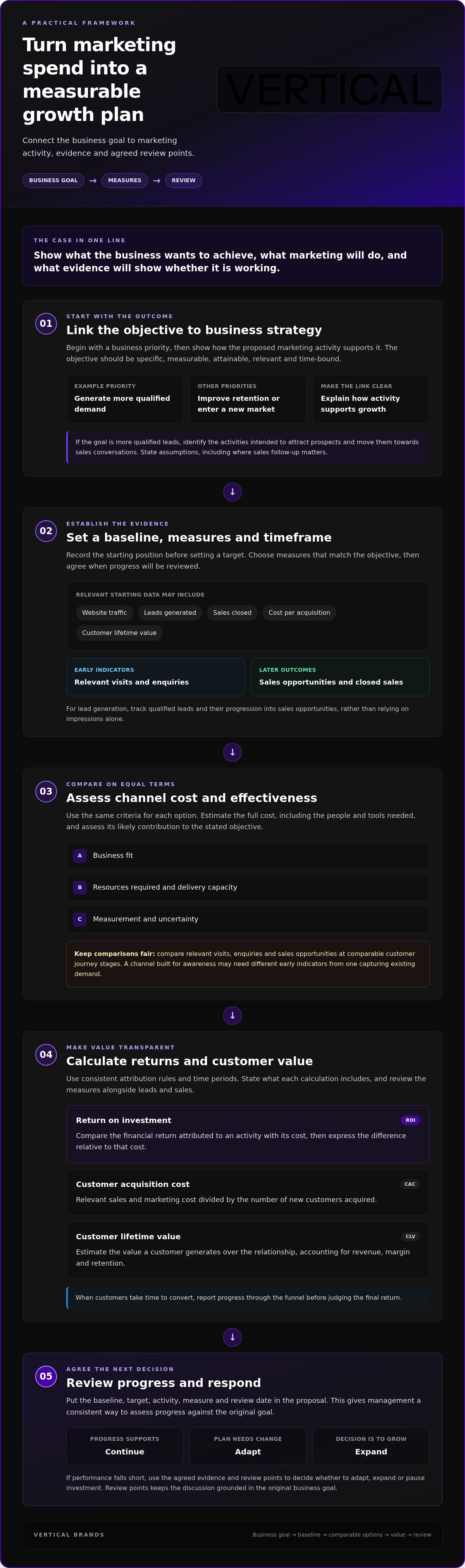
This guide explains how to build that case. You’ll learn to connect marketing activity to business outcomes, put costs in context and set realistic review points. It also covers how to assess delayed results, moving the discussion from defending a spend line to evaluating a disciplined growth plan. Each measure should tell a clear story: what the business wants to achieve, what marketing will do and what evidence will show whether it is working.
Key Takeaways
• Start with the business goal, then show how the proposed marketing activity supports it.
• Set a baseline, define measurable objectives and agree when progress will be reviewed.
• Use market trends and competitor activity to explain the opportunity, not as a substitute for your own business case.
• Translate campaign tactics into business outcomes, and make the expected timeline and assumptions clear.
• A clear review plan help leaders assess progress and decide whether to adapt, expand or pause investment.
How can I justify marketing spend when results take time?
Build the case around business outcomes, not promises of immediate sales. Set objectives, establish a baseline and explain how you’ll measure progress over an agreed timeframe.
•
Link marketing objectives to business strategy
Start with the business priority, such as generating more qualified demand, improving retention or entering a new market. Then show how the marketing strategy and each proposed activity support that priority. An objective should be specific, measurable, attainable, relevant and time-bound. Avoid presenting a channel or campaign as the goal itself. The CEO needs to see how the marketing budget supports the company’s growth plans.
If the business needs more qualified leads, for example, explain which activities are intended to attract prospects and move them towards sales conversations. State the assumptions behind the plan, including what marketing can influence and where sales follow-up matters. This makes the case for justifying marketing spend to a CEO clearer: the request has a business purpose, not just a list of tactics.
•
Set baselines and measures
Record the starting position before setting a target. Use relevant existing data, such as website traffic, leads generated, sales closed, cost per acquisition or customer lifetime value. Choose measures that match the objective. If the goal is lead generation, track qualified leads and their progression into sales opportunities, rather than relying on impressions alone.
Set a timeframe and planned review points alongside the objective. Separate early indicators, such as relevant visits or enquiries, from later outcomes, such as closed sales. This helps explain why a campaign may show progress before revenue changes. Put the baseline, target, activity, measure and review date in the proposal. These measures give management a consistent way to assess progress against the original goal.
•
Compare channel cost and effectiveness
Compare channels using the same criteria: business fit, resources required, measurement, delivery capacity and uncertainty. Estimate the full cost of each option, including the people and tools needed to run it, then assess its likely contribution to the stated objective. Avoid comparing one channel’s reach with another’s sales results. Use measures that reflect comparable stages of the customer journey.
For example, compare how each channel could generate relevant visits, enquiries and sales opportunities, then review the cost associated with those outcomes. No single measure suits every objective. A channel that supports awareness may need different early indicators from one designed to capture existing demand.
•
Calculate marketing returns and customer value
Calculate return on investment by comparing the financial return attributed to a specific activity with its cost, then expressing the difference relative to that cost. Customer acquisition cost is the relevant sales and marketing cost divided by the number of new customers acquired. Customer lifetime value estimates the value a customer generates over the relationship, accounting for factors such as revenue, margin and retention.
Use consistent attribution rules and time periods, and state what each calculation includes. Review these measures alongside leads and sales, not in isolation. If customers take time to convert, report progress through the funnel before judging the final return. A transparent calculation helps management assess what the marketing spend is designed to deliver.
What should a marketing budget proposal include?
Build the proposal around the opportunity, the evidence and the decision required. Competitor activity can provide context, but your company’s priorities and audience should drive the recommendation.
•
Benchmark against competitors
Compare competitors’ marketing activity with your own priorities, rather than treating it as a template to copy. Review their visible channels, creative, messaging and offers, then identify where they appear to serve the same audience. Separate observations from assumptions: a competitor’s campaign may reveal market activity, but it doesn’t prove its return.
Use the comparison to explain a specific decision. If rivals are publishing useful content around a customer need, for example, assess whether your business has a credible response and the capacity to deliver it. Include relevant market trends and explain how they affect demand or brand relevance. Don’t treat a competitor’s apparent spend as evidence that you should match it.
•
Forecast revenue from the proposed budget
Build a forecast from your own historical performance, market trends and data-based assumptions. Map the proposed activity to its expected audience response, qualified leads, sales opportunities and closed sales. Use the conversion rates your business has observed at each stage, then model how a change in activity could affect revenue. State the assumptions and timeframe clearly.
Present a cautious case alongside the expected case, and show which assumptions most affect the outcome. For example, if a forecast depends on sales converting more enquiries, identify that dependency rather than crediting marketing alone. Include the expected return as a projection, not a guaranteed result. The average marketing budget across all industries is 7.7 percent of revenue, but that figure is context, not a target for every business.
Close with the decision you’re requesting: the budget allocation, the business outcome it supports, who owns delivery and when progress will be reviewed. Include a contingency plan for challenges such as weaker-than-expected demand or limited delivery capacity. Explain what would trigger a change in activity and how funds could be redirected towards the company’s strongest priorities. This turns competitive analysis into a decision framework, rather than a list of rival campaigns.
A clear marketing strategy can help connect market conditions, audience needs and planned activity in one proposal.
Making marketing tactics understandable to management
Translate each channel into a business decision, not a list of marketing tasks. A concise proposal shows expected outcomes, key risks, ownership and review points.
• Present each tactic in terms of its business outcome. Explain what the channel does, which audience it reaches and how it supports the proposal’s objective. For example, describe a campaign as a way to generate qualified sales enquiries, rather than simply “running paid social”. Use a simple chart to connect activity with leads, opportunities and customers. A clear visual sequence makes complex information easier to assess and helps justify your marketing without assuming management knows every channel’s mechanics.
• Make uncertainty visible and structure investment in stages. Propose an initial test with a defined purpose, measurement approach and decision point. If the test produces the required evidence, recommend the next stage; if it falls short, explain what will change. Smaller-scale tests can help validate a larger initiative before committing more resources. This avoids framing the proposal as an all-or-nothing choice and gives management a practical way to challenge assumptions.
• Assess management’s appetite for risk before recommending the scale or pace of investment. Identify the main uncertainties, such as audience response, conversion performance or delivery capacity, then show how each will be monitored. Compare a cautious test with a larger commitment and explain the trade-offs in learning, reach and exposure. Don’t present the most optimistic forecast as the only option. A proposal becomes more credible when leaders can see what decisions follow different results.
• Agree who delivers the work, who approves changes and when progress is reviewed. Reporting can be weekly or monthly, depending on how quickly the activity generates useful signals. Include activity, results and upcoming plans in each update. For example, a monthly report could show campaign delivery, lead progression and the next planned adjustment. Schedule a formal budget review at least quarterly, supported by monthly progress summaries. These charts make the decision trail easier to follow.
Keep the management view focused. Put detailed channel data in an appendix, then use the main presentation to show the objective, investment logic, risks and decision required. For instance, a single funnel visual can clarify where a campaign attracts attention, creates contacts and supports sales opportunities. Separate early indicators from commercial outcomes, and state which evidence is available at each review. That gives leaders a practical basis to continue, adapt or pause activity, rather than judging an unfinished initiative by one short-term metric.
Addressing bosses’ concerns about marketing spend
To show the impact of cutting marketing spend, compare current activity with a forecast scenario that removes or reduces it. Track changes in leads, sales opportunities, customer acquisition and revenue, while separating marketing’s contribution from other business factors.
• Address cost, timing and proof directly in the proposal. Break the requested spend into activities and explain the role each plays in reaching the business objective. Nearly 26% of marketing spend is wasted, so show how you’ll identify underperforming activity and what decisions follow. A budget review should assess evidence, not defend every line simply because it was approved previously.
• Use evidence from previous campaigns to demonstrate marketing’s contribution to sales, customer acquisition, retention, brand recognition and growth. Show the measures behind each claim, such as enquiries progressing into sales or returning customers engaging with a campaign. Separate what the data demonstrates from what it only suggests. This distinction makes success easier to assess and gives management a basis for challenging assumptions.
• Connect activity to commercial outcomes, not surface engagement alone. Social media links, page views and interactions can indicate attention, but they don’t prove return on investment by themselves. Trace the route from engagement to contacts, qualified leads, sales opportunities and customers. A CRM can record leads, conversions and customer interactions alongside marketing activity, helping teams connect campaign evidence with sales outcomes.
• Make risk visible. Present the evidence, the demand created and the practical challenge the activity addresses. Explain whether the strategy reduces a known business problem, and how much demand it has generated relative to the spend. A 2024 study of 450 UK business leaders found 72% felt disconnected from their marketing data. Use a clear reporting view to connect campaign activity with business measures, rather than adding more disconnected metrics.
• Offer alternative budget scenarios when leaders question the level of investment. Set out what each option prioritises, which activities change and what outcomes you’ll monitor. For example, compare maintaining a campaign with reducing it, then forecast the effect on lead flow using your own historical performance. Label the forecast as an estimate, not a guaranteed result. This gives management a decision with visible trade-offs.
Agree a review process before activity begins. Define who owns the work, who can approve changes and when results will be reviewed. The evidence also shows whether a cut removes waste or weakens a productive route to revenue. Report the change against the same measures used before the decision, so leaders can judge whether the adjustment helped achieve the intended business outcome.
Presenting marketing spend as a growth opportunity
Frame the request as a choice about growth, not simply a department cost. Show how planned activity could create a specific commercial opportunity and what evidence will guide investment decisions.
• Start with a growth objective the board can recognise. For example, use a 15 percent increase in market share as the business goal, then explain which audience or market the marketing activity will target. Connect each proposed effort to that objective. Don’t present the percentage as a guaranteed outcome. It is a target for assessing whether the investment is moving the business towards its ambition.
• Show how investment could unlock revenue through a clear commercial pathway. Map the sequence from audience reach to response, sales and retained customers. An illustrative proposal might model a 3% increase in broadcast marketing spend alongside an estimated 7% increase in overall revenue. Present this strictly as a scenario, with its assumptions and dependencies, not as a forecast every business can expect.
• Explain how the proposal supports expansion without weakening existing priorities. If the company is considering a new market, model setting aside about 20% of the current marketing budget for that opportunity. Specify which audience the activity would reach, what the business needs to learn and how the team will assess demand. This makes the allocation a deliberate growth test, rather than an open-ended addition to spend.
• Show how marketing can contribute beyond immediate campaign sales. An email programme, for example, might support repeat purchases, while consistent activity helps maintain customer engagement between transactions. Link these efforts to the commercial outcome they are intended to influence. Marketing automation can also connect sales and marketing processes, helping teams manage customer journeys and identify where follow-up supports conversion.
• Present the decision as a set of choices. Show what the business could pursue by maintaining current activity, investing in a growth opportunity or redirecting effort towards a different audience. For each option, state the expected benefit, resource implications and key uncertainty. A strong proposal explains what management will learn from each route and how that learning will shape later investment.
Make the next step practical: develop a growth-focused marketing plan that connects business priorities with measurable activity. The case are strongest when the proposed investment has a clear purpose, a defined learning agenda and a disciplined route to scale.
Vertical Brands: Klaviyo Email Marketing
Vertical Brands offers Klaviyo Email Marketing to help businesses connect email activity with their growth objectives. Consider this service when your proposal includes customer communication, retention or revenue opportunities that need a clear measurement plan. Email Marketing & CRM Management can also support a joined-up view of customer interactions and campaign activity.
For a broader acquisition plan, assess Paid Social and Paid Search alongside email, with each channel measured against its role and business objective. The right measures make it easier to explain what each activity contributes and where progress should be reviewed. Contact Vertical Brands to discuss how these services could support your marketing priorities.
Turn the business case into your next decision
A proposal becomes useful when it changes what the business does next. Choose the priority that matters most, agree what evidence will guide investment, and make the next review a decision point rather than a reporting exercise. That keeps marketing accountable to growth while giving longer-term activity room to develop.
A clear case for justifying marketing spend to your CEO connects the opportunity to action. Vertical Brands offers Klaviyo Email Marketing, Email Marketing & CRM Management and Paid Social to support businesses building measurable marketing activity. The right mix depends on the objective, audience and role of each channel. The measures give leadership a practical basis for deciding where to focus next.
Discuss your marketing priorities with Vertical Brands and take the next step towards a more deliberate growth plan. Your next proposal can be the start of a sharper, more accountable investment decision.
Frequently Asked Questions
Can social media marketing generate measurable business results?
Yes, social media marketing can be measured when campaign activity is connected to business records. Use tagged links to identify visits from a campaign, then follow those visitors through enquiries, sales opportunities and purchases. For example, compare leads from a product launch campaign with leads from other sources. Social engagement can help explain audience response, but it should not stand alone as evidence of commercial impact.
How do you justify your marketing budget to management?
Present the budget as a decision tied to a business need, such as supporting a product launch or improving repeat purchases. Explain what the activity will change, which teams need to contribute and what evidence will inform the next decision. If a launch depends on sales materials being ready, for example, make that dependency explicit. A useful proposal includes operational requirements as well as marketing activity.
How do you justify marketing spend to a CEO?
Lead with the decision you need from the CEO and the business outcome it supports. Make the trade-off clear: explain what the company can pursue with the proposed investment and what it would defer without it. For example, a retention campaign may support a priority to increase repeat purchasing while requiring coordination with customer service. Keep the discussion focused on business value, dependencies and the evidence that will inform future decisions.
What marketing metrics best demonstrate ROI to executives?
Choose metrics that match the executive decision. For a sales-growth objective, report revenue and contribution margin alongside acquisition costs; for a retention objective, examine repeat purchases and customer value over time. Add pipeline measures when sales cycles are long, so leaders can see progress before deals close. The strongest dashboard keeps a small set of commercial measures in view and uses channel metrics only to explain changes.
What benchmarks are available for marketing spend by industry and company size in the UK?
A broad cross-industry benchmark puts the average marketing budget at 7.7 percent of revenue. Treat this as context, not a target for every UK business. A suitable allocation depends on growth stage, competitive pressure, margins, sales cycles and the channels needed to reach customers. For a useful comparison, assess your own historical results and business priorities alongside any broad benchmark, rather than relying on one percentage.
How do you attribute sales and revenue to marketing campaigns?
Use consistent tracking across campaign links, web analytics and your CRM, then agree how credit is assigned to each touchpoint. A customer might discover a product through social media, return through a search advert and later purchase after an email. A first-touch model credits discovery; a last-touch model credits the final interaction. Compare models carefully, since each describes the customer journey from a different angle.
How do you build a business case for increased marketing investment?
Show why the current level of activity limits a defined opportunity, then explain what additional investment would enable. If a campaign performs well with one audience, for example, propose a controlled expansion to a related audience and identify the extra resources required. Include operational capacity, expected learning and the decision that follows. The evidence gives management a reason to consider growth without presenting expansion as automatic.
What evidence and data should a marketing budget proposal include?
Include recent campaign performance, customer and sales data, relevant market observations, resource requirements and the assumptions behind your forecast. Add finance input where margin affects the commercial case, and sales input where lead quality or follow-up shapes conversion. For example, explain whether the team can handle additional enquiries before forecasting more sales. This gives decision-makers evidence from across the business, not just marketing reports.

Other posts






























































Stay ahead with better decisions.
Get business insights today.
