Improving E-commerce Customer Lifetime Value: A Practical Growth Guide
More acquisition won’t fix a customer relationship that has no reason to continue. Improving e-commerce customer lifetime value starts with understanding what brings customers back, what makes them leave and whether repeat purchases contribute to sustainable growth. If acquisition spend isn’t buildi...

More acquisition won’t fix a customer relationship that has no reason to continue. Improving e-commerce customer lifetime value starts with understanding what brings customers back, what makes them leave and whether repeat purchases contribute to sustainable growth. If acquisition spend isn’t building durable relationships, the answer isn’t necessarily another campaign. It’s a clearer view of the customer experience and the economics behind retention.
Retention activity can be difficult to prioritise when marketing, CRM and website improvements compete for budget. Too often, these teams work towards separate priorities, leaving gaps between the promise made at acquisition and the experience customers receive afterwards. That makes it harder to see which changes are driving commercial value.
This guide sets out a practical way to identify the controllable drivers of customer lifetime value and decide where to focus first. You’ll learn how to use customer cohorts and commercial evidence to assess retention opportunities, connect CRM activity with acquisition and website experience, and measure progress against business outcomes. The aim is a joined-up growth plan, not a collection of disconnected tactics.
• Set a clear definition of customer lifetime value before comparing performance or choosing an intervention.
• Use customer segments and purchase behaviour to pinpoint where value is created or lost.
• Assess retention, website experience, product discovery and acquisition quality against customer need, evidence and effort.
• Build an improving e-commerce customer lifetime value plan around a defined cohort, a diagnosed barrier and a measurable test.
• Choose a primary measure and supporting indicators before launch, so each intervention has a clear way to assess its impact.
Why improving e-commerce customer lifetime value starts with the right business question
Acquiring more customers can increase sales, but it doesn’t automatically make growth more durable. The sharper question is whether each customer relationship creates enough value to justify the cost and effort of acquiring and serving that customer. Improving e-commerce customer lifetime value starts with that distinction, not with a target to make one headline number rise.
Customer lifetime value (LTV) estimates the value generated across a customer relationship. It can describe value already observed or project what a customer may generate over time. The assumptions, customer group and period behind the calculation shape its meaning. A useful starting point is this Customer Lifetime Value (CLV) definition and importance, then tailor the measure to the decision your team needs to make.
Higher LTV is not automatically higher profit: the value measure must account for the costs of generating and serving that value. A revenue figure can look strong whilst the underlying economics remain weak.
Which customer lifetime value definition should an e-commerce team use?
Choose the calculation that matches the decision. Revenue-based LTV totals the sales attributed to a customer over a defined period. It can help assess purchasing behaviour and compare sales generated by customer groups, but it doesn’t show what remains after product and service costs.
Gross-profit LTV subtracts the cost of the products sold from revenue, giving a clearer view of product economics. Contribution-based LTV goes further by deducting relevant variable costs associated with fulfilling and serving those orders. This can better support decisions about retention investment, acquisition efficiency and the commercial value of repeat purchases. The right measure depends on the question being asked.
Document the formula, included costs, attribution approach and observation window. Keep them consistent when comparing cohorts or reporting progress. If the definition changes between periods, an apparent improvement may reflect a change in calculation rather than different customer behaviour.
Why averages can hide customer behaviour
An overall average compresses distinct customer journeys into one figure. A cohort acquired through one campaign may buy a lower-margin product once, whilst another may return for higher-value items. Combining them can conceal where value is actually building. Compare customers grouped by a meaningful shared feature, such as acquisition period or first product purchased.
Product mix affects margin. Order frequency affects how often revenue and contribution accrue. Customer tenure affects how much behaviour has been observed. A newer cohort may appear less valuable simply because it has had less time to purchase again. Separate these influences before interpreting a change as a retention win or loss.
Treat LTV as an estimate, not a guaranteed forecast. Historical results describe what happened under a particular customer mix and set of conditions. Future behaviour can differ. State whether a figure is observed or projected, identify the period it covers, and revisit assumptions as more customer data becomes available. That discipline makes the metric useful for decisions, rather than a promise about future returns.
How to diagnose the drivers of e-commerce customer lifetime value
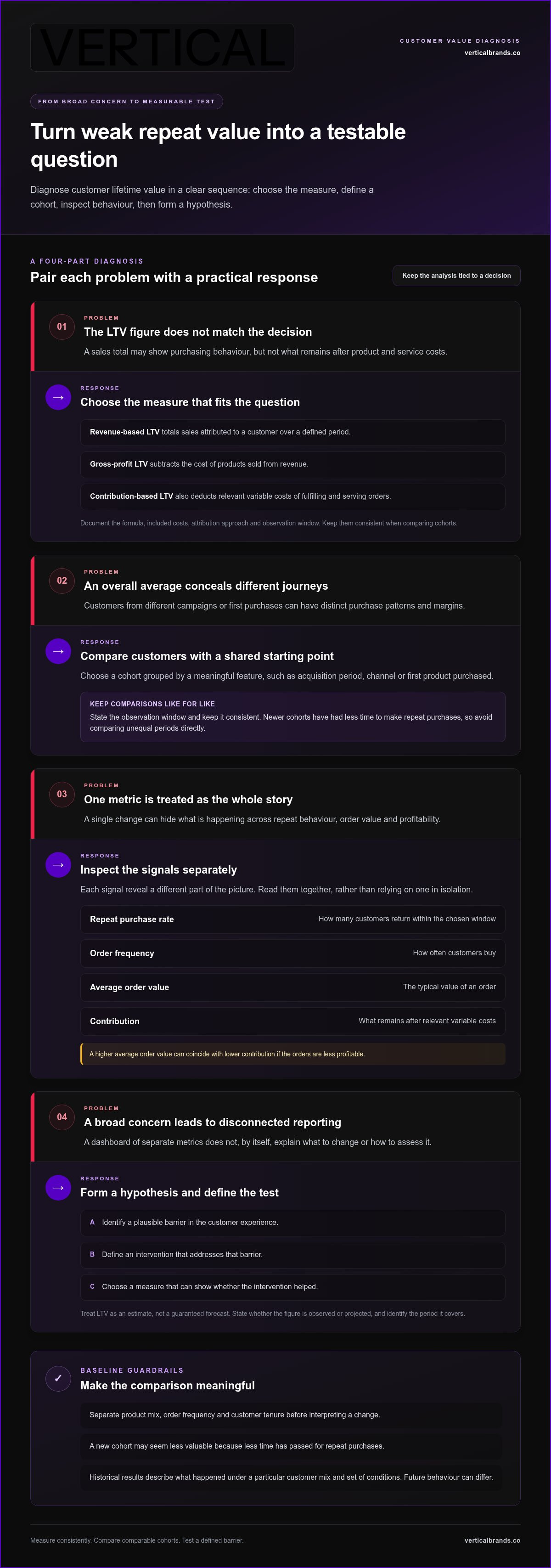
A useful diagnosis turns a broad concern, such as weak repeat value, into a testable business question. Follow a consistent sequence: select the LTV definition, segment customers, inspect their behaviour, then identify a test. This keeps the analysis tied to a decision rather than producing a dashboard of disconnected metrics.
Set the measure.
Use the same revenue, gross-profit or contribution-based definition throughout the analysis.
Choose a cohort.
Group customers around a shared starting point, such as acquisition period, channel or first purchase.
Inspect behaviour.
Review repeat purchase rate, order frequency, average order value and contribution separately.
Form a hypothesis.
Identify a plausible barrier, then define an intervention and a measure that can show whether it helped.
These signals answer different questions. Repeat purchase rate shows how many customers return within the chosen window. Order frequency indicates how often they buy. Average order value captures the typical value of an order, whilst contribution helps assess what remains after relevant variable costs. A higher average order value, for example, can coincide with lower contribution if the orders are less profitable. The pattern across these signals is more useful than any one metric in isolation.
Build a useful baseline from customer cohorts
Group customers by a meaningful starting point, then compare like with like. An acquisition-period cohort can show how customers acquired in one period behave over time; a channel cohort can help assess differences between customers arriving through distinct routes. State the observation window and keep it consistent. Recent cohorts have had less time to make repeat purchases, so their early results shouldn’t be compared directly with older cohorts across unequal periods.
Cohort analysis makes customer value differences visible by showing how groups behave over comparable periods. It also helps prevent changes in customer mix from being mistaken for a change in performance. Record the acquisition context alongside the results, including relevant campaign or channel changes, so the comparison has practical meaning.
Find the constraint behind weak repeat value
Trace the journey from product discovery through purchase and fulfilment to post-purchase communication. Look for observable friction: customers who browse but don’t add products, abandon a purchase, contact support about an unclear step, or fail to return. These behaviours indicate where to investigate, not what caused the problem. Pair them with customer feedback to form a specific hypothesis, such as whether product information or follow-up communication is missing the mark.
Keep correlation separate from causation. If repeat purchases rise after a campaign, that timing alone doesn’t prove the campaign drove the change. Compare the relevant customer groups and periods, account for other changes where possible, and test one defined intervention against a clear outcome. This evidence-led discipline is central to improving e-commerce customer lifetime value. Teams aligning cohort analysis with commercial growth planning can use the diagnosis to focus the next test, rather than treating every movement in the metric as a marketing result.
Which LTV improvement levers should an e-commerce brand prioritise?
There’s no universal retention tactic that works for every brand. Prioritise the lever that addresses a demonstrated customer need and has a plausible route to commercial value. Compare lifecycle communication, customer experience, product discovery and acquisition quality against four criteria: customer need, supporting evidence, execution effort and a measurable outcome. The best lever depend on where customers are encountering friction, not on which tactic is easiest to launch.
Use a compact comparison before committing resource. For each proposed intervention, record:
Intervention
What will change?
Hypothesis
Why might it improve customer behaviour?
Audience
Which customers have the relevant need?
Measure
What outcome would indicate progress?
Risk
What could undermine the result, such as margin erosion or added operational complexity?
This simple structure makes competing ideas easier to assess. A welcome series may be quick to deploy but irrelevant if the main issue is a confusing product range. A website redesign may address a real barrier, but require more effort than improving product guidance. Prioritise evidence and likely commercial impact, not channel visibility.
Lifecycle communication and CRM
Useful communication helps a customer take a relevant next step: understand how to use a product, explore a suitable complement or return when replenishment makes sense. CRM segmentation can make messages more relevant to different needs, rather than sending every customer the same sequence. A useful segmentation framework starts with differences in customer behaviour, product use and purchase timing.
Measure the behaviour the message is intended to support, alongside contribution where possible. More clicks or opens alone don’t establish that the communication created customer value. CRM activity should fit the wider experience and customer context.
Acquisition quality and the on-site experience
Acquisition quality is not simply a question of which channel generates the most orders. Assess whether customers arriving through paid social, paid search, organic search or other routes fit the offer and return under comparable conditions. If one channel attracts first-time buyers who rarely engage again, investigate the promise, audience and product match before increasing spend.
The website carries that promise into the buying experience. Unclear product information, difficult navigation or avoidable purchase friction can weaken confidence before the first order, limiting the chance of a satisfying relationship afterwards. Strong product guidance and a clear path to purchase help ensure the on-site experience supports the expectations created by acquisition.
Balance incentives with customer value
Discounts can prompt a purchase, support a relevant offer or reactivate a customer. They can also reduce contribution and encourage customers to wait for the next promotion. Don’t rule them out automatically. Test whether the incentive changes behaviour among the intended audience, then assess the resulting contribution rather than sales alone. Improving e-commerce customer lifetime value means selecting interventions that support customer need and make commercial sense over time.
How to build and measure an e-commerce LTV improvement plan
A practical plan connects a customer problem to a commercial outcome. Keep the process repeatable: define the outcome, choose a cohort, diagnose a barrier, test an intervention, then review what happened. This creates a decision trail, so teams can see why an initiative was launched and what its results mean.
Define the outcome.
State the behaviour or commercial result the work should influence, such as more repeat purchases or stronger contribution from a defined customer group.
Choose a cohort.
Set the customer group and observation window before activation.
Diagnose a barrier.
Use the evidence to identify a specific point in the customer journey that may be limiting value.
Test an intervention.
Change one primary factor where practical, and select a suitable comparison method.
Review and decide.
Assess the primary measure, supporting indicators, margin and customer experience before scaling, refining or stopping.
Choose one primary measure for the decision, then define supporting indicators that help explain the result. For example, if the outcome is stronger repeat contribution, supporting measures might include repeat purchase rate, order frequency and average order value. Set these before launch. If the primary figure improves whilst customer experience or contribution deteriorates, the intervention hasn’t delivered a balanced result.
Design tests that can inform a decision
Write a hypothesis that links one observed barrier to one proposed change. For example: “Customers who have bought this product may need clearer complementary product guidance; showing relevant options after purchase could increase repeat contribution.” Define the eligible audience, observation period, primary measure and comparison approach in advance. Record the assumption behind the test, too.
Where practical, compare eligible customers who receive the intervention with a similar group who don’t. If a controlled comparison isn’t feasible, document the limits of the evaluation and avoid treating a before-and-after movement as proof of cause. Note delivery changes, promotions, stock availability and other factors that could affect behaviour during the observation window.
Turn results into a prioritised roadmap
Rank opportunities by evidence strength, likely customer impact, execution effort and commercial relevance. Separate quick operational fixes, such as correcting unclear post-purchase information, from broader strategic work, such as revising the acquisition proposition or website journey. A growth stages framework can help teams consider how priorities shift as a brand scales, without assuming the same intervention suits every business.
For each completed test, record the result and the decision: scale when evidence supports broader use, refine when the signal is promising but the execution needs adjustment, or stop when the expected value isn’t supported. Assign an owner and review date so learning turns into action. Review the measures alongside customer feedback, not in isolation.
Improving e-commerce customer lifetime value depends on linking customer evidence to disciplined execution. Build a measured LTV growth plan that connects cohort analysis, CRM activity and customer experience to the commercial outcome your business needs.
How Vertical Brands can help connect LTV strategy with execution
Once you’ve identified what limits customer value, the next step is to connect that diagnosis to coordinated execution. A retention challenge rarely sits within one channel alone. Customers may arrive through acquisition activity, encounter friction on the website, then receive communication that doesn’t reflect their needs. Treating each issue separately can leave the underlying customer journey disconnected.
Vertical Brands brings growth advisory, Klaviyo and CRM management, paid social, paid search, SEO and website development into a commercially grounded plan. The starting point is the constraint: is it the quality of customer acquisition, an unclear on-site experience, weak lifecycle communication or a measurement gap? From there, channel activity can be aligned around the same audience, priority and outcome. That makes improving e-commerce customer lifetime value a coordinated growth objective, not a promise attached to a single service.
Bring CRM and acquisition activity into one growth plan
Growth advisory can connect customer cohort insights with channel priorities, so acquisition decisions account for what happens after the first order. For example, if analysis shows that a particular customer group is less likely to return, review how that group was reached, what expectations the campaign created and whether the post-purchase experience supports another useful purchase.
Klaviyo and CRM management can support lifecycle communication through customer data, segmentation and automated email flows. The aim is to make communication more relevant and assess it against agreed measures, not assume that sending more messages increases LTV. If platform readiness is the constraint, address data structure and migration requirements before expanding activity. If acquisition quality is the issue, assess paid social audiences and campaign messaging alongside the downstream behaviour of the customers they attract. These channel choices need to connect back to the same commercial priorities.
Paid search and SEO can also be aligned with customer intent, whilst website development can address gaps between what acquisition promises and what the on-site experience delivers. The right combination depends on the evidence and operational priorities, not a fixed channel formula.
Choose a practical next step
Before adding another campaign or tool, write down the business question. Which customer group is underperforming, what barrier may be limiting value, and what evidence would show that a change helped? A clear brief gives CRM, acquisition and website work a shared direction. It also helps teams distinguish an execution issue from a measurement problem.
Vertical Brands can connect CRM management and performance marketing to the growth priorities your evidence identifies. Bring the customer insight, commercial question and measures you want to improve into one discussion. Discuss your e-commerce growth priorities and define the next practical step.
Turn your customer insight into the next growth move
Improving e-commerce customer lifetime value is ongoing work, not a one-off campaign. The next step is to select a customer or commercial priority and make it clear who owns the action, what evidence will guide it and when the result will be reviewed. A focused plan give teams direction without adding activity for its own sake.
Vertical Brands connects Klaviyo and CRM management with paid social, paid search, SEO and website development, aligning execution with the growth priority you’ve identified. The right mix depends on your customer evidence and commercial goals. A clear question and a defined measure give the team a stronger starting point than another disconnected tactic.
Discuss a growth plan built around your customer and commercial priorities. Take the next step with purpose, and build from what your customers and results are telling you.
Frequently Asked Questions
Is customer lifetime value the same as customer lifetime revenue?
No. Customer lifetime revenue records sales attributed to a customer, while customer lifetime value may refer to revenue, gross profit or contribution, depending on the business’s chosen method. For example, two customers could spend the same amount but generate different contribution if their orders have different product mixes or fulfilment costs. Before using a report, check its formula and time horizon, not just the metric name.
Can improving customer lifetime value increase profit without increasing revenue?
Yes, it can, although revenue may stay flat or even fall slightly. Imagine customers shift from heavily discounted bundles to full-price products with healthier contribution, while order volume remains similar. Profitability still depends on product and service costs, so compare contribution before and after the change and check for signs of added friction, such as more abandoned baskets or complaints. Improving e-commerce customer lifetime value shouldn’t come at the expense of customer trust.
How much should an e-commerce business spend on improving customer lifetime value?
There’s no universal budget. Start by sizing the business opportunity, then consider the cost of the proposed work, the strength of the customer insight and the contribution needed to justify it. A small test of a post-purchase message may require fewer resources than a major website change, but the cheaper option isn’t automatically better. Set a decision threshold and review actual results before expanding investment.
What is a good customer lifetime value for an e-commerce business?
There isn’t one target that fits every online retailer. A replenishment-led business, a one-off purchase category and a premium product range have different buying cycles and economics. Set a target that reflects your margins, customer mix, acquisition costs and measurement period. If external figures inform planning, check that their formula and category resemble your business. Otherwise, they can create a misleading benchmark.
Can a small e-commerce brand measure customer lifetime value?
Yes. A smaller brand can begin with order records and customer identifiers, then calculate a simple measure over a defined period. Check that repeat orders are attributed to the right customer and that refunds or cancellations are handled consistently. The dataset are often limited at first, so estimates can shift sharply when a few orders change. Use the result to guide what to investigate, not as a precise sales forecast.
Does a loyalty programme always improve customer lifetime value?
No. A loyalty programme is useful only if the behaviour it encourages is worth the cost. Points may prompt customers to return, but if members would have purchased anyway, the reward can simply reduce contribution. Where practical, compare eligible customers with a suitable non-member group and include reward redemption and administration costs. Also check whether the programme brings purchases forward or changes buying patterns, rather than creating additional orders.

Other posts




























































Stay ahead with better decisions.
Get business insights today.
