Luxury Brand Digital Marketing Agency: How to Choose a Growth Partner
What should a luxury brand expect from a digital marketing agency: more reach, or growth that protects what makes the brand distinctive? A luxury brand digital marketing agency should be judged on how well it connects commercial performance with brand standards, not simply on the activity it deliver...

What should a luxury brand expect from a digital marketing agency: more reach, or growth that protects what makes the brand distinctive? A luxury brand digital marketing agency should be judged on how well it connects commercial performance with brand standards, not simply on the activity it delivers across separate channels.
That concern is justified. Performance tactics can weaken a carefully built identity when they prioritise short-term returns over tone, creative quality and customer experience. And when paid acquisition, search, CRM and website activity are managed in isolation, it becomes harder to see how each contributes to sustainable growth.
The right partner brings those parts together. This article sets out a practical framework for assessing agency fit beyond polished credentials, from how a team approaches brand positioning to how it connects acquisition, retention and website experience. You’ll learn what to look for in an integrated strategy, how to assess its commercial focus, and how to judge whether the partnership can support growth without making the brand feel less distinctive.
Key Takeaways
• Assess a luxury brand digital marketing agency on its strategic understanding, channel integration and approach to protecting brand standards, not just its credentials.
• Understand how paid media, SEO, website experience and CRM can play distinct roles within one connected growth plan.
• Use clear creative standards to guide testing and optimisation, so performance activity supports rather than dilutes brand positioning.
• Prepare for a stronger partnership by defining commercial priorities, brand constraints, available data and decision-makers before work begins.
• Explore how growth advisory, acquisition, retention and website development can align around agreed goals. A clear brief help keep immediate priorities and longer-term ambitions in view.
What a luxury brand digital marketing agency should deliver
A luxury brand digital marketing agency should act as a strategic partner, aligning brand experience with customer acquisition and retention. Its role is not simply to place adverts or manage individual channels. It should understand how each interaction supports the brand’s position, helps customers assess its offer and contributes to commercial goals.
Luxury marketing is not generic premium marketing with more polished imagery. Premium positioning can focus on added features or convenience; luxury often draws on a distinct identity, considered presentation and the value customers associate with the brand. That value is not created by price or visual style alone. Brand management for luxury brands also considers heritage, feeling and goodwill. A capable partner translates those principles into digital decisions without assuming that all affluent customers share the same needs, motivations or purchasing habits.
How luxury customer expectations shape digital activity
Perceived value takes shape across the whole experience. Product photography, detailed descriptions and clear navigation help customers understand what is being offered. The tone and usefulness of advertising set expectations before a visit; the website then needs to carry those expectations through consideration and purchase. Post-purchase messages matter too. A confirmation, service update or carefully timed email can either reinforce the brand’s standards or feel disconnected from them.
Consistency does not mean repeating identical copy everywhere. It means making each touchpoint recognisably part of the same brand while giving it a clear purpose. An advert may introduce a product, a landing page may explain its details, and customer communications may support the relationship after purchase. The signals across these moments need to work together, while content and timing can reflect different customer interests and stages. Brand standards also need to remain recognisable as customers move between touchpoints.
When specialist agency support becomes useful
External support becomes valuable when activity is fragmented or capacity is constrained. Paid campaigns may send visitors to pages that don’t reflect the advert. Search content may attract the wrong intent. CRM messages may operate separately from acquisition activity, leaving teams without a shared view of how customers move between channels. These are operating problems, not simply a shortage of marketing tactics.
Before engaging an agency, identify the capability gap. Is the priority strategic direction, specialist execution or coordination across existing teams? A long service list is not proof of fit. Look for a clear connection between the proposed work and the problem to solve, with responsibilities and decision-making understood from the outset.
• Define the brand standards that every channel must uphold.
• Identify where customer journeys or team workflows break down.
• Match agency support to a specific strategic or execution need.
That groundwork makes the partnership more focused. It gives the agency a practical basis for connecting brand experience with commercial priorities, rather than treating every channel as a separate brief.
How luxury brand digital marketing connects brand and performance
Brand standards and commercial performance can reinforce each other, but they need a shared operating plan. A luxury brand digital marketing agency should define how each channel contributes, what it can test and which brand rules remain fixed. The goal is not to make every interaction identical. It is to ensure that optimisation strengthens the experience rather than pulling it away from the brand’s identity.
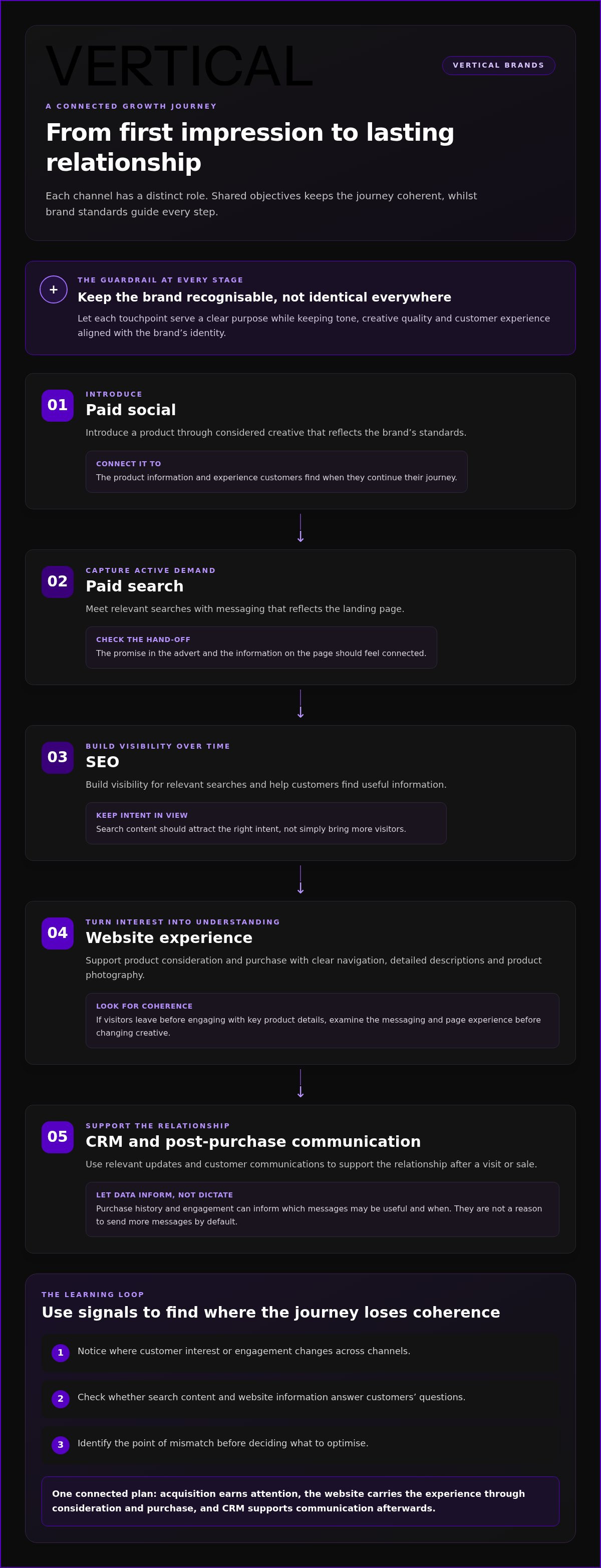
Integrated marketing requires shared objectives, not merely multiple channels. Paid social can introduce a product through considered creative. Paid search can capture active demand with messaging that reflects the landing page. SEO can build visibility for relevant searches over time. The website turns interest into product consideration and purchase, while CRM supports useful communication after the initial visit or sale.
These roles should inform one another. If social engagement signals interest in a particular product, the team can examine whether search content and website information answer customers’ questions. If visitors arrive through paid search but leave before engaging with key product details, that may point to a mismatch in messaging or page experience. It does not automatically mean the creative should change. First identify where the journey loses coherence.
Connect customer acquisition with retention
Acquisition activity earns attention and brings potential customers into the journey. Post-purchase communication has a different job: it can provide relevant updates and help sustain the relationship. CRM data, such as purchase history and engagement, can inform which messages are useful and when they may be appropriate. It should guide decisions, not become a reason to send more messages by default.
For a business changing email platforms, a Klaviyo migration guide can help teams plan how customer data and existing communications move into the new setup. Once in place, CRM insights can also inform acquisition, for example by helping teams consider which customer groups a campaign should reach, without treating previous behaviour as a perfect prediction of future choices.
Use measurement without reducing the brand to short-term metrics
Channel measures show what is happening within a specific activity. Clicks, search visibility, landing-page engagement and email responses can help teams identify patterns and decide what to investigate. Wider business outcomes, such as sales and repeat purchases, provide a broader view of performance. Neither layer tells the whole story alone.
Attribution is directional evidence, not proof that one channel caused every sale. Customers may encounter a brand through several touchpoints before acting, and measurement systems can assign credit differently. Review channel signals alongside customer behaviour, commercial outcomes and brand consistency. The signals is useful when they prompt a better question, not when they are treated as a verdict.
Agree the measures and brand guardrails before testing. Keep core elements, such as tone and visual identity, consistent; test specific variables such as audience, format or landing-page structure. That creates room to learn without changing everything at once. For teams looking to connect channel activity with website and retention decisions, integrated growth support can help align the work around shared objectives.
How to compare a luxury brand digital marketing agency
Performance activity doesn’t have to undermine luxury positioning. It becomes a risk when speed, volume or short-term metrics override the standards that shape the brand. A useful comparison looks beyond service lists and polished credentials. It tests how an agency turns brand principles into decisions about campaign creative, website journeys, measurement and day-to-day approvals.
Use this scorecard to compare strategic and operational fit. Ask how the agency would approach your priorities, rather than relying only on a presentation of its capabilities.
| Area | What to assess | Evidence of fit |
|---|---|---|
| Strategic understanding | Can the team explain your positioning and commercial priorities? | A proposed approach links brand standards to specific decisions, rather than relying on broad claims of luxury expertise. |
| Channel capability | Can it connect relevant channels around the customer journey? | Paid media, search, website and CRM activity have defined roles and clear handovers. |
| Measurement | Does reporting connect activity with agreed objectives? | Channel indicators are considered alongside wider commercial signals, with assumptions made clear. |
| Governance | Are approvals, responsibilities and brand safeguards understood? | The proposal sets out how creative is reviewed, who makes decisions and how changes are managed. |
| Communication | Will the team work effectively with your people? | Updates, decisions and next steps are clear, with space for input from brand, e-commerce and marketing teams. |
An integrated team doesn’t simply offer several services. It connects planning, execution and learning, so an insight from one channel can inform another. A collection of disconnected services may leave your internal team to join up the work, resolve competing priorities and explain inconsistent reporting. Broader guidance on assessing a performance marketing agency can also help clarify what you expect from a growth partner.
Assess luxury judgement and commercial discipline
Ask how the agency would translate your brand standards into a real campaign or website decision. For example, how would it test a new message without changing the established tone? Reporting should connect activity to agreed business objectives, while stating what the data can and can’t show. Treat case studies as evidence of an agency’s approach, not a forecast of your own results.
Check scope, ownership and collaboration
Clarify who sets strategy, manages execution, reports progress and approves changes. Then map how the agency will work with existing brand, e-commerce and marketing teams. The best-fit luxury brand digital marketing agency should prioritise work according to your current constraints and growth objectives, rather than recommending every available service. Strong proposals are specific about responsibilities and the decisions each team owns.
Use the discussion to test how the agency handles trade-offs. If a commercial opportunity conflicts with a brand guideline, the team should be able to explain the options, implications and decision required. That conversation reveals more about practical fit than a broad promise of growth.
Prepare your luxury brand for a digital growth partnership
A productive partnership starts with a clear brief, not a list of channels. Before appointing a luxury brand digital marketing agency, map the commercial question, the standards it must work within, the information available and who will make decisions. This gives an agency something useful to assess and helps prevent early activity from being driven by assumptions.
Set objectives and establish a useful baseline
Start by separating immediate commercial needs from longer-term ambitions. A short-term priority might be improving the quality of acquisition or addressing friction on a key website journey. Longer-term ambitions could include stronger customer retention or a more coherent brand experience across digital touchpoints. Both matter, but they may require different work and measures.
Use this sequence to prepare a working brief:
State the commercial question.
Define what the business needs to understand or improve before selecting a channel. For example, is the priority to attract more relevant prospects, support repeat purchasing or make product consideration clearer?
Record current priorities.
Summarise acquisition, retention, website and customer experience needs. Separate what must be addressed now from what should shape the longer-term plan.
Map existing activity.
Note which channels are active, who manages them and how work is coordinated. Include campaigns, search activity, website changes and customer communications.
Document the evidence and gaps.
List the reporting and customer information available, along with questions it cannot currently answer. You don’t need a perfect analytics setup to begin, but the limits should be visible.
Identify journey friction.
Record known issues, such as a gap between an advert and its landing page, unclear product information or disconnected post-purchase communications. Add what the team knows, not assumptions about every customer.
This baseline helps keep recommendations grounded. It also distinguishes a measurable commercial issue from a wider brand ambition that needs time, coordination or further evidence.
Align teams around decisions and working rhythm
Set out who owns brand approval, commercial decisions and day-to-day collaboration. These roles may sit with different people. Make clear who can approve creative, who can change priorities and how questions are resolved when a commercial opportunity meets a brand constraint. Notes from each team help expose competing expectations before work begins.
Agree how communication, reporting and reviews should work, without prescribing a fixed cadence before the scope is clear. Your plan should make room to review progress, raise risks and update priorities as evidence develops. If the right focus depends on business maturity, use an e-commerce growth stages framework to distinguish foundational needs from opportunities that are ready to scale.
A brief like this gives a growth discussion with Vertical Brands’ growth team useful context on how strategy, acquisition, retention and website experience could align with your priorities.
How Vertical Brands supports luxury brand digital marketing
A luxury brand digital marketing agency needs more than channel access. It needs a clear view of how acquisition, customer retention and website experience support agreed commercial and brand objectives. Vertical Brands brings these disciplines together through growth advisory, paid media, SEO, Klaviyo email marketing and CRM management, website design and development, and content capabilities including influencer marketing and UGC.
The focus is on finding the right combination for the challenge, rather than prescribing every service at once. That means connecting activity where it makes sense, while keeping each channel’s role clear and the brand’s standards in view.
Bring acquisition, CRM and website work into one growth plan
Different capabilities address different points in the customer journey. Paid social can introduce a brand or offer through targeted creative. Paid search can respond to active search demand, whilst SEO supports visibility through relevant organic searches. Their priorities and measures may differ, but both should lead to a website experience that reflects the message customers saw before they arrived.
Once visitors become customers, Klaviyo and CRM management can support relevant, automated communication and retention. Customer information can help shape audience decisions and inform how messages relate to previous interactions. It is one part of a wider growth plan, not a standalone solution. Website design and development can also address journey friction, from unclear navigation to a gap between campaign messaging and page content.
Content connects the experience across these touchpoints. Influencer marketing and UGC content can contribute creative material for digital activity, with the format and use guided by the brand’s positioning and objectives. Growth advisory helps establish priorities across the mix, so channel decisions relate to the commercial question rather than operating as isolated tasks. The priorities is a tailored combination of capabilities, not a fixed package.
Start with the commercial challenge
Begin by stating the growth question you need to address. Is acquisition reaching the right audience? Does the website make product consideration clear? Could customer communication better support retention? A defined question gives the partnership a practical starting point and helps distinguish immediate execution needs from longer-term development.
From there, the work can be shaped around your objectives, current activity, available customer and channel information, and internal decision-making. The approach is tailored to the business, without assuming that every luxury brand has the same audience, constraints or priorities. It also avoids treating channel activity or a promised outcome as a substitute for a considered growth plan.
This is the context Vertical Brands uses to connect acquisition, CRM, content and website work with a business’s growth objectives.
Make your next growth decision count
The next step isn’t to commit to every channel. It’s to decide which business question deserves attention first, and what your brand must preserve as you address it. That focus gives a potential luxury brand digital marketing agency a meaningful starting point and gives your team a way to judge whether proposed work fits.
Use the partnership to build a more deliberate way of making growth decisions. As customer behaviour and commercial priorities change, the plan should leave room to learn, adapt and keep brand standards intact. A clear brief and shared ownership make that work more focused from the outset.
Vertical Brands brings together growth advisory and digital execution to help connect commercial priorities with the customer experience. Discuss your brand’s growth priorities with Vertical Brands and take the next step towards a partnership built around what your business needs now. Your growth plan can move forward with purpose and distinction.
Frequently Asked Questions
Is a luxury brand digital marketing agency only suitable for established brands?
No. An emerging brand can benefit if it has a clear position, a defined customer and realistic commercial priorities. Agency support may help establish disciplined channel activity before disconnected campaigns become harder to coordinate. The scope should reflect the brand’s stage: a newer business might focus on validating demand and improving its website journey, whilst an established brand may need to address channel overlap or customer retention.
How much does a luxury brand digital marketing agency cost?
There isn’t one standard fee. The cost depends on the work involved, such as whether the brief covers strategy, paid media, SEO, CRM management, website development or several of these together. The level of execution and reporting required also affects scope. Compare proposals by the responsibilities, deliverables and priorities they include, rather than looking at the headline figure alone. Consider how each proposed scope relates to your objectives.
How long does it take to see results from digital marketing?
There’s no reliable universal timeframe. Early indicators, such as campaign engagement or changes in website behaviour, may appear before broader commercial effects can be assessed. The pace depends on factors including channel, starting data, sales cycle, implementation needs and how quickly decisions are made. Agree which signals matter at each stage, and review them in context. Avoid treating a short-term movement as proof of lasting progress.
Can a luxury brand use performance marketing without damaging its image?
Yes, provided performance activity works within clear creative and brand standards. For example, a team can test different audience groups or landing-page structures while keeping the brand’s tone, visual identity and product presentation consistent. Set approval boundaries before campaigns launch, and define which elements can change during optimisation. That gives teams room to learn without making brand identity itself the variable under test.
What should a luxury brand share with a digital marketing agency before work begins?
Share the commercial priorities, brand guidelines, current channel activity and a view of the customer journey. Useful context also includes previous campaign learnings, website issues, existing reporting and who approves decisions. You don’t need to resolve every data gap first. Flag what information is available, what’s incomplete and any access or workflow constraints. This allows the agency to shape recommendations around the actual operating environment, not assumptions.
Should a luxury brand choose one agency or several channel specialists?
Choose the model that fits your internal capacity and coordination needs. Several specialists can provide focused expertise, but your team must connect their plans, reporting and decisions. One integrated partner can simplify coordination, though its proposed scope still needs clear ownership and accountability. A luxury brand digital marketing agency should show how channel work fits together, rather than treating a broad service list as evidence of integration.
Which digital marketing channels should a luxury brand prioritise first?
Prioritise according to the commercial question, customer behaviour and the readiness of your digital foundations. If potential customers are already searching with clear intent, paid search or SEO may warrant attention. If the website makes consideration difficult, improving key pages could come first. If existing customers need more relevant follow-up, CRM activity may be a stronger priority. The strongest starting point are the channel or experience gap most closely tied to your objective.

Other posts






















































Stay ahead with better decisions.
Get business insights today.
