Performance Driven Web Design: Scaling E-commerce Revenue in 2026
Aesthetics are a commodity; technical performance is the only differentiator that actually scales revenue. If you are watching hard-won paid ad spend evaporate because of sluggish mobile landing pages, you already recognise the problem. High bounce rates amongst mobile users and fragmented data betw...

Aesthetics are a commodity; technical performance is the only differentiator that actually scales revenue. If you are watching hard-won paid ad spend evaporate because of sluggish mobile landing pages, you already recognise the problem. High bounce rates amongst mobile users and fragmented data between your storefront and CRM continues to stifle scaling direct-to-consumer brands. Performance driven web design treats your online store as an active commercial engine rather than a decorative brochure, systematically removing the hidden friction that drains marketing margin.
Discover how to transform your website from a static brochure into a high-octane growth engine that slashes acquisition costs and boosts retention. The days of relying on purely visual redesigns to unlock commercial growth is over. Ahead, we break down the operational blueprint required to secure lower customer acquisition costs, elevate conversion rate optimisation, and establish seamless data synchronisation with Klaviyo and paid media channels.
Key Takeaways
• Adopt performance driven web design to replace decorative overhauls with structural changes that protect ad spend and elevate customer lifetime value.
• Leverage modern technical mechanics like Core Web Vitals optimisation and server-side rendering to eliminate costly mobile latency.
• Connect storefront UX directly to Klaviyo flows and paid social funnels to maximise revenue extraction from every visit.
• Discover why most traditional site audits fails to pinpoint commercial leaks, shifting your focus from vanity metrics to measurable profit.
• Implement a disciplined growth advisory approach that unifies web development with your broader e-commerce scaling strategy.
The Shift from Aesthetic Brochures to Performance Driven Web Design
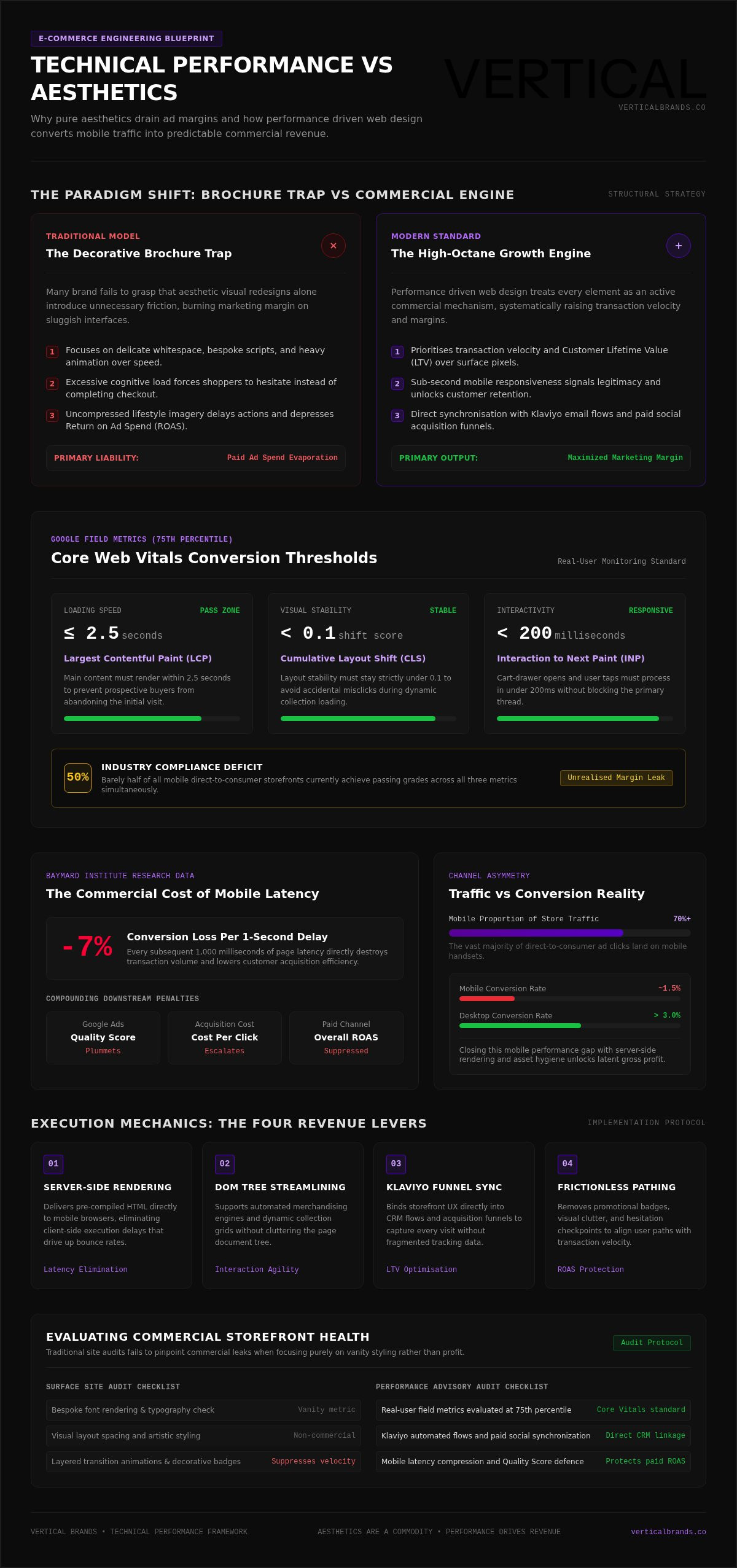
Traditional e-commerce design treats websites like glossy digital catalogues. Agencies obsess over bespoke typography, delicate whitespace, and complex animations. This approach fails commercial reality. A visually stunning storefront that loads sluggishly is an operational liability, burning paid traffic before visitors can evaluate your proposition. Performance driven web design systematically reframes the digital storefront as a conversion engine. It prioritises measurable business metrics, specifically Return on Ad Spend (ROAS) and Customer Lifetime Value (LTV), over surface-level styling.
Speed is not merely a technical preference; it forms the foundation of commercial throughput. Integrating rigorous web performance optimization protocols ensures that every page element earns its weight in code. If an uncompressed lifestyle asset or dynamic script delays user action, it destroys gross margin. Performance driven web design prioritise outcomes over pixels by aligning interface design directly with transactional velocity.
To examine the relationship between technical refinement and direct storefront revenue, watch this operational walkthrough:
Why Aesthetics Alone Are Costing You Money
The "pretty site trap" seduces direct-to-consumer leadership teams regularly. Brands invest heavily in artistic layouts, only to watch user engagement plummet. Visual clutter, layered transitions, and aggressive promotional badges directly obscure the primary call to action. Many brand fails to grasp that cognitive load suppresses transaction velocity. Every decorative distraction forces the customer to think, hesitating precisely when they should be checking out. Clean, intuitive pathways consistently outperform decorative flourishes on revenue per session. When brands need their message to resonate authentically, collaborating with specialists like Good Times Media helps craft memorable digital narratives that engage audiences without compromising on interface clarity.
The 2026 Standard for E-commerce Excellence
Consumer tolerance for digital friction in the UK is gone. Shoppers expect sub-second interactions on mobile devices, demanding instant responsiveness across all touchpoints. Machine learning and automated merchandising engines now dynamically curate collection grids and product recommendations, yet they must do so without bogging down the DOM tree. Modern consumers equate interface agility with security and legitimacy. Technical precision is no longer just back-end maintenance; it serves as a powerful signal of brand authority that underpins scalable growth.
Technical Mechanics of a High Performance Digital Storefronts
Architecture dictates commercial capacity. When page elements stall or reflow unexpectedly, shoppers abandon sessions without hesitation. Technical health is not an abstract engineering issue; it is an active revenue lever. Performance driven web design treats speed, responsiveness, and structural stability as core sales mechanisms. Meeting Google's official Core Web Vitals benchmarks is mandatory for maintaining visibility and customer acquisition margins. In modern direct-to-consumer commerce, the technical architecture of high-growth storefronts determine conversion ceilings across every channel.
Google evaluates user experience through three strict field metrics measured at the 75th percentile of real-user data. Largest Contentful Paint (LCP) must render within 2.5 seconds. Cumulative Layout Shift (CLS) must remain below 0.1 to avoid accidental misclicks. Interaction to Next Paint (INP) must process user taps and drawer-cart interactions in under 200 milliseconds. Barely half of mobile storefronts currently achieve passing grades across all three metrics simultaneously.
Speed as the Ultimate Business Metric
Latency destroys marketing efficiency. Research compiled by the Baymard Institute indicates that a single-second delay reduces e-commerce conversions by roughly 7 per cent. Milliseconds matter. When landing pages lag, Google Ads Quality Scores plummet, driving up your Cost Per Click and suppressing ROAS. Mobile traffic accounts for upwards of 70 per cent of all direct-to-consumer store visits, yet mobile conversion rates linger near 1.5 per cent, compared to over 3 per cent on desktop devices. Prioritising server-side rendering, asset compression, and clean execution paths closes this gap directly. For brands looking to implement bespoke web and application infrastructure, check out jedelix.digital. Speed is not a luxury. Speed is your most decisive merchandising feature.
Building for Scalability and AI-Readiness
Scale requires operational resilience. Disconnected third-party apps and redundant JavaScript libraries create massive technical debt, degrading execution times during major commercial events. A high performance digital storefronts handles traffic spikes seamlessly because its underlying framework is ruthlessly pruned. Implementing clean structured schema also enables emerging AI search engines to crawl and index product variants without hindrance. Building this operational durability requires disciplined engineering; working alongside focused specialists for website design and development guarantees that your infrastructure actively fuels scaling instead of restraining it.
Aligning Design with Paid Social and CRM Performance
Isolating web design from performance channels is commercial negligence. Most design agencies build storefronts in a vacuum, ignoring how media buyers acquire traffic and how lifecycle teams retain it. Performance driven web design acts as the central connective tissue between customer acquisition and customer retention. Every landing page layout, category hierarchy, and dynamic form must be engineered to capture first-party data and accelerate the path to purchase. Cognitive research into human perceptual response time limits proves that delays break user focus, meaning sluggish transitions destroy ad profitability immediately.
Data fragmentation between your storefront and marketing engine cripples scale. A brands site must work with Klaviyo to drive repeat purchases through structured behavioural tracking. If your theme code fails to pass real-time event parameters, your retention engine operates blind.
Lowering CAC Through Landing Page Optimisation
Routing paid social traffic to a generic homepage burns marketing capital rapidly. Modern acquisition demands focused, dedicated landing pages that directly reflect the hooks, creatives, and visual assets used in your ads. Integrating authentic UGC content right above the mobile fold provides instantaneous social proof, reducing bounce rates and validating customer intent. A disciplined framework for paid social management relies entirely on these tailored landing environments to compress Customer Acquisition Cost and stabilise Return on Ad Spend across volatile auction environments.
Driving LTV with Integrated CRM Design
Initial purchases merely establish the customer relationship; long-term profitability lives in lifetime value. Storefront interactions should seamlessly feed your email marketing automation. Dynamic pop-ups, browse-abandonment tracking, and back-in-stock alerts must render quickly without degrading user experience or blocking key navigational paths. When transitioning between software ecosystems, executing meticulous Klaviyo migration services guarantees that historical shopper behaviour inform future design iterations. Aligning interface typography, button styling, and layout rhythm between Klaviyo inbox flows and checkout screens builds profound brand consistency that turns one-time shoppers into reliable repeat buyers.
Evaluating Your Current Site: Why Most Audit Fails
Most digital reviews are superficial exercises. A web designer checks visual alignment, runs a synthetic homepage scan, and delivers a superficial report. This provides zero commercial insight. The audit reveal where money is lost in the user journey by identifying friction between discovery and checkout. Traditional agencies obsess over vanity metrics like total impressions or raw page views. Performance driven web design demands ruthless focus on growth metrics: mobile checkout completion rates, revenue per session, and real-user input delay.
Rigorous behavioural analysis exposes structural flaws that synthetic testing misses. Reviewing heatmaps and session recordings often uncover that mobile shoppers repeatedly tap dead interface elements or struggle with complex navigation drawer. Every visual hesitation costs margin.
The Performance Driven Health Check
Auditing a digital storefront requires precision diagnostic instruments. Stop relying on single-page lab audits that ignore field conditions. Deploy an integrated operational toolset:
Chrome User Experience Report (CrUX)
Evaluates authentic 28-day rolling field performance across mobile hardware.
WebPageTest
Pinpoints script execution bottlenecks, third-party tag blocking, and render delays.
Hotjar
Tracks user scroll depth, drop-off locations, and dead taps.
Google Search Console
Monitors indexing integrity and identifies mobile usability failures.
Screaming Frog
Audits technical redirection chains, metadata gaps, and resource architecture.
Most audit fails to account for live mobile network fluctuations. If your team only tests on enterprise fibre broadband in an office, you are misjudging reality.
Identifying and Removing Conversion Friction
Friction destroys transaction momentum. Industry data indicates an average cart abandonment rate of 70.2 per cent, heavily influenced by slow form rendering, multi-step hurdles, and intrusive fields. Every unnecessary click represents an active exit ramp. Aligning front-end architecture with modern E-commerce search engine optimisation protocols eliminates redundant redirects and keeps technical crawling frictionless.
Benchmarking Against High-Growth Competitors
Identify your category's primary market leaders and evaluate their digital infrastructure ruthlessly. Measure their interaction latency, audit their asset-delivery mechanisms, and dissect their mobile checkout sequences. Do not copy their design aesthetic; reverse-engineer their structural efficiency. Establish clear development sprint milestones that tie directly to bounce reduction and revenue lift. When your internal team lacks the technical bandwidth to diagnose these conversion leaks, request an operational growth review to uncover your exact performance deficits.
Executing a Performance First Web Strategy with Vertical Brands
Fragmented execution destroys scaling momentum. When your design agency, paid media buyers, and retention team operate in separate silos, misaligned priorities bleed profit. Vertical Brands operate as an integrated growth partner for ambitious direct-to-consumer businesses across the UK. By anchoring front-end technical development directly to paid acquisition and lifecycle marketing, performance driven web design transitions from an aesthetic expense into an active revenue driver. Managing paid social, search, Klaviyo automation, and technical storefront architecture under one roof eliminates cross-agency friction. The integration of technical development and growth advisory produce exceptional operational efficiency.
Vertical Brands offer a unique approach to scaling e-commerce revenue. Every deployment serves an explicit commercial target, protecting margin while expanding top-line volume.
Our Disciplined Approach to Development
Velocity requires discipline. We replace bloated exploratory design phases with rapid, linear execution focused strictly on conversion mechanics. Our engineers eliminate redundant third-party scripts, streamline checkout pathways, and ensure responsive layout stability across every screen size. Performance driven web design is not an abstract creative exercise. It is an engineering discipline centred on removing transactional resistance. Every one of our development sprints are tied directly to measurable revenue outcomes, ensuring your storefront handles high-volume traffic without degradation.
Taking the Next Step Toward Scaling
Aesthetics alone will not scale an enterprise. UK brands aiming to expand sustainably in 2026 cannot afford storefronts that leak paid traffic and suppress customer lifetime value. Positioning your website as the core engine within the e-commerce growth stages framework clarifies exactly where technical investments yield the highest commercial return. A comprehensive technical growth audit exposes hidden operational bottlenecks, revealing precisely how your digital architecture either accelerates or chokes progress. Transition your digital storefront from a static brochure into a scalable commercial asset.
Architecting Your Digital Storefront for Scalable Expansion
Visual appeal without technical velocity is a failed strategy. To scale profitably in 2026, direct-to-consumer businesses must treat their site architecture as their primary commercial asset. Performance driven web design bridges the gap between ad click and lifetime value, turning paid traffic into repeatable margin. Aligning sub-second page rendering with seamless Klaviyo data synchronisation ensures you capture every ounce of demand you generate.
Every ambitious retail brand require an operational partner who understands the mechanics of revenue generation. As an elite strategic guide and decisive driver of e-commerce progress, Vertical Brands brings technical development, paid acquisition, and CRM management under one unified framework. Stop letting latent friction erode your profitability. Partner with Vertical Brands for performance-driven growth and build an online storefront engineered to scale your bottom line.
Frequently Asked Questions
What is performance driven web design and how does it differ from traditional design?
Performance driven web design is an engineering-led approach that prioritises transactional speed, friction removal, and commercial outcomes over purely cosmetic styling. Traditional design focuses almost entirely on visual brand presentation, delicate whitespace, and aesthetic trends. In contrast, performance frameworks align interface layout decisions directly with conversion rate optimisation, paid advertising efficiency, and customer lifetime value. Every asset must prove its commercial contribution to storefront revenue.
How does site speed affect my Google Ads and Meta ad performance?
Site speed directly dictates your paid acquisition profitability by determining landing page experience scores and bounce rates. Slow-loading mobile pages lower Google Ads Quality Scores, which directly increases your Cost Per Click. On Meta, high bounce rates signal poor post-click user experience, causing ad algorithms to penalise your delivery auctions. Accelerating storefront response times lowers acquisition costs by ensuring expensive incoming traffic actually reaches your checkout funnel.
Can I improve my current website performance without a full redesign?
Yes, significant performance gains can be achieved through targeted code refactoring and technical pruning rather than a complete rebuild. Removing redundant third-party tracking scripts, minifying stylesheet files, and offloading heavy typography instantly recovers valuable loading speed. Converting uncompressed images to modern formats and auditing theme liquid architecture also deliver immediate commercial lift. Tactical engineering sprints resolves conversion friction without disrupting ongoing commercial operations.
Why is mobile-first design so critical for UK e-commerce brands in 2026?
Mobile-first architecture is critical because mobile devices now drive the vast majority of UK retail browsing sessions. Despite overwhelming traffic volume, mobile conversion rates consistently lag behind desktop baselines due to poorly configured checkout inputs and layout shifts. Designing specifically for single-thumb navigation, rapid tap interactions, and accelerated mobile payment gateways captures commercial demand that traditional desktop-adapted templates routinely surrender.
How do Core Web Vitals impact my search engine rankings?
Google uses Core Web Vitals as an explicit organic ranking signal within its page experience evaluation algorithms. Pages failing to meet thresholds for Largest Contentful Paint, Interaction to Next Paint, or Cumulative Layout Shift get penalised in competitive mobile search results. Search engine crawlers prioritise fast, structurally stable sites over bloated code bases. Strong technical health ensures organic visibility while directly protecting your search engine optimisation investments.
What role does Klaviyo play in a performance-driven web strategy?
Klaviyo functions as the core behavioural engine that converts anonymous storefront traffic into loyal repeat buyers. In an effective performance driven web design framework, the front end is meticulously configured to feed granular customer actions directly into automated CRM flows. Fast, unobtrusive signup forms capture zero-party data efficiently, whilst browse-abandonment triggers fire instantly without introducing script bloat or slowing down the primary user journey.
How often should I audit my website for performance bottlenecks?
High-growth brands should audit technical site health monthly, alongside conducting a deep diagnostic review before peak trading cycles. Frequent app installations, promotional marketing tags, and inventory expansions constantly introduce new latency risks into your codebase. Continuous performance monitoring guarantees that technical regressions are caught before they damage paid media ROAS. A regular schedule of reviews keep your digital infrastructure lean, secure, and commercially aggressive.

Other posts































































Stay ahead with better decisions.
Get business insights today.
