Shopify Plus Marketing Agency: How to Choose in 2026
A Shopify Plus marketing agency should do more than manage campaigns around a storefront. It should connect platform decisions, customer acquisition, customer experience and retention to your commercial priorities. The challenge is separating evidence from confident claims. Proposals can look simila...

A Shopify Plus marketing agency should do more than manage campaigns around a storefront. It should connect platform decisions, customer acquisition, customer experience and retention to your commercial priorities. The challenge is separating evidence from confident claims. Proposals can look similar on paper, while channel teams, website work and CRM operate in silos. A polished case study doesn’t automatically demonstrate relevant Shopify Plus experience.
It’s right to ask whether an agency can support your growth objectives, not just sell a list of services. Evidence matters more than the pitch. This guide gives you a practical way to assess platform-specific experience, check whether an agency’s capabilities match your growth constraints, and agree scope, measurement and working practices before engagement.
You’ll learn what to ask about Shopify Plus experience and marketing coordination, how to compare proposals on a like-for-like basis, and where gaps in expertise or accountability can undermine results. The aim is to find a partner aligned with your business, not simply the agency with the longest service menu.
• Start with the growth constraint you need to solve, then assess whether a Shopify Plus marketing agency has relevant, verifiable experience.
• Compare strategy, channel delivery, platform work, measurement and account ownership against the same requirements.
• Check current platform capabilities against Shopify documentation, and ask agencies to show how their experience applies to your setup.
• Use a shortlist process to test evidence, clarify responsibilities and agree how performance will be measured before work begins.
• Vertical Brands’ services span Klaviyo, CRM, paid media, SEO, web development and growth advisory. Confirm Shopify Plus credentials and scope before treating it as a platform-specific fit.
Why choose a Shopify Plus marketing agency around business needs, not platform prestige?
Choosing Shopify Plus doesn’t, by itself, make an agency the right commercial partner. Assess a Shopify Plus marketing agency against the constraint your business needs to solve, whether that’s acquisition efficiency, conversion, retention or technical delivery. Start with the business outcome, then identify what is blocking progress. Otherwise, it’s easy to buy an impressive-looking service list without addressing the problem.
First, identify the type of issue. A difficult-to-use storefront points to a store experience problem. Weak customer acquisition calls for a closer look at channel performance and audience fit. Low repeat purchasing raises different questions about retention and customer communications. Incomplete reporting can make all three harder to diagnose. Digital marketing spans multiple online channels, but the right mix depends on the bottleneck, not the platform’s reputation.
For a high-level overview of Shopify Plus, watch this video from Shopify:
What should a Shopify Plus marketing agency actually solve?
Map each objective to an observable obstacle before briefing agencies. If the priority is profitable acquisition, examine where paid search, paid social or SEO fit, and decide how success will be evaluated. If conversion is the issue, investigate the customer journey and store experience. If retention is weak, review how email marketing and CRM support customer relationships. These problems can overlap, but they aren’t interchangeable.
Also distinguish platform implementation from ongoing marketing strategy and channel management. A provider may be able to deliver website design and development, but that alone doesn’t show how it will coordinate acquisition, retention and measurement. Shopify Plus won’t automatically resolve unclear ownership, disconnected teams or an untested growth strategy.
Agency fit is the match between your business constraint, the agency’s verified capability and its measurable responsibility. Use that test to assess proposals. Ask what the agency will own, what your team must provide and which measures will show whether the work is addressing the original constraint.
When does a specialist agency make sense?
External support may make sense when your team lacks a defined capability, has insufficient capacity to deliver agreed work, or needs better coordination across channels. That’s different from a general desire to outsource marketing. Pinpoint the gap: is it channel expertise, development delivery, strategic direction or the time to manage work across internal teams?
Before shortlisting, decide which activities and decisions you expect a partner to own. A clear objective and accountable owner make delivery easier to assess. Specify where the agency should lead, where your team retains approval, and how results will be reviewed. The key question is whether its responsibilities address the constraint, not whether its Shopify credentials sound impressive.
Which Shopify Plus marketing capabilities should you assess before shortlisting?
Compare agencies against the work your growth plan requires, not the length of their service list. A Shopify Plus marketing agency should make clear what it can deliver directly, where it needs specialist input and how the work will be assessed. Use the same criteria for every candidate.
| Capability | What to assess | Evidence to request |
|---|---|---|
| Strategy | Can the agency connect your commercial priorities to a clear plan? | Prioritised actions, rationale and defined responsibilities. |
| Channel execution | Does its expertise match the channels your plan depends on? | Relevant examples and the agency’s specific role in delivery. |
| Platform work | Can it handle the required website design and development, or identify where another specialist is needed? | Relevant project details, scope and delivery ownership. |
| Measurement | Are outcomes and reporting expectations agreed in advance? | Named measures, reporting approach and review responsibilities. |
| Account ownership | Who coordinates activity and makes day-to-day decisions? | Named roles, communication practices and escalation routes. |
Platform features change. Verify Shopify Plus-specific claims against current Shopify documentation, including whether a feature applies to your plan and setup. Don’t treat general Shopify experience as proof of Shopify Plus expertise. Ask for relevant examples, the agency’s exact contribution, and permission to verify case-study details or named credentials. Unsupported claims aren’t evidence.
How should Shopify Plus platform experience be evidenced?
Request examples that match the work you need, not just a list of familiar platform terms. Ask whether the agency led strategy, completed development, managed marketing or supported another team. Evidence is useful only when you can connect the agency’s role to your requirements. Verify platform-specific credentials and case-study details before relying on them.
Which marketing services need to work together?
Assess paid social, paid search, SEO and CRM against your priorities. Check whether website development supports the customer experience behind acquisition and retention, rather than operating as a separate project. Forbes’ overview of e-commerce marketing strategies offers context for considering how different activities contribute to a plan.
If a CRM platform migration is part of your brief, use this Klaviyo migration guide as a reference point. Vertical Brands’ confirmed services include Klaviyo email marketing, CRM management, paid media, SEO, website design and development, and growth advisory. Shopify Plus-specific credentials and scope still need confirmation. Review whether its stated growth services align with your requirements at Vertical Brands’ growth services.
Shopify Plus agency vs in-house or specialist options
There’s no single operating model that suits every brand. An in-house team offers direct control and close knowledge of the business, but may lack capacity or depth in every channel. A single-channel specialist can bring focused expertise, although your team may need to coordinate that work with other partners. An integrated agency can connect several disciplines, provided its actual capabilities match your requirements.
The trade-off is between internal control, specialist depth and cross-channel coordination. Compare the options against the same criteria: who owns strategy, how much delivery capacity is available, how activity across channels is coordinated, and how much management time your internal team must contribute. A Shopify Plus marketing agency isn’t automatically the best choice because of its label or platform focus.
When is an integrated agency model the better fit?
An integrated model may help when separate teams or suppliers create hand-offs, duplicated effort or competing priorities. It can bring related work into closer coordination, but it doesn’t guarantee better performance. Confirm which channels the agency can support directly, what your team must retain, and whether specialist partners are needed to cover any gaps. The ecommerce growth stages framework can help you consider whether your needs are changing as the business develops.
For example, a brand investing in paid media and SEO may also need its website development and CRM activity to support the same priorities. Vertical Brands’ stated services include paid social, paid search, SEO, website design and development, Klaviyo email marketing, CRM management and growth advisory. That range may be relevant where those needs align, but confirm the exact scope and any Shopify Plus-specific experience before making a decision.
What should you compare beyond the agency’s service list?
Look at the operating model, not just the menu. Ask who will work on your account, who makes decisions, how often progress is reviewed and what happens when performance shifts. Compare how each option defines success and who is responsible for acting on the findings. A broad service list is of little value if ownership is unclear or your team still has to coordinate every task.
In-house
assess internal capacity, decision authority and gaps in specialist expertise.
Channel specialist
check how its work connects to other activity and who manages those hand-offs.
Integrated agency
verify the proposed team, direct delivery capabilities and escalation process.
Each option brings different strengths, so document the work you expect it to own before comparing proposals. The performance marketing agency selection guide offers broader partner-evaluation context. For any external reference, check its relevance and evidence before relying on it, ensuring you use verified industry data and case studies to inform your partnership decisions.
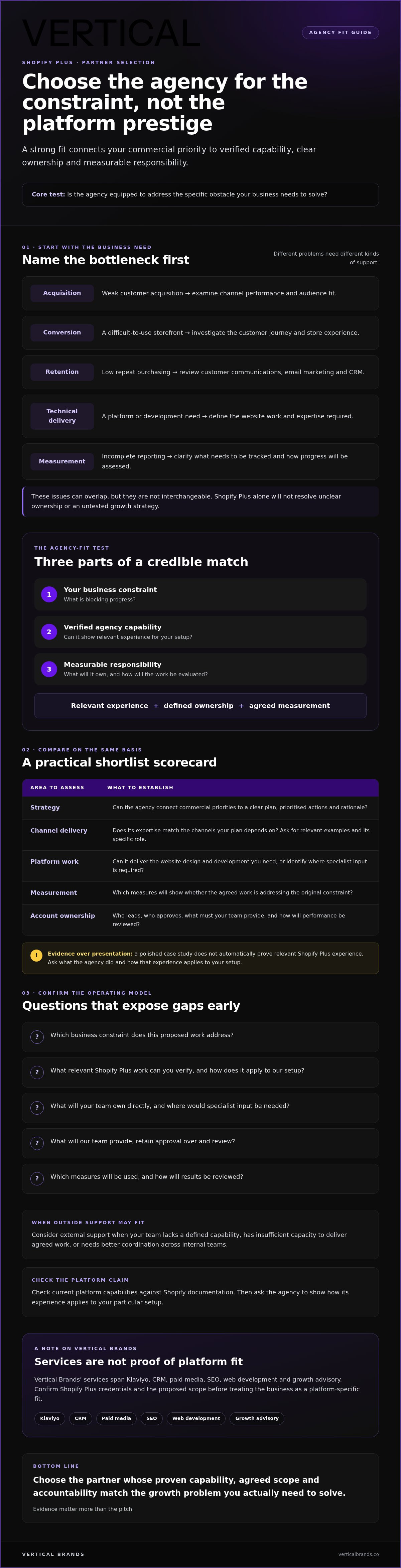
What questions should you ask before hiring a Shopify Plus marketing agency?
A disciplined shortlist makes it harder for polished proposals to hide gaps in evidence, ownership or measurement. Use the same process with every candidate: define what you need, test relevant proof, examine how delivery will work, then agree how success will be assessed. A Shopify Plus marketing agency should be able to answer direct questions about its role, not just describe broad capabilities.
1. Define requirements.
Which commercial constraint are you addressing? Which channels, platform work or internal decisions are within scope, and what must your team retain?
2. Request evidence.
Which Shopify Plus projects are relevant to your needs? What did the agency deliver directly, and can you speak with a suitable reference?
3. Assess delivery.
Who owns strategy, execution, analysis and implementation? How will the agency coordinate work across channels and with your team?
4. Agree measurement.
Which outcomes will be tracked, how are they defined, what will reporting include, and how often will you review progress?
Which questions expose scope and accountability gaps?
Ask who approves decisions, what inputs or access the agency depends on, and how changes to deliverables or priorities are handled. Clarify the difference between recommendations and work the agency will execute. Establish how reporting connects activity to agreed measures, who interprets the findings, and what happens if performance shifts. If responsibilities are unclear before engagement, they’re unlikely to become clearer during delivery.
How can you assess evidence without relying on promises?
Request examples that resemble your business challenge, then establish the agency’s exact role. Ask how outcomes were measured, what timeframe the evidence covers, and whether attribution can be explained and verified. Check references where possible, and confirm that case-study details are relevant to your situation. Claims should be documented and approved for use, not repeated simply because they appear in a pitch deck. Evidence becomes useful when the context and contribution are clear.
Keep a written scorecard. Record evidence, scope, named responsibilities, channel integration and reporting for each shortlisted agency. This makes gaps visible and gives your decision-makers a consistent basis for comparison. Don’t treat a Shopify platform claim as proof of Shopify Plus experience: ask for specifics and verify them before relying on the claim.
Once you’ve documented your requirements and evaluation criteria, you can have a more focused conversation about fit. If your priorities include Klaviyo email marketing, CRM management, paid media, SEO, website design and development, or growth advisory, discuss your growth requirements with Vertical Brands. Confirm Shopify Plus-specific experience and the proposed scope directly before proceeding.
Could Vertical Brands be the right Shopify Plus marketing agency for your growth plan?
Potentially, if your priorities match its confirmed services. Vertical Brands offers Klaviyo email marketing, email marketing and CRM management, paid social, paid search, SEO, website design and development, and growth advisory. That gives buyers several capabilities to assess against a growth plan. It does not, on its own, confirm Shopify Plus specialisation.
The available information doesn’t verify Shopify Plus credentials or define a Shopify Plus-specific service scope. Treat those as questions to resolve, not assumptions. Ask about relevant platform experience, the work the team would deliver directly, and any capabilities that require a specialist partner. Request evidence that relates to your setup and objectives before relying on platform-specific claims.
Which needs align with Vertical Brands’ confirmed services?
Start by matching each business requirement to a stated capability:
Retention and customer-data needs
assess whether Klaviyo email marketing and CRM management fit your requirements, and confirm the specific scope of work.
Acquisition priorities
consider paid social, paid search and SEO in relation to the channels and outcomes in your plan.
Store experience requirements
discuss website design and development only after confirming the work required and whether it falls within the proposed scope.
Strategic direction
clarify how growth advisory would address your priorities and what decisions or deliverables it covers.
This comparison should also reveal what’s missing. If your plan depends on a capability that isn’t confirmed, ask how that gap would be addressed and who would own the work. Don’t assume every service applies to Shopify Plus simply because it appears in an agency’s wider offer.
What should happen before an engagement begins?
Use initial discussions to establish Shopify Plus-specific experience, relevant evidence, named responsibilities and any dependencies on your internal team or other specialists. Then agree objectives, scope, reporting and working practices in writing. Be clear about what the agency will deliver, how progress will be reviewed and which measures matter to your business.
The right fit depends on the needs you’ve identified, not the platform label. If your priorities align with Vertical Brands’ confirmed services, discuss your ecommerce growth requirements with Vertical Brands. Use that conversation to test strategic fit and confirm the capabilities required before setting expectations.
Choose a partner aligned with your growth priorities
Select a Shopify Plus marketing agency for its ability to address a defined commercial need, not for platform prestige or an expansive service list. Compare each option against consistent criteria: relevant evidence, clear ownership, coordinated delivery and agreed measurement. Then identify any capability gaps, including Shopify Plus-specific experience or scope that has not been verified.
Vertical Brands’ stated portfolio spans CRM, paid social, paid search, SEO, website design and development, and growth advisory. Klaviyo email marketing and CRM management are priority offerings. These capabilities may align with acquisition, retention or store experience objectives, but confirm the precise scope and any Shopify Plus credentials directly. The right fit is the set of services you need, supported by evidence and clear responsibility.
Set out your requirements first. Then use an initial discussion to test strategic fit, responsibilities and working practices before setting expectations. Discuss your ecommerce growth requirements with Vertical Brands and explore whether its confirmed services match your priorities. With clear criteria and careful verification, you can choose a partner with confidence and move forward with a plan grounded in your business needs.
Frequently Asked Questions
What does a Shopify Plus marketing agency do?
A Shopify Plus marketing agency helps connect marketing activity and store work to a merchant’s growth priorities. Depending on its capabilities, it may provide services such as paid social, paid search, SEO, email and CRM management, or website design and development. Scope varies between providers. Clarify which work the agency delivers directly, how it coordinates channels and platform activity, and what outcomes it will measure before appointing a partner.
How do I choose the right Shopify Plus marketing agency?
Choose against your business requirements, not the agency’s platform claims or service list. Define the constraint you need to address, such as acquisition, retention, conversion or technical delivery. Then compare agencies on relevant evidence, delivery responsibilities, channel coordination and measurement. Ask for examples that match your needs and verify the provider’s role in the work. Agree scope, reporting and working practices before engagement, including what your team must own.
Does a Shopify Plus marketing agency need Shopify Plus-specific experience?
Shopify Plus-specific experience is valuable when your brief depends on platform-specific requirements, but don’t treat general Shopify experience as equivalent proof. Ask for examples of relevant Plus work, what the agency delivered, and who was responsible. Verify any credentials or case-study claims. If your needs are primarily channel marketing, assess that expertise separately, then confirm how the agency will work with your Shopify Plus setup and any technical specialists.
Can one agency manage Shopify Plus development and digital marketing?
It can, if it has proven capability in both areas and the proposed scope covers the work you need. Ask who will lead website design and development, who will manage marketing channels, and how those teams will coordinate priorities and timelines. Some agencies use specialist partners for parts of delivery, so establish that upfront. Don’t assume a broad service portfolio confirms Shopify Plus development experience or implementation capability.
How much does a Shopify Plus marketing agency cost?
What should I ask a Shopify Plus agency before hiring them?
Ask which Shopify Plus projects are relevant and what the agency delivered directly. Who owns strategy, execution, analysis and implementation? How will paid channels, SEO, CRM and website work connect? What are the deliverables, dependencies and decision rights? Also ask how results are defined, what reporting includes and how often performance is reviewed. Check references and verify case-study claims relevant to your situation before relying on them.
When should a Shopify brand hire a marketing agency?
Consider external support when you can identify a capability gap, delivery constraint or coordination problem that is limiting progress. For example, your team may need specialist support with paid search, CRM management, SEO or website development. Define the work and decisions you expect a partner to own first. Hiring is less useful if the objective, internal responsibilities and measures of success remain unclear.

Other posts




























































Stay ahead with better decisions.
Get business insights today.
