Protect Deliverability: 3 Winback Email Strategy Sequences for UK Teams

A winback email strategy targets lapsed but recoverable customers, not your whole dormant list. We recommend you start by segmenting contacts by recency and value, then run a short, value-first sequence before any discount appears. Done well, this recovers a meaningful share of at-risk customers; the rest confirm they have genuinely churned, which is useful information for your list hygiene too.
TL;DR:
- Segment contacts by recency, value, and engagement to prioritize high-value, recent lapses over dormant or low-value customers.
- Use behavioral triggers rather than fixed dates to decide when to trigger winback emails, especially for high-value customers.
- Start with value-driven messages before escalating to offers, ensuring personalized, time-limited incentives only after initial attempts fail.
- Monitor reactivation rates, revenue, and deliverability metrics like bounce and complaint rates regularly to protect sender reputation.
- Respect consent rules by suppressing non-responders and only re-permissioning through explicit actions, not automatic resends.
Table of Contents
- When to re-engage: measurable triggers and timing rules
- Segment before you send: RFM and engagement buckets that matter
- Winback sequences: three tested flow templates with timing and content prompts
- Subject lines and preview text formulas that increase open and CTR
- Offers versus value-first messaging: escalation rules
- Measure success: KPIs, reporting, and inbox health
- Sunset policy and list hygiene: how to stop safely and when to re-permission
- How Vertical applies this: high-level case signals and lessons
- First-person take: common mistakes and quick guardrails
- Getting winback programs built and running
- FAQ
- Sources
When to re-engage: measurable triggers and timing rules
Timing decides whether a winback email reads as timely or desperate. We watch for a cluster of signals rather than one metric alone, since a single missed open rarely means much on its own.
The clearest disengagement signals are:
- No email opens or clicks across your last 4 to 6 sends.
- No purchase or login within a window tied to your typical repurchase cycle.
- No site or app activity despite continued browsing by similar customers.
For high-value customers, we trigger a winback flow sooner after a period of silence, because the cost of losing them is higher. For lower-value or lower-frequency buyers, we wait longer to avoid flagging normal seasonal gaps as churn. Behavioral triggers (a specific lapse in activity) tend to outperform fixed calendar snapshots, since they respond to how each customer actually behaves rather than an arbitrary date on the calendar.
Segment before you send: RFM and engagement buckets that matter
Segmentation is what separates a winback program that protects your sender reputation from one that quietly damages it. We build on recency, frequency, and monetary value (RFM) to decide who gets contacted first and how.
- Recent, high-value lapses get priority: customers who spent well but went quiet in the last 60 to 90 days.
- Frequent, low-spend lapses get a lighter-touch sequence, since the relationship exists but the revenue opportunity is smaller.
- Long-dormant contacts (12 months or more of silence) go into a final, short attempt before suppression rather than a full sequence.
Consent matters just as much as value here. Under PECR, you need consent to email individuals unless the soft opt-in applies, meaning the contact bought a similar product from you before and was given a clear opt-out at the time. Corporate contacts at generic addresses are treated differently from named individuals and sole traders, and detailed PECR guidance treats sole traders as individuals for consent purposes. Build this distinction into your segmentation logic before your first winback send, not after a complaint arrives.
Winback sequences: three tested flow templates with timing and content prompts
Flow length should match customer value and dormancy depth. A single template for every segment wastes sends on low-value contacts and under-serves your best lapsed customers.
- Short (1 to 2 emails): for recent, high-value lapses. Email 1 at day 0 reminds them what they are missing with a direct, no-discount message. Email 2 at day 5, if needed, adds a light nudge or a question about what changed.
- Medium (3 to 4 emails): for mid-value, moderately dormant customers. Open with value content (a product update or use case), follow with social proof, then close with a modest, time-limited offer if the first two emails get no response.
- Long (4 to 6 emails): for long-dormant or lower-certainty segments. Progress from value messaging to a stronger offer, then end with a re-permission or short survey step before suppression.
Copy prompts that work across all three:
- Subject: name the account or activity directly (“Your [product] account” or “We miss having you around”).
- Preview text: extend the subject with a specific reason to open, never a repeat of the same words.
- CTA: one action per email (resume, browse, reply), never multiple competing buttons.
Our guide on abandoned cart emails covers similar timing logic and CTA design that applies directly to winback sequencing.
Subject lines and preview text formulas that increase open and CTR
Subject lines for winback emails work best when they sound like a real person checking in, not a campaign announcement. A few formulas to test:
- Plain: “Haven’t seen you in a while”
- Curiosity: “We changed something you’ll want to see”
- Update: “What’s new since you last visited”
- Benefit reminder: “Still getting [specific benefit]?”
- FOMO: “Your [item/account] is still waiting”
Preview text should extend the subject rather than repeat it, giving the reader a second, distinct reason to open. Keep wording free of spam-trigger terms like “free,” “act now,” or excessive punctuation, since these still affect inbox placement on some providers. Test one variable per send: subject tone, preview length, or send time, never all three at once.
Pro Tip: Run subject-line tests on your medium-value segment first. It’s large enough for a clean read but not so valuable that a weak variant costs you real revenue.
Our piece on conversion copywriting for growth teams has more on testing voice-of-customer language that tends to outperform generic marketing copy.
Offers versus value-first messaging: escalation rules
Leading with a discount teaches customers to wait for one before they buy again, which erodes margin over time. We start every winback sequence with value: a product reminder, an account status update, or proof that other customers are getting results.
An offer earns its place only after value messaging fails to move the customer, and only when it is:
- Personalized to what the customer previously bought or browsed.
- Time-limited, so it creates a real reason to act now rather than later.
- Tied to a specific behavior (a cart left, a renewal missed) rather than offered blanket-wide.
This sequencing matters because retaining the right customers is more valuable than acquiring new ones, and a customer who returns without a discount carries better margin than one who was trained to wait for a markdown.
Measure success: KPIs, reporting, and inbox health
A winback program only proves itself through numbers, and the right ones go beyond open rate. We track reactivation rate (the share of targeted contacts who purchase or re-engage within a set window), revenue per reactivated customer, and the longer-term lift in customer lifetime value.
Keeping the right customers measurably increases business value, and HBR’s analysis of retention economics shows that retained customers are cheaper to serve and tend to spend more over time than newly acquired ones.
Deliverability metrics deserve equal attention:
- Bounce rate, which signals list quality problems.
- Spam complaint rate, which directly affects inbox placement for every future send.
- Unsubscribe rate, which tells you whether your frequency or offer cadence is off.
A short, useful report ties these together: reactivation volume and revenue on one side, bounce and complaint trends on the other, so you can see whether winback activity is helping or quietly harming your sender reputation.
Sunset policy and list hygiene: how to stop safely and when to re-permission
Every winback program needs an exit plan for contacts who never respond. Without one, dormant addresses keep absorbing sends and dragging down your engagement rates across the board.
- Run your full winback sequence (short, medium, or long depending on segment) and give each contact a real chance to respond.
- Send one final message asking directly whether they want to stay subscribed, sometimes paired with a short survey.
- Suppress non-responders from regular sends, moving them to an archive list rather than deleting their data outright.
- Check your suppression list before every future campaign to confirm these contacts stay excluded.
- Re-permission only through an explicit action, like a new sign-up or a reply to a check-in email, never by resuming sends automatically.
This approach reflects the practical checklist in PECR guidance, which calls for clear opt-outs, do-not-contact handling, and avoiding the use of bought or unverified lists. Our note on turning post-purchase surveys into revenue has reusable survey formats that work well as a final re-permission step.
How Vertical applies this: high-level case signals and lessons
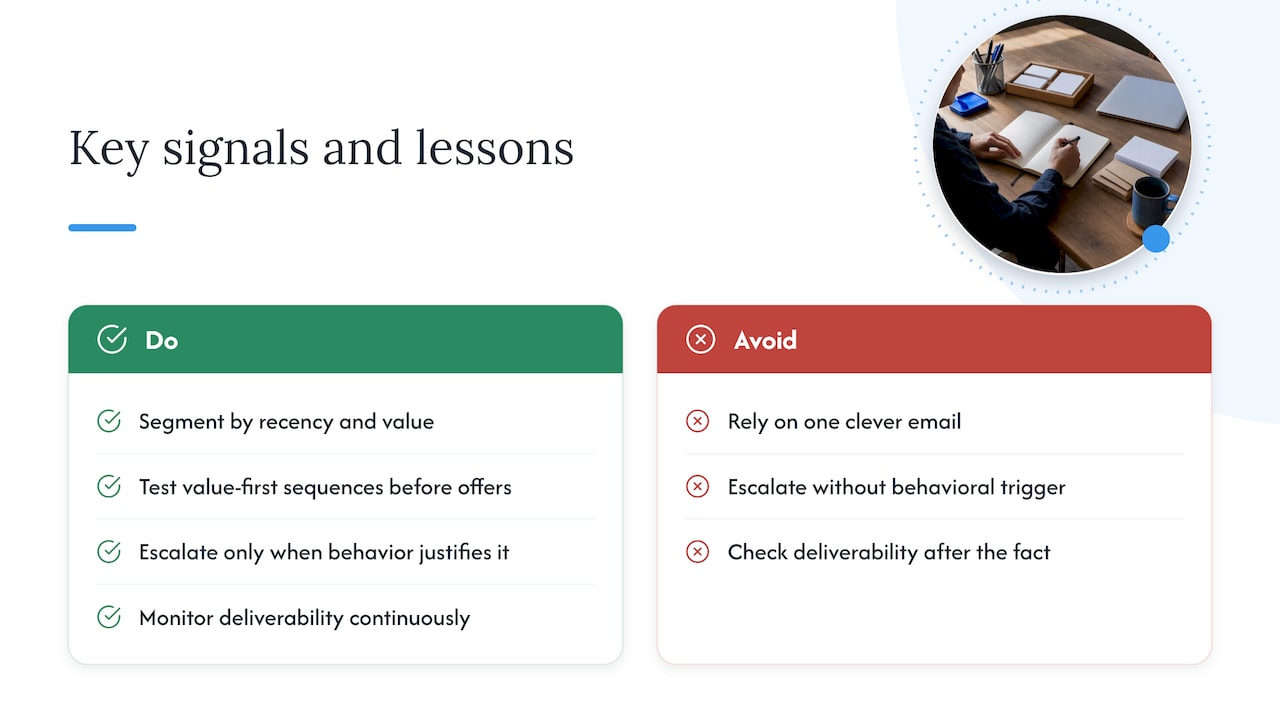
Winback programs benefit from segmenting by recency and value, testing value-first sequences before any offer, escalating only where behavior justifies it, and monitoring deliverability metrics continuously rather than after the fact. The lesson for most teams is simple: the segmentation and sequencing discipline matters more than any single clever email.
First-person take: common mistakes and quick guardrails
The most common mistake we see is blasting an entire dormant list with one discount email and calling it a winback strategy. That approach burns deliverability and conditions customers to wait for markdowns. Three guardrails help: segment before you send, lead with value, and suppress non-responders instead of emailing them indefinitely. Test with one clear hypothesis and a small cohort before rolling anything out wider.
— Alex
Getting winback programs built and running
Building a winback program that actually protects deliverability while recovering revenue takes coordinated work across email marketing, CRM management, and measurement, which is exactly where an integrated setup saves time compared to juggling separate vendors for each piece.
Our team handles this end to end:
- Segmentation and RFM modeling built into your CRM management setup.
- Winback sequence design and copy through our email marketing service.
- Growth consulting to tie reactivation activity back to revenue and CLTV.
When strategy, creative, and CRM work are integrated, testing a new sequence or adjusting an offer rule can happen quickly without waiting on handoffs between agencies. If you want help building or auditing a winback program, our services page outlines where to start.
FAQ
What is a winback strategy?
A winback strategy is a targeted email sequence aimed at customers who have stopped engaging or buying but are still considered recoverable, based on their past recency, frequency, and value. It typically starts with value-led messaging and escalates to a personalized offer only if the customer stays unresponsive.
What is the 30/30/50 rule for cold emails?
This rule is commonly cited in cold outreach discussions as a rough split of effort between list quality, subject line and copy, and offer or timing, though definitions vary across sources. It is not a winback-specific standard, so for reactivation emails we recommend focusing on segmentation and value-first sequencing instead.
What is the most effective email marketing strategy?
For re-engagement specifically, segmenting by recency and value before sending, then leading with value rather than a discount, tends to protect both deliverability and margin. Pairing this with clear KPIs like reactivation rate and revenue per reactivated customer lets you see what is actually working.
What is the 3 email rule?
This generally refers to keeping a sequence short, often three emails, when targeting a narrow or high-value segment, so customers get enough touches to respond without feeling over-contacted. It works well for recent, high-value lapses, though longer-dormant segments often need additional steps before a final sunset attempt.
Sources
For consent and compliance, our team relies on ICO guidance on PECR, and on HBR’s research on customer retention value.
- The Value of Keeping the Right Customers | HBR
- Electronic mail marketing | ICO
- How do we comply with the PECR electronic mail marketing rules? | ICO
Recommended

Other posts


















































Stay ahead with better decisions.
Get business insights today.
