Advanced CRM Segmentation Strategies: The Performance Framework for 2026
Is your CRM a high-velocity revenue engine or a digital graveyard? Most D2C brands treat segmentation as a basic administrative task rather than a strategic lever. They settle for 'batch and blast' emails that drive high unsubscribe rates and ignore the signals hidden in their data. You've likely se...

Is your CRM a high-velocity revenue engine or a digital graveyard? Most D2C brands treat segmentation as a basic administrative task rather than a strategic lever. They settle for 'batch and blast' emails that drive high unsubscribe rates and ignore the signals hidden in their data. You've likely seen your ROAS on paid channels plateauing whilst your customer lists sit idle. Advanced CRM segmentation strategies is the only way to break this cycle of inefficiency.
We understand the frustration of seeing underutilised data waste capital. It's a structural failure that limits your growth potential. This guide promises to help you master the sophisticated tactics required to transform stagnant profiles into predictable revenue. This pricing model were introduced to reward those who prioritise precision over volume. We will preview the Performance Framework for 2026. This disciplined approach focuses on predictive signals, multi-channel alignment, and automated retention that requires minimal daily oversight. It's time to remove the friction and scale.
Key Takeaways
• Transition from static demographics to dynamic behavioural signals to capture immediate customer intent.
• Utilise RFM analysis and predictive data to isolate your most profitable VIP segments and protect margins.
• Advanced CRM segmentation strategies ensures that manual list maintenance is replaced by automated revenue engines.
• Audit your Klaviyo data flow to ensure clean integration between your store and CRM for hyper-relevance.
• The framework allow for the removal of operational friction to drive measurable performance and scale.
Beyond Demographics: Why Basic CRM Segmentation Fails High-Growth Brands
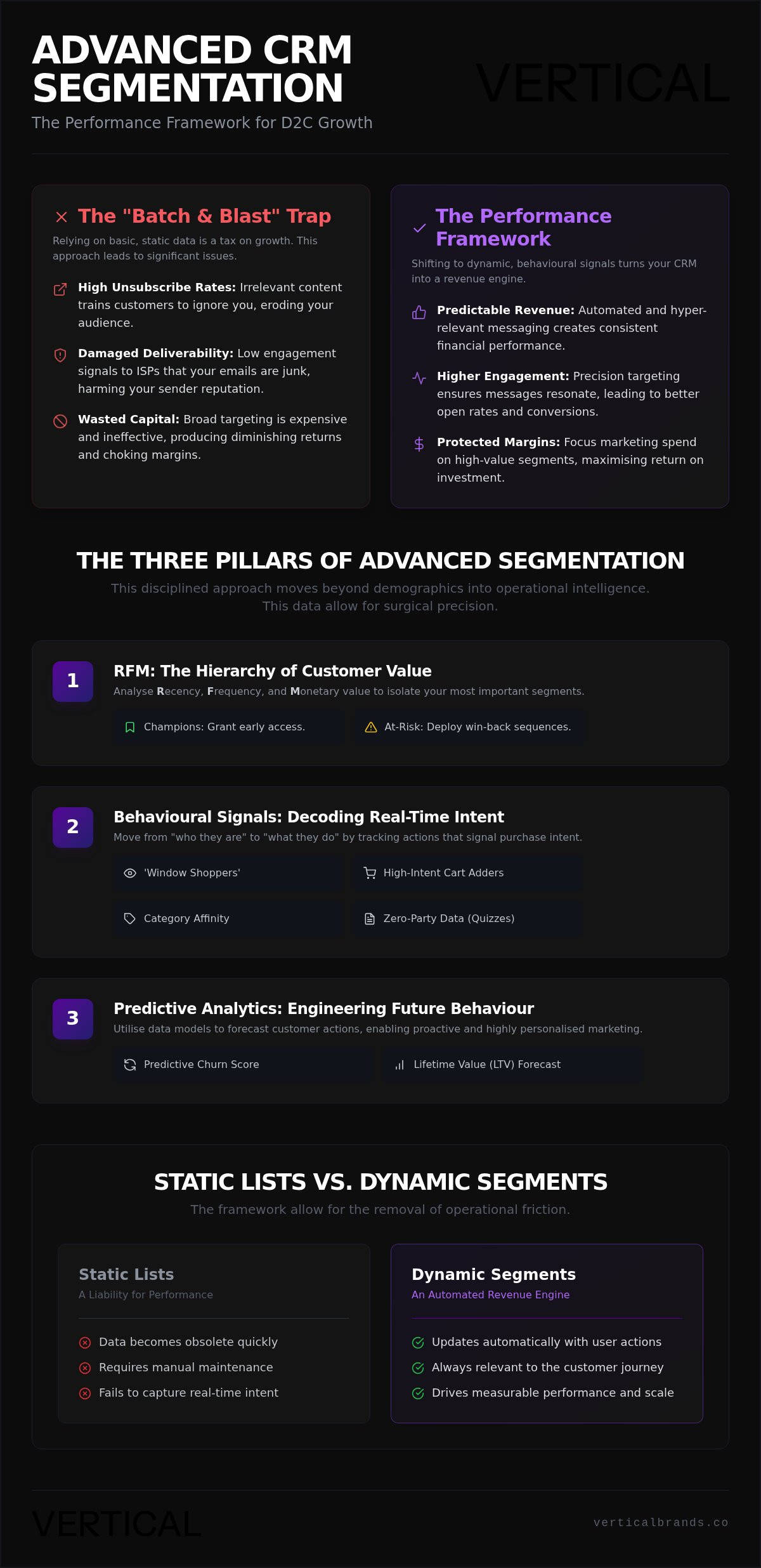
The "batch and blast" era is dead. Generic marketing is a tax on your growth. High-growth D2C brands cannot rely on demographic-only segmentation. It leads to list decay. It erodes brand authority. Modern Customer Relationship Management (CRM) requires a move from static attributes to dynamic behavioural signals. This transition is the foundation of Advanced CRM segmentation strategies. Broad targeting is expensive and ineffective. It wastes capital. It ignores the nuance of consumer behaviour. Advanced CRM segmentation is a predictive growth tool that engineers future purchase behaviour through disciplined data signals.
Broad targeting erodes the structural integrity of your marketing operations. When you send irrelevant content, you train your customers to ignore you. Unsubscribe rates climb. Engagement drops. Your CRM becomes a list of ghosts rather than a revenue engine. Strategic authority comes from relevance. Every message must serve a specific purpose for a specific segment. Failing to segment properly is a choice to leave money on the table whilst increasing your operational friction. It creates a cycle of diminishing returns that eventually chokes your profit margins.
The Limitations of Static Data
Age, gender, and location are no longer sufficient for scaling. These are broad categories that lack purchase intent. They don't account for the current stage of the customer journey. Data lag is a silent killer of conversion rates. A segment created 30 days ago is already obsolete in a high-volume environment. You must move from "who they are" to "what they do" in real-time. This framework prioritise measurable outcomes over aesthetic fluff. If your segments don't update automatically based on site interactions, you're behind. The data suggest that static lists are a liability for performance-first brands who need to move at speed.
Deliverability and the Reputation Stake
Poor segmentation kills deliverability. Sending to unengaged profiles triggers ISP spam filters. This damage your sender reputation. Precision is the only protection for your primary revenue channel. Low engagement signals to providers like Gmail that your content is irrelevant. Disciplined list management ensures high inbox placement. It removes the friction in the customer journey. You must protect your sender score with the same rigour you apply to your ROAS. Implementing Advanced CRM segmentation strategies ensures that your most valuable messages actually reach the intended audience. This strategy ensure that you maintain a lean, high-performing list. Without this discipline, your emails will end up in the promotions tab or, worse, the junk folder.
The Three Pillars of Advanced Segmentation: RFM, Behavioural, and Predictive Data
Structure creates scale. The three pillars are the backbone of Advanced CRM segmentation strategies. We move beyond basic demographics into operational intelligence. This framework ensures every customer interaction is data-backed. It removes the friction that slows down D2C growth. By integrating RFM, behavioural, and predictive data, you transform your CRM into a profit engine. One of the most powerful tool in this framework is the ability to automate relevance across the entire lifecycle.
RFM: The Hierarchy of Customer Value
RFM scoring is not a suggestion. It is a requirement for margin protection. By decoding Recency, Frequency, and Monetary value, you isolate your 'Champions' from those 'At Risk'. Champions get early access and exclusive previews. At-risk profiles receive aggressive win-back sequences to prevent permanent churn. This data-driven hierarchy ensures your budget goes where the return is highest. RFM scores dictate different communication cadences by ensuring high-frequency buyers aren't over-saturated whilst dormant users are re-engaged before they disappear. This level of CRM analytics and segmentation is what separates market leaders from stagnant brands.
Behavioural Signals Beyond the Click
Intent is found in the action. We track 'Window Shoppers' who view products but don't add to cart. We isolate 'High-Intent Cart Adders' for immediate, high-pressure follow-ups. Product category affinity is essential for relevant cross-selling. If a user consistently browses a specific collection, your CRM should reflect that preference immediately. Utilising zero-party data from quizzes and surveys refines the profile even further. This data allow for surgical precision in every campaign. It ensures that your messaging remains hyper-relevant to the individual's current needs.
Predictive analytics take this a step further. We use historical data to forecast the next purchase date with high accuracy. We identify churn risk before the customer even knows they're leaving. Integrating these pillars into a cohesive, automated CRM strategy removes the need for manual guesswork. It creates a self-optimising system that drives LTV. This setup require a deep understanding of your customer's lifecycle and technical capabilities. If you want to build this revenue engine, our growth advisory services can help align your data with your specific revenue goals.
Static Lists vs. Dynamic Segments: Optimising for Real-Time Intent
Static lists are a relic of a slower era. They are snapshots of a moment that has already passed. High-volume e-commerce demands real-time motion. Advanced CRM segmentation strategies prioritise dynamic membership over manual maintenance. If your segments don't update automatically, they are inaccurate. Manual export and import processes is a massive source of operational friction. It slows down execution. It introduces human error. Moving data between platforms by hand is a strategy for stagnation. It ensures that your messaging is always a step behind the customer’s actual behaviour. You cannot build a high-velocity revenue engine on 48-hour-old CSV files.
The Efficiency Gap
Managing static lists is a labour-intensive failure. It wastes internal resources that should be focused on growth advisory and strategy. Dynamic automation reduces the manual burden to zero. It ensures that users are only ever in the most relevant segment based on their latest action. This prevents 'offer fatigue' by removing converted users immediately from promotional flows. A customer who just purchased shouldn't receive a 'complete your order' nudge ten minutes later. Automated segments ensure a seamless customer journey across every touchpoint whilst protecting your brand’s reputation for relevance. This structural efficiency allows your team to focus on high-level creative rather than administrative data entry.
Synchronising CRM with Paid Media
This drive for structural efficiency is universal; for example, Yellow Rose Consultants provides property surveyor business support to help firms automate lead generation and administrative tasks, allowing their experts to focus on high-value professional work.
Your CRM is the engine of profitability for your paid channels. Real-time synchronisation is the non-negotiable standard for 2026. Dynamic segments should fuel your Facebook and Google 'Lookalike' audiences. This setup require a direct integration to maintain data fresh. The power of exclusion is equally critical. You must remove recent purchasers from top-of-funnel ad spend instantly. This creates a closed-loop growth system between CRM and performance marketing. It ensures your budget is always focused on new acquisition or high-intent retention. Advanced CRM segmentation strategies bridge the gap between your database and your ad account. This alignment removes waste and accelerates scaling. It is about structural integrity and removing the friction that chokes high-growth brands. Every pound spent on a customer who has already converted is a pound stolen from your acquisition efforts. Precision in exclusion is just as important as precision in targeting.
Implementing a Multi-Layered Segmentation Strategy in Klaviyo
Data integrity is the starting point. You must audit your current data flow before building complex structures. Ensure the integration between your e-commerce store and Klaviyo is seamless. Fragmented data leads to fragmented results. Advanced CRM segmentation strategies require a clean foundation. We build segments on facts, not assumptions. This framework ensure that every customer signal is captured and utilised correctly. Precision begins with a technical audit.
The Core Four Segments Every Brand Needs
VIPs
The top 5% driving the majority of your revenue. Protect these margins at all costs.
Engaged Non-Buyers
High-intent leads who browse frequently but haven't purchased. They require a strategic nudge.
Churn Risks
Profiles entering the 'danger zone' based on their predicted next purchase date.
New Subscribers
Optimise the first 30 days. This is your window of peak engagement and brand affinity.
Layering complexity is the next logical step. Combine behavioural triggers with RFM tiers for hyper-targeting. A VIP who is also a high-intent cart adder deserves a different message than a first-time browser. This level of granularity removes the friction that generic messaging creates. It ensures that your brand remains relevant whilst driving high-velocity revenue. You are no longer guessing; you are engineering outcomes.
Refining Through A/B Testing
Testing is a disciplined, recurring process. You must test different offer structures across high and low RFM segments. High-value customers often respond better to exclusive access whilst low-value segments might need a monetary incentive. Analysing the impact of send-frequency on different engagement tiers is also vital. Some segments want daily updates; others require a lighter touch to avoid list decay. Incremental gains are the goal here. Small improvements in conversion rates compound into significant revenue growth over time.
Refining these segments require constant oversight and intellectual rigour. It is a strategic task that demands technical expertise. If your current setup feels stagnant, we can implement the Advanced CRM segmentation strategies needed to accelerate your growth. We specialise in Klaviyo email marketing that transforms data into a performance engine.
Strategic CRM Management: Aligning Segmentation with Growth Goals
Segmentation is not a technical task. It is a strategic asset. Many brands treats it as a backend chore. This is a mistake. Advanced CRM segmentation strategies align your data with your high-level growth goals. Vertical Brands focus on removing operational friction to accelerate D2C scaling. We integrate CRM insights into our broader growth advisory. This move the relationship from service provider to strategic growth partner. It ensures that every data point serves a commercial purpose. The focus is on measurable outcomes. We eschew aesthetic fluff for lean, professional execution.
The Engine of Profitability
Rising Customer Acquisition Costs (CAC) are a reality in 2026. Paid social is more expensive than ever. Advanced segmentation offsets these costs by driving extreme efficiency in your retention efforts. It turns your database into the engine of profitability. Maximising LTV is the primary lever for sustainable e-commerce scaling. Integrating a loyalty solution like BonusQR into your tech stack allows you to track and reward repeat behaviours, feeding valuable data back into your segmentation engine. A managed CRM service ensures high-stakes performance is maintained daily without your constant oversight. You don't just set it and forget it. You optimise it. This disciplined approach ensures that your CRM supports your paid search and social efforts rather than competing for budget. It creates a unified front. The removal of friction in the customer journey is the only way to maintain high-velocity growth whilst protecting your margins.
The global CRM market is projected to reach $126.2 billion in 2026. This growth is driven by the necessity of AI-powered segmentation. Businesses that use CRM report a 29% average increase in sales revenue according to data from 2025. These are not just numbers; they are the result of disciplined execution. When your CRM is aligned with your growth goals, it becomes a decisive driver of progress. It allows you to predict future purchase behaviour rather than simply reacting to past events. Structural integrity is the foundation of this success. We prioritise clarity and growth over traditional marketing pleasantries.
Start with a comprehensive audit. Examine your current CRM structure for operational gaps. Look for where data is siloed or stagnant. Identify the #1 segmentation lever for your specific niche. Every brand has one. It might be VIP retention or cart recovery precision. Scaling requires removing the friction that slows down your customer journey. Precision is the antidote to rising costs and plateauing growth. You need a partner who values efficiency over ceremony. We are deeply embedded in the mechanics of business growth. We act as both a visionary strategist and a disciplined tactician to ensure your structural integrity remains intact. It is time to act with urgency.
Scale your brand with Vertical Brands' strategic CRM management.
Engineering Future Growth through Disciplined Data
The era of generic marketing is over. You must embrace Advanced CRM segmentation strategies to maintain a competitive edge in 2026. This framework ensure that your data is a strategic asset rather than a technical burden. We have explored the shift from static lists to dynamic, real-time intent. You now understand how RFM and predictive signals protect your profit margins whilst offsetting rising acquisition costs. Precision is the only way to break through the performance plateaus that stall high-growth brands.
Structural integrity is the only way to scale. It require a partner who prioritises measurable outcomes over aesthetic fluff. Vertical Brands provide expert Klaviyo managed services and performance-first growth advisory. We maintain a data-driven ROI focus to remove the friction in your customer journey. It's time to transform your stagnant database into a high-velocity revenue engine. Our approach ensures your CRM supports your broader business goals through intellectual rigour and technical expertise.
Scale your e-commerce revenue with our specialist Klaviyo management.
Your brand is ready for the next level of operational precision. Let's build your engine of profitability together.
Frequently Asked Questions
What is the difference between a list and a segment in a CRM?
A list is a static collection of profiles added manually or through a specific sign-up form. It doesn't change unless you intervene. A segment is dynamic. It uses real-time data to group users based on specific behaviours or properties. Advanced CRM segmentation strategies rely on segments because they update automatically. This ensure your targeting is always accurate. Lists are for broad organisation whilst segments are for high-velocity performance.
How often should I update my CRM segments?
You shouldn't need to update segments manually if your logic is sound. Dynamic segments refresh in real-time as customer data flows into the system. However, you must audit your segmentation logic quarterly to ensure it aligns with shifting growth goals. Reviewing your engagement tiers and RFM thresholds ensure that your triggers remain relevant. Stagnant logic leads to missed opportunities. Regular refinement is a requirement for maintaining structural integrity.
Can advanced segmentation help reduce my customer churn rate?
Advanced segmentation is critical for churn reduction. By isolating 'At Risk' customers through RFM analysis, you can trigger automated win-back sequences before they disappear. Predictive analytics identify profiles whose purchase frequency has dropped below their individual average. This allow for surgical intervention. Companies using CRM systems report up to a 27% improvement in customer retention. It's about identifying the signal of a departing customer and acting with urgency.
Do I need a large customer base for RFM analysis to be effective?
RFM analysis is effective regardless of your database size. It's a structural framework for understanding value. Even with a smaller list, identifying your top 5% of spenders allows for more efficient budget allocation. It prevents you from wasting resources on low-intent profiles. As you scale, the data becomes more statistically significant. Starting early ensures that your growth is built on a foundation of profitability rather than just volume.
How does CRM segmentation impact my paid social ad performance?
CRM segmentation is the engine of profitability for paid social. By syncing dynamic segments with your ad accounts, you can create high-fidelity Lookalike Audiences based on your actual VIPs. Equally important is the power of exclusion. Removing recent purchasers from your top-of-funnel spend prevents wasted budget. This integrated approach ensures your ROAS remains high by focusing your spend on new acquisition or high-intent retention. It remove the friction between channels.
What are the most important behavioural triggers for e-commerce?
High-intent triggers include cart abandonment and browse abandonment. These capture immediate purchase intent. Category affinity is also vital for relevant cross-selling. If a user views a specific collection multiple times, that's a signal for a targeted offer. Other critical triggers include price drop alerts and back-in-stock notifications for previously viewed items. These automations require minimal daily oversight once established. They are the building blocks of a high-velocity revenue engine.
Is it worth hiring an agency for Klaviyo and CRM management?
Hiring a specialist agency removes operational friction and ensures technical precision. Most brands lacks the internal resource to manage complex RFM tiers and predictive flows. An agency like Vertical Brands provides a performance-first growth advisory that turns your CRM into a profit engine. We prioritise measurable outcomes over aesthetic fluff. This allow your team to focus on high-level strategy whilst we handle the mechanics of execution and structural alignment.

Other posts





























































Stay ahead with better decisions.
Get business insights today.
