Customer Retention Marketing Strategies: Driving E-commerce Profitability in 2026
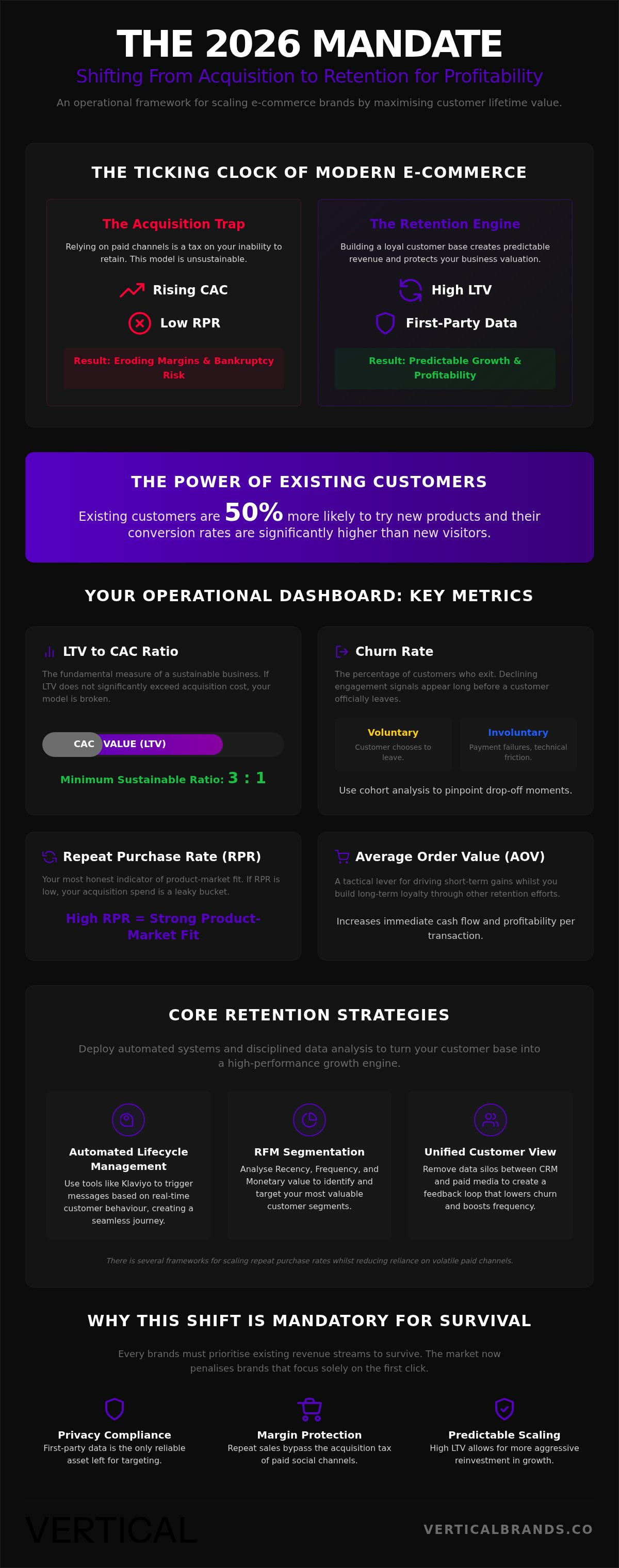
Acquisition is no longer a growth strategy; it is a tax on your inability to keep customers. In the 2026 market, relying on paid channels to fuel growth is a recipe for bankruptcy. Every pound spent on acquisition are wasted without a robust retention loop. You already know that the current trajecto...

Acquisition is no longer a growth strategy; it is a tax on your inability to keep customers. In the 2026 market, relying on paid channels to fuel growth is a recipe for bankruptcy. Every pound spent on acquisition are wasted without a robust retention loop. You already know that the current trajectory of rising CAC is unsustainable. Fragmented data across platforms and low repeat purchase rates are eroding your margins whilst your competitors scale through operational precision. The data shows that most brand's don't understand how to bridge the gap between traffic and loyalty. Effective customer retention marketing strategies are the only way forward.
This guide delivers the operational frameworks and data-driven tactics required to maximise customer lifetime value and eliminate churn. We will explore frameworks that move beyond simple loyalty programmes. You'll gain a clear roadmap for scaling LTV and reducing your reliance on constant new customer acquisition. Discover how to build predictable revenue growth through Klaviyo and disciplined CRM management. It is time to turn your customer base into a high-performance engine for profitability.
Key Takeaways
• Shift focus from acquisition to retention to stabilise brand valuation. Every brands must prioritise existing revenue streams to survive.
• Master the mechanics of LTV and churn for operational stability. Data accuracy is non-negotiable for driving predictable growth.
• Deploy automated CRM flows and RFM segmentation to reduce costs. Existing customers are 50 per cent more likely to trial new products.
• Execute sophisticated customer retention marketing strategies by integrating Klaviyo with paid media for a unified customer view.
• There is several frameworks for scaling repeat purchase rates whilst reducing reliance on volatile and expensive paid channels.
Defining Customer Retention Marketing in the 2026 E-commerce Landscape
Retention marketing is not a passive loyalty programme. It is a strategic mandate for driving repeat revenue. In the 2026 e-commerce environment, every brands needs to understand that retention is the primary driver of business valuation. Investors no longer value growth at all costs through inefficient acquisition. They value predictable, recurring revenue from a stable customer base. This requires a transition from broad broadcasting to precision-based behavioural targeting. You are no longer shouting at a crowd. You are whispering to an individual based on their specific purchase history and browsing patterns.
This shift is central to the e-commerce growth stages framework. At scale, retention becomes the engine of profitability. Without it, your margins are consumed by platform fees and rising ad costs. You must move from chasing the next customer to maximising the one you already have. This is not about sentiment. It is about the cold mechanics of unit economics. If your LTV does not significantly exceed your CAC, your business is a ticking clock.
The Shift from Acquisition to Retention
The 2026 market penalises brands that focus solely on the first click. Acquisition costs have spiked. Privacy regulations have dismantled traditional tracking. This makes transactional buyers a liability. Successful operators focus on building brand advocates. These are customers who return without needing a new paid ad to find you. There is several reasons why this shift is mandatory for survival:
Privacy compliance
First-party data is the only reliable asset left for targeting.
Margin protection
Repeat sales bypass the acquisition tax of paid social channels.
Predictable scaling
High LTV allows for more aggressive reinvestment in growth.
Retention as an Operational Discipline
Retention is an operational discipline. It moves beyond simple email newsletters. It is about automated lifecycle management. This means using Klaviyo to trigger messages based on real-time behaviour. Structural alignment reduces friction. It ensures the customer journey is seamless from the first purchase to the tenth. A unified view of customer behaviour is essential for customer retention marketing strategies to succeed. You must remove the silos between your CRM and your performance media teams. When these functions align, you create a feedback loop that lowers churn and increases purchase frequency. It is a machine designed for growth. It requires technical precision and a commitment to data integrity.
Essential Metrics: Calculating LTV and Churn for Operational Stability
Metrics are the bedrock of performance. Without data, you are merely guessing. LTV represents the total revenue a customer generates over their entire relationship with your brand. Churn rate tracks the percentage of those who exit. Repeat Purchase Rate (RPR) is your most honest indicator of product-market fit. If RPR is low, your acquisition spend is a leaky bucket. Average Order Value (AOV) acts as a tactical lever. It drives short-term gains whilst you build long-term loyalty. The metrics is the only way to verify success in a competitive landscape.
The LTV to CAC Ratio
Sustainable scaling requires a 3 to 1 ratio at minimum. If your CAC is too high, you are essentially buying revenue at a loss. Identifying the point of diminishing returns in acquisition spend is critical. Once you hit this ceiling, every additional pound spent yields less return. Use your LTV data to inform your strategic digital growth advisory decisions. It dictates whether you should push for volume or protect your margins. Developing effective customer retention marketing strategies requires an obsession with these numbers.
Predicting and Preventing Churn
Churn is often predictable. Declining engagement signals appear long before a customer officially leaves. Monitor open rates, click-through rates, and login frequency. There is two types of churn to track. Voluntary churn occurs when a customer chooses to leave. Involuntary churn happens due to payment failures or technical friction. Cohort analysis allows you to see when customers typically drop off. Is it after the second purchase? At the six-month mark? Pinpointing these moments allows you to deploy customer retention marketing strategies with surgical precision. If you need a partner to audit your current data structures, our team provides comprehensive growth advisory services to align your metrics with your commercial goals.
The Cost Advantage: Why Retention Outperforms Acquisition in 2026
Acquisition is a sunk cost. Retention is an investment. Industry data indicates that acquiring a new customer is up to 7 times more expensive than retaining an existing one. This fiscal reality dictates that brands prioritising customer retention marketing strategies possess a significant competitive edge. Existing customers are 50 per cent more likely to try new products compared to first-time visitors. They also spend 33 per cent more on average per transaction. These numbers aren't just statistics. They are the building blocks of a sustainable cash flow. When you focus on the customers you already have, you build the financial foundation required for aggressive market expansion.
The Efficiency of CRM Channels
Email and SMS function as high-margin channels. Unlike paid search, where you pay for every click, CRM allows for direct access to your audience. This removes the middleman from the equation. Automated flows further enhance this efficiency by reducing manual labour. Once a flow is built, it operates autonomously. To maximise these returns, many brands require professional Klaviyo migration services to ensure their data architecture is sound. There is several ways that a clean migration reduces technical debt. It allows you to focus on strategy rather than fixing broken integrations. A well-organised CRM is the most valuable asset in your performance marketing stack.
Compounding Revenue Growth
Small improvements in retention yield massive dividends. Research shows that a 5 per cent increase in customer retention can boost profits by 25 per cent. This compounding effect is the result of reducing the payback period on your initial CAC. When a customer buys a second and third time, the original acquisition cost is amortised across multiple transactions. High-growth brands don't treat retention as an afterthought. They prioritise it within their performance framework to ensure every acquisition dollar works harder. Every brands should be looking at their retention data as the primary indicator of future profitability. It is the only way to scale without being entirely dependent on the whims of ad platform algorithms. By reducing the reliance on constant new acquisition, you create a more predictable and resilient business model.
Strategic Implementation: Practical Retention Tactics for E-commerce Scaling
Execution is where strategy meets reality. Scaling requires a shift from manual campaigns to automated logic. Effective customer retention marketing strategies are built on RFM data. This involves categorising customers based on Recency, Frequency, and Monetary value. High-value segments deserve a tiered loyalty structure. This rewards specific behaviours rather than just transactions. Use UGC content to maintain authenticity amongst your existing base. It reinforces the community aspect of your brand. Every brands must move away from generic discounts to protect their margins. There is several tactics that drive immediate impact without increasing your overheads.
Automated Lifecycle Flows
Automated lifecycle flows remove the burden of manual execution. The post-purchase thank you is critical. It builds trust immediately after the sale. You must confirm the customer made the right choice. Replenishment reminders are essential for consumable products. They ensure you capture the next order before a competitor does. Win-back sequences are designed to reactivate lapsed buyers. The data suggest that timing is more important than the discount offered. You need to reach the customer exactly when their interest begins to fade.
Personalisation at Scale
Personalisation is no longer optional. It is a baseline expectation for the modern consumer. Dynamic product recommendations should be based on past purchase history. This ensures relevance across every touchpoint. Tailoring content for specific niches is equally vital. For example, growth marketing for beauty brands requires a different tone than high-end electronics. Use zero-party data from quizzes to refine your customer profiles. This allows for surgical precision in your messaging. You are no longer guessing what they want. You are responding to what they told you. If your current setup lacks this level of automation, our team provides the Klaviyo email marketing expertise needed to transform your retention engine into a profit centre.
Building a Unified Retention Infrastructure with Vertical Brands
Retention is not a single tool. It is an integrated ecosystem. Most brands fail because they treat CRM as a silo. True growth requires structural alignment. You must connect your data points across every channel. This is how you execute sophisticated customer retention marketing strategies. It is about removing friction at every level. Continuous optimisation is the only path to sustainable scaling. You test. You learn. You scale. Operational reality dictates that software alone is never the solution. You need a disciplined framework to drive progress. Every brands must move beyond surface-level tactics to build a resilient business model.
CRM and Paid Media Synergy
Aligning your paid social management with your CRM data is the ultimate performance lever. You can use Klaviyo lists to create high-value lookalike audiences on Meta. This ensures your acquisition spend targets users with the highest potential LTV. Excluding recent purchasers from acquisition ads saves significant budget. Why pay to reach someone who just bought? Instead, retarget existing customers with exclusive UGC-led offers. This reinforces their decision and drives immediate repeat revenue. The synergy between these channels reduces your total blended CAC. It creates a seamless loop where acquisition feeds retention and retention informs acquisition.
Executing the Strategic Blueprint
Vertical Brands focuses on performance-driven results. We don't care about vanity metrics. We care about your bottom line. Technical integrity is the foundation of any successful CRM setup. If your data is broken, your strategy will fail. There is many ways to audit your current retention infrastructure. You need to identify where the leaks are. Strategic advisory removes the operational friction that prevents you from scaling. It is time to stop guessing and start executing with precision. Auditing your current setup is the first step toward building a machine that generates predictable revenue. We provide the expertise required to ensure your retention infrastructure is both robust and scalable. You need a partner who values efficiency over ceremony.
Securing Your Profitability Engine
The transition toward retention is a structural mandate for 2026. You've seen how LTV data must dictate your strategic decisions and how automated flows eliminate manual inefficiency. Aligning your performance media with your CRM is the only way to lower blended CAC whilst protecting your margins. Implementing advanced customer retention marketing strategies ensures your brand remains resilient against market volatility. There is no room for passive management in a high-stakes environment. Every brands must prioritise the mechanics of repeat purchase rates to survive. There is several frameworks that allow you to turn your existing database into a predictable revenue stream. Our team of Klaviyo specialists are ready to provide direct growth advisory and performance-driven results. It's time to build a machine that scales without friction. Success is a matter of disciplined execution and structural integrity. You have the tools to dominate your sector.
Scale your e-commerce brand with Vertical Brands
Frequently Asked Questions
What is the most effective customer retention marketing strategy for 2026?
The most effective strategy is automated lifecycle management integrated with real-time behavioural data. You must use specific triggers to send the right message at the right moment. This removes the manual labour often associated with campaign management. Effective customer retention marketing strategies rely on these automated loops to drive consistent repeat revenue. It is about operational precision rather than volume. You need a system that works autonomously to maintain growth.
How do I calculate customer lifetime value for an e-commerce brand?
You calculate LTV by multiplying your average order value by the purchase frequency and then by the average customer lifespan. This provides a clear view of the total revenue a customer generates over time. Most brands don't understand their numbers well enough to scale effectively. Without this metric, your acquisition spend is a blind investment. It is the bedrock of operational stability for any national UK brand.
Can Klaviyo help with customer retention automation?
Klaviyo is the primary engine for retention automation in high-growth e-commerce brands. It allows you to build sophisticated flows based on specific customer actions like purchase history or site browsing. You can segment your audience with surgical precision using first-party data. This ensures your messaging is always relevant and timely. There is no better tool for executing a data-driven CRM strategy that drives measurable growth and revenue.
What is a good customer retention rate for fashion and beauty brands?
Fashion brands typically aim for a retention rate between 20 and 30 per cent. Beauty brands often see higher rates, usually between 25 and 35 per cent, due to the consumable nature of their products. These benchmarks vary depending on your specific niche and price point. You should focus on improving your own baseline rather than just chasing industry averages. Consistent monitoring of these rates is essential for long-term health.
How does paid social contribute to customer retention?
Paid social contributes to retention through strategic retargeting of your existing customer base. You can use your CRM data to create custom audiences on platforms like Meta. This allows you to show exclusive offers or UGC content to people who have already bought from you. It keeps your brand top of mind without the high cost of cold acquisition. It is a powerful synergy for scaling your digital presence effectively.
What are the main causes of customer churn in e-commerce?
The main causes of churn include poor post-purchase communication and a lack of personalised engagement. If a customer feels like just another number, they will leave. Technical friction during the checkout or delivery process also drives people away. Every brands must remove every point of resistance in the customer journey. Churn is often a symptom of a broken operational framework that ignores the customer's actual needs and preferences.
Should I focus on acquisition or retention when scaling?
You must focus on both, but retention should be your priority foundation. A high retention rate provides the cash flow needed to fund aggressive acquisition. If you only focus on the first click, you will eventually hit a ceiling. Scaling requires a balanced approach where your CRM engine supports your paid media efforts. There is several reasons why this alignment is mandatory for long-term commercial success in a competitive market.
How do I use UGC content in my retention marketing?
Use UGC content to build authenticity in your post-purchase flows and retargeting ads. Real customer reviews and videos act as powerful social proof. They remind existing customers why they chose your brand in the first place. This content feels less like an ad and more like a personal recommendation. It is an essential component of modern customer retention marketing strategies that aim to build long-term loyalty and trust.

Other posts






















































Stay ahead with better decisions.
Get business insights today.
