Five Ad Creative Frameworks Marketers Can Match to Buyer Temperature

Ad creative frameworks are repeatable structures, like AIDA, PAS, BAB, Star-Story-Solution and ABCD for video, that organize a product benefit into a message someone will actually watch and act on. We recommend starting with those five, and for video specifically, following one rule above all others: open with a hook, weave the brand into the action rather than parking a logo on screen, and aim for at least two shots in the first five seconds.
TL;DR:
- Match frameworks to audience temperature: use AIDA or Star Story Solution for cold viewers, PAS or BAB for warm viewers, and FAB or 4P for hot prospects.
- Open video ads with movement, a face, or an unexpected visual, and use at least two shots in the first five seconds to earn attention.
- Compare cuts that reveal the brand by second two and second five, measuring recall against skip rate; early exposure may lift recall while increasing skips.
- Use 15 second cuts for a hook, proof, and call to action; 30 second cuts add a mini story, while 60 second cuts support a full narrative.
- Match metrics to goals: track reach and view through rate for awareness, click through rate and landing page time for consideration, and acquisition cost for conversions.
Table of Contents
- A quick catalog of proven ad creative frameworks
- Matching the framework to audience temperature and goal
- How video-first frameworks like ABCD earn attention in five seconds
- Templates you can paste straight into a creative brief
- Running a testing recipe that tells you which framework wins
- How we apply framework-driven creative at Vertical
- Three edits that rescue a weak creative brief
- Get a creative audit built around these frameworks
- FAQ
- Sources
A quick catalog of proven ad creative frameworks
Each framework solves a different problem. Picking the right one before you brief a shoot saves rework later.
- AIDA (Attention, Interest, Desire, Action): open with a pattern interrupt, build interest with a specific benefit, create desire with proof or scarcity, close with one clear action. Best for cold audiences on Meta or YouTube.
- PAS (Problem, Agitate, Solution): name the problem, intensify it with a relatable detail, then resolve it with your product. Best for pain-point products and retargeting.
- BAB (Before, After, Bridge): show the frustrating before state, the better after state, then position the product as the bridge. Works well for transformation-style offers.
- Star-Story-Solution: introduce a relatable character (the star), show a short story of struggle, then land on the solution. Suits TikTok and longer-form video.
- ABCD (Attract, Brand, Connect, Direct): a video-first structure built for skippable formats, covered in detail below.
These core structures, along with 4P and FAB, map consistently to audience temperature and platform fit, which makes briefing faster once you know which one you need.
Three short examples show how this plays out:
- A skincare feed ad using PAS: “Dull skin by 3pm? (Problem) Your cleanser might be stripping your barrier. (Agitate) Our formula restores it in 14 days. (Solution)”
- A fitness app video using AIDA: open on a transformation clip, state the specific result, show a testimonial-style proof point, end with “Start your free trial.”
- A kitchenware brand using Star-Story-Solution: a tired home cook burns dinner again, discovers the product mid-story, serves a perfect meal by the end.
To turn any benefit into a hook, state the result first and the mechanism second: “Fall asleep faster” beats “Our blend contains magnesium and L-theanine.”
Matching the framework to audience temperature and goal
The right framework depends less on creativity and more on where the viewer already stands. Cold audiences need context before they’ll trust a claim; hot audiences already want the product and just need a reason to act now.
- Cold audiences: use AIDA or Star-Story-Solution to build context and curiosity before asking for anything.
- Warm audiences: use PAS or BAB, since they already recognize the problem and need a reason to trust your solution.
- Hot audiences: use FAB (Feature, Advantage, Benefit) or 4P (Promise, Picture, Proof, Push) to close with specificity and urgency.
Before locking a framework, run through a short checklist: what footage or UGC do you already have, what’s the production budget, what’s the runtime limit for the platform, and what are the exact spec requirements (aspect ratio, caption safe zones, file size)? For additional support in scaling awareness, check out the best tools for rapid brand awareness. Walking through audience temperature first, then constraints, gives you a decision flow you can run in a ten-minute briefing meeting instead of a guessing exercise.
How video-first frameworks like ABCD earn attention in five seconds
Google’s ABCD framework (Attract, Brand, Connect, Direct) was built specifically for skippable video, and the data behind it is direct: ads that use tight framing, open with people on screen, and include at least two shots in the first five seconds attract more attention than static, single-shot openers.
- Attract: use movement, a face, or an unexpected visual in the opening frame.
- Brand: integrate your product or logo into the action rather than floating it over the footage.
- Connect: build an emotional or practical reason to keep watching.
- Direct: close with one unambiguous instruction.
The brand placement decision carries a real tradeoff. Unskippable Labs found that showing the brand early raises recall but can also raise skip rate, while humor and smiling characters in the first seconds correlate with stronger view-through and recall. Google’s own guidance confirms the same pattern: weaving brand cues into the action outperforms a static logo overlay.
Pro Tip: Test two cuts of the same ad, one with the brand visible by second two and one that delays it to second five, then compare skip rate against recall before you scale either.
Templates you can paste straight into a creative brief
A blueprint turns a vague brief into a shootable script. Three length-based templates cover most direct response use cases.
- 15-second cut: 0 to 3 seconds, hook with a bold claim or visual surprise; 3 to 10 seconds, connect with one proof point; 10 to 15 seconds, brand and CTA together.
- 30-second cut: 0 to 3 seconds, hook; 3 to 15 seconds, connect through a mini story or demo; 15 to 30 seconds, layer brand into the resolution, then direct.
- 60-second cut: 0 to 5 seconds, hook with two or more shots; 5 to 40 seconds, full Star-Story-Solution arc; 40 to 60 seconds, brand reinforcement and a specific CTA.
Add platform tweaks before final QC: burned-in captions for sound-off viewing, a thumbnail frame that reads on its own, correct aspect ratio for the placement, and a final check that the CTA text is legible on mobile.
Running a testing recipe that tells you which framework wins
Run framework-level A/B splits, framework A against framework B, with equal audience and budget, before you touch copy or talent. That order of operations surfaces which structure performs before you waste time polishing the wrong one.
- Awareness goals: prioritize view-through rate and reach.
- Consideration goals: prioritize click-through rate and time on landing page.
- Conversion goals: prioritize cost per acquisition and return on ad spend.
Hold and hook rates in the first few seconds are early predictors of downstream conversion performance, so a weak hook rate is a signal to stop early rather than wait for a full week of spend. For a deeper setup guide, see our creative testing framework.
How we apply framework-driven creative at Vertical
We combine creative, performance, and web development processes to brief, produce, and test frameworks efficiently.
- Start with a framework matched to audience temperature.
- Shoot multiple hook variants before committing to one edit.
- Read hook and hold data within days, not weeks, before scaling spend.
Pro Tip: Brief three hook variants for every concept, since the hook decides whether the rest of the structure ever gets seen.
Three edits that rescue a weak creative brief
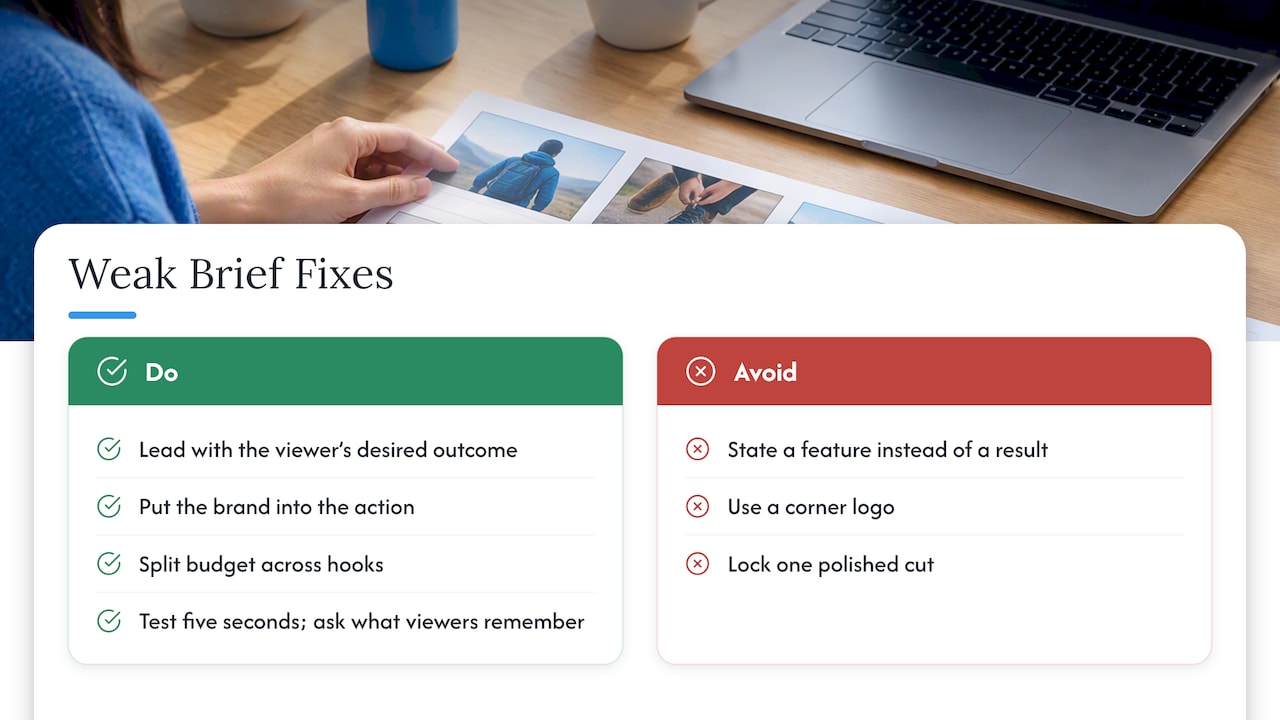
Most weak briefs share the same three gaps. First, the hook states a feature instead of a result, so sharpen it to the outcome the viewer wants. Second, the brand sits in a corner logo instead of inside the action, so write it into what the hands or the product are doing. Third, the brief asks for one polished cut instead of three testable variants, so split the budget across hooks before locking the edit.
A bland brief that says “show the product in use” becomes three testable concepts: one opening on a face, one opening on a before-and-after cut, one opening on a bold on-screen claim. Before sending any brief into production, run the five-second remember test: show someone the first five seconds only, then ask what they remember. If it isn’t the brand or the benefit, rework the open.
— Alex
Get a creative audit built around these frameworks
Choosing the right framework is only half the work. Getting it produced, tested, and scaled without losing weeks to back-and-forth between separate creative and media teams is where most in-house efforts stall. We handle creative design, media planning, and performance tracking as one connected service, so a framework decision turns into a shot list and a live test in the same week.
If you want a second pair of eyes on your current ad concepts, request a creative audit through our services page and we’ll walk through which frameworks fit your audience and goals before you spend another dollar on production.
FAQ
What is the best ad creative framework for beginners?
AIDA is the easiest starting point because its four steps (Attention, Interest, Desire, Action) map directly onto a simple video or feed ad structure. Pair it with PAS once you need to speak to an audience that already recognizes the problem you solve.
How many shots should a video ad have in the first five seconds?
Aim for at least two shots in the first five seconds, since Google’s ABCD framework ties this pattern to stronger attraction in skippable formats. A single static shot gives viewers less reason to keep watching.
Should the brand appear immediately in a video ad?
Showing the brand early tends to raise recall but can also raise skip rate, based on Unskippable Labs research. Weaving the brand into the action rather than displaying a static logo tends to balance both outcomes better.
Which metrics tell me a framework is working?
Match the metric to the goal: view-through rate and reach for awareness, click-through rate and time on landing page for consideration, and cost per acquisition or return on ad spend for conversion. Early hook and hold rates in the first seconds often predict how those later metrics will land.
Is a 15-second or 30-second video ad more effective?
It depends on the goal: some tests found 30-second cuts produced a higher view-through rate while 15-second cuts drove stronger ad recall in certain cases. Choosing length by objective and testing both variants beats committing to one length by default.
Sources
- A playbook for building effective creative on YouTube (ABCD)
- Ad copy frameworks reference (AIDA, PAS, BAB, etc.)
Running platform experiments or a brand lift study alongside these frameworks gives you a direct read on which structure moves your own audience, not just the average one.
Recommended

Other posts










































Stay ahead with better decisions.
Get business insights today.
