Brand Marketing ROI: Give Finance Proof They Can Audit

Brand marketing produces measurable, compounding ROI when you track it with a modern measurement stack: marketing mix modeling, incrementality testing, and brand lift studies working together. WARC, the IPA, and Think with Google all point to the same pattern: brand investment shows up first as a short-term sales uplift and later as pricing power and lower acquisition costs.
TL;DR:
- The IPA reports that 93% of campaigns with very large trust gains also produce at least one very large business effect, including sales or profit.
- Set a revenue, margin, or acquisition cost goal first, then choose a linked brand metric, target, data source, and reporting cadence before launch.
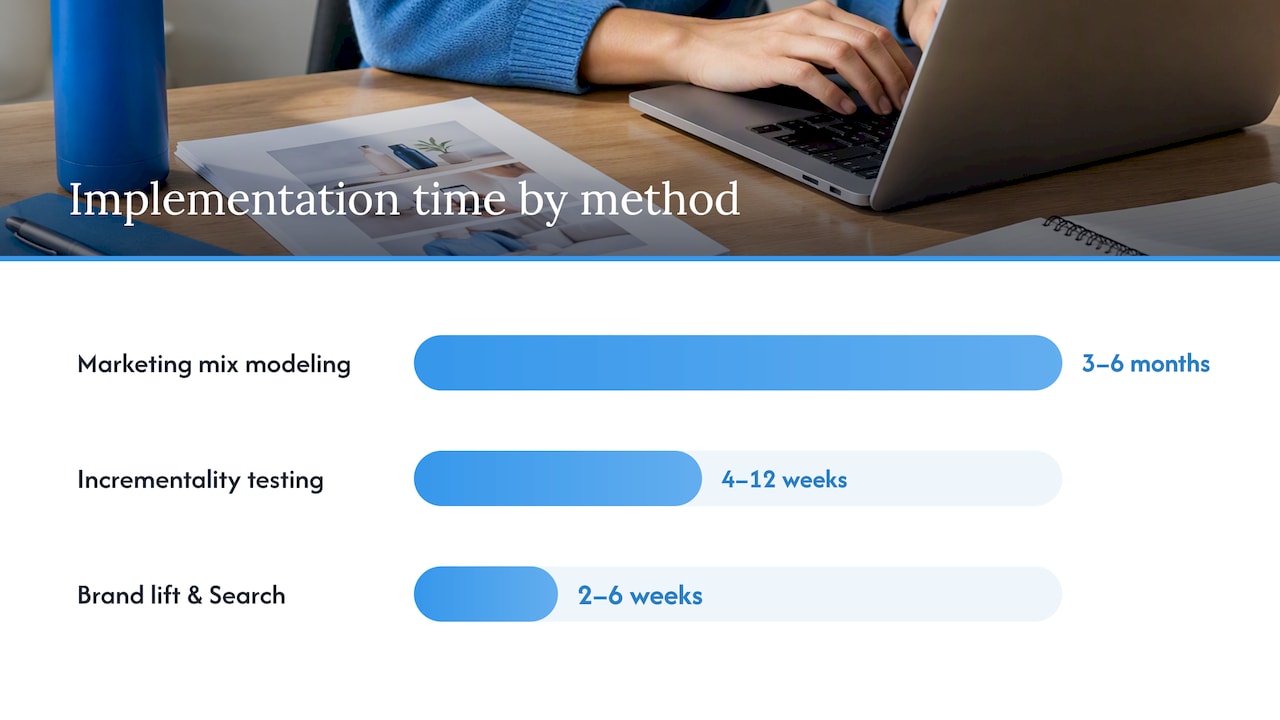
- Marketing mix modeling takes 3 to 6 months and needs two years minimum of spend and sales data; incrementality tests take 4 to 12 weeks.
- WARC recommends 50% to 60% of budgets for brand building; returns in months 5 to 24 can match those from the first four months.
Table of Contents
- Why brand ROI matters: the evidence behind the business case
- Set objectives and KPIs that map to revenue
- How to calculate brand ROI: MMM, incrementality, and brand lift
- Budgeting and timeframes: brand versus performance spend
- Reporting brand ROI in language finance will accept
- Practical toolkit: templates and a pilot protocol
- The next three years in proving brand ROI
- How we help you measure and scale brand ROI
- FAQ
- Sources
Why brand ROI matters: the evidence behind the business case
Finance teams want proof, not conviction, so the case for brand investment has to rest on something sturdier than intuition. The IPA’s analysis of trust-building campaigns gives that proof: campaigns that produce very large increases in brand trust are far more likely to generate very large business effects than campaigns that don’t, and that gap shows up directly in acquisition, sales volume, and profit.
WARC’s research on the “multiplier effect” adds the budget-allocation argument: businesses that integrate brand and performance spend, rather than treating them as separate budgets, see stronger compounding returns over time, with optimal allocations often skewing toward brand-building activity.
That evidence translates into three outcomes worth reporting:
- Pricing power: stronger brands can hold or raise prices without losing volume.
- Lower CAC: recognition and trust reduce the work performance media has to do.
- Market share resilience: trusted brands hold share better during downturns or competitive pressure.
93% of campaigns with very large trust increases also report at least one very large business effect, according to the IPA. That single figure is often enough to shift a skeptical finance conversation.
Set objectives and KPIs that map to revenue
Brand metrics only earn credibility with finance when they connect to a business outcome. The fix is an objective-first mapping exercise, done before you pick a single KPI.
- Name the business outcome first. Revenue growth, margin improvement, or reduced CAC, not “more awareness.”
- Choose the brand KPI that causally links to it. Awareness feeds consideration; consideration feeds conversion; trust feeds pricing power.
- Set a specific, time-bound target. A 5-point lift in unaided awareness within two quarters, for example, rather than an open-ended goal.
- Assign a data source and cadence to each KPI. Trackers, brand lift studies, and search data all run on different clocks.
Common brand KPIs and where the data comes from:
- Awareness and consideration: quarterly or continuous brand tracker surveys.
- Brand lift: campaign-level lift studies run during active media.
- Share of Search: monthly pulls from search platforms as a low-cost proxy for market share momentum.
- Net Promoter Score: customer surveys tied to CRM data for longitudinal tracking.
The Think with Google modern measurement playbook recommends pairing continuous brand trackers and campaign-level brand lift with Share of Search, then layering marketing mix modeling on top to connect those signals to revenue.
Pro Tip: Tie every brand KPI target to a dollar range before the campaign launches, even a rough one, so the post-campaign conversation starts with “did we hit it” instead of “what does this number mean.”
How to calculate brand ROI: MMM, incrementality, and brand lift
Three methods do the heavy lifting, and each answers a different question.
Marketing mix modeling, run in its nested or full-funnel form, uses historical spend, sales, and external variables to separate the contribution of each channel, including brand media, over a multi-year window. It needs at least two years of consistent spend and sales data, and its real value is capturing effects that a short attribution window misses, including the pricing power that longer-term custom models reveal but standard short-window models often don’t.
Incrementality experiments, run as holdouts, geo splits, or randomized tests, isolate cause and effect directly. WARC’s measurement research describes well-run incrementality tests as the most straightforward path to causal proof when you lack the history or budget for a full MMM.
Brand lift and Share of Search convert most cleanly into a revenue estimate.
| Method | Best use case | Time to implement | Data needs |
|---|---|---|---|
| Marketing mix modeling | Long-term, multi-channel budget allocation | 3 to 6 months | 2+ years of spend and sales data |
| Incrementality testing | Causal proof for a specific channel or campaign | 4 to 12 weeks | Holdout or geo-split capability |
| Brand lift and Share of Search | Fast directional read on awareness-to-revenue | 2 to 6 weeks | Tracker survey or search data access |
Our marketing mix modeling guide walks through the data requirements for teams building their first MMM.
Budgeting and timeframes: brand versus performance spend
Allocation guidance only works when it comes with a realistic timeline attached, because brand spend pays back on a different schedule than performance media.
- Start from the 40 to 60% range. WARC’s multiplier research finds optimal media budgets often allocate 50 to 60% to brand-building, with the remainder on performance activation.
- Plan for carryover, not instant payback. Effectiveness research shows marketing returns in months 5 through 24 often match the returns from the first four months, meaning a 90-day read understates total impact.
- Model marginal ROI before locking budgets. Use your MMM output to find the point where additional brand spend produces diminishing returns, then set next year’s budget just below that point.
A meta-analysis across hundreds of effectiveness studies finds that carryover into months 5 to 24 often matches the return generated in the initial months, indicating significant long-term effects, which is the single strongest argument against judging brand spend on a 30-day window.
Our guide to marketing budget allocation breaks the 40 to 60% range into channel-level examples.
Reporting brand ROI in language finance will accept
CFOs respond to a consistent structure, not a pile of dashboards. A simple template keeps every report comparable quarter over quarter: KPI measured, business impact, confidence level, recommended next action. A brand lift of 6 points, for example, maps to an estimated $2 million in incremental revenue, carries medium confidence because it’s based on a single geo test, and recommends scaling the test to two more markets before committing full budget.
Build the supporting dashboard around a small, consistent set of components:
- Branded search lift as a fast, low-cost leading indicator.
- MMM-attributed revenue by channel, updated quarterly.
- Incrementality test outcomes, reported as a range, not a single point estimate.
- Cost-per-lift-point, so finance can compare brand investment efficiency across campaigns.
Present uncertainty honestly: a range with a confidence level reads as more credible than a single number dressed up as precise. Our attribution models article covers why single-touch attribution tends to erode that credibility over time.
Practical toolkit: templates and a pilot protocol
We build brand ROI measurement by combining strategy, creative, performance media, and web development in one integrated team, which keeps the measurement plan and the execution plan in sync from the start. For FACEGYM, that integrated approach contributed to a 50% increase in purchases and a 41% rise in bookings, outcomes documented in our work examples.
A five-step pilot protocol gets a first incrementality test running inside a quarter:
- Pick one channel and one geography to hold out from brand spend for four to eight weeks.
- Set the KPI and target lift before launch, not after.
- Run the test while keeping all other variables stable.
- Compare test versus holdout using the same reporting template from the previous section.
- Scale what works into the next quarter’s full MMM inputs.
Pro Tip: Keep the pilot’s scope small enough that a null result costs you a few weeks, not a full budget cycle.
The next three years in proving brand ROI
Privacy-safe experiments, nested MMMs, and integrated brand-performance teams will stop being advanced practice and become the baseline expectation from finance. Teams that wait for perfect data will fall behind those running a causal test this quarter. The agencies and in-house teams that pair strategy, creative, and measurement under one roof will move through that cycle faster than those coordinating it across separate vendors.
— Alex
How we help you measure and scale brand ROI
We build brand ROI measurement the same way we build the campaigns themselves: strategy, creative, performance media, and measurement under one team, so the test design and the media plan are never working against each other.
A short list of where we typically start:
- Brand strategy to define the KPIs and targets finance will accept.
- Media planning to set the brand-to-performance split for your specific growth stage.
- Incrementality testing to produce a causal read within weeks, not quarters.
- Marketing mix modeling implementation once pilot results justify the investment.
Most engagements start with a short audit of your current measurement setup, move into a single pilot experiment, and scale into a full MMM once the pilot proves the approach. Review our services to see where a pilot could start for your team, or look at how a decision framework can help you document the hypothesis and confidence level behind your next measurement investment before you commit budget.
FAQ
What is a good ROI for marketing?
A good marketing ROI depends heavily on the channel, the business model, and the measurement window used, so there’s no single universal benchmark. Brand-building investment in particular tends to show weaker short-term ROI than performance media but stronger returns over the months 5 to 24 window, which is why judging it on a 30-day basis understates its real value.
Is a 2% ROI good?
A 2% ROI is low by most standards and would typically prompt a review of targeting, creative, or measurement methodology before concluding the investment failed. Context matters: a brand campaign measured only on immediate sales can show a low short-term figure while still building trust and pricing power that pay off later.
What is the 3-3-3 rule for marketing?
Definitions of the 3-3-3 rule vary across marketing sources, and no primary measurement authority we rely on defines it as a standard framework. Where it does appear, it generally refers to a content or campaign cadence rule rather than a brand ROI measurement method, so it’s worth confirming the specific definition with whoever introduced it to your team.
What is the 40-40-20 rule in marketing?
Like the 3-3-3 rule, the 40-40-20 rule is used differently depending on the source, most often describing a split between audience, offer, and creative as drivers of campaign performance. It is not part of the measurement frameworks referenced by WARC, the IPA, or Think with Google, so treat it as a rule of thumb rather than a validated model.
How long does it take to see brand marketing ROI?
Short-term sales uplift can appear within weeks of a brand campaign, but the larger share of the return builds over months 5 to 24, driven by pricing power, trust, and lower acquisition costs. A meta-analysis of effectiveness studies finds that carryover period often matches the return generated in the first four months.
Sources
- The Multiplier Effect: A CMO’s guide to brand building in the performance era | WARC
- IPA | Trust-building advertising delivers stronger business growth
- Modern measurement playbook | Think with Google
Recommended

Other posts






























































Stay ahead with better decisions.
Get business insights today.
