Scaling E-commerce Through Paid Social Creative Strategy: The Performance Case Study
Creative is no longer a subjective art form; it is a cold, hard operational discipline. Most brands treats creative as a secondary concern to technical media buying. This is a fatal error in 2026. You likely feel the pressure of rising Customer Acquisition Costs and the relentless cycle of creative...

Creative is no longer a subjective art form; it is a cold, hard operational discipline. Most brands treats creative as a secondary concern to technical media buying. This is a fatal error in 2026. You likely feel the pressure of rising Customer Acquisition Costs and the relentless cycle of creative fatigue. It is exhausting to maintain performance whilst consumer behaviour shifts and margins are squeezed by platform volatility. We understand the frustration of stagnant ROAS and the struggle to produce high-volume UGC that actually converts.
This guide reveals how a disciplined paid social creative strategy for e-commerce transforms underperforming accounts into high-growth engines. You will discover a predictable framework for scaling ad spend and reducing acquisition costs through rigorous, data-driven iteration. We will break down the exact mechanics of performance creative that aligns with your brand identity without sacrificing results. Neither the strategy nor the execution are effective in isolation; you need both to win.
Key Takeaways
• Adopt a disciplined paid social creative strategy for e-commerce to move beyond technical media buying and lower your CAC.
• Identify the precise structural differences between standard brand assets and performance creative that drives measurable growth.
• Implement a rigorous testing cadence to audit and iterate on winning assets whilst avoiding the pitfall of creative fatigue.
• The data suggest that this strategies works most effectively when combined with high-volume UGC content production.
• Most brand fails to integrate Klaviyo CRM data with paid social for a complete view of the customer journey.
The 2026 E-commerce Crisis: Why Creative Strategy is Your Only Lever
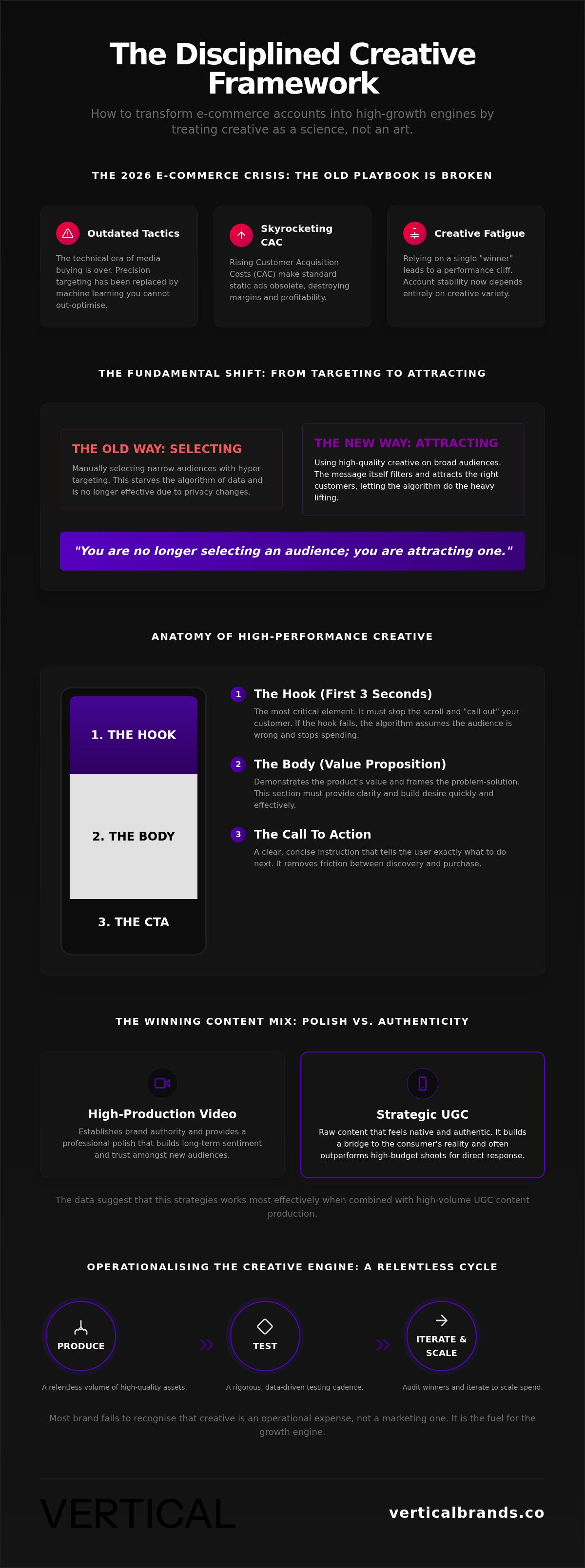
The technical era of media buying is over. Precision targeting has been replaced by machine learning. In 2026, you cannot out-optimise an algorithm that already knows your customer better than you do. The only remaining lever for growth is your message. A paid social creative strategy for e-commerce is defined as the systematic production of assets designed to trigger specific buyer behaviours. It is a fundamental shift from "hacking" the platform to "winning" with the message.
The data suggest that this strategies works well when targeting is broad. Algorithms now require more data, not less. Narrowing your audience only starves the machine. By providing high-quality creative, you allow the platform to find your buyers based on how they engage with your content. You aren't just buying space; you're buying attention. This requires a disciplined approach to asset production that most brands lack.
The Death of Hyper-Targeting
Privacy changes have dismantled the traditional tracking landscape. The move toward broad targeting is no longer optional. Your creative must now do the heavy lifting of audience segmentation. You are no longer selecting an audience; you are attracting one. This requires "calling out" your customer in the first three seconds of a video. If the hook fails, the algorithm assumes the audience is wrong. The machine stops spending on the wrong people only when your creative speaks to the right ones.
This evolution is central to the rise of social commerce, where the friction between discovery and purchase is eliminated. Your ads are the storefront. They must qualify the lead instantly through visual cues and specific messaging. If you don't speak directly to the pain point, the scroll continues. You must treat every asset as a filter for your traffic.
The Economic Reality of High-CAC Markets
Rising Customer Acquisition Costs (CAC) have made standard static ads obsolete. They simply do not have the shelf life required for scale. Account stability depends entirely on creative variety. If you rely on a single "winning" ad, you are one week away from a performance cliff. Creative fatigue is a silent killer of margins. It forces you to restart the learning phase constantly, which wastes budget and destroys momentum.
Scaling requires a relentless volume of high-quality assets. You must produce, test, and iterate without pause. This approach ensures that fatigue never takes hold of your account whilst you scale spend. For a deeper look at managing these pressures, read our guide on how to Improve e-commerce ROAS: Myth-busting the North Star Metric for 2026. Most brand fails to recognise that creative is an operational expense, not a marketing one. It is the fuel for the engine. Without a disciplined production cycle, your ad spend is merely a donation to the platform.
The Anatomy of High-Performance Creative: Beyond Aesthetic Appeal
Performance creative is not a beauty contest. It is a battle for attention. Many brands fail because they prioritise "pretty" over "profitable". Whilst brand creative focuses on long-term sentiment, a paid social creative strategy for e-commerce focuses on immediate action. Every brand need a mix of content to sustain growth. High-production video establishes authority, but raw content builds the bridge to the consumer's reality.
The psychological triggers driving clicks are simple but powerful. Visual contrast, social proof, and problem-solution framing are essential. You must disrupt the scroll with a pattern interrupt. This is why motion graphics must coexist with raw video. Motion graphics provide clarity and professional polish, whilst raw content provides the authenticity that modern consumers crave. Investing in professional UGC content production removes the friction of "looking like an ad" and starts looking like a recommendation from a peer.
The Power of Strategic UGC
Raw content often outperforms high-budget studio shoots because it mimics organic social behaviour. It feels native to the platform. To scale, you must structure your UGC with mathematical precision. Every asset requires a hook to stop the scroll, a body to demonstrate value, and a clear call to action. Without this structure, your content is just noise. Learn how to build UGC for paid social ads that actually scale to ensure your production efforts aren't wasted.
The Hook Rate and Hold Rate Framework
You cannot manage what you do not measure. Creative evaluation relies on two primary metrics: the Hook Rate and the Hold Rate. The Hook Rate measures the percentage of people who watched the first three seconds. If this is low, your visual disruptor failed. The Hold Rate measures how many of those people stayed to the end. If your Hook Rate is high but your Hold Rate is low, your message is the problem. Each of these creative types serve a purpose in diagnosing account health.
Developing assets that stop the scroll whilst maintaining brand integrity is a delicate balance. It requires constant testing of different angles and hooks. If an ad fails, you must know why. Is it the hook, the body, or the offer? A disciplined paid social creative strategy for e-commerce provides these answers through data, not intuition. It removes the guesswork from scaling and replaces it with a repeatable, operational cycle.
Operationalising the Creative Engine: Audit: Iterate: and Scale
Creative is an operational discipline. It is not a matter of artistic inspiration. Scaling requires a systematic approach to production and evaluation. A paid social creative strategy for e-commerce must include a rigorous audit process. You must deconstruct winning ads into their core components. Identify the specific hook, the visual style, and the offer that resonated. This system ensure that every pound spent is backed by data. Once you find a winner, you double down. You don't guess.
Maintaining a "creative bank" is essential for consistent delivery. This repository should house your highest-performing hooks, frames, and calls to action. It allows for rapid assembly of new assets without starting from scratch. Using search data to inform social creative provides a distinct omnichannel advantage. If a specific pain point is driving high-intent traffic on search engines, it should be the headline of your next ad. This alignment removes friction and creates a seamless experience for the consumer.
The Testing Methodology
Clean data requires standardised variables. You cannot test a new hook, a new visual, and a new offer simultaneously. Isolate the variable. We recommend testing hooks before investing in full-video production. It is a low-cost method to validate an angle before committing resources. Our "Winner-Takes-All" approach ensures that budget only flows to assets with proven efficiency. This prevents waste and focuses your spend on high-probability outcomes. Efficiency is the only goal.
Combating Creative Fatigue
Creative fatigue is a silent margin killer. It occurs when your audience has seen your ads too many times, leading to a sharp drop in engagement. Early warning signs include rising frequency and a declining CTR. The maths of creative frequency is simple. If your audience is seeing the same ad four times a week, they are tuning out. Most brand fails to rotate assets before the performance crash happens. You must rotate creative proactively to maintain account stability. For a deeper dive into account structure, read our guide on Paid Social Management: The Strategic Blueprint for Scaling D2C Brands. Consistent rotation is the price of scale.
The Case Study Blueprint: From Stagnation to 8-Figure Growth
Execution is where strategy meets reality. We recently worked with a UK brand that had plateaued at 6 figures. Their media buying was technically sound, but their creative was stagnant. Identifying the bottleneck in the current paid social creative strategy for e-commerce revealed a lack of hook variety. The brand was over-reliant on a single "hero" video that had reached its frequency limit. Scaling required a total structural overhaul of their production cycle.
Phase One: The Strategic Audit
We began by analysing historical data to find hidden patterns in customer behaviour. This audit revealed that consumers were clicking but not converting. There was a clear gap between current assets and market expectations. We established a baseline for hook rates, which were hovering around 15%. This was insufficient. We needed to hit 30% to make the unit economics work at scale. This phase ensured we weren't just guessing but solving a specific structural failure.
Phase Two: The Creative Execution
Scaling meant volume. We produced 50+ unique assets in 30 days to find a winner. This wasn't about luck; it was about testing 10 different hooks against 5 different bodies. We aligned influencer marketing with paid social goals to ensure the content felt authentic. This high-volume approach is the only way to beat creative fatigue in high-CAC markets. You can read more about our process for Professional UGC Content Production: The Strategic Reference for Brands.
Step 3 involved aligning ad creative with high-converting landing pages. If the ad promises a specific benefit, the landing page must validate it instantly. Friction occurs when the message shifts between the click and the purchase. The data suggest that this strategies works best when production is decoupled from media buying. Finally, we implemented continuous optimisation through rapid feedback loops. We audited performance every 72 hours. This allowed us to kill losers quickly and shift budget to winners. Our team provide the expertise required for scale. This methodology is how we drive 8-figure e-commerce growth for our partners.
Scaling Your Brand Without Burnout: The Vertical Brands Partnership
Vertical Brands is more than a service provider. We are a decisive driver of progress. Our team provide the expertise required for scale. Most agency fails because they operate in silos. They treat paid social and CRM as separate entities. This creates friction and lost revenue. A performance-first agency is the missing link in your growth strategy because we unify these channels. We remove the operational burden of high-volume production. This allows you to focus on product development and brand vision whilst we handle the mechanics of growth.
A robust paid social creative strategy for e-commerce requires a 360-degree view of the customer. We integrate Klaviyo CRM data to inform our creative decisions. This isn't just about ads; it's about the entire lifecycle. By removing the friction of creative production, we ensure your account never suffers from stagnation. You get high-quality performance creative that aligns with your brand identity without the internal resource drain.
CRM and Paid Social Synergy
Using email data to build high-converting social audiences is a competitive advantage. We analyse your best customers in Klaviyo and build lookalikes that actually convert. Aligning ad creative with automated email flows ensures a seamless experience. If a customer sees a specific UGC hook on Meta, they should see that same value proposition in their welcome flow. This alignment increases trust and reduces CAC. Read our guide on The Direct Guide to Klaviyo Migration for High-Growth Brands to see how we handle the technical foundation.
The Path to 8-Figure Revenue
Developing a long-term growth roadmap is essential for surviving market volatility. You cannot scale on a week-to-week basis. You need a disciplined tactician to navigate e-commerce complexity. Our growth advisory service provides the structural integrity required for 8-figure scaling. We move quickly from identifying a need to presenting a solution. There is no room for inefficiency in a high-stakes environment. We prioritise clarity and results over marketing pleasantries.
The data suggest that this strategies works best when production is professionalised. We handle the mechanics of success so you don't have to. Take the next step toward predictable growth and book a growth audit with Vertical Brands today. We will identify your bottlenecks and build the engine required for your next phase of scale.
Securing Your 8-Figure Future
Scaling in 2026 requires a fundamental shift from media buying hacks to operational excellence. You have now seen how a disciplined paid social creative strategy for e-commerce removes the friction of rising acquisition costs. Performance is no longer a happy accident. It is the direct result of high-volume UGC production and rigorous, data-driven iteration. Most brand fails because they lack the structural integrity to test and scale at the required pace. You don't have to be one of them.
The data suggest that this strategies works best when integrated with specialised Klaviyo CRM management. By aligning your retention efforts with your acquisition engine, you create a 360-degree view of sustainable growth. Vertical Brands specialises in 8-figure e-commerce scaling through direct-response UGC that actually converts. We are ready to act as your strategic guide and remove the complexity of execution. Scale your brand with a performance-first creative strategy and start winning with the message. Your next phase of growth is well within reach if you choose to lead with creative.
Frequently Asked Questions
What is a paid social creative strategy for e-commerce?
It is a systematic framework for producing and testing ad assets designed to trigger specific buyer behaviours. This isn't about making "pretty" videos; it's about using data to dictate production. A robust paid social creative strategy for e-commerce ensures that every asset serves a functional purpose in the funnel. It aligns brand identity with performance metrics to drive scalable growth whilst reducing the friction of manual media buying adjustments.
How often should I refresh my ad creative to avoid fatigue?
You should refresh assets whenever your frequency metrics spike and your click-through rates begin to drop. For high-spend accounts, this often means weekly iterations. Most brand fails to rotate creative before performance crashes. You need a consistent production cycle to ensure the algorithm always has fresh fuel. Monitoring the "first-time impression ratio" provides a clear signal of when your audience has reached a saturation point with specific visuals.
Why is UGC so effective for paid social ads in 2026?
UGC works because it mimics organic social behaviour and builds authentic trust amongst modern consumers. It removes the "ad-blindness" that plagues traditional studio content. By featuring real people in real environments, you lower the barrier to entry for new customers. This content type is particularly effective for social commerce, where the transition from discovery to purchase needs to feel seamless and peer-recommended rather than corporate and forced.
How do I measure the success of my creative strategy beyond ROAS?
Focus on leading indicators like Hook Rate, Hold Rate, and Cost Per Unique Add to Cart. These metrics tell you if your creative is actually stopping the scroll and engaging the viewer. ROAS is a lagging indicator that can be influenced by many external factors. By measuring how effectively an asset qualifies traffic, you gain a clearer view of its operational efficiency. Successful creative strategies focuses on these granular data points to guide future production.
Can I scale my e-commerce brand without a high creative budget?
Yes, scaling is possible by prioritising high-impact, low-production assets over expensive studio shoots. You don't need a massive budget; you need a disciplined testing cadence. Focus on "remixing" existing assets by changing hooks or background music to find new winners. The data suggest that this strategies works well even with smartphone-captured content. Efficiency comes from how you use the assets, not how much you spent on the initial production.
What is the difference between hook rate and hold rate?
Hook rate measures the percentage of people who watch the first three seconds of your ad. It evaluates the effectiveness of your visual disruptor. Hold rate measures how many of those viewers stay until the end of the video. If your hook rate is high but your hold rate is low, your message is likely failing to deliver on the initial promise. Both metrics are essential for diagnosing where a specific asset is losing potential customers.
How does Klaviyo integration improve my paid social performance?
Integrating Klaviyo allows you to use actual purchase behaviour to build high-converting seed audiences for Meta and Google. You can target your highest-value customers with specific creative whilst excluding recent purchasers to save budget. This synergy ensures that your paid social creative strategy for e-commerce is backed by first-party data. It creates a closed-loop system where your email retention data directly informs your acquisition strategy for maximum efficiency.
Is professional UGC production worth the investment for small brands?
Professional production is worth it because it removes the operational friction of managing multiple creators and editing cycles. Small brands often waste more money on failed ad spend than the cost of high-quality assets. A performance-first agency ensures that every piece of content is structured for conversion. This investment pays for itself by lowering your Customer Acquisition Costs and providing a predictable framework for scaling your spend without wasting budget on unproven visuals.

Other posts



























































Stay ahead with better decisions.
Get business insights today.
