Shopify Web Development Agency UK: Build for Growth in 2026
A polished Shopify storefront can still underperform when the customer journey, tracking and follow-up systems don’t work together. A Shopify web development agency UK businesses choose should plan for more than launch day. Commercial goals, customer needs and the systems that support the store all...

A polished Shopify storefront can still underperform when the customer journey, tracking and follow-up systems don’t work together. A Shopify web development agency UK businesses choose should plan for more than launch day. Commercial goals, customer needs and the systems that support the store all matter alongside visual design.
Before committing to development, define what needs to change and how the project will address it. This guide explains how to assess the decisions that shape a Shopify build, compare project approaches against your business requirements and turn a brief into a practical launch and improvement plan.
That means looking beyond page layouts to user experience, conversion rate optimisation and the links between your storefront, CRM and marketing activity. It also means accounting for platform changes. Shopify’s 26 August 2026 deadline for non-Plus stores to upgrade Thank You and Order Status pages to Checkout Extensibility has passed. Plan development around the current platform requirements, and make customer experience and retention part of the discussion from the outset.
Key Takeaways
• A Shopify web development agency UK businesses work with should align storefront decisions with customer experience and commercial goals, not just visual design.
• Assess whether a design refresh, focused improvements or a broader development project best fits your current business needs.
• Map the customer journey and agree the project scope before development begins, so testing and measurement have a clear focus.
• A clear project brief helps connect each stage, from objectives and journey mapping to launch and ongoing learning.
• Consider how website development can work alongside CRM, paid media, SEO and growth advisory to support a more joined-up e-commerce operation.
What a Shopify web development agency should solve beyond the storefront
A Shopify web development agency plans, builds or improves the experience customers have in a Shopify store. Its role is to connect the storefront’s design and structure with business objectives, from helping shoppers find relevant products to making the route to purchase clear. Shopify is an e-commerce platform with a wider set of tools and services, as outlined in this Shopify platform overview.
A new or improved storefront doesn’t, by itself, attract the right visitors or give customers a reason to return. Those outcomes also depend on marketing, customer relationship management and ongoing measurement. Account for these needs early, so the store supports the wider commercial system rather than treating launch as the finish line.
For a concise introduction to Shopify development, watch this video:
When does a Shopify business need development support?
Development support may be useful when launching a store, redesigning an existing one or changing how the business operates online. A growing catalogue, new customer journeys or evolving internal processes can all prompt a review of the storefront and its structure.
Start by identifying the friction customers encounter. Is the navigation clear? Do product pages answer the questions shoppers need to make a decision? Is the route to purchase straightforward? A cluttered layout may be the visible problem, but the cause could be an unclear information structure, too many confusing choices or a journey that lacks a clear next step. A Shopify web development agency UK businesses engage should investigate how the store looks and how it works.
What should a successful Shopify project achieve?
Set objectives before gathering visual preferences. Be specific about what the project needs to address, such as improving product discovery, making the purchase journey easier to follow or supporting operational requirements. Connect each priority to a customer need, then agree how you will assess progress.
A useful brief makes these decisions explicit. Which customer journeys matter most? What information helps someone choose a product? What should the checkout experience make clear? The answers guide design and development priorities and give the team a basis for testing after launch. The brief should also identify what the team needs to measure and learn as the store evolves.
A new design or technical build alone cannot guarantee better performance. Results depend on strategy, implementation and ongoing measurement working together. Keeping that distinction in view helps the project focus on business needs, not simply a refreshed appearance.
How Shopify development connects design, technology and e-commerce growth
A Shopify store is more than a set of pages. Design shapes how customers discover products and assess whether they meet their needs. Technology determines how the store is organised, how connected systems exchange information and how practical the store is to maintain. Shopify is described by Forbes as a subscription-based e-commerce platform, but commercial value depends on how the storefront is configured around the business and its customers.
Effective development connects these decisions. A clear store structure can help shoppers move from category to product information without losing context. Consistent design and predictable page behaviour make the experience feel coherent, while a considered technical scope supports the workflows behind it. A Shopify web development agency UK brands engage should connect user experience and conversion rate optimisation with the operational needs of the store, rather than treating design and technology as separate workstreams.
How do frontend decisions affect the customer journey?
Navigation, product information, mobile usability and checkout clarity shape the journey at each step. If categories are difficult to understand, shoppers may struggle to find the right item. If product details are incomplete or hard to scan, comparison becomes more difficult. If checkout feels disconnected from the rest of the site, customers may lose confidence.
Brand presentation should match page behaviour. Clear labels need to lead to the pages they promise, and product imagery and descriptions should set consistent expectations. These choices can reduce avoidable friction, but no design decision guarantees a conversion increase. Measure how customers use the experience and use those findings to guide improvements.
How should Shopify development connect with marketing systems?
Store journeys should align with CRM and email activity. For example, the information a customer sees on a product page can help inform relevant follow-up, while consistent messaging carries the experience from campaign to storefront. The Direct Guide to Klaviyo Migration for High-Growth Brands explores the email platform side of that relationship.
SEO also depends partly on how a store is organised. Categories, product pages and internal pathways need to make sense to people and search engines. Paid campaign landing pages should continue the promise made in the advert rather than sending visitors to a generic destination. Analytics should reflect the customer journey, so teams can interpret activity and identify where to investigate. These connections makes marketing and development decisions easier to assess together.
Core workstreams:
Experience
navigation, product discovery and purchase journeys.
Structure
store organisation, integrations and maintainability.
Measurement
analytics aligned with meaningful customer actions.
Growth alignment
CRM, email, SEO and paid campaign journeys.
For a joined-up approach, explore website design and development for e-commerce growth.
How to compare Shopify development approaches against your business needs
Choose a project scope by diagnosing the constraint, rather than assuming every issue calls for a rebuild. A design-led refresh, a focused improvement and a broader storefront project address different needs. The right option depends on what customers struggle with, what the business needs to change and which growth priorities matter now.
A redesign alone doesn’t guarantee stronger commercial performance. New visuals can improve presentation, but they won’t automatically resolve confusing navigation, operational bottlenecks or disconnected marketing journeys. A Shopify web development agency UK businesses consider should explain how the proposed work relates to customer experience and business objectives.
| Approach | Business need | Likely scope and operational impact | Measurement focus |
|---|---|---|---|
| Design-led refresh | The store feels dated or inconsistent, but its core structure still supports the business. | Refine visual presentation and key page experiences, with limited changes to wider operations. | Review customer responses to updated pages and the journeys they support. |
| Focused improvement | A specific issue, such as difficult product discovery or an unclear purchase journey, needs attention. | Improve the relevant pages or journey without expanding the project into a full rebuild. | Track relevant journey behaviour and assess whether the identified friction has changed. |
| Broader storefront development | Store structure, customer journeys or operational requirements need more substantial change. | Plan connected changes across the storefront and its supporting workflows. | Measure against agreed business objectives and review the wider customer experience. |
Which project scope fits your current Shopify challenges?
If one journey is creating friction, investigate that journey first. A focused improvement may be more appropriate than rebuilding pages that already serve customers well. Broader structural or operational needs can justify a more comprehensive scope, particularly when several parts of the storefront need to work differently together.
Vertical Brands provides website design and development focused on user experience and conversion rate optimisation. This means connecting proposed work to customer needs and clear priorities, rather than treating appearance as the only measure of success.
What signals a growth-aligned development approach?
Look for a plan that records requirements, explains key decisions and sets out how progress will be assessed. It should consider how the storefront supports CRM and marketing activity, as well as how its structure serves search visibility. These connections help teams understand what the project is meant to change and what to learn after launch.
The choice depends on the constraint the business needs to address. For a related perspective, read Performance Driven Web Design: Scaling E-commerce Revenue in 2026, which explores how design decisions relate to wider e-commerce priorities.
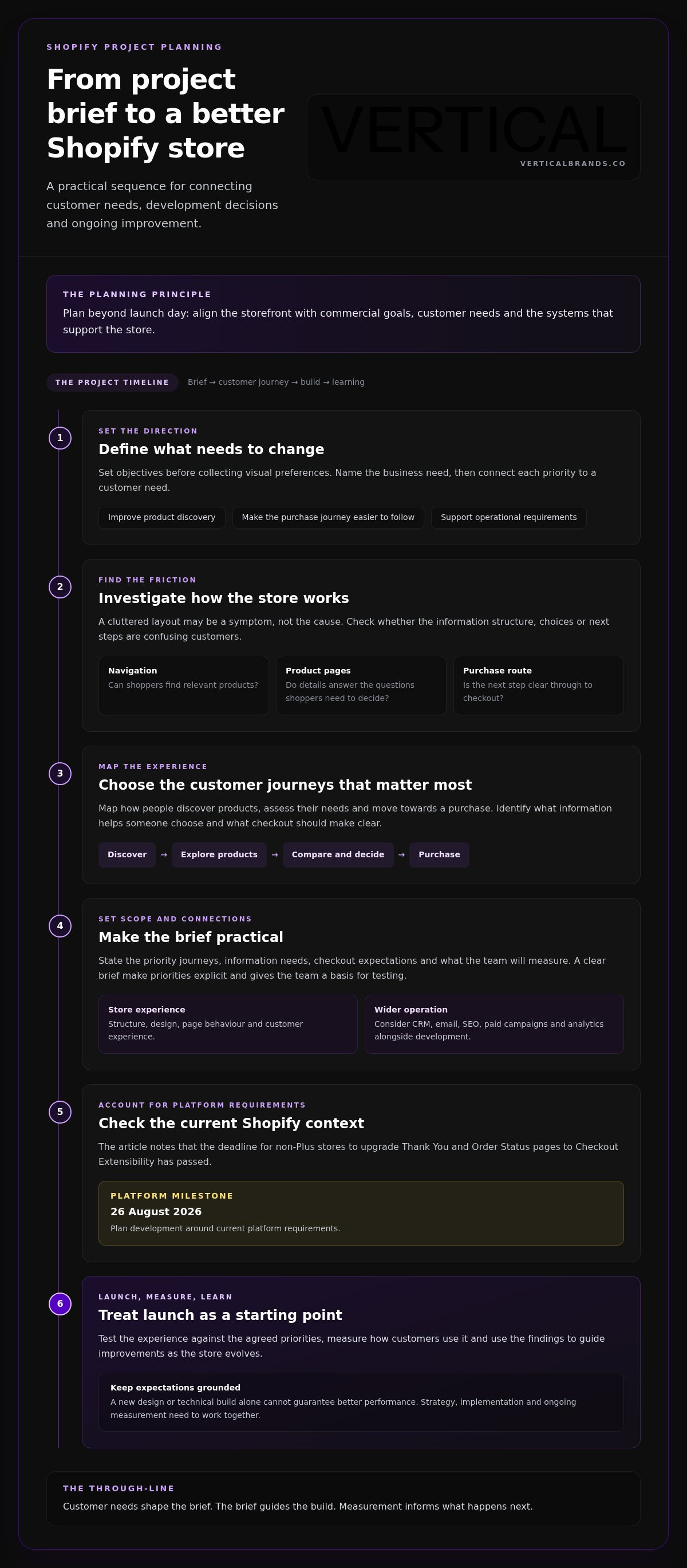
Planning a Shopify web project: brief to launch
A disciplined project moves from business need to a tested customer experience, then uses what the team learns to guide further improvements. For a Shopify web development agency UK businesses engage, the brief should make priorities, responsibilities and measures of progress clear before development begins.
What should a Shopify project brief include?
Record the commercial objectives, customer needs, current points of friction and operational requirements. Note essential integrations and dependencies, but focus on what they need to achieve instead of prescribing a technical solution too early. Agree how the team will assess progress, including what to review after launch.
A clear scope prevents avoidable ambiguity. It gives the team a shared reference for decisions, helps distinguish essential work from later enhancements and makes changes easier to manage during delivery.
From brief to launch: a practical sequence
1. Define objectives.
Decide what the project must support, such as improving product discovery or addressing a business process. Output: agreed objectives and measures.
2. Map customer journeys.
Identify key routes through the storefront and where customers encounter friction. Output: prioritised journeys and customer needs.
3. Agree scope.
Decide which pages, functions, integrations and operational requirements are essential for launch. Output: a documented project scope, dependencies and responsibilities.
4. Develop.
Build and review the agreed experience against the objectives. Output: a storefront ready for structured checks.
5. Test before release.
Check key functions, review content and test priority customer journeys. Resolve issues that could confuse shoppers or interrupt the intended experience. Output: a release-ready store and a record of outstanding items.
6. Launch and learn.
Monitor customer behaviour against the agreed measures, identify friction and prioritise follow-up work. Output: a prioritised improvement plan informed by observed performance.
What should happen before and after launch?
Before release, review the store as a customer would. Check that navigation and key links work, product information is clear, content is accurate and the purchase journey behaves as intended. Test the journeys mapped in the brief, not just whether individual pages load.
After launch, use the agreed measures to understand what customers do and where they encounter difficulty. Separate urgent issues from potential enhancements, then prioritise changes by business value and customer impact. Include search visibility in the plan. The guide E-commerce search engine optimisation: A Strategic Framework for Scaling in 2026 offers a related perspective on aligning SEO with e-commerce growth.
Use Vertical Brands’ website development support to connect project planning with user experience and conversion priorities.
How Vertical Brands aligns Shopify development with wider e-commerce growth
A Shopify build should support how a business attracts, serves and retains customers. Vertical Brands is a UK-wide digital growth consultancy that provides website design and development focused on user experience and conversion rate optimisation. For businesses assessing a Shopify web development agency UK-wide, the key question is how the storefront fits into the wider growth plan, not simply how it looks at launch.
Development is one connected part of e-commerce operations. Store structure and page journeys influence how customers discover and consider products. CRM and email activity can continue that experience after a visit, while paid media and SEO shape how people arrive. Growth advisory helps bring these priorities into a coherent commercial direction. The work should reflect business objectives, customer needs and project requirements, not a one-size-fits-all package.
Why connect Shopify development with CRM and performance marketing?
Customers should experience a clear thread from their first interaction through to follow-up. If paid activity promotes a particular product or offer, the landing experience should reflect that message and make the next step clear. If someone browses without purchasing, relevant CRM and email activity can support continued engagement. The customer journey and follow-up messages need to feel consistent, rather than like separate parts of the business.
SEO also benefits from a storefront that presents products and categories clearly. Development decisions can influence how customers move through those pages, while search and paid teams need destinations that match the intent behind a visit. Connecting these disciplines early helps teams make deliberate choices about content, page structure and measurement. It doesn’t guarantee a specific commercial result, but it gives the work a shared purpose and makes learning more useful.
Vertical Brands brings website design and development together with email marketing and CRM management, paid media, SEO and growth advisory. This allows businesses to consider storefront changes alongside the activity that brings customers to the site and supports ongoing relationships. The right mix depends on your objectives and current constraints.
What happens when you start a conversation with Vertical Brands?
Start with the business goal. Outline the customer journey challenges, what the current storefront needs to do differently and any operational requirements that shape the project. Include the wider growth activity the website needs to support, such as CRM, paid campaigns or search visibility.
From there, the discussion can focus on priorities, scope and how website work aligns with the wider growth plan. Bring the requirements together before deciding what the project needs to address first.
Explore website development with Vertical Brands and frame your project around business goals, customer experience and growth priorities.
Build your Shopify store around the next stage of growth
A strong Shopify project starts with business objectives, not a collection of visual preferences. Define the customer journeys that matter, identify where the current experience creates friction and choose a scope that addresses those needs. A focused improvement may be more effective than a complete rebuild when the challenge is specific.
Development also works best as part of a wider growth system. Store design and structure shape the customer experience, while CRM, paid media and SEO connect acquisition with ongoing engagement. Your objectives, customer journeys and operational needs shape a more useful brief when considered together.
Vertical Brands provides website design and development focused on user experience and conversion rate optimisation, alongside Klaviyo and CRM management, paid media, SEO and growth advisory. If you’re assessing a Shopify web development agency UK businesses can work with, start by aligning the project with your commercial priorities and the experience you want customers to have.
Discuss your Shopify development goals with Vertical Brands and take the next step towards a storefront built around your business needs.
Frequently Asked Questions
What does a Shopify web development agency do?
A Shopify web development agency plans, builds or improves Shopify storefront experiences around a business’s objectives. Its work can cover design, navigation, product journeys, technical structure and connections with other business systems. The aim is to make the storefront useful to customers and practical for the business to manage. Development is one part of growth, alongside the marketing and customer communications that bring people to the store and encourage ongoing engagement.
How do I choose a Shopify web development agency in the UK?
Choose an agency approach that connects the project scope to your business needs. A Shopify web development agency UK businesses work with should clarify objectives, customer journey challenges, essential integrations and how progress will be assessed. Consider whether the plan accounts for user experience and conversion priorities, as well as CRM, marketing and search visibility. A clear brief and agreed measures make it easier to assess decisions throughout the project and after launch.
How much does Shopify website development cost in the UK?
Shopify website development costs depend on the work involved, so there isn’t one figure that suits every project. A design refresh, a focused journey improvement and a broader storefront build have different requirements. Integrations, content needs and operational considerations can also affect scope. When reviewing a project plan, separate development work from ongoing platform and app costs, and make sure the proposed scope explains what is included and which priorities it addresses.
Can a Shopify development agency improve conversion rates?
A development agency can address elements of the customer experience that may create friction, such as unclear navigation, hard-to-assess product information or a confusing purchase journey. Website design and development focused on user experience and conversion rate optimisation can help identify and address these issues. However, no redesign guarantees higher conversion rates. Results depend on strategy, implementation and ongoing measurement, including how customers respond to changes.
How long does a Shopify website development project take?
Project duration depends on the agreed scope, the complexity of the work and how quickly decisions, content and other inputs are ready. A focused improvement has different demands from a new storefront or a wider development project. Integrations, review cycles and testing also affect the plan. Set priorities and responsibilities early, then agree a project schedule based on the actual requirements rather than relying on a generic estimate.
Does Shopify development include SEO and email marketing?
Not automatically. SEO and email marketing can be planned alongside website development, but the project scope should state what work is included. Store structure and landing experiences can support search visibility and paid campaigns, while CRM and email activity can extend customer communications beyond a visit. Vertical Brands offers website development alongside search engine optimisation, Klaviyo email marketing and CRM management, making it possible to align these areas within wider growth activity.
Is Shopify suitable for a growing e-commerce business?
Shopify may suit a growing e-commerce business when its platform, store structure and connected workflows align with the company’s needs. Assess how customers will find and evaluate products, what operational requirements the storefront must support and which integrations matter. Growth priorities can change, so consider how the store can be maintained and improved over time. The platform alone doesn’t create growth; strategy, customer experience and ongoing measurement also matter.

Other posts



























































Stay ahead with better decisions.
Get business insights today.
