Keep Discounts Under 25%: Product Bundling Strategy Protects Margin

Product bundling increases average order value and conversion when the items inside a bundle are genuinely complementary and the price is set to protect margin. The highest-leverage tactics to test first are mixed bundles, curated starter kits, and simple frequently bought together offers. Watch three numbers in the first few weeks: AOV lift, bundle attach rate, and margin per order.
TL;DR:
- Well-designed bundles that are genuinely complementary can increase average order value without harming margins if prices are set based on cost and value considerations.
- Measuring success requires tracking multiple KPIs, including contribution margin and return rates, to prevent cannibalization and hidden losses.
- Starting with mixed bundling offers the best low-risk option before investing in more complex tactics like build-your-own or personalized bundles.
- Bundles that pair used-together, non-interchangeable products significantly enhance the customer experience and can justify slightly deeper discounts.
- Analyzing existing co-purchase and co-view data helps identify high-potential bundle candidates with low fulfillment complexity for quick testing.
Table of Contents
- What product bundling is and why it works
- What bundling moves for your business: the benefits you should measure
- Tactical catalogue: the bundle strategies and when to use each
- Pricing and margin rules: how to set bundle prices without destroying profit
- How to discover and prioritize bundle candidates using your data
- Testing design and the KPI dashboard you need to judge success
- Copyable examples and bundle templates you can test this week
- Common mistakes and corrective actions
- Agency perspective: piloting and scaling bundle strategies
- What the research actually supports
- How Vertical can help implement profitable bundle strategies
- Sources
- FAQ
What product bundling is and why it works
Product bundling means packaging two or more items for sale at a single price, usually at a discount to the sum of their standalone prices. It differs from cross-selling, where a second item is suggested separately at checkout without being tied to a combined price. That distinction matters for how you build your pricing and your product pages, because a bundle needs one price, one product page treatment, and one inventory decision, while a cross-sell is just a suggestion layered onto an existing purchase.
Three mechanisms explain why bundling moves the needle:
- Perceived savings through anchoring: showing the standalone sum next to the bundle price gives customers a reference point that makes the bundle feel like a deal.
- Reduced decision fatigue: a curated set removes the work of choosing individual items, which shortens the path to purchase.
- Experiential framing: pairing products with moderate usage complementarity, meaning items used together but not identical in function, raises how experiential the purchase feels. Research in the Journal of Consumer Research found this effect across thirteen pre-registered experiments on product pairs with moderate complementarity.
Bundling tends to perform best with consumables that get used up and repurchased, routines where products are naturally used in sequence, and digital goods where marginal fulfillment cost is close to zero. A skincare brand selling a cleanser and a moisturizer together is leaning on routine. A software company bundling a core tool with an add-on module is leaning on near-zero incremental cost.
What bundling moves for your business: the benefits you should measure
Bundling is not a single metric win. It shifts several numbers at once, and some of those shifts can mislead you if you only look at the headline figure.
The primary KPIs to prioritize:
- Average order value (AOV): the clearest and fastest-moving signal after a bundle launch.
- Bundle attach rate: the share of orders that include the bundle versus standalone items.
- Revenue per visitor: a cleaner read than AOV alone, since it accounts for conversion changes too.
- Contribution margin per order: the number that tells you whether the AOV lift is actually profitable.
Bundling typically lifts per-transaction revenue by a noticeable margin when bundles are well-designed and genuinely complementary. That range gives you a benchmark for what a successful pilot should look like, though the figure depends heavily on category and discount depth.
Beyond revenue, bundling carries operational benefits that rarely show up in a dashboard. It helps clear slow-moving inventory by pairing it with a strong seller. It can improve retention when bundles are built around a routine, since customers who buy a full regimen tend to return for replenishment. And it simplifies choice architecture on the product page, which can reduce bounce on crowded catalogs.
The pitfalls sit in the same data you are celebrating. Cannibalization happens when customers who would have bought two full-price items instead buy the discounted bundle, which can make AOV look great while contribution margin quietly falls. Return rates also deserve scrutiny: a bundle with one weak item can drag the whole order into a return, costing more in reverse logistics than the discount ever saved.
Tactical catalogue: the bundle strategies and when to use each
Not every bundle type fits every catalog. Here is a practical rundown of the main approaches and where each one earns its place.
- Mixed bundling: customers can buy items individually or as a set, and the set carries a discount. This is the safest default because it does not force a purchase decision. The UX pattern that works best anchors the bundle price against the visible sum of standalone prices, so the saving is obvious rather than implied.
- Pure bundling: items are only available as a set, never individually. This suits digital goods and onboarding kits, where splitting the offer would confuse new customers or add negligible value on its own.
- Leader bundling: a flagship product is paired with a lower-margin add-on at a modest discount, used to upsell around a product customers already want. It works well when the add-on has low marginal cost and high perceived value.
- Build-your-own or mix-and-match: customers choose a set number of items from a defined pool at a flat bundle price. This needs more UX investment, since the interface has to clearly show what counts toward the bundle and what the running total looks like, but it converts well for categories like snacks, supplements, or apparel multipacks.
- Volume bundles and BOGO: buying three for the price of two, or a straightforward buy-one-get-one. To compute the effective discount, divide the total savings by the sum of standalone prices. A buy-two-get-one-free offer on a $20 item gives the customer $20 off $60, an effective discount of 33%, which sits above the usual sweet spot and should be reserved for clearing inventory rather than everyday pricing.
- Subscription or recurring bundles: a set of products delivered on a cadence, priced with lifetime value in mind rather than a single transaction. The discount can be slightly deeper than a one-off bundle because the business is trading margin for predictable repeat revenue.
- Dynamic or personalized bundles: offers assembled per visitor based on browsing or purchase history, usually requiring dedicated tooling. These are worth the investment once you have enough traffic and purchase data to justify building or buying a personalization layer. Personalized offers can outperform static groupings when there is enough data to support them, which makes this the right move for established catalogs, not new ones.
Pro Tip: Start with mixed bundling on your two best-selling complementary products before investing in build-your-own or dynamic tooling.
Pricing and margin rules: how to set bundle prices without destroying profit
Above 25%, you risk training customers to wait for discounts and compressing margin past what the bundle’s incremental volume can make up.
Before setting a price, work out four numbers: the standalone value of each item, the total variable cost of fulfilling the bundle, your target contribution margin, and the maximum discount the bundle can sustain while still hitting that margin.
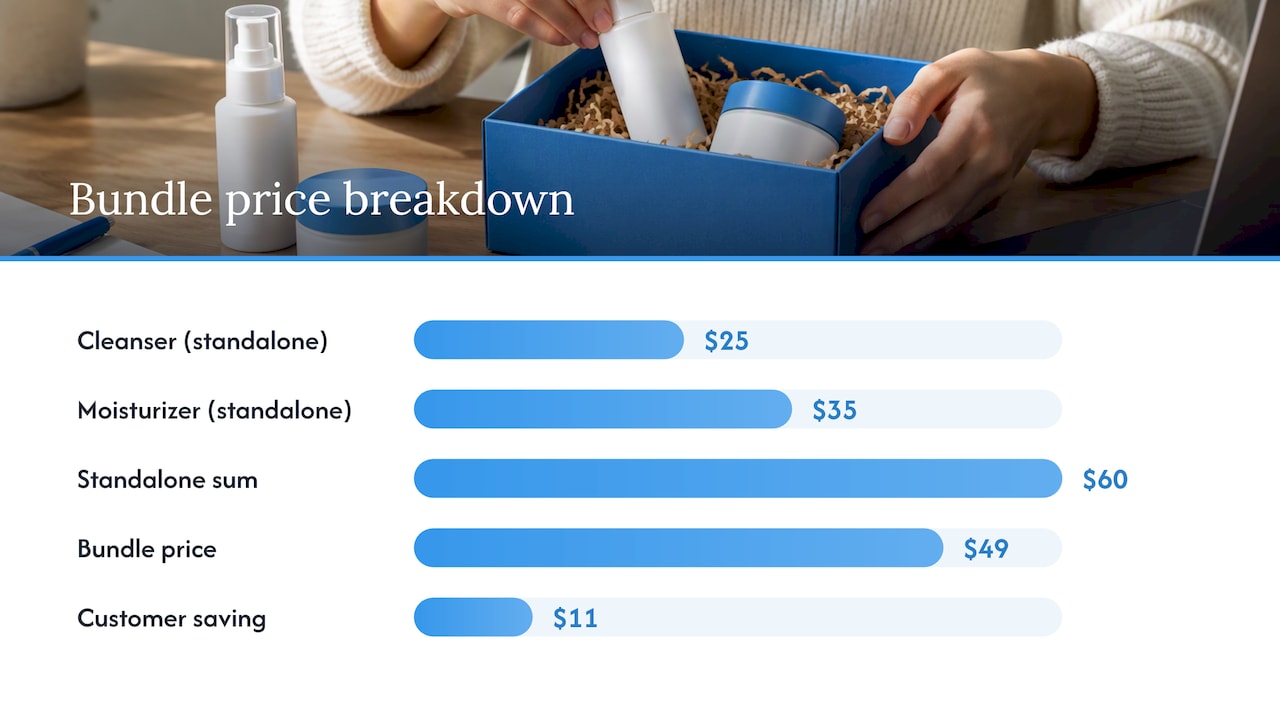
As a worked example, say a skincare bundle contains a cleanser priced at $25 and a moisturizer priced at $35, for a standalone sum of $60.
How you display the price matters as much as the number itself:
- Show the standalone sum (a visible compare-at price) alongside the bundle price, since this anchor consistently outperforms showing the bundle price alone.
- State the monetary saving, not just the percentage: “$60 value, yours for $49” tends to land better than “18% off” for most ecommerce bundles.
- Round the bundle price to a figure that feels deliberate, like $49 rather than $49.87, which reads as more considered than an arbitrary discount calculation.
Use percentage framing when the discount is small and the standalone prices are low, since a dollar figure can look unimpressive. Use monetary framing when the standalone sum is large enough that the dollar saving feels substantial on its own.
How to discover and prioritize bundle candidates using your data
The fastest way to find bundle candidates is to look at what customers already buy together. Pull co-purchase data from your order history and session co-view data from your analytics platform, then look for pairs that appear together well above their individual purchase frequency.
A practical workflow:
- Export order line items and group by order ID to find products that repeatedly appear in the same basket.
- Cross-check with session-level co-view data to catch pairs that get browsed together but not yet purchased together, which often signal an untapped bundle.
- Segment the analysis by new versus returning customers, since first-time buyers respond better to starter kits while returning customers respond better to replenishment and upgrade bundles.
- Run a qualitative sanity check: does pairing these two products make sense in actual use, and can your fulfillment process pack them together without added cost or breakage risk?
Score each candidate on a simple impact versus ease matrix: high co-purchase frequency and low fulfillment complexity goes to the top of your test queue, while high-impact pairs that need new packaging or sourcing get scheduled for later. Pairing qualitative customer feedback with this data, the kind collected through post-purchase surveys, helps confirm that a statistically strong pairing also makes sense to the people actually using the products.
Pro Tip: Treat any bundle candidate with a return rate above your category average as a packaging or pairing problem to fix before you scale it, not a reason to discount it further.
Testing design and the KPI dashboard you need to judge success
Treat every new bundle as a controlled test, not a permanent catalog decision, until the data backs it up.
- Randomize cohorts. Split traffic so one group sees the bundle offer and a control group sees the standalone products as usual, keeping the rest of the page experience identical.
- Set a minimum run time. Give the test enough duration to capture a full weekly purchase cycle, typically two to four weeks depending on your traffic volume, so day-of-week effects do not skew the read.
- Track the full dashboard, not one metric. Monitor AOV lift, bundle attach rate, revenue per visitor, contribution margin per order, cannibalization of standalone sales, and return rate together.
- Decide your roll-out criteria in advance. A bundle earns a permanent spot when it lifts contribution margin per order without a material rise in returns; anything short of that gets iterated on pricing or pairing before a second test.
- Watch for confounders. A concurrent site-wide sale, a new traffic source, or a seasonal spike can all distort your read, so log any external changes that happen during the test window.
Situating these metrics within your broader conversion funnel makes it easier to see whether a bundle is actually improving the checkout experience or just redistributing revenue that was coming in any way.
Copyable examples and bundle templates you can test this week
These templates are deliberately simple enough to launch without new tooling.
- Starter kit or regimen bundle: pick your three most commonly co-purchased routine items, price at an 18% to 20% discount off the standalone sum, and place it on the category landing page rather than burying it in a single product page.
- Anchor plus complement bundle: pair your best-selling flagship item with a lower-cost complement, and offer a small threshold upgrade, such as adding a third item for an extra few dollars, to nudge AOV higher without changing the core offer.
- Mix-and-match flow: let customers pick any three items from a defined set at a flat price, with a running counter in the cart so they always know how many selections remain.
- Frequently bought together placement: show this module directly under the add-to-cart button on the product page rather than lower on the page, since visibility at the decision point matters more than the exact wording of the offer.
Common mistakes and corrective actions
Most bundle failures trace back to a handful of repeatable errors.
- Over-discounting: set a margin floor before you launch, and test smaller discounts before jumping to the maximum of your 10% to 25% band.
- Hiding individual prices: always show the standalone sum next to the bundle price so the saving is visible, not assumed.
- Poor pairing: lean on co-purchase data and a basic usage check rather than intuition about what “should” go together.
- Too many bundles at once: launch one to three bundles per cycle so you can attribute performance clearly instead of diluting attention across a dozen offers.
- Ignoring fulfillment and returns: model the variable cost of packing and shipping a bundle before pricing it, since a bundle that is cheap to sell but expensive to fulfill erodes margin quietly.
Agency perspective: piloting and scaling bundle strategies
Running a bundle pilot well requires strategy, creative, and development working from the same brief rather than three separate vendors. Vertical structures pilots around a clear scope:
- A defined goal, such as AOV lift or inventory clearance, agreed before the pilot starts.
- A set timeline, typically a few weeks of live testing against the KPI dashboard above.
- Data inputs drawn from existing order history and session behavior rather than guesswork.
- Success criteria tied to contribution margin, not just revenue, before any bundle moves to a permanent catalog spot.
Client work shows what this looks like in practice: some clients have seen significant increases in purchases and bookings following growth engagements, illustrating the potential results of a well-scoped pilot.
What the research actually supports
The strongest evidence behind bundling is narrower than most advice suggests. The Journal of Consumer Research work on usage complementarity backs a specific claim: pairing items that are used together, but are not interchangeable, raises how experiential a purchase feels. It does not support throwing any two products together and calling it a bundle, which is the mistake most merchants make when they chase the AOV lift without checking the pairing logic first.
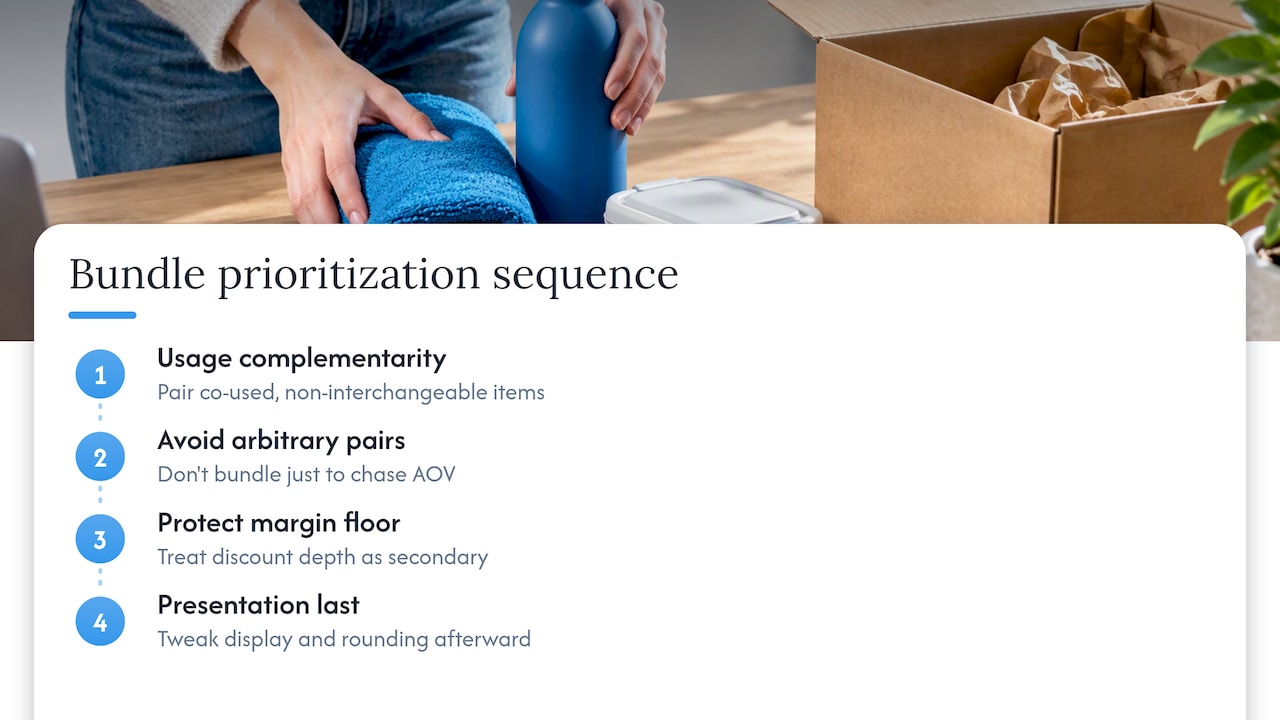
The overrated piece of conventional advice is discount depth. Plenty of guidance treats a bigger discount as a safer bet for conversion, but the margin floor matters more than the discount headline.
If you prioritize one thing, prioritize the pairing. Get the co-purchase data right, protect the margin floor, and only then spend time on presentation and rounding. The sequencing, more than any single tactic, is what separates a bundle that lifts revenue from one that just reshuffles it.
— Alex
How Vertical can help implement profitable bundle strategies
Building a bundle strategy that holds up under real margin pressure takes more than a pricing formula. It takes clean data analysis, product page work that presents the offer clearly, and a testing structure that tells you honestly whether a bundle is working.

Vertical’s eCommerce Management and Website Design & Development services cover exactly this work: pulling co-purchase data, building the bundle pricing model, and shipping the product page and checkout changes needed to test it properly.
- Scope a pilot built around your existing order data and a defined margin floor.
- Get the product page and cart UX built to present the bundle clearly, including the compare-at price.
- Track the full KPI dashboard through the test window and get a clear roll-out or iterate recommendation.
Visit the services page to see the full list of capabilities and request a project brief to start scoping a bundle pilot.
FAQ
What are the five product mix pricing strategies?
Definitions vary across sources, but common versions typically include product line pricing, optional feature pricing, captive product pricing, product bundle pricing, and by-product pricing. Each addresses how a business prices related items within its catalog rather than a single product in isolation.
What are the four types of product strategies?
Product strategy frameworks differ by source, so there is no single universal list of four. Rather than citing an unverified framework, focus on your actual bundling options covered above: mixed, pure, leader, and build-your-own bundling cover the practical range most ecommerce teams need.
What is an example of bundling?
A skincare starter kit that pairs a cleanser and a moisturizer at a combined price below buying each separately is a common example. A software add-on sold alongside a core subscription at a small discount is another, since both rely on complementary use rather than unrelated products.
What is the difference between cross-selling and bundling?
Bundling packages multiple items under one combined price, while cross-selling suggests an additional item as a separate purchase alongside the main one. A bundle is priced and merchandised as a single offer; a cross-sell leaves the pricing and purchase decision independent.
Recommended

Other posts

































































Stay ahead with better decisions.
Get business insights today.
