E-commerce Marketing Agency UK: How to Choose the Right Partner in 2026
The agency with the longest service list may be the wrong choice for your business. Choosing an e-commerce marketing agency UK brands can rely on means looking beyond the number of channels it offers. Consider how well its strategy fits your commercial priorities, team and stage of growth.Agency pro...

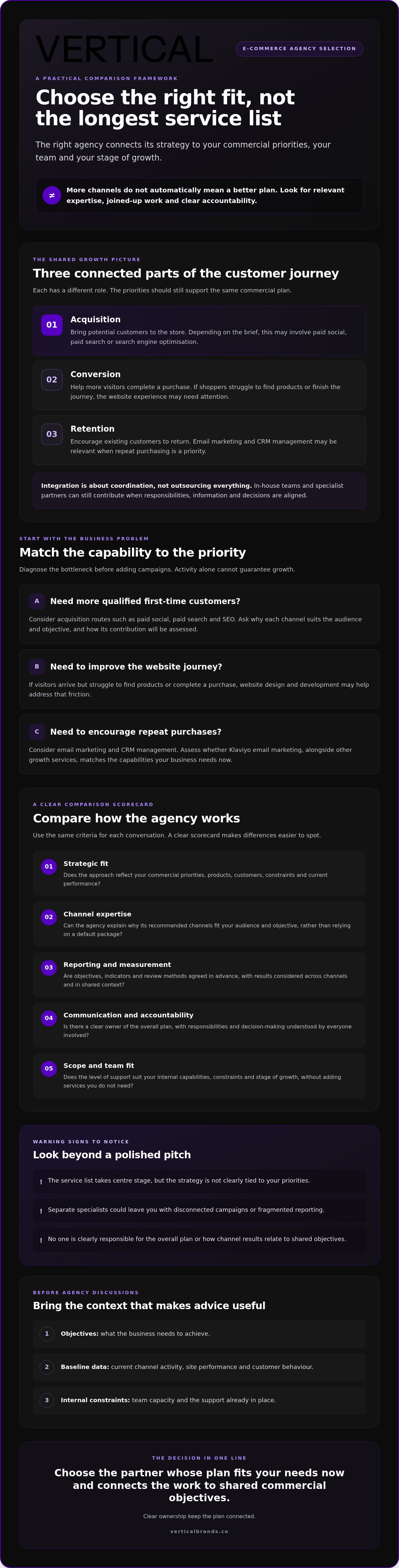
The agency with the longest service list may be the wrong choice for your business. Choosing an e-commerce marketing agency UK brands can rely on means looking beyond the number of channels it offers. Consider how well its strategy fits your commercial priorities, team and stage of growth.
Agency promises can sound remarkably similar. Separate specialists may also leave you with disconnected campaigns, fragmented reporting and no clear owner of the overall plan. Those problems can be easy to miss during a polished pitch, when service lists and headline claims take centre stage.
This guide gives you a practical framework for comparing strategic fit, channel expertise and accountability. You’ll learn how to identify the capabilities your business needs now, assess whether an agency can connect acquisition, retention and website experience, and ask sharper questions about measurement and decision-making. We’ll also cover warning signs of a poor fit and the steps to take before committing. The aim is a better-informed shortlist, built around sustainable growth rather than a bigger menu of services.
Key Takeaways
• Choose an e-commerce marketing agency UK partner by how well its approach fits your growth priorities, not by the length of its service list.
• Assess whether the agency can connect acquisition, conversion and retention to shared commercial objectives.
• Use a comparison framework to evaluate strategic fit, channel expertise, reporting, communication and scope. A clear scorecard makes differences easier to spot.
• Prepare objectives, baseline data and internal constraints before agency discussions to make recommendations more relevant.
• Consider whether Klaviyo email marketing and CRM management, alongside other growth services, match the capabilities your business needs now.
What should a UK e-commerce marketing agency actually do?
A capable e-commerce marketing agency UK businesses choose should do more than supply campaigns. It should connect commercial objectives to a clear plan, then coordinate the expertise and execution needed to advance those objectives. That starts with understanding the retailer’s products, customers, constraints and current performance, rather than recommending channels by default.
Acquisition brings potential customers to the store. Conversion focuses on helping more of those visitors complete a purchase. Retention encourages existing customers to return. Each has a different role, but the priorities should support the same commercial plan. The right channels and level of support depend on the retailer’s stage, internal capabilities and immediate constraints.
For a quick overview of the channels involved, see this guide to digital marketing. To compare how agencies describe their e-commerce services, watch the video below.
Which business problems can an e-commerce agency address?
Start by identifying the bottleneck. If customer acquisition is the priority, paid social, paid search and search engine optimisation can help a retailer reach potential customers through different routes. The agency should explain why a channel suits the audience and objective, and how its contribution will be assessed.
If repeat purchases are a priority, email marketing and CRM management can help a business plan communications around its customer relationships. If shoppers reach the site but struggle to find products or complete the journey, website design and development may help address that friction. For businesses seeking targeted technical support, specialists like Get Digital focus on search engine optimisation and website development to enhance both organic discoverability and on-site experience. The diagnosis matters: adding campaigns won’t fix every problem.
What does integrated marketing mean for an online retailer?
Integrated e-commerce marketing is coordinated planning across relevant channels, using shared objectives, customer insights and performance context to support the retailer’s commercial priorities. It doesn’t mean outsourcing every channel to one agency. An in-house team or specialist partners can still deliver parts of the plan, provided responsibilities, information and decision-making are aligned.
That coordination reduces the risk of separate specialists optimising for conflicting goals or reporting results without shared context. Acquisition, conversion and retention don’t operate in isolation. A useful plan recognises how they connect while staying realistic about the retailer’s resources and needs.
How should an e-commerce marketing agency connect strategy to execution?
Execution should follow diagnosis, not a pre-set channel package. Before recommending campaigns, an agency should understand the retailer’s commercial objectives and baseline: current channel activity, site performance, customer behaviour and internal capacity. That context helps distinguish a traffic problem from a conversion barrier or a retention opportunity.
Prioritisation should follow the brief. A retailer seeking more qualified first-time customers may focus on acquisition. If visitors arrive but few complete a purchase, the site journey may need attention before more traffic is added. If repeat purchasing is the priority, customer communications and retention work may take precedence. Channel priorities should be specific to the business, and activity alone can’t guarantee growth.
Agree on shared measures before work begins. Define the commercial objective, the indicators that will help assess progress and how results will be reviewed across channels. This reduces the risk of one specialist reporting increased traffic while another focuses on sales, without explaining how the figures relate. Measures should reflect what the business can reliably track and the decisions they’re intended to inform.
How do paid media, SEO and CRM work together?
Paid search and paid social can support acquisition by reaching potential customers through different routes. Search engine optimisation (SEO) is a distinct workstream, supporting discoverability over time rather than acting as a direct substitute for paid activity. Klaviyo email marketing and CRM management can support relevant customer communications and retention. These channels needn’t all be active at once. Their roles should make sense together, with shared context on audience, priorities and performance.
Retail conditions and customer expectations also shape the plan. GS1 UK’s overview of e-commerce in 2026 offers useful context for retailers considering how their marketing priorities fit wider developments. Use trends to inform questions, not as a reason to adopt a channel without a clear business case.
How can website work support marketing performance?
Website design and development may be relevant when the user experience creates friction. Check whether product information is clear, navigation supports product discovery and the purchase journey matches customer expectations. Then review campaign landing pages: a visitor responding to a specific offer should arrive somewhere that clearly reflects its message. Otherwise, the gap between advert and page can undermine the campaign’s intent.
Ask the agency to explain which problem a proposed website change addresses, how it connects to campaign activity and what evidence will guide its evaluation. For a related perspective, explore performance-driven web design and consider whether coordinated growth support across paid media, SEO, CRM and website development fits your needs.
How do you compare e-commerce marketing agencies beyond their service lists?
A long list of services doesn’t show whether an agency can lead the work, coordinate specialists or make decisions against your commercial priorities. Compare the operating model, not just the menu. Use the same criteria for each e-commerce marketing agency UK you’re considering, and ask for specific evidence rather than accepting broad claims about growth or performance.
The table below gives you a practical starting point. Score each area against your requirements, then note what evidence supports your assessment.
| Criteria | What to assess | Useful evidence or question |
|---|---|---|
| Strategic fit | Does the proposed approach reflect your objectives, stage and constraints? | Ask how the plan follows from your brief and baseline information. |
| Channel expertise | Is there relevant experience in the channels you need now? | Ask who will deliver each agreed workstream and how it connects to the others. |
| Reporting | Will reporting help you make decisions, not just review activity? | Ask which measures will be tracked and how they relate to your objectives. |
| Communication | Are account ownership, review points and recommendations clear? | Confirm who leads the relationship and how often progress is discussed. |
| Scope | Are responsibilities and exclusions understood by both sides? | Request a clear description of what the agency will do and what remains with your team. |
What questions should you ask before appointing an agency?
Get specific about ownership. Who leads the account, and who executes each workstream? How will priorities and reporting be reviewed? Ask what happens if early activity doesn’t support the agreed direction. A credible answer should explain how the team will investigate, communicate its findings and recommend a change, rather than defend activity simply because it was planned.
Which evidence makes an agency’s claims credible?
Ask for relevant examples, then establish their context: what work was included, what the client’s starting point was and whether the example can be shared with permission. Check that the reported measures match your objectives and business model. A traffic result may not answer a retailer’s question about repeat purchases. The clearest proof comes from examples with enough context to judge their relevance, not just impressive-sounding outcomes.
For a deeper look at evaluating performance-focused partners, consult a guide to choosing a performance marketing agency. Use its criteria alongside your own priorities. Strong comparisons make gaps visible before appointment, when you can still clarify responsibilities and test whether the proposed working relationship fits.
What should a UK e-commerce brand prepare before choosing an agency?
A focused brief helps an e-commerce marketing agency UK shortlist understand the business before proposing channels or activity. It also makes proposals easier to compare. Prepare the essentials first, then assess whether each agency’s recommendations fit your objectives, resources and current stage.
1. Define objectives.
State the commercial outcome you want to prioritise, such as acquiring customers, improving the purchase journey or encouraging repeat purchases. Clarify what success would mean for your business.
2. Gather baseline information.
Record current marketing activity, available performance reports and the sources used to produce them. Note any gaps or measurement limitations so an agency can distinguish known facts from assumptions.
3. Set constraints.
Document internal skills, available time, approval requirements, budget boundaries and operational dependencies. Flag unresolved issues that could affect delivery, such as changes to the website or delays in getting campaign materials approved.
4. Agree decision criteria.
Decide what matters most in your agency choice: strategic fit, channel expertise, reporting, communication, scope or team ownership. Use the same criteria to assess each proposal.
What information belongs in an agency brief?
Summarise your business objectives, priority audiences and the customer journey, from discovery through purchase and repeat engagement. List the channels you currently use, who manages them and what reporting is available. Include internal resources, approval processes and practical constraints. Be candid about what isn’t clear. A useful brief doesn’t need to make every issue look resolved.
How should you evaluate proposals and working arrangements?
Compare the proposed priorities against your brief, not the length or polish of the presentation. Ask who owns each workstream, who makes decisions and how recommendations will be discussed. Confirm the expected communication rhythm, what reporting you’ll receive and how either side can raise a concern. The information you gather also helps keep those conversations grounded in your actual operating conditions.
Consider your growth stage as well. A business establishing its first repeatable acquisition channels may need different support from a retailer refining an established mix. Use a relevant e-commerce growth stages framework to test whether the agency’s recommendations match your current needs, rather than assuming every brand should follow the same sequence.
Before appointing an e-commerce marketing agency UK partner, make sure the proposed scope reflects your priorities and clearly identifies what your team must provide. If coordinated support across Klaviyo email marketing and CRM management, paid media, SEO or website development fits your brief, explore Vertical Brands’ growth services.
When is Vertical Brands the right e-commerce marketing agency partner?
Vertical Brands may be a good fit if your priorities align with its services. Its specialism in Klaviyo email marketing and CRM management is particularly relevant to retailers focused on customer communication and retention. The wider service mix also includes paid social, paid search, search engine optimisation, website design and development, influencer marketing, UGC content and growth advisory.
That breadth can suit a brand looking to coordinate support across customer acquisition, retention and website experience. It doesn’t mean every service should be included. The right scope depends on your objectives, current channel responsibilities and internal capacity. A useful conversation should identify where external support fits and where your team or existing partners remain responsible.
Which growth priorities align with Vertical Brands’ services?
If repeat purchasing and customer communication are priorities, explore whether Klaviyo email marketing and CRM management match your requirements. For acquisition, discuss the role paid social, paid search or SEO could play in meeting your goals. If your brief includes website or content needs, ask how website design and development, influencer marketing or UGC content could support the plan. These priorities often sit alongside internal dependencies, so clarify what your team needs to contribute.
What should happen in the first agency conversation?
Bring a clear account of your objectives, current constraints and who manages each channel today. Explain what you want to change, what is working and where you lack reliable information. In return, ask the agency to clarify which services may fit, who would own the agreed work and how progress would be measured and reported.
Be direct about scope before making a commitment. Confirm what is included, what remains with your team and how recommendations will be reviewed. Ask how reporting connects to the objectives you’ve set, rather than relying on activity measures without context. A clear brief helps both sides identify unanswered questions before work begins.
Vertical Brands is a UK-wide digital growth consultancy. If its service mix appears relevant, use the conversation to test that fit rather than assuming every capability belongs in your plan. Discuss your objectives, existing responsibilities and measurement expectations, then establish whether the proposed scope is appropriate for your business.
Discuss your e-commerce growth objectives with Vertical Brands and assess whether its services align with your priorities.
Choose a partner built around your growth priorities
The right e-commerce marketing agency UK partner isn’t necessarily the one with the longest service list. Look for strategic fit, clear ownership and reporting that connects channel activity to your commercial objectives. Prepare your priorities, baseline information and constraints before comparing proposals, then check that the recommended scope reflects what your business needs now.
Vertical Brands may suit retailers seeking specialist Klaviyo email marketing and CRM management alongside capabilities across paid social, paid search, SEO and website development. Its UK-wide service coverage supports brands looking for coordinated growth support, without tying the choice to a specific location. The best fit still depends on your requirements, so clarify responsibilities, measurement and scope before making a decision.
Ready to assess whether the service mix fits your objectives? Discuss your e-commerce growth priorities with Vertical Brands. A clear conversation is a practical next step towards finding a partner that can support your plans.
Frequently Asked Questions
What does an e-commerce marketing agency do?
An e-commerce marketing agency plans and delivers marketing activity to support an online retailer’s business objectives. Depending on the agreed scope, this may include paid social, paid search, search engine optimisation, email and CRM management, website design and development, or content services. The work should start with the retailer’s priorities, not a standard channel package. Before appointing an agency, confirm who owns each activity, how progress is reported and what your team needs to provide.
How do I choose an e-commerce marketing agency in the UK?
Choose an e-commerce marketing agency UK businesses can assess by starting with the outcome you need, then comparing strategic fit, relevant channel expertise, reporting and team ownership. Give each agency the same brief. Ask who will lead and deliver the work, how priorities will be set and how progress will be reviewed. Compare the proposed approach against your objectives and operating constraints. A longer service list alone doesn’t show that an agency is the right partner.
How much does an e-commerce marketing agency charge?
Agency fees depend on the agreed scope, services, team involvement and working arrangement. There isn’t one figure that applies to every e-commerce business, so compare what each proposal includes rather than looking at the fee in isolation. Ask for a clear breakdown of responsibilities and deliverables, and check whether media or platform costs are separate. Before appointing an agency, confirm how changes to scope are discussed and how any additional work is agreed.
Can one agency manage SEO, paid media and email marketing?
Some agencies provide support across SEO, paid media and email marketing, but having several services available doesn’t ensure they’ll be coordinated. Ask how channel plans share objectives, customer insights and reporting, and who is responsible for aligning the work. You can also keep some expertise in-house or work with specialist partners. The right model depends on your priorities and internal capabilities, with responsibilities made clear across everyone involved.
What should I ask an e-commerce marketing agency before signing?
Ask who will lead your account and deliver each workstream, how priorities are decided and what reporting you’ll receive. Clarify how often progress is reviewed, how recommendations are communicated and what your team must provide. Request relevant examples, then ask about their scope and context. Make sure responsibilities, working arrangements and expectations are documented before agreeing to proceed. Clear answers help you assess whether the proposed partnership fits your business.
How long does it take to see results from an e-commerce marketing agency?
Timing varies by channel, starting position, business context and the work agreed, so there’s no universal timeline. Ask the agency to distinguish early delivery indicators, such as whether agreed work is being implemented, from longer-term business measures. Agree when progress will be reviewed and what evidence will inform decisions. The review should focus on what the available data show, including whether priorities need to change, rather than relying on a guaranteed timeframe.
Is a specialist e-commerce agency better than a general digital marketing agency?
Not necessarily. A specialist may bring experience relevant to online retail, whilst a broader creative marketing agency, such as Indigo Collective Group, can suit a business seeking both strategic leadership and hands-on execution across channels. Assess the proposed team, working process and evidence of relevant experience rather than relying on the label. Ask how the agency will address your objectives, coordinate channels where needed and report progress. The best choice depends on your requirements and whether the partner’s approach fits your business.

Other posts






























































Stay ahead with better decisions.
Get business insights today.
