Fix Deliverability First: A Five Part B2B Cold Email System

A short, signal-based first email plus disciplined follow-ups and correctly configured sending infrastructure is the formula that drives results in B2B cold email. Authentication and warmup are not optional extras, they determine whether your message even reaches the inbox. Get the targeting, the copy, and the technical setup right together, and the templates and checklist below give you a starting structure to apply immediately.
TL;DR:
- Proper authentication with SPF, DKIM, and DMARC, along with consistent warmup, is essential to ensure cold emails reach the inbox and are not marked as spam.
- List accuracy and current signals like recent hires, funding announcements, or product launches significantly boost personalization effectiveness and response rates.
- Follow-up sequences should be spaced carefully, adding new proof or switching angles to maintain engagement and avoid repetition that feels like pressure.
- The success of a campaign hinges more on infrastructure, targeting, and deliverability than on copy or subject line tricks alone.
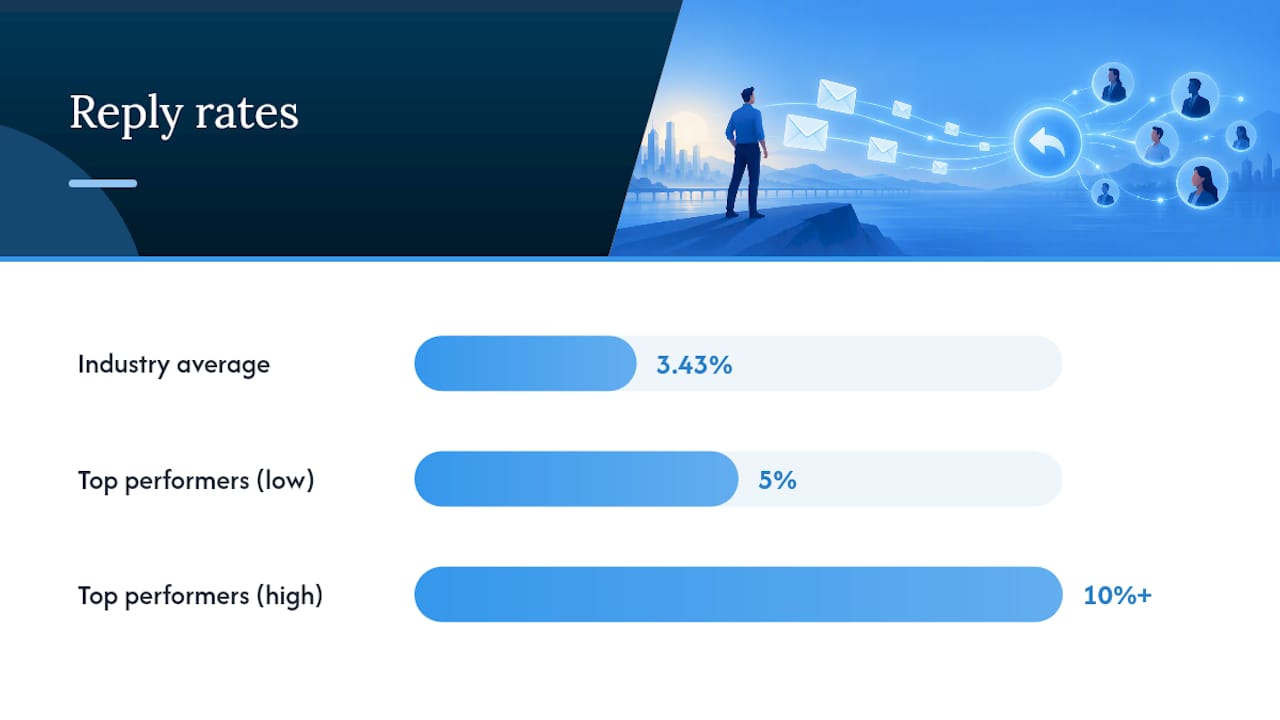
- Average reply rates hover around 3.43%, with top campaigns reaching 5% to 10%, but only when the technical setup and list quality are correctly managed.
Table of Contents
- Cold email templates you can adapt today
- A five-part framework for every cold email
- Getting your sending infrastructure right
- Building lists that support real personalization
- How to structure your follow-up sequence
- The benchmarks that tell you what to fix
- Why this system reflects what we do at Vertical
- What most cold email advice gets backward
- How Vertical can help you run cold email that performs
- Sources
- FAQ
Cold email templates you can adapt today
Templates work best as a starting structure, not a script. Each one below is built around a signal you substitute for the prospect in front of you, following the practical example format used across industry template libraries.
For high-value accounts, where you have researched the company and the person, lead with a specific observation:
- High-value first touch: Reference a recent funding round, product launch, or leadership change, then connect it to a concrete outcome you help similar companies achieve.
- Mid-value first touch: Use a role-based signal, such as a recent promotion or a job posting that signals a priority, paired with one line of social proof.
- Low-touch, higher-volume first touch: Keep the personalization to one accurate detail (industry, team size, tech stack) and let the value line carry more weight.
- Follow-up 1 (three to four days later): Add a new piece of proof, a case study or statistic the first email did not include.
- Follow-up 2 (five to seven days after that): Change the angle entirely, ask a different question, or send a brief break-up line that gives the reader an easy way to say no.
Subject lines carry more weight than most senders realize. Keep them between three and seven words, written the way a colleague would phrase them, not like a marketing headline. Since most B2B recipients read email on a phone first, your opening line needs to make sense with no images and minimal scrolling. Assume the first six or seven words are what gets read.
Pro Tip: Write your subject line last, after you know exactly what the body promises, so the two never feel disconnected.
Vendor libraries from Zendesk offer additional starting points if you want more variations to test against your own ICP.
A five-part framework for every cold email
Rather than reinventing structure for each campaign, use a repeatable five-part framework and adapt the details:
- Opener (signal): Open with something specific to the recipient, a hire, a launch, a role change, never a generic compliment.
- Reason or hypothesis: State briefly why you are reaching out to this person now, tied to the signal above.
- Value or outcome: Describe the outcome you help similar companies reach, in plain terms, not features.
- Proof: Include one credible data point, client result, or specific detail that supports the claim.
- Small ask: Close with a low-friction next step, a quick call, a reply with interest, not a 30-minute demo request.
A few micro-rules keep this framework honest. First-touch emails should run 75 to 125 words. Subject lines stay in the three to seven word range. Every line should read cleanly on a phone screen, since that is where most of your recipients will open it first.
Before you send anything, run it through a short approval checklist:
- Can you name the exact signal behind the opener, and is it current?
- Does every proof point something you can substantiate if asked?
- Does the ask match the size of the relationship you actually have?
Pro Tip: If you cannot point to the specific signal that inspired the opener, the email is not personalized, it is just formatted to look that way.
Good copy structure matters here the same way it does in other high-conversion formats, and the conversion copywriting principles that work for landing pages apply just as well to a first-touch subject line.
Getting your sending infrastructure right
Copy quality means little if your email never reaches the inbox. Authentication is the foundation:
- SPF tells receiving servers which mail servers are allowed to send on behalf of your domain.
- DKIM attaches a cryptographic signature to your emails, confirming the message was not altered in transit.
- DMARC tells receiving servers what to do when SPF or DKIM checks fail, and reports back on authentication results.
Gmail’s bulk-sender guidance requires all three for high-volume senders, along with consistent sending patterns and a working one-click unsubscribe. Unauthenticated mail is far more likely to get rejected or routed straight to spam.
Beyond authentication, use a dedicated sending domain for cold outreach rather than your primary business domain. This protects your main domain’s reputation if something goes wrong, and it gives you room to warm up new inboxes gradually before ramping to full volume. A typical warmup period runs several weeks, gradually increasing daily send volume while engagement (opens, replies) stays healthy, an approach echoed in operational guides on domain separation and warmup.
Cold email remains one of the most cost-effective B2B channels when the infrastructure behind it is correct. 2026 industry benchmarks put average reply rates around 3.43%, with top performers reaching 5% to 10% or higher, and infrastructure problems, not weak copy, explain most underperforming campaigns.
Monitor bounce rates and spam complaints closely. Gmail Postmaster Tools and similar monitoring dashboards flag reputation issues before they tank an entire domain.
Building lists that support real personalization
Personalization only works when the underlying list is accurate. Start by defining your ideal customer profile tightly: company size, industry, role, and the specific problem you solve. A smaller, well-researched list of 200 to 500 contacts per sequence will outperform a much larger list built on generic scraped data, because the tradeoff between personalization depth and volume is real and unavoidable.
Prioritize signals that are current and specific:
- Recent hires or promotions, which often signal new priorities or budget.
- Funding announcements, which suggest new spending capacity.
- Product launches, which create a natural reason to reach out.
- Role changes, which frequently come with a mandate to fix something.
Avoid signals that feel inserted rather than researched, like a mail-merge token pulling in a company name with no other context. That kind of personalization is easy to spot and tends to undermine trust rather than build it.
Data hygiene matters as much as targeting. Verify email addresses before sending, maintain suppression lists for unsubscribes and bounces, and pause any list segment where bounce rates climb past a few percentage points. A clean list protects both your reply rate and your domain reputation.
How to structure your follow-up sequence
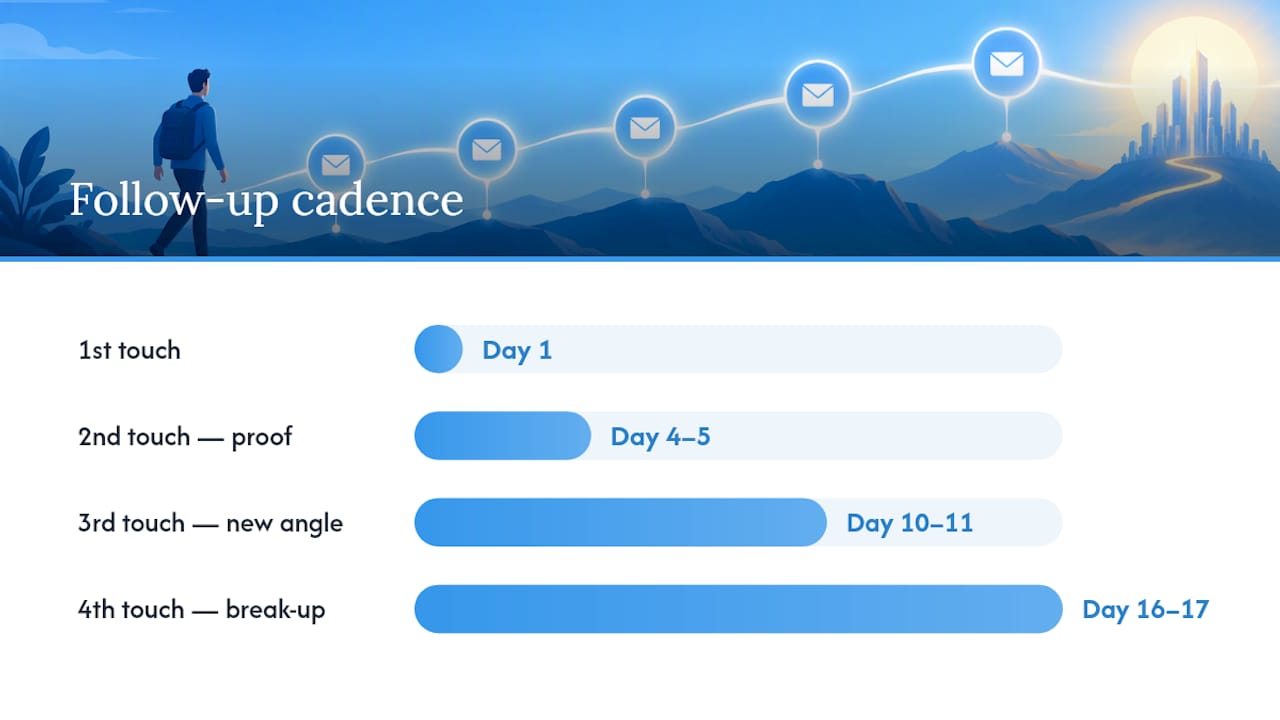
Most positive replies come from follow-ups, not the first email, which makes sequence design one of the highest-leverage parts of the whole campaign. A workable cadence looks like this:
- Day one: Send the signal-based first touch.
- Day four or five: Follow up with new proof, a case study or statistic the first email did not include.
- Day ten or eleven: Shift the angle entirely, ask a different question tied to a different pain point.
- Day sixteen or seventeen: Send a short break-up email that gives the reader a clean way to opt out or say “not now.”
Stop the sequence the moment you get a clear no, a bounce, or an out-of-office reply indicating a role change. Each touch should add something new rather than repeating the original pitch in different words, since a repeated message reads as pressure rather than genuine interest.
Route every reply, positive or not, into a qualification step immediately. A fast, thoughtful response to a first reply often matters more to conversion than anything in the original sequence, and treating replies as a queue to work through daily keeps the whole system credible. The post-purchase email sequencing principles that apply to lifecycle marketing carry over directly here: timing and relevance beat volume every time.
The benchmarks that tell you what to fix
Three metrics matter, and they should be diagnosed in order. Deliverability comes first: if your emails aren’t landing in the inbox, nothing else can be measured accurately. Open rate comes second, and reply rate last, since it depends on both of the others working.
2026 benchmark data puts average reply rates around 3.43%, with strong campaigns reaching 5% to 10% or higher. If your reply rate is low but your deliverability and open rates look healthy, the problem is almost always the copy or the targeting, not the infrastructure.
When metrics lag, fix in this order:
- Low deliverability: check SPF, DKIM, and DMARC configuration first, then review send volume and warmup status.
- Low open rate: revisit subject lines and sender name recognition.
- Low reply rate: revisit personalization quality and the strength of the ask.
Track positive reply rate separately from raw reply rate. A campaign generating plenty of “please remove me” responses can look active while producing zero pipeline.
Why this system reflects what we do at Vertical
Vertical runs strategy, creative, and performance work under one roof, which is exactly the kind of integration cold email needs: copy, targeting, and technical setup have to move together, not in separate silos.
Alex works on outbound and email strategy at Vertical, with hands-on experience running cold email programs across client accounts.
What most cold email advice gets backward
Most cold email content treats templates as the product, when they are really the least differentiated part of the system. Anyone can copy a five-part structure. What separates a campaign that converts from one that gets ignored is almost always the infrastructure and the targeting decisions made before a single word gets written.
The conventional advice overindexes on subject line tricks and copy formulas, while treating deliverability as a footnote. That ordering is backward. A brilliant email sent from an unauthenticated domain with no warmup history will underperform a mediocre email sent from a properly configured one, every time.
If you take one thing from this, prioritize getting your SPF, DKIM, and DMARC correct and your sending domain warmed before you spend another hour polishing copy. The templates matter, but they are the last ten percent, not the first.
— Alex
How Vertical can help you run cold email that performs
We set up cold email the way we approach every channel: strategy, copy, and infrastructure handled together instead of split across vendors. That means proper domain warmup, authentication, campaign build, and ongoing optimization managed as one system rather than a template handed off with no support behind it.
Most engagements start with a setup phase to get infrastructure and targeting right, then move into scaling send volume once early metrics confirm deliverability is solid. If you want cold email that reflects an integrated approach behind strong results, our cold email and email marketing services page is the place to start.
Sources
For the technical and legal detail behind this article, see ICO guidance on B2B direct marketing and Gmail’s sending guidelines, along with 2026 cold email benchmarks.
- Sending limits and best practices - Gmail Help
- Cold Email: The Ultimate Outreach Guide for 2026 | Instantly
- 9 Constructive B2B Cold Email Templates for 2024 | SalesLoft
FAQ
Are B2B cold emails legal to send?
Cold emailing corporate contacts (limited companies, LLPs) without prior consent is generally permitted under UK PECR and GDPR guidance, provided you use clear sender identification and a working unsubscribe link. Sole traders and some partnerships are treated as individual subscribers and typically require consent first.
Is cold emailing illegal in this context?
No, cold emailing businesses is not illegal when you follow the applicable direct marketing rules, including honest sender identification, a lawful basis for holding the contact data, and an easy way to opt out. The rules differ for individual subscribers such as sole traders, who generally need prior consent under PECR.
Is cold calling dead in B2B sales?
Cold calling has not disappeared, but most effective B2B outbound programs now combine email, calling, and platforms like LinkedIn rather than relying on a single channel. Pairing cold email with other outreach channels tends to outperform any one channel used alone.
What is the 30/30/50 rule for cold emails?
Definitions of this rule vary across the industry, and there is no single standardized version. A common interpretation splits campaign effort roughly between list and targeting quality, subject line and deliverability, and the email copy itself, though the exact proportions differ by source.
What reply rate should a B2B cold email campaign expect?
2026 benchmark data shows average reply rates around 3.43%, with top-performing campaigns reaching 5% to 10% or higher. Reply rate depends heavily on deliverability and targeting quality being solid first.
Recommended

Other posts





















































Stay ahead with better decisions.
Get business insights today.
