Prove Branded Paid Search ROI in 2–4 Weeks

Run it. For most brands, branded paid search earns its budget twice over: it protects the click a competitor would otherwise steal, and when the ad copy and landing page are aligned, it converts high-intent searchers into pipeline you can actually measure. The caveat is real, though. Skip the alignment and the testing, and you’re just paying to click your own name.
TL;DR:
- Branded paid search is most effective when campaigns are tightly aligned with relevant landing pages and segmentation of prospective versus returning customers.
- Running branded campaigns only makes sense during competitor bidding, product launches, or when organic rankings are unstable, and should be tested with short-term holdout experiments.
- Building a branded campaign requires careful keyword selection, negative keywords, matching ad copy to landing pages, bid caps, and conversion tracking to measure incremental lift.
- Properly optimized branded campaigns can build a measurable pipeline, not just provide defensive protection against competitors, especially when combined with landing page and audience alignment.
- Many brands waste spend by failing to audit alignment or conduct incrementality testing, but improvements in structure and measurement can significantly boost ROI.
Table of Contents
- What Is Branded Paid Search, and How Is It Different From Non-Branded?
- Branded vs. Non-Branded: How Intent, Cost, and Funnel Role Compare
- The Real Benefits and the Myths That Won’t Die
- When Should You Actually Run Branded Campaigns?
- How to Set Up a Branded Campaign That Actually Performs
- What FACEGYM’s Results Show About Branded Search Done Right
- How We Prioritize Branded Search Inside a Growth Plan
- Get Branded Search That Pays for Itself, Not Just Protection
- Sources
What Is Branded Paid Search, and How Is It Different From Non-Branded?
Branded paid search means bidding on your own company name, product names, common misspellings, and combinations like “[brand] pricing” or “[brand] reviews.” These are people who already know you and are searching with intent to find, compare, or buy. Non-branded (generic) paid search targets category terms, like “project management software” or “running shoes for flat feet,” where the searcher hasn’t picked a winner yet.
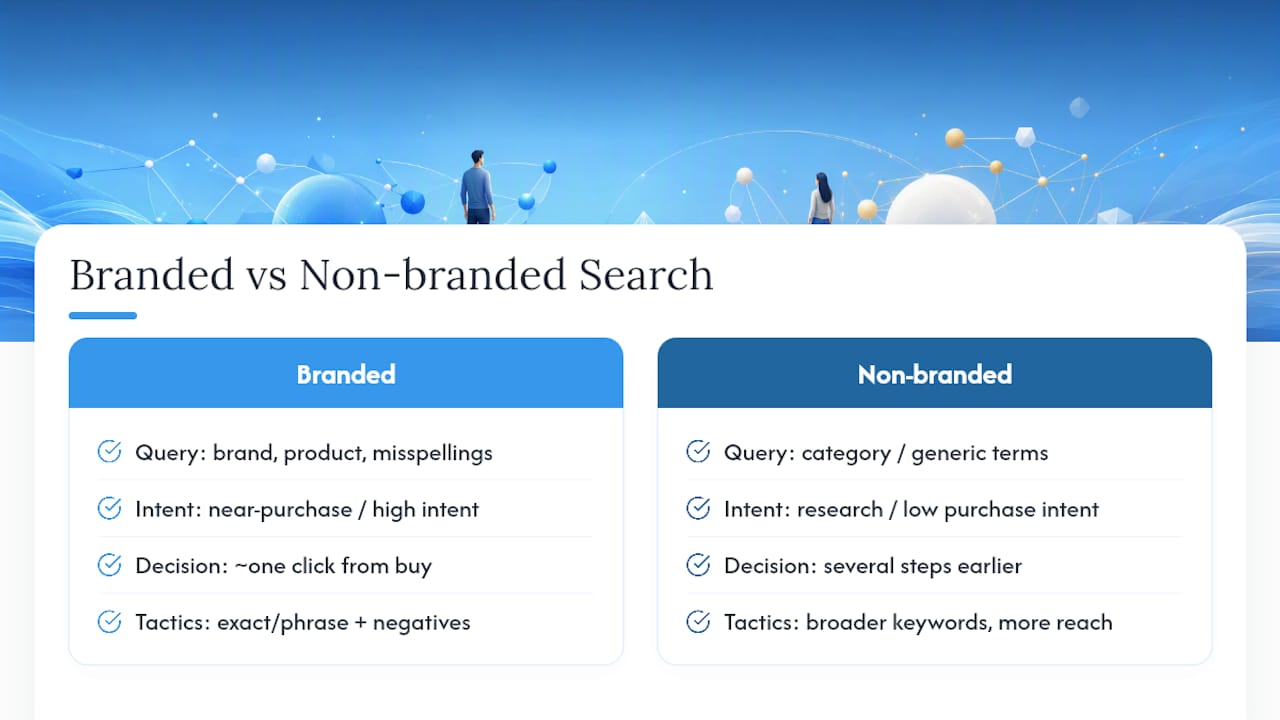
The intent gap matters more than most marketing plans admit. A branded search often sits one click from a decision. A generic search sits several steps earlier, closer to research than purchase.
Match types and negative keywords do heavy lifting here. Exact and phrase match keep branded campaigns tight around your actual name and product line, while negative keywords block your ads from firing on unrelated generic queries that would waste budget meant for defense.
Branded vs. Non-Branded: How Intent, Cost, and Funnel Role Compare
Branded and non-branded campaigns behave like two different products inside the same account. Branded terms convert at a much higher rate because the searcher has already chosen you. They also tend to cost less per click, since your own brand relevance drives a stronger quality score than a competitive generic keyword ever could.
- Branded clicks skew toward late-funnel intent: pricing checks, login attempts, “near me” searches, product comparisons against your own name.
- Non-branded clicks skew toward early research, where the same person might not search your brand for weeks.
- Quality Score rewards branded ads for tight relevance, which usually lowers CPC even in competitive categories.
There’s a documented feedback loop worth knowing about: research on generic-to-branded spillover found that non-branded search activity increases future branded search volume, but the reverse isn’t true. Branded ads don’t generate new category awareness the way generic ads do. That asymmetry is the real argument for running both, not either.
The Real Benefits and the Myths That Won’t Die
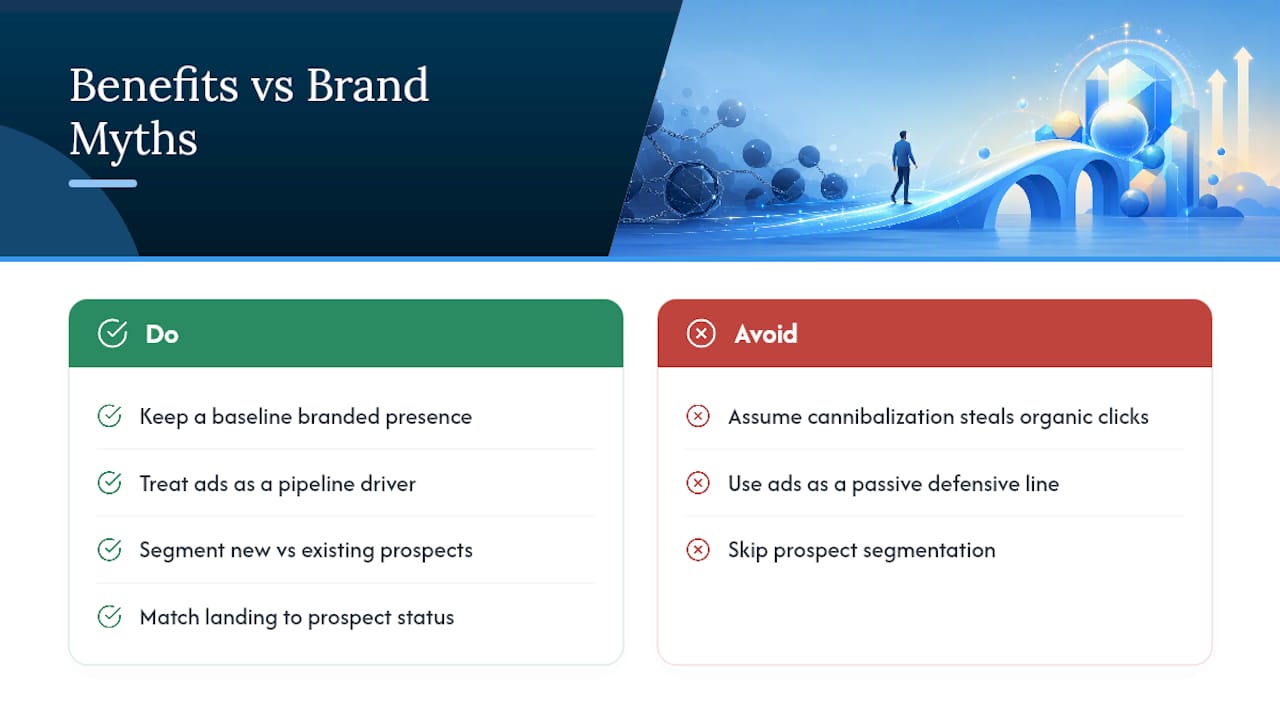
The defensive case is the one everyone already knows: a competitor can legally bid on your brand name, and paid results often sit above your organic listing, meaning a rival can intercept a searcher who typed your name looking for you, according to Interteam Marketing’s breakdown of Google Ads brand campaigns. That alone justifies a baseline branded presence for most companies with real competitors.
The myth that won’t die is cannibalization: the idea that branded ads just steal clicks you’d have gotten organically for free. In practice, a smartly run branded campaign functions as a conversion-optimized touchpoint that protects brand equity and accelerates pipeline rather than a tax on traffic you already owned.
Brand search campaigns work best when treated as a pipeline driver rather than a passive defensive line, segmented by prospect status and matched to the right landing experience.
Segmenting new prospects from existing customers is the lever most teams skip, and it’s usually the one that separates a branded campaign that pays for itself from one that just recycles free traffic.
When Should You Actually Run Branded Campaigns?
Not every brand needs to defend every keyword every day. A few clear triggers tell you when the spend is worth it:
- A competitor starts bidding on your brand name in the auction.
- You’re launching a new product, running a promotion, or hosting an event where search volume for your name will spike.
- Your organic listing is unstable, buried under review sites, or losing visibility during a site migration.
- You operate in a category where three or more competitors are actively bidding on brand terms. Heavier auction pressure on your own name tends to correlate with stronger measurable lift when you defend it.
Pro Tip: Before committing to a permanent branded budget, run a two to four week holdout experiment: pause branded ads in a test region or ad group and compare organic-only conversions against a control group still seeing branded ads. That’s the fastest way to see your real incremental lift.
How to Set Up a Branded Campaign That Actually Performs
A branded campaign built without structure just becomes an expensive habit. Build it in this order:
- Build the keyword list first. Include your brand name, product names, common misspellings, and modifiers like “reviews,” “pricing,” “login,” and “near me.” Use phrase and exact match to keep the campaign tight.
- Add negative keywords immediately. Block generic terms that might otherwise pull budget away from navigational searches meant to protect your name.
- Match ad copy to the landing page. A search for “[brand] reviews” should route to a page with proof and testimonials, not your generic homepage. A search for “[brand] pricing” should land on the pricing page. This single fix, covered in more depth in landing page design rules that actually drive conversions, is where most branded budgets quietly leak value.
- Cap your bidding. Manual bids or strict automated caps protect you from algorithms that inflate CPCs during short-term spikes in brand interest without any gain in real incrementality.
- Segment your audience. Separate new prospects from returning customers so your bidding isn’t wasted acquiring people who were converting anyway.
- Set up conversion tagging before launch, not after, so your incrementality test has clean data from day one.
Pro Tip: Track cost-per-incremental-conversion, not just cost-per-conversion. The second number flatters every branded campaign; the first tells you whether the spend is actually earning its keep.
For a deeper look at aligning the click to the asset it lands on, RADKA Advertising’s case study work shows how measurement and message alignment work together in practice.
What FACEGYM’s Results Show About Branded Search Done Right
Work with FACEGYM produced significant increases in purchases and bookings, driven partly by tightening the connection between branded search intent and what happened after the click. Ad copy, landing pages, and audience segmentation were aligned so a branded searcher landed exactly where their intent pointed, whether that was a booking page or a product page.
The lesson to replicate first is the alignment step, not the media buy. Before increasing branded spend, audit whether your top branded queries actually route to pages built to convert that specific intent, a principle covered further in what makes a product page convert in 2026.
How We Prioritize Branded Search Inside a Growth Plan
Defend your brand terms at a profitable bid, not the highest possible one. Set a walk away price before the auction pressures you into it, then let landing-page alignment and incrementality testing do the real work of proving the spend earns its place. Branded search should never run in isolation. Tie it to creative that matches the query and to sales follow-up that closes what the click started, using the same conversion copywriting principles that make any landing page perform.
— Alex
Get Branded Search That Pays for Itself, Not Just Protection
Most brands treat branded paid search as insurance and stop there. Some agencies build it as a measured pipeline channel instead, pairing managed branded PPC with landing page optimization and real incrementality testing so you know exactly what that spend is earning, not just what it’s protecting.
That means keyword structure, negative lists, and bid caps set up correctly from the start, ad copy mapped to the exact page a branded searcher expects, and a holdout test built in so you can prove lift instead of guessing at it. If your branded campaigns have never been audited for alignment or incrementality, that’s the fastest place to find wasted spend. Request a branded search audit or pilot and see where your current setup is leaving pipeline on the table.
Sources
- Journal of Marketing Research — study on spillover from generic to branded paid search
- TheSearchMonitor — how to create an effective branded PPC campaign
- Senior Executive — Branded PPC: How to turn brand search campaigns into a pipeline driver
Recommended

Other posts

























































Stay ahead with better decisions.
Get business insights today.
