B2C CRM Implementation Services: A Practical Guide for 2026
A CRM can centralise customer records and still leave your team working from different versions of the truth. When commerce, marketing and service data remain fragmented, B2C CRM implementation services need to do more than configure software. They should establish how customer information is organi...

A CRM can centralise customer records and still leave your team working from different versions of the truth. When commerce, marketing and service data remain fragmented, B2C CRM implementation services need to do more than configure software. They should establish how customer information is organised, used and owned.
If you’re unsure whether implementation means platform setup, strategy or ongoing management, define the scope before choosing a provider. Clean data, clear responsibilities and team adoption matter as much as the technology. Get those foundations wrong, and reporting and customer journeys can quickly lose credibility.
This guide explains what an implementation should cover, how to assess a provider’s approach and what to clarify about data, integrations, ownership and post-launch support. You’ll learn how to shape a CRM around customer lifecycle and business priorities, and how Klaviyo and CRM management can support retention activity. The goal is a dependable view of customer data and consent preferences in a system your team can use. Clear ownership and a post-launch plan give that system a stronger foundation.
Key Takeaways
• Assess B2C CRM implementation services by the work they include, from strategic discovery and data preparation to team enablement.
• Map customer data, permissions and behaviour before building journeys, so communications reflect useful signals rather than disconnected records.
• Ask providers to define deliverables, responsibilities and acceptance criteria before work begins. Clear criteria help everyone judge when each stage is ready to progress.
• Use a staged implementation plan to make key decisions, assign an owner and check readiness at each point.
• Set expectations for ongoing platform management, journey reviews, data quality and reporting before implementation is complete.
B2C CRM implementation services: what the work should actually deliver
Buying access to a CRM doesn’t create a usable customer operation. Implementation means planning the data structure, configuring the platform, connecting relevant systems and preparing people to use it in their day-to-day work. For a B2C brand, that means considering how customer records support marketing and service, not simply how fields appear on screen. Customer relationship management (CRM) can describe several approaches, but the implementation scope must fit the organisation’s actual needs.
Fragmented profiles make it harder to understand a customer’s relationship with the brand. If purchase history sits in one tool, service interactions in another and consent preferences are unclear, communications can become irrelevant or reach the wrong audience. The right scope depends on existing systems, data quality, customer journeys and who will own the CRM internally.
This video offers a B2C-specific perspective on setting up a CRM:
What does B2C CRM implementation include?
A well-defined project usually starts with discovery and a review of data, systems and customer journeys. It then sets out platform configuration, required integrations, testing, team training and handover. These are workstreams to agree, not automatic deliverables from every provider. Decide what the business needs now, then separate optional enhancements for later. For example, a brand may first need reliable customer records and consent preferences before adding more complex automated journeys.
Agree how success will be assessed before work starts. Measures might cover operational readiness, data completeness, reporting reliability or whether teams can carry out agreed tasks. Tie each measure to the project’s goals. Don’t assume a CRM launch will produce a particular revenue lift.
When does a consumer brand need implementation support?
Look for duplicated customer records, disconnected systems, unclear ownership or campaign reports that teams don’t trust. Growth can expose these problems as customer volumes and channel activity increase. A platform change or the adoption of a new channel can also prompt a broader implementation review. The right scope depends on what is causing friction, not simply on the age of the current software.
Distinguish a foundational project from a narrower request. Campaign production or updating an existing email flow may not require a full implementation. If the issue spans data structure, integrations, permissions and team processes, B2C CRM implementation services should define and address the underlying operating setup. Vertical Brands’ Klaviyo email marketing and CRM management expertise is relevant when customer retention and email activity form part of that picture.
How B2C CRM implementation connects customer data to useful journeys
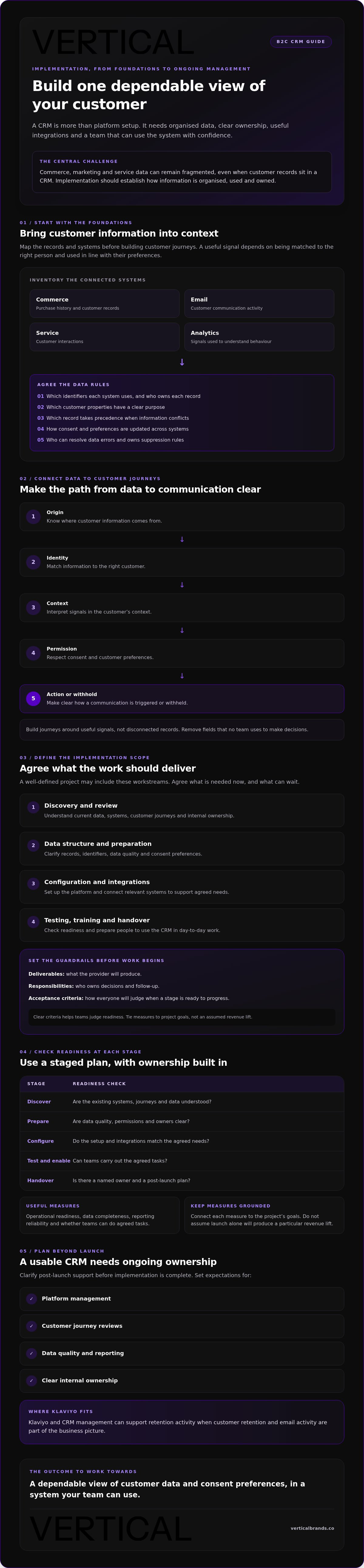
A useful customer journey depends on more than collecting data. The information must be matched to the right person, interpreted in context and used in line with their permissions and preferences. B2C CRM implementation services should make that sequence explicit, from where data originates to how a communication is triggered or withheld.
Start with an inventory of commerce, email, service and analytics systems. Record the customer identifiers each system uses, who owns each record and where data quality breaks down. Agree which customer properties have a clear purpose, such as purchase history or a communication preference. Remove fields that no team uses to make decisions. Name an owner for each source, so someone can resolve errors and confirm how its data is used.
Which data foundations should be agreed first?
Map consent and preferences from the point of collection through to the systems that activate them. Identify which record takes precedence if information conflicts, who can update it and how changes are reflected elsewhere. Assign an accountable owner to suppression rules, too. A useful starting point for project stages is this CRM implementation plan, but the data decisions must reflect your own customer journeys and systems.
Entity map: Commerce captures orders and customer details → CRM matches and organises records → email uses approved contact data and preferences → service adds interaction history → analytics combines agreed data for reporting. The map should show what moves between systems, identify its source of truth and name the person responsible. Don’t assume every platform needs every field.
How should CRM data support customer journeys?
Map lifecycle moments before building communications. A first purchase could trigger useful post-purchase information; repeat purchases can shape relevant follow-up; lapsed engagement may prompt a carefully selected re-engagement message. Browsing and service signals can add context, but only if they are reliable and appropriate to use.
For each journey, specify the event that starts it, the audience, the message and the conditions that stop or suppress it. A recent order, an unresolved service issue or a changed preference could affect whether a message is timely. This is where permissions, data governance and customer experience meet. Keep detailed segmentation tactics in a separate advanced CRM segmentation guide, so implementation decisions stay focused on sound foundations.
Teams planning retention activity can also consider how Klaviyo email marketing and CRM management fits into their wider customer data and journey requirements.
How to assess B2C CRM implementation services before choosing a partner
Compare the work behind the proposal, not just the platform or credentials. Strong B2C CRM implementation services should connect strategic discovery, data preparation, technical delivery and team adoption to your brand’s priorities. A badge may show platform knowledge, but it doesn’t prove the provider understands your commerce model, customer journeys or internal constraints.
Use a consistent scorecard to compare scope and accountability. Ask each provider to explain what they will deliver, what your team must supply and how both sides will decide a stage is complete. These CRM best practices offer useful principles, but your brief should translate them into requirements your business can verify.
| Workstream | What to assess |
|---|---|
| Strategic discovery | How goals, priority journeys and team needs shape the proposed scope. |
| Data work | How records, identifiers, consent information and known quality issues are reviewed. |
| Integrations | Which systems need to connect, what data moves and who confirms the requirements. |
| Configuration | How platform structure and agreed workflows will support actual use. |
| Enablement | What testing, training and documentation are included, and for whom. |
| Ongoing support | What post-launch responsibilities are available and where the project ends. |
What should a CRM implementation brief specify?
Set out business objectives, current systems, priority customer journeys and known data constraints. Name the internal stakeholders, decision-makers and dependencies, then list required integrations and expected deliverables. Define success measures before reviewing proposals, such as validating agreed records or enabling a team to complete a defined workflow. This makes scope easier to compare and reduces assumptions on both sides.
Which questions reveal whether a provider is a good fit?
Ask how they diagnose data quality, respond to incomplete requirements and document decisions. Who approves test results? What training and handover are included? Who owns issues after launch? Request relevant consumer or e-commerce examples, references where available and clear definitions behind any stated outcomes. Verify claims directly. Platform badges can support a case, but they shouldn’t replace evidence of fit.
Look for proposals that make responsibilities visible, rather than implying the provider will resolve every dependency alone. The criteria should be clear enough that your team can challenge gaps before work begins. If you’re reviewing retention activity alongside CRM scope, explore Klaviyo email marketing and CRM management as part of that assessment.
A B2C CRM implementation plan that protects data quality and adoption
A controlled sequence makes decisions visible before they become launch risks. B2C CRM implementation services should make clear what must be agreed at each stage, who is accountable and what evidence allows the work to move forward. Project dates and duration depend on confirmed scope, data condition and integration requirements, so set them once those factors have been assessed.
How should brands prepare for implementation?
Appoint an internal decision-maker and nominate owners for marketing, commerce, service and data. Document existing tools, data sources, active campaigns and known process gaps. Then agree the first priorities and what will remain out of scope. This prevents the project from becoming an open-ended attempt to fix every system and workflow at once.
A practical implementation sequence
Discovery
Confirm objectives and priority customer journeys. The decision-maker owns scope approval. Progress when stakeholders agree on the goals and boundaries.
Data and systems audit
Review sources, identifiers, data quality and dependencies. Data and system owners confirm the findings. Progress when gaps and risks are documented.
Design
Agree the CRM structure, ownership rules and intended workflows. Marketing, commerce and service owners approve the design. Progress when requirements are signed off.
Configuration
Set up the agreed fields, permissions and workflows. The implementation lead is responsible, with business owners validating the configuration against requirements.
Integration
Connect only the systems required for the agreed scope. Assign an owner to each connection. Progress when expected data can be traced between source and destination.
Testing
Validate representative customer records, consent states, data transfers and journey conditions. Business owners review the test evidence and resolve failures before customer-facing journeys go live.
Enablement
Provide role-specific training, operating documentation and escalation routes. Team leads confirm users can complete their core tasks and know where to raise issues.
How can teams reduce launch and adoption risks?
Test more than the ideal case. Include incomplete records, changed preferences and suppression conditions, as well as routine customer data. User testing should confirm that teams can interpret records and that journeys behave as intended. Don’t activate customer-facing communications until the agreed checks pass and an accountable owner approves the launch.
After launch, track the measures agreed during planning. These could include data quality checks, team adoption and operational reliability. The owners are responsible for reviewing issues and escalating them through the agreed route. Treat this as part of the operating plan, not an informal task left to whoever spots a problem first.
For support with CRM management and customer retention activity, review Vertical Brands’ CRM management services as part of your implementation planning.
What ongoing B2C CRM management should deliver after implementation
Implementation establishes the agreed structure. Ongoing management keeps it accurate, usable and aligned with changing customer and business needs. It may include platform administration, data quality checks, journey reviews, reporting and campaign improvement. Define these responsibilities separately from the initial project, so routine ownership doesn’t fall into a gap after launch.
A specialist partner can extend the team’s capacity, but shouldn’t replace internal ownership. Your business still needs decision-makers for customer priorities, data use and approval of communications. The partner’s role, access and accountability should be clear, with measures tied to agreed customer and operational objectives rather than activity for its own sake.
What should happen in the first phase after launch?
Check that integrations, customer records and priority journeys behave as designed. Review exceptions, such as records that fail to sync or communications that aren’t suppressed when expected. Gather feedback from the people using the system, then close gaps in training or documentation. Use those findings to prioritise measured improvements, rather than adding complexity before the foundations are stable.
Agree a review rhythm that suits the business. Assess data quality, platform issues, journey performance and campaign reporting against the objectives set during implementation. If a journey no longer reflects customer behaviour or business priorities, document the reason for changing it and who approves the change. This creates a clear line between insight and action.
How can an agency support CRM growth over time?
Ongoing support can connect platform management with email strategy, automation and retention priorities. Vertical Brands’ capabilities include Klaviyo email marketing, CRM management and automated email flows. If your brand is considering a platform move, consult a direct Klaviyo migration guide alongside the CRM plan, so data, journeys and operational responsibilities are considered together. Review each journey’s priorities against customer needs and the team’s capacity to manage it.
To discuss how CRM implementation requirements relate to email and retention activity, talk to Vertical Brands about your CRM requirements.
What is the next step for a brand assessing support?
Prepare a concise brief covering objectives, current systems, known constraints and priority customer journeys. Use the provider comparison framework to assess delivery, governance and post-launch support. Ask who owns ongoing decisions, what work sits with your team and how progress will be reviewed. A clear brief makes it easier to compare proposals on fit, not just platform familiarity.
For support with email marketing and CRM management, explore Vertical Brands’ email marketing and CRM management.
Build a CRM your team can keep moving forward
A successful B2C CRM implementation is not defined by software access or a completed setup. It depends on clean, connected customer data, clear ownership and journeys designed around real customer needs. The right B2C CRM implementation services should also clarify what happens after launch, from platform management to data quality and ongoing review.
Start with a defined scope, agreed measures and named owners. Then assess providers on their process, evidence and ability to support your priorities. A CRM should be managed as an operational capability, not treated as a one-off technical project. Specialist Klaviyo email marketing, CRM management, automated email flows and data-led marketing strategy contribute to a more considered approach to retention. The strongest plans are reviewed and improved as customer needs and business priorities change.
Ready to clarify the work your business needs? Discuss your CRM implementation requirements with Vertical Brands. A clear brief is a practical first step, and your team can build from there.
Frequently Asked Questions
What do B2C CRM implementation services include?
B2C CRM implementation services can include discovery, data planning, platform configuration, integrations, testing and team training. The work should clarify how customer records, permissions and priority journeys will be managed, rather than simply setting up software. Post-launch support may also be included, but it isn’t automatic. Scope depends on your current systems, data quality, business requirements and internal ownership, so agree deliverables and responsibilities before work begins.
How long does B2C CRM implementation take?
There’s no reliable standard timeline for every implementation. Duration depends on the agreed scope, the condition and structure of your data, the integrations required and how quickly decisions are made. Testing and training also need time in the plan. Ask a provider to explain the assumptions behind its proposed schedule, including dependencies on your team, and how changes to scope could affect delivery before you commit.
How much do B2C CRM implementation services cost?
The cost of B2C CRM implementation services depends on the work required. Key factors include project complexity, the number and type of integrations, data preparation, platform configuration, training and post-launch support. A provider can give a meaningful proposal only after understanding your systems, requirements and constraints. Share a concise brief and ask for a scoped proposal that distinguishes included deliverables, exclusions and any assumptions affecting the fee.
Can a CRM implementation improve customer retention?
A well-configured CRM can support more relevant customer journeys and clearer measurement, which may help a brand improve its retention activity. For example, purchase history could inform a suitable follow-up, provided the data and communication preferences are reliable. A CRM doesn’t guarantee a retention outcome. Results depend on data quality, the offer, execution and customer behaviour, as well as whether the team reviews performance and acts on what it learns.
Is Klaviyo suitable for B2C CRM implementation?
Klaviyo is relevant for B2C brands whose priorities include email marketing, CRM management and automated email flows. Whether it fits depends on your requirements, including the customer data you need to use, the journeys you want to support and the systems involved. Assess those needs before choosing a platform. Vertical Brands specialises in Klaviyo email marketing and CRM management, but confirm the proposed scope and platform fit for your particular project.
What should I prepare before choosing a CRM implementation partner?
Prepare a brief covering business objectives, current systems, known data constraints and priority customer journeys. Name the internal stakeholders, decision-makers and teams responsible for customer data. Set out required integrations, project dependencies and what you need a provider to deliver. Include evaluation criteria such as testing, training, documentation and post-launch support. A concise brief makes proposals easier to compare and helps surface assumptions early. Clear criteria make the selection process more useful.

Other posts
































































Stay ahead with better decisions.
Get business insights today.
