Subscription Box Marketing Agency: A Growth Guide for 2026
A first order can make a campaign look successful, but it doesn’t prove a subscriber will stay. A subscription box marketing agency should help build more than a flow of new customers. It should connect acquisition with the experience that earns repeat orders and helps address avoidable churn.Subscr...

A first order can make a campaign look successful, but it doesn’t prove a subscriber will stay. A subscription box marketing agency should help build more than a flow of new customers. It should connect acquisition with the experience that earns repeat orders and helps address avoidable churn.
Subscription growth can be difficult to assess when paid media, email, SEO and customer experience operate separately. Acquisition, retention and customer experience are often treated as separate problems, leaving teams with activity across channels but no clear view of how each part contributes to lasting value. The challenge isn’t simply attracting more buyers. It’s understanding what happens after the first order.
This guide explains how to assess an agency’s fit for a subscription business, which capabilities to look for and how to measure performance beyond short-term campaign results. You’ll also see how CRM, paid social and search, SEO, creative and website development can play distinct roles in a connected growth system. The aim is a practical route to more aligned marketing, clearer measurement and sustainable subscriber growth.
Key Takeaways
• Assess whether a subscription box marketing agency links your commercial goals to channel choices, delivery and meaningful measures.
• Give each channel a distinct role: paid social can test creative, search can capture demand, SEO can build discoverability and CRM can support subscriber communications.
• Separate marketing’s influence on retention from product quality, fulfilment and customer support, then identify where better coordination could help.
• Use a structured assessment to examine strategic alignment, channel integration, measurement and execution. Each area have a role in a coherent growth plan.
• See how Vertical Brands brings Klaviyo CRM, paid media, SEO, web development and creative together, with growth advisory guiding the plan.
What a subscription box marketing agency should understand about recurring growth
A subscription box marketing agency should align demand generation with the subscriber experience and the reasons customers continue, pause or cancel. Its role is to connect the first campaign with the relationship that follows, rather than treating a successful first order as the end goal.
That changes the marketing brief. A one-off purchase can be assessed around a single transaction; a subscription relationship unfolds over repeated billing and delivery cycles. The subscription business model makes continuity part of the offer, so acquisition decisions need to account for what customers expect after signing up.
For a practical perspective on subscription growth, watch this video:
How subscription revenue changes the marketing brief
First-order performance matters, but it can’t show whether customers understand the offer, value each delivery or choose to renew. Marketing should support the journey beyond checkout: set clear expectations before sign-up, orient new subscribers after their first order, then reinforce ongoing value with relevant communications.
Offer structure shapes that journey. A fixed delivery schedule, flexible frequency or different cancellation terms creates different expectations. Campaign messaging should make the value and commitment clear, while onboarding should explain what happens next. If the promise in an advert doesn’t match the experience, acquisition may bring in short-lived subscriptions rather than lasting relationships.
Which subscription models need different marketing decisions?
Marketing priorities depend on what the customer is subscribing to. Curated boxes rely on anticipation and the perceived value of each selection. Replenishment subscriptions focus more on convenience and timing, with communications that help customers stay supplied. Access-based memberships need to make continuing benefits clear, rather than presenting each billing cycle as a product delivery.
Purchase frequency and cancellation terms matter too. A frequently replenished product may call for timely reminders; a less frequent curated box may need stronger communication about what’s coming and why it’s worth staying. Expectations around renewal differ by offer, so one message cadence or retention approach won’t suit every category.
For a subscription brand, growth means balancing new demand with the conditions that support continued membership. That gives acquisition, onboarding and ongoing communication a shared commercial purpose, while recognising that product quality, fulfilment and customer support remain central to the customer experience.
Which marketing channels should a subscription box agency connect?
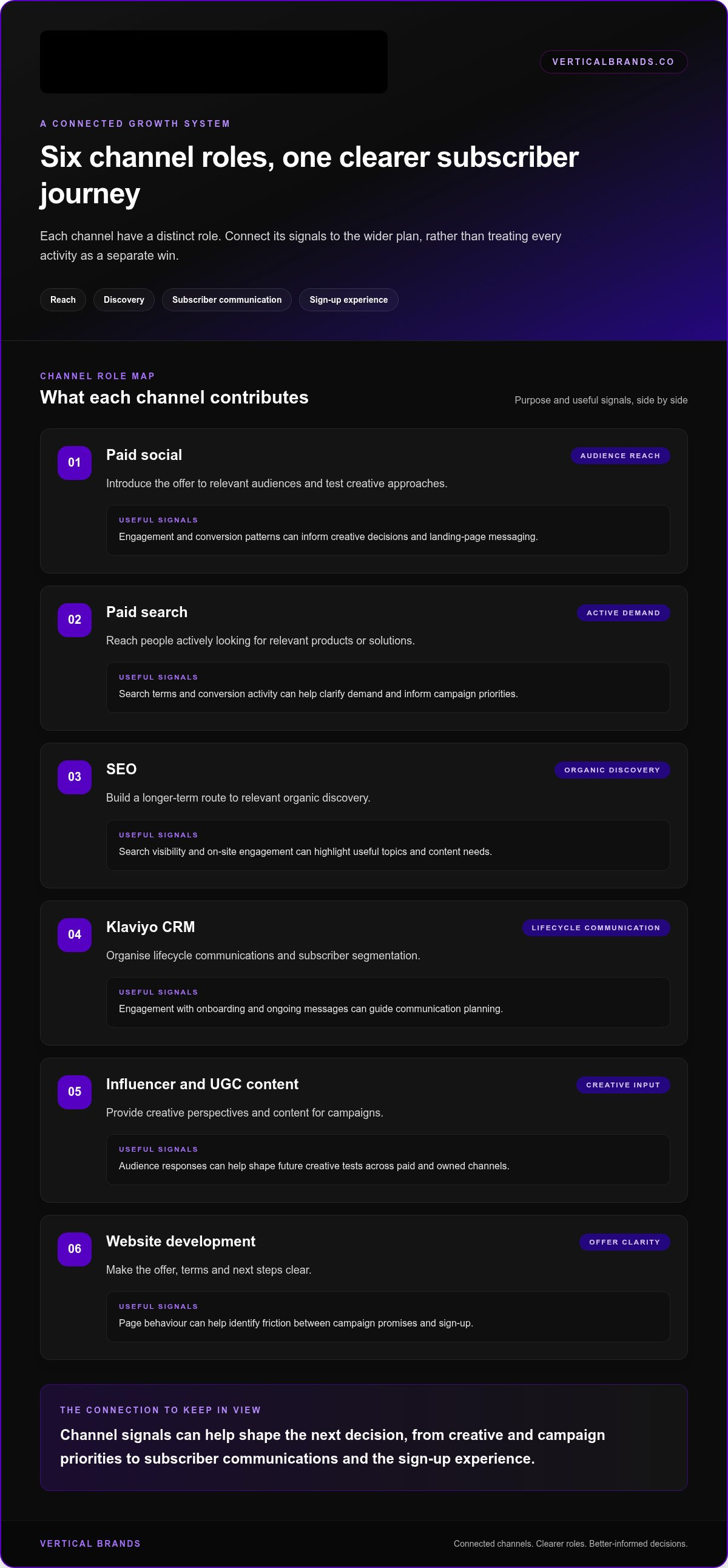
Channels work best when each has a clear role and its signals inform the wider plan. Paid media can test routes into the market. Search captures active demand. SEO builds discoverability over time, while CRM supports communication after sign-up. A subscription box marketing agency should connect these activities rather than report them as separate wins.
| Channel | Purpose | Useful signals and connections |
|---|---|---|
| Paid social | Introduce the offer to relevant audiences and test creative approaches. | Engagement and conversion patterns can inform creative decisions and landing-page messaging. |
| Paid search | Reach people actively looking for relevant products or solutions. | Search terms and conversion activity can help clarify demand and inform campaign priorities. |
| SEO | Build a longer-term route to relevant organic discovery. | Search visibility and on-site engagement can highlight useful topics and content needs. |
| Klaviyo CRM | Organise lifecycle communications and subscriber segmentation. | Engagement with onboarding and ongoing messages can guide communication planning. |
| Influencer and UGC content | Provide creative perspectives and content for campaigns. | Audience responses can help shape future creative tests across paid and owned channels. |
| Website development | Make the offer, terms and next steps clear. | Page behaviour can help identify friction between campaign promises and sign-up. |
Where paid media, search and creator content fit
Paid social can introduce a box to audiences who may not yet know the brand, while creative tests reveal which messages merit further development. Paid search serves a different moment: it can reach people expressing intent through their searches. SEO supports discovery over a longer horizon, helping relevant pages meet useful search needs. Influencer marketing and UGC add creative inputs, but content alone doesn’t guarantee performance. Signals from each channel help teams make better-informed decisions about the next test.
Why CRM and the website affect subscriber experience
A campaign sets expectations. The landing page needs to explain the offer clearly, including what subscribers receive and what happens after sign-up. Klaviyo CRM can support segmented lifecycle communication, from onboarding to ongoing engagement, so messages reflect a subscriber’s stage and relationship with the brand.
Platform changes can affect how that communication is managed. For practical guidance, see this Klaviyo migration guide. Connecting channel planning with practical execution is also part of integrated digital growth support.
Does a subscription box marketing agency improve retention, not just acquisition?
An agency can support retention, but more campaign activity doesn’t automatically reduce churn. Marketing can set expectations, guide onboarding and deliver relevant communications. It can’t control every reason a subscriber leaves. Product quality, fulfilment and customer support all shape the experience, and the teams responsible for them need to address those areas.
Campaign performance shows how marketing activity performs; subscription health reflects the wider relationship between the brand and its subscribers. A subscription box marketing agency should keep those measures connected without claiming that a change in one channel caused a change in overall retention.
What marketing can influence across the subscriber lifecycle
Retention work starts before someone subscribes. Campaigns and landing pages should set clear expectations about what the box includes, how the offer works and what happens after sign-up. Onboarding can reinforce those details, explain the next steps and help new customers understand the value they’ve chosen.
Lifecycle communication adds relevance over time. CRM segmentation can help tailor messages to factors such as a subscriber’s stage in the journey or past engagement, rather than sending the same communication to everyone. A winback message may also be worth testing with former subscribers. Treat it as an experiment, not a guaranteed fix: results depend on the offer, audience and reasons people cancelled.
How to interpret performance without overclaiming causation
Acquisition-only reporting might focus on clicks, new customers or first orders. A broader view can include onboarding engagement, renewal behaviour, cancellations and repeat purchases, where the business has reliable data. Cohort analysis can compare groups who subscribed around the same time, while repeat-purchase analysis can show whether customers return for later orders. A cohort view also help reveal where subscriber behaviour changes, though it doesn’t explain the reason on its own.
Use these signals as evidence to investigate, not proof of cause. If a retention message and renewal rate improve in the same period, other factors may also have contributed. Changes to the product, delivery experience, customer support or offer could be relevant. Attribution has limits too: a subscriber may interact with several channels before renewing, and reporting may not capture every influence.
For a practical assessment, agree which measures marketing can directly influence, which outcomes it can contribute to and which depend on wider operations. Review them together over an appropriate period. That creates a more credible picture than treating one campaign’s result as a verdict on subscriber loyalty.
How to evaluate an agency’s subscription box marketing approach
A useful assessment starts with the business challenge, not a list of services. The right subscription box marketing agency approach should translate commercial priorities into channel decisions, define how progress will be measured and explain how the work will be delivered. Use this framework to assess whether the strategy connects objectives with execution.
Start with the commercial priority.
Is the immediate need to attract suitable subscribers, improve onboarding, strengthen repeat purchasing or address a website barrier? A clear priority gives each marketing activity a reason to exist.
Connect objectives to channels.
The plan should explain why CRM, paid media, SEO or creative supports the priority, and how those channels work together. If the goal is better subscriber communication, for example, CRM activity should reflect the customer journey rather than sit apart from acquisition campaigns.
Agree the measurement framework.
Set definitions for each metric, establish a baseline and identify the review period. Separate channel indicators, such as campaign engagement, from wider commercial measures, such as renewals or repeat orders. The measures should reflects the business objective, not just the easiest data to report.
Make execution and decisions clear.
Establish how work is prioritised, how tests are reviewed and how findings shape the next action. Structured communication helps teams understand what changed, what the evidence suggests and where operational context may affect interpretation.
Assess strategy, measurement and working practices
Growth advisory can connect business priorities with channel planning, while practical delivery turns the plan into campaigns, CRM activity, creative and website improvements. Reporting should show what each channel did and how that activity relates to wider indicators, without treating correlation as proof of impact. A disciplined review process gives teams a shared basis for deciding what to continue, adjust or test next.
Check whether the channel mix matches the growth challenge
Klaviyo CRM and email marketing can support segmentation and lifecycle communication. Paid social and paid search can address audience discovery and active demand; SEO can build organic visibility. Influencer marketing and UGC provide creative inputs to campaigns. Website design and development can address friction when pages make the offer or next step unclear. The mix should follow the diagnosed need, rather than assume every channel needs equal investment.
For channel-specific context, read this paid social management framework. Vertical Brands brings strategic planning together with channel and website execution. Explore integrated growth support to connect marketing priorities with delivery.
How Vertical Brands connects subscription marketing with wider e-commerce growth
Subscription marketing works best as part of a coherent e-commerce growth plan. Vertical Brands brings growth advisory together with Klaviyo email marketing and CRM management, paid social, paid search, SEO, website design and development, influencer marketing and UGC. Each capability have a distinct role. The value comes from aligning them around the brand’s priority, not running every channel at once.
A joined-up model for acquisition and subscriber relationships
Start with the subscriber journey. Paid media can introduce the offer and test how audiences respond to different creative. Those campaign signals can inform future messaging, while CRM supports relevant communication after sign-up. If an advert highlights a particular benefit, the landing page should make that benefit clear, and follow-up emails should reflect the same promise. Consistency narrows the gap between what a campaign says and what a subscriber experiences.
SEO supports discovery through relevant organic content, while influencer marketing and UGC can contribute new creative perspectives. Website development can help address pages or journeys that make the offer difficult to understand. These activities aren’t interchangeable: their place in the plan depends on the growth challenge and the evidence available. Growth advisory helps organise priorities before channel execution expands.
This integrated approach doesn’t assume marketing alone determines subscriber retention. Product quality, fulfilment and customer support shape the experience too. Instead, it connects marketing activity with the wider journey, helping teams identify where communication, creative or digital execution may support the customer relationship.
Decide the next growth priority
Before expanding activity, identify the most immediate constraint. Is the brand struggling to attract suitable customers, communicate ongoing value or deliver a clear digital experience? Define a baseline using the measures available, agree the priority and choose activity that addresses it. Without that sequence, adding channels can create more work without clarifying what needs to change.
For broader planning, explore the e-commerce growth stages framework. It can help place channel decisions within the wider development of an e-commerce business.
The next step is to identify the constraint that matters most, then align strategy, channels and measurement around it. Vertical Brands connects strategic planning with practical digital execution for brands building e-commerce growth. Discuss your e-commerce growth priorities.
Build your next growth move around the whole subscriber journey
A subscription box marketing agency should connect acquisition with the experience that follows, not treat first orders as the only measure of progress. Clear priorities, agreed measurement and coordinated channels help reveal where marketing can support growth, while product quality, fulfilment and customer support remain part of the wider subscriber experience.
The practical next step is to identify your main constraint: attracting suitable subscribers, strengthening ongoing communication or improving the digital experience. Set a baseline before expanding activity, then align the plan with the outcome that matters most. Klaviyo email marketing and CRM management can support subscriber communication, while paid social, paid search, SEO and growth advisory connect channel planning. Web development, influencer marketing and UGC content creation support execution.
With a clear priority, teams can focus effort, assess the evidence and make better-informed decisions. The next steps starts with a focused growth plan. Discuss a growth strategy built around your business priorities, and move forward with greater clarity.
Frequently Asked Questions
What does a subscription box marketing agency do?
A subscription box marketing agency connects marketing activity across customer acquisition, subscriber communication and growth measurement. Its work may include paid social and search, SEO, CRM and email marketing, website development, influencer marketing and UGC content. The aim is to align channel choices with the brand’s commercial priorities and subscriber journey, rather than treating each campaign as an isolated task. Marketing can support growth, but it doesn’t control every part of the subscription experience.
How can a marketing agency help reduce subscription box churn?
An agency can support retention by setting clear expectations in campaigns, improving onboarding communication and using CRM segmentation to make messages more relevant. It can also help test winback activity with former subscribers. These are marketing levers, not guaranteed solutions. Churn can also relate to product quality, fulfilment, customer support or the value subscribers perceive, so retention planning works best when marketing signals are considered alongside the wider customer experience.
How much does a subscription box marketing agency cost?
There isn’t one standard fee that applies to every subscription box brand. Scope depends on the work required, such as strategic planning, CRM management, paid media, SEO, creative production or website development. The channel mix and level of execution also shape the engagement. Define the business priority and required deliverables first, then assess the proposed scope against them. Avoid comparing fees without understanding which activities, responsibilities and reporting each proposal covers.
Which marketing channels work best for subscription box businesses?
The best channel mix depend on the brand’s audience, offer and growth constraint. Paid social can introduce the box and test creative; paid search can reach people expressing active intent. SEO supports relevant organic discovery over time. CRM and email can manage subscriber communications, while influencer marketing and UGC provide creative inputs. Website development supports a clear journey from campaign to sign-up. Consider each channel’s performance in context and according to its distinct role.
Can Klaviyo help a subscription box business retain customers?
Klaviyo can support retention activity through email marketing, segmentation and lifecycle communication. A brand might use it to organise onboarding messages, share relevant updates or test communications for different subscriber groups. The platform supports the work, but it can’t guarantee that customers renew. Results also depend on the relevance of the messages and the experience subscribers receive. Clear objectives and suitable data help teams assess whether CRM activity is contributing to the intended outcome.
What should a subscription box marketing agency report on?
Reporting should connect channel activity with agreed business objectives. Depending on the plan and available data, it might include campaign engagement, acquisition activity, onboarding interactions, renewals, cancellations and repeat orders. Define each measure and its baseline before interpreting changes. Channel attribution has limits, so a result in one campaign doesn’t prove that it caused a wider change in subscription health. Review marketing signals alongside relevant product, fulfilment and customer support context.
When should a subscription box brand hire a marketing agency?
A brand may benefit from agency support when it has a defined growth challenge but needs strategic direction, channel expertise or additional execution capacity. This could mean coordinating paid media with CRM, strengthening SEO or improving the website journey. Before expanding activity, establish a baseline and identify whether the main constraint is acquisition, subscriber communication or digital experience. A clear priority makes it easier to scope the work and evaluate progress against meaningful measures.

Other posts































































Stay ahead with better decisions.
Get business insights today.
