Supermetrics vs Funnel.io: Which Fits Your Team in 2026?

Supermetrics is the better choice when you need to move data from a handful of ad platforms into a tool you already use, quickly and cheaply. Funnel.io is the better choice when several teams, clients or dashboards must share one consistent, stored version of your marketing data. The rest of this guide shows how to tell which situation you are in, what each tool really costs as you grow, and where both fall short.
Prices below are in US dollars, as the vendors publish them. UK buyers should check the current figure, and whether VAT is added, at checkout.
TL;DR
- Supermetrics is a pass-through connector tool. It pulls data into a destination such as Looker Studio or Google Sheets and does not store it by default. It is quick to start.
- Funnel.io is a marketing data hub. It downloads, stores and models data in its own cloud environment before sending it on, which suits shared definitions and governance.
- Entry price: Supermetrics Starter is $44 a month billed yearly ($55 billed monthly). Funnel starts at $300 a month billed annually.
- Rule of thumb: a few channels and one dashboard tool points to Supermetrics. Many accounts, several destinations and a need for consistent metrics point to Funnel.
- Neither tool fixes bad tracking or unclear KPIs. Settle those first.
Table of Contents
- What each tool actually does
- Side-by-side comparison
- Pricing: the entry price is not the whole story
- Governance versus speed
- Connectors and coverage
- How user reviews compare
- Our perspective
- Which one should you choose?
- Getting the reporting right with an agency
- FAQ
- Sources
What each tool actually does
Both products take data out of ad platforms, analytics tools and other marketing sources and put it where you report on it. The difference is structural.
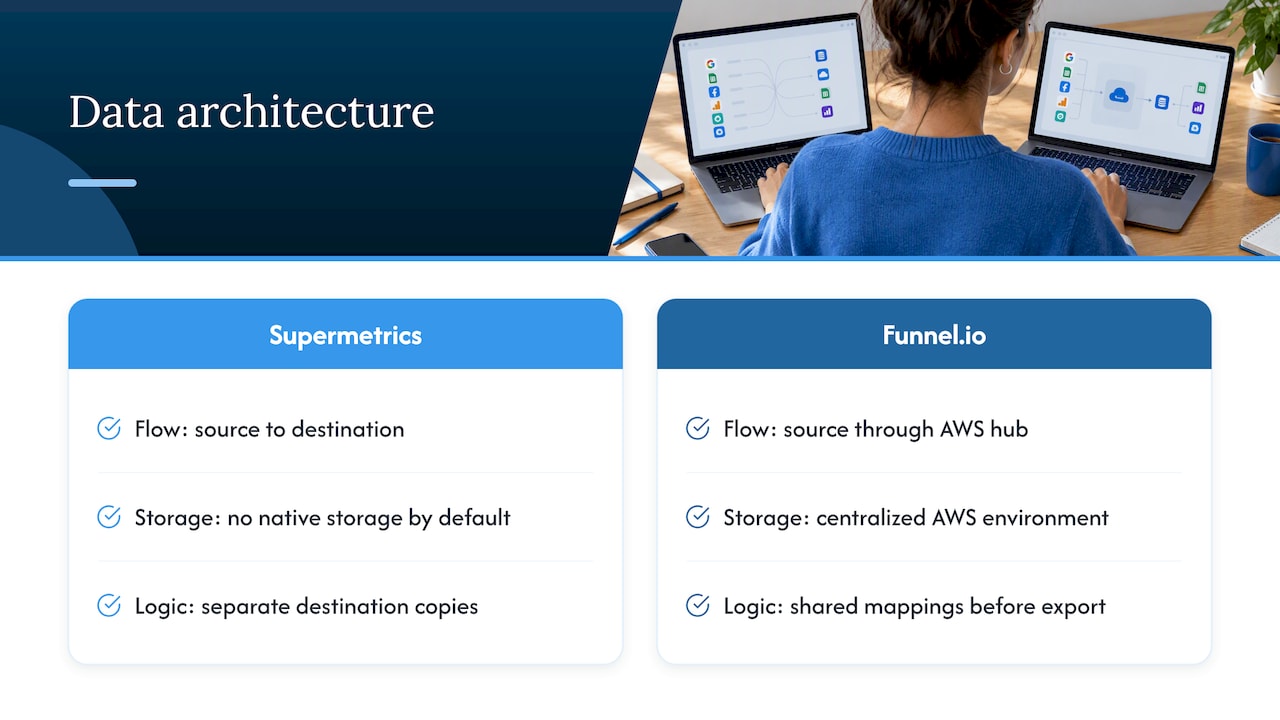
Supermetrics works as a pass-through. You connect a source, choose a destination, and the data flows into a spreadsheet, a BI tool or a warehouse. Per Supermetrics’ own comparison guide, it has no native storage by default, so each destination file holds its own copy of the logic you built.
Funnel.io sits in the middle. It pulls data from your sources, stores it in its own AWS environment, lets you map and transform it, and then exports it to the destinations you choose. The same guide describes this as a centralised hub. You define “cost”, “campaign” or “channel” once and every dashboard downstream inherits it.
Two caveats on sourcing. The comparison pages come from the vendors themselves, and each one flatters its author. We use them for facts about how each product is built and treat their conclusions with care.
Side-by-side comparison
| Criterion | Supermetrics | Funnel.io |
|---|---|---|
| Model | Connector pass-through | Central data hub with storage |
| Data storage | None by default | Stored and modelled in Funnel’s environment |
| Connector count | 150+ (per the vendor comparison) | 500 to 600+ (same source) |
| Published entry price | $44/month billed yearly, $55 billed monthly | $300/month billed annually |
| Pricing logic | Flat plans, modular by destination, users and sources | Capacity-based “flexpoints” |
| Best for | Fast setup, a few channels, one visualisation tool | Governance, many accounts, several destinations |
| Main risk | Costs and fragility grow with destinations | High entry cost, more setup effort |
Pricing: the entry price is not the whole story
Supermetrics
The Starter plan is $44 a month billed yearly, or $55 billed monthly. It covers one core destination, three data sources and one user, and pricing steps up as you add users, sources and accounts. There is no charge that varies with data volume, which makes the early bill easy to predict.
The friction appears when you add a second destination. A plan is typically tied to one core destination, so a team that sends data to both Looker Studio and BigQuery often ends up with more than one subscription or an enterprise agreement. Teams tend to underestimate this when they first compare headline prices.
Funnel.io
Funnel’s published pricing starts at $300 a month billed annually for Starter. Its model has two parts: your plan decides which features you get, and you spend flexpoints to use them. Funnel’s help article on flexpoints explains that a flexpoint is a proprietary unit of subscription capacity.
People often read flexpoints as a usage meter, like counting API calls. It is closer to a capacity contract. You buy enough capacity to run the connectors, platform accounts and destinations you need, and you add capacity when your setup grows. You are not billed per row or per query, so costs are predictable once the setup is sized. The initial sizing is the complicated part.
Where the lines cross
Supermetrics’ own guide suggests that value can tip toward Funnel’s bundled capacity once a team reaches roughly 20 to 30 managed client accounts, or several advanced warehouse destinations. Treat that as a rough marker from one vendor, not a law. The practical test is simple:
- List every source account you will connect.
- List every destination: dashboard tool, spreadsheet, warehouse.
- Count the people who need access.
- Get a quote for that full picture from both vendors, not for the starter plan.
Compare the totals at the scale you expect in twelve months. A $44 plan that becomes five plans plus manual rework is not cheaper than a single hub contract.
Governance versus speed
Funnel’s team frames the decision as governance against speed. That framing is self-interested, but it matches how the products are built.
Choose speed (Supermetrics) when:
- You report on a few channels, such as Meta, Google Ads and GA4.
- You already work in Looker Studio or Sheets and want to stay there.
- One or two people own the reporting.
- You need something running this week.
Choose governance (Funnel) when:
- Several teams or clients need the same definition of cost, revenue or channel.
- You send data to more than one destination.
- You want history preserved when an ad platform changes its API.
- You report to finance or leadership and numbers must match from one report to the next.
On that last point, practitioners note that with a pass-through tool a changed API can break dashboards file by file. With a hub, the repair happens once at the hub and stored history carries through. That is a real operational advantage once you maintain dozens of reports.
Connectors and coverage
Funnel lists many more connectors than Supermetrics: roughly 500 to 600+ against 150+ in the Supermetrics comparison. A bigger library matters only if your stack includes niche or regional platforms. Most UK eCommerce and B2B teams run on a short list: Meta, Google Ads, GA4, TikTok, LinkedIn, Klaviyo, Shopify. Check that list against each vendor’s connector page and confirm the fields you need, such as creative-level breakdowns or conversion values, are available. A connector existing and a connector returning the metric you report on are different things.
Also check which connectors your plan includes. Funnel’s entry plan does not cover its whole library, and tiers differ, so verify on the pricing page before assuming.
How user reviews compare
On G2’s side-by-side page, Funnel holds 4.5 out of 5 from 153 reviews and Supermetrics 4.4 out of 5 from 787 reviews. The ratings are close. The review counts tell you more: Supermetrics has a larger base of small and individual users, while Funnel’s reviewers skew towards teams with more complex needs. Read the critical reviews of each for the problems that match your scale, rather than the stars.
Our perspective
We run paid media, email and eCommerce programmes for clients, so we see this decision from the reporting side, not the software side. The tool choice is rarely the real problem. Most of the pain we see comes from three places: no agreed definition of the metrics, tracking that undercounts conversions, and reports that nobody uses to make a decision.
Our advice is plain.
- Start with the questions. Write down the five decisions your team makes each week and the numbers behind them. Then pick the tool. If the answer is a single dashboard for one brand, Supermetrics is usually enough and the saving is real.
- Pay for governance when you have the problem, not before. A data hub earns its price when several people argue over whose number is right. If that is not happening, it is early.
- Fix tracking first. A well-modelled dataset of bad data is still bad. Our guides on server-side tracking and attribution models cover the groundwork, and our dashboard KPI guide helps you decide what belongs on the screen.
- Keep ownership clear. Someone must own definitions, connector health and access. Without that, either tool drifts.
Because strategy, performance marketing and web development sit with one team for us, we can set up tracking, reporting and the campaigns it measures together, which removes the hand-offs that usually cause broken numbers.
— Alex
Which one should you choose?
| Your situation | Likely fit |
|---|---|
| One brand, 3 to 5 channels, Looker Studio or Sheets | Supermetrics |
| Freelancer or small team, tight budget | Supermetrics |
| Agency with many client accounts and shared templates | Funnel.io |
| Several destinations including a warehouse | Funnel.io, after pricing both |
| Multiple teams that must agree on metrics | Funnel.io |
| Unsure, with a small stack today and growth planned | Start with Supermetrics, review at the next contract renewal |
If you start on Supermetrics, keep your metric definitions documented outside the tool. That makes a later move to a hub far less painful. If you start on Funnel, size the capacity carefully and ask for the sizing worked through on your real account list.
Getting the reporting right with an agency
A connector tool moves numbers. It does not tell you which campaigns to scale or why conversion fell. If you want a team to design the measurement setup, run the paid channels and report in a way leadership trusts, our growth marketing services cover digital marketing strategy, paid social, paid search, email, CRM management, eCommerce management and web development under one roof. If you are weighing options, our guide to choosing a performance marketing agency sets out what to ask. You can also start from our home page.
FAQ
Is Supermetrics an ETL tool?
It behaves like a lightweight one. Supermetrics extracts data from marketing platforms and delivers it to a destination, but by default it does not store the data itself. If you need storage and modelling, you either add a warehouse or use a hub-style tool.
Is Funnel.io an ETL tool?
It does the extract-and-load work, but it goes further. Funnel stores data in its own environment and lets you transform and map it before export, so it is better described as a marketing data hub. That is the main reason it costs more at entry.
How much does Supermetrics cost?
The Starter plan is $44 a month billed yearly or $55 billed monthly, with one core destination, three sources and one user. Larger plans and extra destinations raise the price, so quote your full setup before deciding.
How much does Funnel.io cost?
Funnel’s published Starter plan begins at $300 a month billed annually. Pricing is capacity-based through flexpoints, so your final cost depends on the connectors, accounts and destinations you need.
Sources
- Funnel vs. Supermetrics: A comparison guide (Supermetrics)
- Funnel vs Supermetrics: differences explained (Funnel)
- Supermetrics pricing
- Funnel plans and pricing
- Understanding Flexpoints (Funnel Knowledge Base)
- Funnel.io alternatives (Funnel blog)
- Funnel vs Supermetrics on G2
Recommended

Other posts


























































Stay ahead with better decisions.
Get business insights today.
