How to Scale Facebook Ads Without Killing Your ROAS

The best way to scale Facebook ads is to combine conservative vertical budget increases with systematic horizontal audience expansion, backed by continuous creative testing. Neither move alone holds up. Push budget too fast and you spike CPA. Expand audiences without fresh creative and fatigue sets in before you see the return.
The cadence that works for most accounts is to raise budgets gradually every few days, only after a campaign shows stable performance. Once vertical increases start straining efficiency, layer in horizontal moves like lookalikes and new interest segments instead of pushing the same ad set harder.
Watch these numbers while you scale:
- ROAS and CPA trending flat or improving over a 7 to 30 day window
- Frequency staying below 3 to 4 for cold audiences
- Learning-phase status clearing before each new budget jump
- Conversion rate holding steady, not spiking off a small sample
Pro Tip: A campaign that “looks” ready to scale after two good days usually isn’t. Stable conversion rates over a longer period are a far better signal than a single strong day of spend. (https://cloud.google.com/discover/horizontal-vs-vertical-database-scaling) are a far better signal than a single strong day of spend.
Key Takeaways
Scaling Facebook ads profitably requires conservative vertical budget increases, systematic horizontal audience expansion, and continuous creative testing working together, not in isolation.
| Point | Details |
|---|---|
| Increase budgets gradually | Raise spend by 10 to 20% every 3 to 4 days and watch CPA before the next bump. |
| Expand horizontally when saturated | Layer lookalikes and interests once vertical increases stop being efficient. |
| Validate creative before scaling | Require a stable conversion rate over 7 to 30 days before committing larger budgets. |
| Fix fatigue with new creative, not edits | Editing live ads resets learning; new creative with a different angle restores performance. |
| Work with Vertical Brands for managed scaling | Vertical Brands pairs paid media, creative production, and funnel work to keep scaling and creative refresh aligned. |
Table of Contents
- Quick Checklist: Immediate Tactics to Start Scaling Today
- Step-by-Step Playbook to Scale Facebook Campaigns
- How to Scale at Different Budget Tiers
- Fixing Ad Fatigue Before It Kills Your Scale
- What to Measure While You Scale
- Common Scaling Mistakes and How to Fix Them
- Agency Proof: What Actually Works in Client Accounts
- The Part of Scaling Nobody Wants to Admit
- Managed Scaling Support From Vertical Brands
- Sources
Quick Checklist: Immediate Tactics to Start Scaling Today
Before you touch a budget field, run through this order of operations. Skipping steps is the fastest way to torch a campaign that was actually working.
- Confirm the winner is real. Check that your top creative has held a stable conversion rate for at least a week, not just a 48-hour spike.
- Pick your lane first. Decide whether you’re scaling vertically (same audience, more budget) or horizontally (new audiences, same budget) based on whether your audience still has room to grow or is already saturated.
- Protect the learning phase. Avoid edits that reset optimization data, and keep increases small enough that Meta doesn’t treat the ad set as new.
- Build your dashboard. Set up tracking for ROAS, CPA, frequency, and learning-phase flags so you catch problems within a day, not a week.
Pro Tip: Duplicate a winning ad set before you scale it aggressively. If the scaled version underperforms, you still have the original running clean.
Step-by-Step Playbook to Scale Facebook Campaigns
Scaling isn’t a single action. It’s a sequence of checks, and skipping any one of them is usually where accounts go sideways.
Pre-scale readiness checks
Before increasing spend, confirm three things: the ad set has generated at least 30 to 50 conversions, CPA and ROAS have held steady across a full week, and your landing page loads fast and converts consistently across devices. A budget increase on top of a broken landing page just buys you more expensive proof that the page is broken.
Creative validation
Run at least three creative variants against each other with a meaningful difference between them, not just a new headline. Give the test a minimum of 3 to 5 days and enough spend to generate at least 25 to 30 conversions per variant before calling a winner. A “winner” declared on day one is usually noise.
Vertical scaling: budget increases
- Increase budget by moderate increments at a time
- Wait 3 to 4 days between increases to let the algorithm re-stabilize
- Pause increases the moment CPA rises more than 20% or ROAS drops below your target threshold
This mirrors the logic used in infrastructure scaling: vertical scaling is simpler to execute, but it hits a ceiling. Push a single ad set too hard and efficiency collapses even if the creative and offer haven’t changed.
Horizontal scaling: audience expansion
Once vertical increases start losing efficiency, move outward by layering in small lookalike audiences, testing interest-based audiences alongside, checking for audience overlap before launching new ad sets, and expanding audiences sequentially one at a time to isolate performance.

Guidance on layering interests and lookalikes without cannibalizing your existing audiences applies directly here.
Campaign structure: ABO vs CBO
Use ABO (ad set budget optimization) while you’re still testing, since it forces even spend distribution and gives you clean data on each variant. Once you’ve identified winners, move to CBO (campaign budget optimization) to let Meta allocate spend dynamically across your best performers. Switching too early, before you have real signal, just lets the algorithm guess.
How to Scale at Different Budget Tiers
Scaling tactics shift meaningfully depending on how much you’re spending daily.
Low budget ($20 to $100/day): Prioritize speed of learning over aggressive growth. Test cheap, high-frequency conversion events (add-to-cart, lead form) before optimizing for purchases. Because percentage increases translate to tiny dollar amounts, bump budgets in fixed increments ($10 to $20) rather than relying on percentages alone.
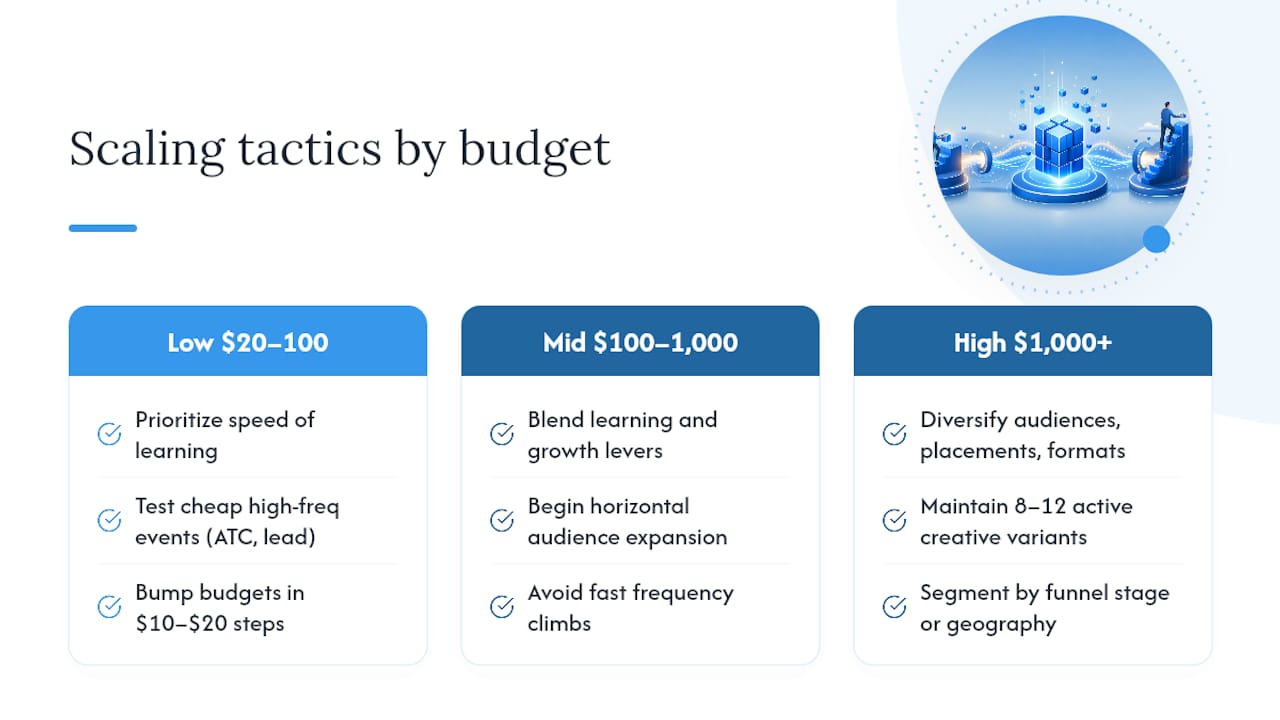
Mid budget ($100 to $1,000/day): Blend both levers. This is where horizontal expansion starts paying off, since a single audience can no longer absorb the spend without frequency climbing too fast.
High budget ($1,000+/day): Diversify aggressively across audiences, placements, and creative formats. Maintain a creative library of at least 8 to 12 active variants so no single ad set starves for fresh input. Segment campaigns by funnel stage or geography to prevent one underperforming pocket from dragging down account-wide metrics.
Fixing Ad Fatigue Before It Kills Your Scale
Creative fatigue and audience saturation look similar on a dashboard but need different fixes. Rising frequency paired with falling CTR usually points to fatigue. Rising CPA with stable frequency and CTR often means the audience itself is tapped out. A sudden conversion rate drop with steady traffic usually means the landing page, not the ad, is the problem.
The data on fatigue is stark. Meta’s own decay curve shows conversion likelihood dropping roughly 45% by the fourth exposure to the same ad.
- Add creative with a different angle, format, or hook rather than minor variations
- Rotate among different formats like video, static, or UGC styles to maintain visual interest
- Broaden the audience if frequency increases but creative still performs well elsewhere
Pro Tip: Avoid editing a live, fatigued ad directly since it resets optimization data. Launch a new ad within the same ad set instead.
Naming variants by concept (“UGC_Testimonial_v2”, “Static_Offer_Bold”) rather than by date alone makes it far easier to spot which creative angle is actually driving the lift once you scale production.
What to Measure While You Scale
Four numbers matter more than any others during a scale-up: ROAS, CPA, conversion rate, and frequency. Watching them in isolation misses the story. A rising CPA alongside a still-clearing learning phase is normal. The same CPA rise after the learning phase has settled is a warning sign.
| Metric | What to watch for |
|---|---|
| ROAS | Flat or improving trend over 7 to 30 days |
| CPA | No more than a 20% rise after a budget increase |
| Frequency | Below 3 to 4 for cold-audience campaigns |
| Conversion rate | Stable, not spiking off small sample sizes |
- Pull performance in 7-day windows minimum before making a scaling decision
- Cross-check Meta’s reported conversions against your CRM or analytics platform to catch attribution drift
- Roll back a budget increase if CPA breaches your threshold for two consecutive days
- Accelerate only when ROAS and conversion rate hold steady across a full week post-increase
Common Scaling Mistakes and How to Fix Them
Most scaling failures trace back to one of a handful of repeatable errors. Diagnosing them in order, creative first, then audience, then landing page, then attribution, saves hours of guessing.
- Scaling too fast. Jumping budget by 50% or more in one move almost always resets learning and spikes CPA. Fix: drop back to 10 to 20% increments.
- Relying on a single creative. One winning ad can’t carry scaled spend indefinitely. Fix: keep 3 to 5 active variants at all times.
- Ignoring the landing page. A slow or broken page will sink even perfect ad performance. Fix: audit load speed and mobile conversion flow before blaming the ad account.
- Calling winners on tiny samples. A “winner” after 10 conversions is a guess, not a result. Fix: wait for 25 to 30 conversions minimum before committing budget.
Agency Proof: What Actually Works in Client Accounts
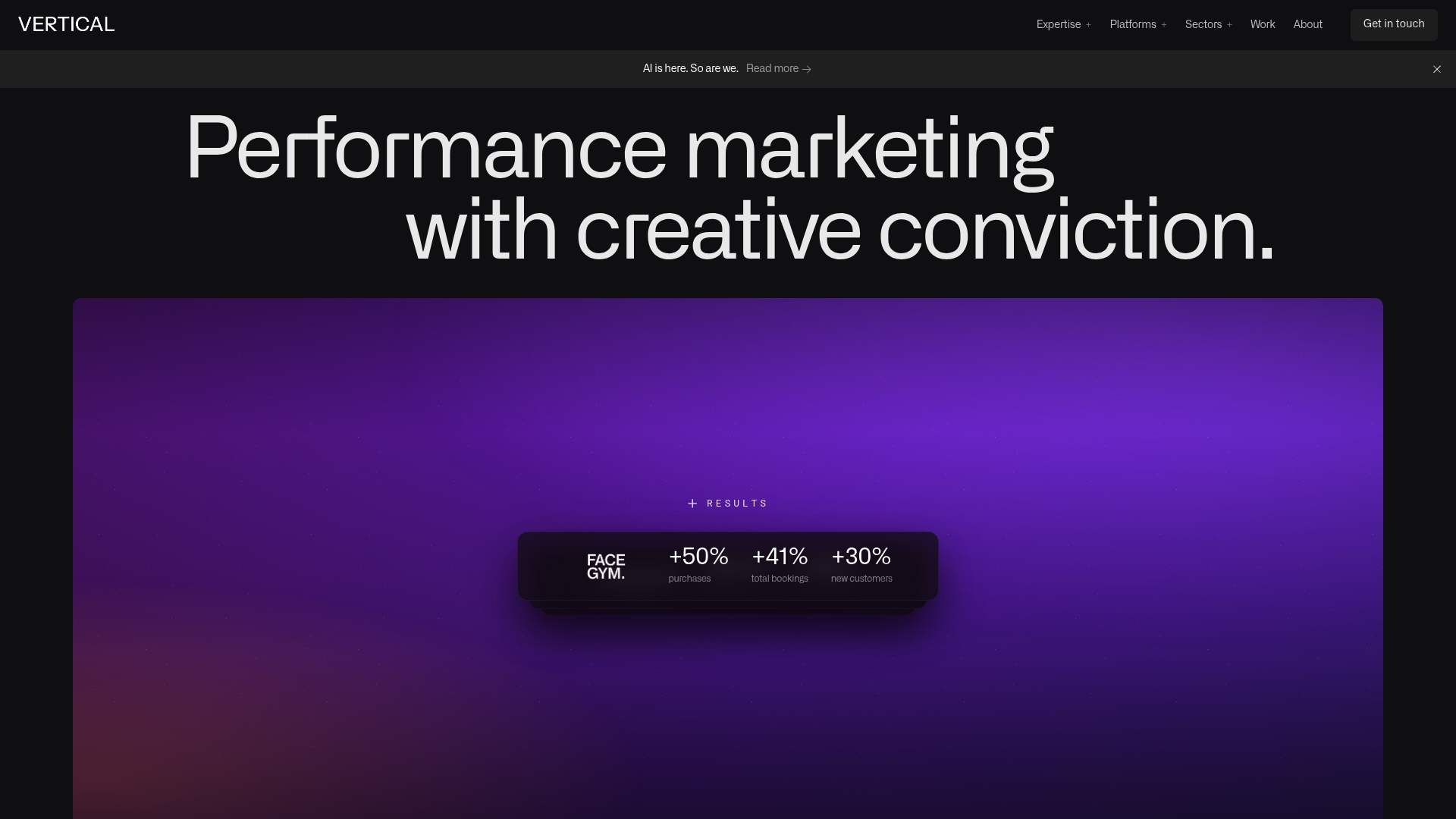
Vertical Brands ran this exact cadence for FACEGYM, pairing disciplined vertical budget increases with a steady creative refresh schedule tied to fatigue signals rather than a fixed calendar.
The lesson that keeps repeating across client accounts: the campaigns that scale cleanly aren’t the ones with the boldest budget jumps. They’re the ones where creative production kept pace with spend, and where the landing page got the same scrutiny as the ad itself.
Working across accounts like Tribal reinforced a similar pattern: naming conventions and creative throughput often determine whether a scaling plan survives contact with a real budget.
The Part of Scaling Nobody Wants to Admit
Most scaling advice treats budget increases as the main event. It isn’t. The accounts that scale cleanly are the ones where creative production keeps pace with spend, not the ones with the most disciplined percentage increases.
You’re buying time until fatigue catches up, not building durable performance. The conventional advice, “just increase budget by X% every few days”, treats vertical scaling as sufficient on its own. It never is past a certain spend level, because no single audience or creative can absorb unlimited reach without frequency climbing and response rates falling.
What the evidence actually supports is prioritizing horizontal capacity, new audiences, new creative angles, before you lean hard on vertical increases. Build the creative pipeline first. Then scale the budget. Do it in the other order and you’re just accelerating toward the same wall, faster.
— Alex
Managed Scaling Support From Vertical Brands
If reading this playbook made you realize your team doesn’t have the creative throughput to keep pace with budget increases, that’s the actual bottleneck worth solving. Vertical Brands runs paid social, creative production, and web optimization under one roof specifically so budget scaling and creative refresh happen on the same timeline instead of competing for resources.
Clients typically engage Vertical Brands on a retainer basis for ongoing scaling support, or as a project engagement to fix a specific funnel or creative bottleneck before ramping spend further. If your account is stalling on scale, talk to Vertical Brands about what a managed engagement would look like for your budget tier.
Sources
- Facebook Ad Fatigue: What It Is, How to Spot It, and How to Fix It
- Horizontal versus Vertical Database Scaling | Google Cloud
Recommended

Other posts































































Stay ahead with better decisions.
Get business insights today.
