The E-commerce Growth Stages Framework: A Strategic Blueprint for 2026
Throwing more capital at a broken structure is not scaling. It is expensive sabotage. Most D2C founders believe that increasing ad spend is the primary lever for growth, yet they often find themselves trapped by stagnating ROAS and fragmented data. You have likely noticed that whilst your budget gro...

Throwing more capital at a broken structure is not scaling. It is expensive sabotage. Most D2C founders believe that increasing ad spend is the primary lever for growth, yet they often find themselves trapped by stagnating ROAS and fragmented data. You have likely noticed that whilst your budget grows, your operational efficiency does not. This friction occurs because your business lacks a clear e-commerce growth stages framework to guide its evolution. Every of these stages require a fundamental shift in how you organise your team and your technology.
We understand the frustration of seeing increased spend fail to yield proportional results. This article provides a definitive five-stage blueprint to help you regain control over your scaling journey. You will learn how to master the structural requirements of a high-growth brand. Our goal is to ensure your operational readiness precedes your marketing expansion. We will preview the next 12 months of your roadmap, focusing on reducing customer acquisition costs and building a lean, high-performance engine. The criteria for success is structural integrity.
Key Takeaways
• Identify where your brand sits within the five-stage e-commerce growth stages framework to align your marketing spend with operational reality.
• Recognise that growth occurs in breakthroughs and plateaus rather than a linear line, requiring different strategies at each level.
• Each of these stages require a fundamental shift in your team structure and tech stack to avoid internal friction.
• Discover the specific trigger points that signal it is time to move forward, such as the necessity of an SEO audit before entering Stage 4.
• Master a brands ability to scale by focusing on structural integrity and Klaviyo management for long term profitability.
The Structural Reality of the E-commerce Growth Stages Framework
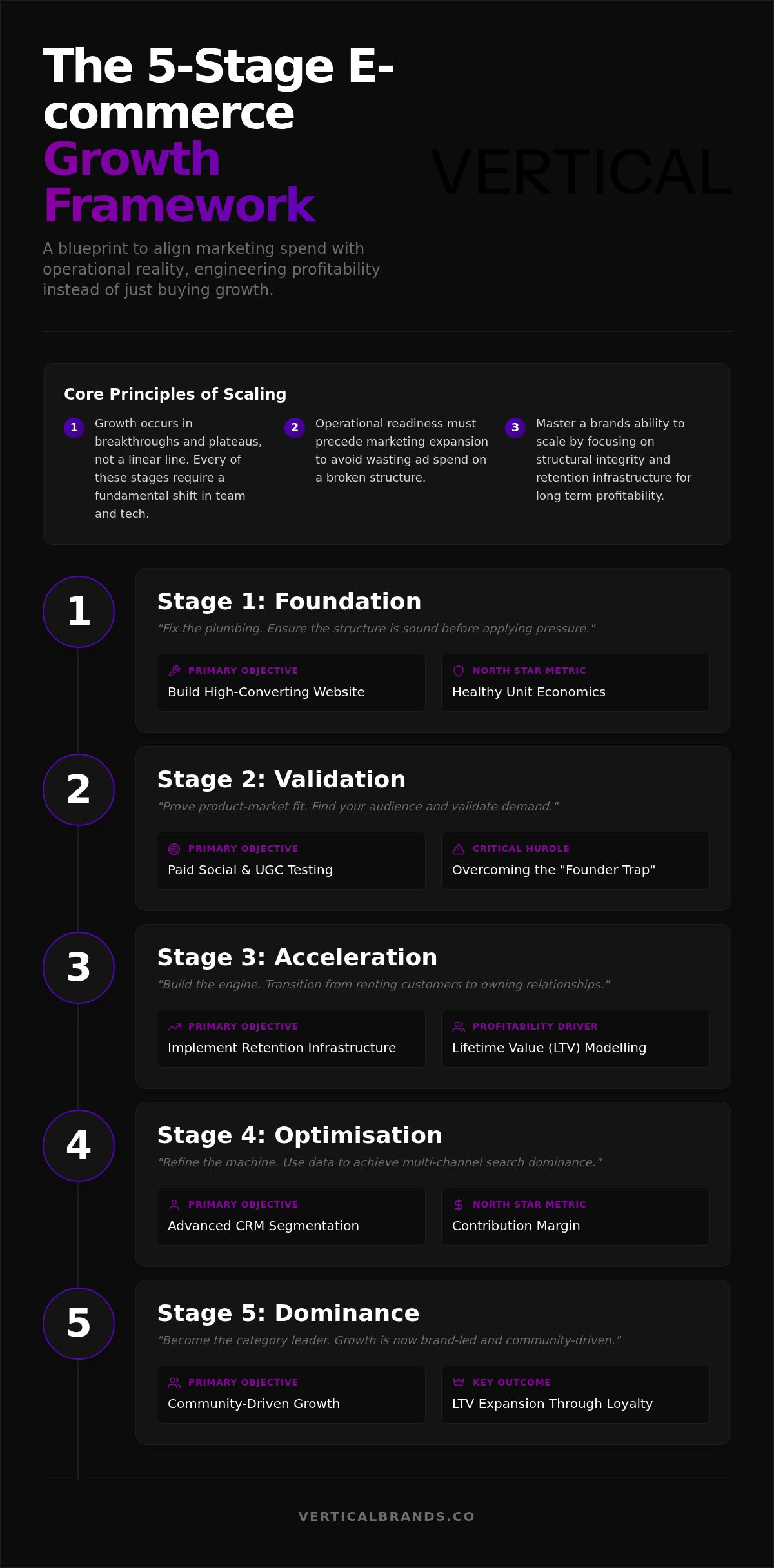
Growth is not a straight line. It is a series of violent shifts. Most D2C brands fail because they treat scaling as a simple volume game. It isn't. The e-commerce growth stages framework defines five distinct phases: Foundation, Validation, Acceleration, Optimisation, and Dominance. Every of these stages require a fundamental shift in how you organise your team and your capital.
Linear scaling is a myth. Success arrives in breakthroughs followed by long plateaus. During these plateaus, internal friction builds up. We call this "Operational Debt". This is the accumulated cost of using manual workarounds instead of scalable systems. If you ignore this debt, you'll waste ad spend attempting to push through a ceiling that is structural, not promotional. Much like the product life cycle stages, your brand must evolve its internal mechanics to survive. Wasted ad spend is the inevitable result of scaling marketing before fixing the foundation. You cannot outspend a broken conversion rate or a high churn rate.
The Core Pillars of Scale
Scaling relies on three specific pillars. Customer Acquisition. Retention Infrastructure. Operational Excellence. In the early stages, acquisition carries the most weight. You need volume to prove the concept. As you mature, the weight shifts. By Stage 3, Retention Infrastructure becomes the primary driver of profitability. Without it, you're just renting customers. Each stage requires a North Star metric. In Foundation, it's unit economics. In Optimisation, it's contribution margin. Operational Excellence ensures that your supply chain and customer service can handle the volume generated by your paid social efforts. If your infrastructure breaks, your growth will be short-lived.
Why Most Brands Stall at Stage Two
Stage 2 is where the "Founder Trap" becomes fatal. Initial success is often built on raw hustle. The founder manages every detail. This manual intervention works for a while. However, it cannot scale. Manual processes are the friction that prevents a brand from reaching Acceleration. You must transition from hustle to systems. This means delegating performance marketing and automating CRM workflows. If the founder remains the bottleneck, the brand cannot grow beyond it's current plateau. The e-commerce growth stages framework is a strategic tool designed to ensure your business structure remains aligned with your revenue goals.
The 5-Stage Framework for Sustainable Brand Scaling
The e-commerce growth stages framework provides a disciplined path from startup to market leader. It moves beyond buying growth to engineering profitability. Scaling a D2C brand requires a methodical approach that aligns your marketing spend with your internal infrastructure.
Stage 1: Foundation.
Fix the plumbing. Build a high-converting website. Ensure unit economics are healthy before you spend a penny on ads.
Stage 2: Validation.
Prove product-market fit. Use paid social management and UGC to find your audience.
Stage 3: Acceleration.
Build the engine. Implement Klaviyo migration services to stop the leak in your bucket.
Stage 4: Optimisation.
Refine the machine. Use advanced CRM segmentation and multi-channel search dominance to capture demand.
Stage 5: Dominance.
Become the category leader. Growth is brand-led and community-driven. LTV expands through loyalty.
Stage 1 and 2: Proving the Concept
Stop wasting budget on polished studio ads. In 2026, authenticity is the only currency that matters. High-quality UGC content outperforms over-produced creative because it builds trust. Each of these stages require rapid testing and iteration. You don't guess what works; you use paid social to identify winning creative angles early. This data points to exactly what your customers want. If a creative fails at low spend, it will never scale. Speed of execution is your primary advantage during these initial phases.
Stage 3: Building the Engine
At this level, CRM management becomes the primary driver of your profitability. You cannot survive on first-purchase margins whilst ad costs rise. Transition from single-purchase thinking to lifetime value modelling. Integrate search and social to create a unified customer journey. If a prospect clicks an ad but doesn't buy, your automated flows must take over. This synergy reduces your reliance on expensive acquisition. The brands ability to scale depend on this transition. You need a strategic growth partner to ensure your infrastructure can handle the load. This is where the framework separates the winners from the brands that simply burn cash.
Identifying Your Current Stage: A Comparative Analysis
Self-awareness is a prerequisite for scaling. You cannot apply Stage 4 tactics to a Stage 1 business without risking total collapse. The e-commerce growth stages framework provides the necessary lens to evaluate your operational reality. Most founders misdiagnose their position by looking solely at top-line revenue. This is a mistake. True assessment requires a holistic view of your team structure, tech stack maturity, and contribution margins.
There is a fundamental difference between "Growth by Spend" and "Growth by Efficiency". Brute force scaling relies on increasing ad spend to hide structural weaknesses. It works whilst capital is cheap. However, it eventually leads to being "Stage Trapped". You might see high revenue, but your net profit remains stagnant or declining. This happens when your acquisition costs outpace your retention engine. The data suggest that most brands fails here because they over-invest in acquisition before they have the infrastructure to support it.
Revenue Benchmarks and Metrics
In the UK D2C market, ARR ranges provide a rough guide, but they aren't absolute. Stage 1 typically sits below £500k. Stage 2 ranges from £500k to £2m. This is the first "Danger Zone". During this transition, CAC often spikes as you exhaust your warmest audiences. You must pivot your focus from top-line revenue to contribution margin. If your margin doesn't support your overheads at £2m, it certainly won't at £10m. Scaling a loss is simply accelerating a bankruptcy.
Tech Stack Maturity
Your technology must mirror your maturity. A basic Shopify setup is sufficient for Validation. However, moving into Acceleration requires more. Every of these stages require a shift in how you handle data. You move from basic email lists to advanced CRM segmentation. This is where AI plays a critical role. It isn't about chatbots. It is about predictive modelling and improving business processes through automated decision-making. By Stage 4, you are likely looking at headless architectures or deeply integrated ERP systems to remove operational friction. If your tech stack feels like a collection of disconnected apps, you are likely Stage Trapped by technical debt.
Strategic Transition: How to Move Between Growth Phases
Transitions are the most volatile periods in the e-commerce growth stages framework. They require deliberate pivots in resource allocation rather than just more of the same. You'll recognise a "Trigger Point" when your current ad spend no longer produces the same yield. This plateau indicates that your acquisition model has outpaced your retention infrastructure. It's time to re-allocate budget. Move capital from pure acquisition into building a robust backend. You must also manage the psychological shift from founder-led hustle to agency-supported growth. Trusting a partner to handle performance marketing allows you to focus on high-level strategy.
Before entering Stage 4, a comprehensive e-commerce SEO audit is non-negotiable. You need to capture the organic demand your brand is now generating. Without this, you are leaving high-intent traffic to your competitors. Managing these shifts requires a disciplined approach to data. The data suggest that most brands fails to identify these triggers early enough to avoid a revenue dip.
Removing Friction from the Customer Journey
During Stage 3, your website becomes more than a storefront. It is a conversion engine. Performance-driven web design is essential here. Poor site speed or clunky UX will cripple your paid media efficiency. If your site takes three seconds to load, you're burning budget. Align your influencer marketing with seasonal scaling goals to create social proof. This ensures that the traffic you buy actually converts. Every of these transition require a ruthless focus on removing every point of friction between the click and the checkout.
The CRM Pivot
Automated email flows are the highest-ROI activity you can implement during Stage 3. This is where you stop renting audiences and start owning them. Move away from broad-batching. Implement data-driven personalisation based on actual purchase behaviour. Customer winback strategies are vital to protect your bottom line. If a customer hasn't purchased in 60 days, your CRM should react automatically. Protecting your margins is the priority whilst you scale. You cannot afford to ignore the compound interest of a loyal customer base.
If you are ready to scale without the friction, partner with our growth advisory team to engineer your transition.
Vertical Brands: Engineering Your Next Growth Phase
Vertical Brands acts as the strategic navigator for brands entering high-stakes scaling. We do not deal in marketing fluff. We deal in structural integrity and measurable outcomes. The UK e-commerce landscape is increasingly volatile. Success requires more than just a creative eye. It requires a disciplined, tactical guide who understands the mechanics of business. Our Growth Advisory service is built to remove the friction identified in the e-commerce growth stages framework. We align your operational capacity with your market ambition.
Scaling is a mechanical challenge. We solve it with an integrated approach that connects Paid Social, SEO, and CRM management. This synergy ensures that every pound spent on acquisition is supported by a robust retention engine. We don't just buy traffic. We engineer a system that converts and keeps it. Every of these stages require a partner who values efficiency over ceremony. We are the decisive driver of your progress.
The Vertical Brands Methodology
Our methodology is rooted in transparency. We remove operational complexity by focusing on the levers that actually drive growth. We prioritise Klaviyo and CRM systems as the bedrock of your business. Without a strong retention engine, acquisition is a waste of capital. A brands ability to scale depends on its data maturity. We also utilise technical SEO to build long-term organic authority. This reduces your reliance on paid media over time. We provide clarity whilst others provide excuses. We focus on the structural requirements that allow for sustainable, profitable expansion.
Next Steps for Ambitious Brands
The first step is a readiness audit. We identify exactly where you sit within the framework. This audit reveals the bottlenecks preventing your transition to the next phase. We look at your unit economics, your tech stack, and your team structure. This is not a surface-level review. It is a deep dive into your operational reality. We find the friction points that are currently costing you money.
Initiating a partnership with Vertical Brands is a commitment to performance. We are looking for ambitious D2C brands ready to move from hustle to systems. If your growth has plateaued, it is a structural issue. We have the blueprint to fix it. Contact our team today to discuss your specific growth trajectory and begin your next phase of scaling. Let's build the engine that drives your dominance in 2026.
Mastering the Structural Evolution of Your Brand
Scaling a D2C brand in 2026 is an exercise in discipline. You must resist the urge to buy growth through brute force. The e-commerce growth stages framework provides the necessary structure to ensure your operational readiness matches your market ambition. By identifying your current stage and addressing the underlying operational debt, you avoid the common plateaus that stall competitors. Every of these stages require a fundamental shift in how you allocate capital and manage your tech stack.
Success belongs to the brands that prioritise structural integrity over marketing fluff. Transitioning from founder-led hustle to a systems-driven engine is the only way to achieve sustainable dominance. We specialise in removing the friction that prevents this evolution. If you are ready to move beyond stagnating ROAS, partner with Vertical Brands to scale your e-commerce growth. Our approach combines Strategic Growth Advisory with specialised Klaviyo management to deliver performance-driven results. The brands ability to scale depend on having the right navigator. Let's build your next phase of growth together.
Frequently Asked Questions
What is the most critical stage in the e-commerce growth stages framework?
Acceleration is the most critical phase. It is where you transition from founder-led hustle to scalable systems. Most brands fail here because they try to skip the infrastructure requirements. This stage requires you to pivot your focus from pure acquisition to building a retention engine. If you don't secure your backend during this phase, your growth will be short-lived. Every of these stages require a specific focus on structural integrity.
How do I know if my brand is ready to move from Stage 2 to Stage 3?
Readiness is defined by your unit economics and creative validation. If your paid social campaigns are consistently identifying winning creative angles and your contribution margins are stable, you are ready. You must have proven product-market fit through UGC and initial social spend. Moving to Stage 3 requires a shift toward automation. If you are still manually managing every customer interaction, you are not yet prepared for the Acceleration phase.
There is many factors involved, but how much should I spend on ads at Stage 2?
Allocation varies based on your specific margins and vertical. However, industry data from 2026 suggests that e-commerce stores with under £1 million in annual revenue typically invest 25 to 35 per cent of their revenue into advertising. This aggressive spend is necessary to validate your product amongst a national audience. The goal is not immediate profit but proof of concept. You are buying data to refine your e-commerce growth stages framework.
Why does ROAS typically decrease as a brand scales into Stage 4?
ROAS decreases because you are moving beyond your warmest, most relevant audiences. As you scale into Stage 4, you begin targeting broader segments where competition is higher and intent is lower. This is why the brands ability to scale depends on shifting focus to contribution margin. You must offset lower acquisition efficiency with higher retention and better CRM management. Efficiency in Stage 4 is found in the backend, not the ad manager.
Can a brand skip stages in the growth framework?
Skipping stages is a recipe for structural failure. Each phase of the e-commerce growth stages framework exists to solve a specific operational need. If you attempt to move from Foundation to Optimisation without Validation, you will build on a broken base. This leads to "Operational Debt" that eventually becomes too expensive to service. You cannot automate a process that hasn't been proven to work manually first. Growth must be methodical.
How does Klaviyo integration impact the Acceleration stage?
Klaviyo is the primary engine for profitability during the Acceleration stage. It allows you to transition from single-purchase thinking to lifetime value modelling. By implementing automated email flows and data-driven personalisation, you reduce your reliance on expensive first-party acquisition. This integration ensures that the traffic you buy through paid social is captured and nurtured. Without a robust CRM setup, you are simply renting customers at an unsustainable cost.
What role does technical SEO play in the Dominance stage?
Technical SEO captures the organic demand created by your brand-led growth. As you reach the Dominance stage, consumers will search for your brand directly. A comprehensive SEO strategy ensures you own these search results and capture high-intent traffic without paying for every click. It builds long-term authority and improves your overall blended CAC. At this level, SEO is about defending your market position and removing friction from the discovery process.
What happens if a brand scales its marketing before its operations are ready?
Marketing expansion without operational readiness leads to a total collapse. You might see a temporary revenue spike, but it will be followed by high churn and poor customer experiences. Site speed will likely suffer, and your supply chain will fail to meet demand. This friction creates a negative feedback loop that damages your brand reputation. Wasted ad spend is the inevitable result when your infrastructure cannot support the volume your marketing generates.

Other posts

























































Stay ahead with better decisions.
Get business insights today.
