8 Klaviyo Flows to Build First with a 30 Minute Audit Plan
Run these eight flows before anything else: welcome series, abandoned cart, browse abandonment, post-purchase, back-in-stock, replenishment, win-back, and review request. Flows generate nearly 41% of total email revenue from just 5.3% of sends, so a single automation can outwork months of campaign sends. Start with a 30-minute audit of your abandoned cart, welcome, and post-purchase flows today.
TL;DR:
- Prioritize fixing exclusions and segmentation within your flows, especially separating cart and checkout triggers, to prevent customer conflict and double messaging.
- Focus first on optimizing abandoned cart, post-purchase, and welcome series flows, which deliver the highest revenue impact with the least setup effort.
- Regularly measure and test flow performance against benchmarks, aiming for click rates above 5.58% and revenue per recipient that exceeds campaign averages.
- Conduct a quick five-minute audit to identify missing education content, improper exclusions, and flow conflicts that limit flow effectiveness.
- Build in-house if you have dedicated resources and testing discipline; otherwise, consider consulting experts for rapid, strategic flow improvements.
Table of Contents
- Which Klaviyo flows examples should you build first?
- Per-flow playbook: trigger, timing, sequence, KPIs, and smart exclusions
- Orchestration: making flows work together instead of against each other
- What does healthy Klaviyo flow performance actually look like?
- Vertical’s mini-audit and agency-tested quick wins
- When flow optimization is a DIY job, and when it isn’t
- Sources
Which Klaviyo flows examples should you build first?
Not every flow deserves equal attention, and treating them that way is how teams waste weeks building automations nobody clicks. The eight flows below cover the customer lifecycle from first visit to repeat purchase, and Klaviyo’s own flow documentation treats most of them as standard starting points for any store. A few, like replenishment, only make sense for certain product types. Here’s how to think about each one.
- Welcome series. Triggered when someone joins your list, this flow turns a cold subscriber into a warm prospect by introducing your brand story and nudging a first purchase. It’s universal. Every store, regardless of category, needs one.
- Abandoned cart. Fires when a shopper adds items to their cart but doesn’t check out. This is usually the single highest-revenue flow in any Klaviyo account because the intent signal is so strong.
- Browse abandonment. Triggered by product-page views without an add-to-cart action. It’s a softer nudge than cart recovery, aimed at shoppers still in research mode. Universal, though conversion rates run lower than cart flows.
- Post-purchase. Kicks off right after an order confirms, covering shipping updates, product education, and setting expectations. Every store needs this one, and it’s the flow most likely to be neglected once the sale is closed.
- Back-in-stock. Notifies shoppers when a sold-out item returns to inventory. This flow depends on your product catalog having size or stock variance worth waiting for. A made-to-order brand may not need it at all.
- Replenishment. Reminds customers to reorder consumables on a predictable cycle, coffee, supplements, skincare, pet food. This one is entirely model-dependent. If you sell furniture or electronics, skip it.
- Win-back. Targets customers who haven’t purchased in a defined window, typically 60 to 120 days depending on your average repurchase cycle. Universal, but timing needs tuning to your category’s natural buying rhythm.
- Review request. Asks recent buyers for feedback and social proof, usually timed to arrive after the product has had time to be used. Universal, and one of the easiest flows to set up with the lowest maintenance once live.
If you’re triaging for speed, three of these move the needle fastest with the least setup effort: abandoned cart, post-purchase, and welcome series. Abandoned cart recovers revenue that’s already sitting on the table. Welcome series captures intent while it’s freshest. Post-purchase reduces returns and support tickets while quietly setting up the next sale. Browse abandonment, back-in-stock, and replenishment matter, but they’re refinements you layer in once the core three are dialed in. A long-form breakdown of real-brand flow examples backs this same prioritization: most agencies recommend running 6 to 10 flows depending on business model, not all 15 or so that Klaviyo’s template library technically offers.
Per-flow playbook: trigger, timing, sequence, KPIs, and smart exclusions
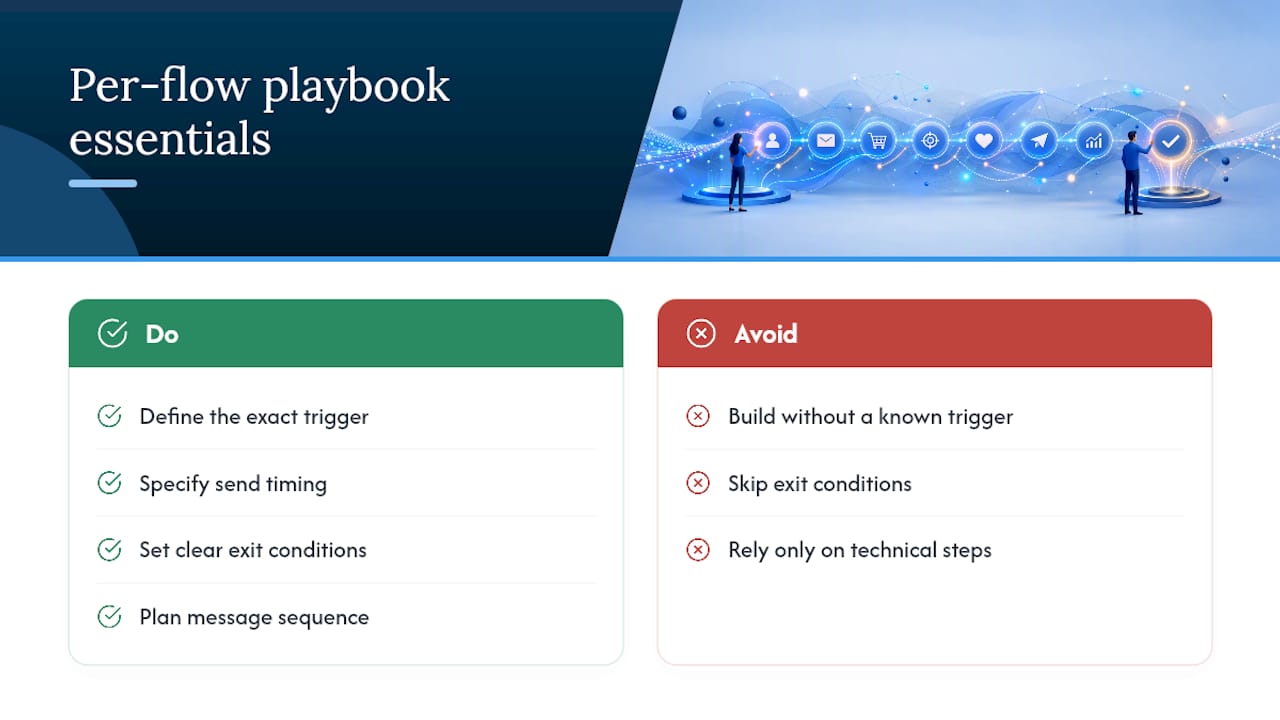
Building a flow without knowing its exact trigger, timing, and exit conditions is how teams end up double-messaging customers or missing the moment entirely. Klaviyo’s Academy documentation covers the technical build steps, but the strategic choices, when to send, what to say, when to stop, are where most flows actually succeed or fail.
Welcome series
- Trigger: subscribed to list (email or SMS signup, popup form entry).
- Timing: message one sends immediately; message two at 48 hours; message three at day 5 if no purchase.
- Message intents: introduce the brand and set expectations (“Welcome. Here’s what makes us different”), highlight a bestseller with social proof (“Why 12,000 customers picked this first”), close with urgency if a discount is offered (“Your code expires tonight”).
- KPIs: placed order rate, click rate (target above the 5.58% flow benchmark), and unsubscribe rate as a guardrail.
- Exclusions: stop the flow immediately once a purchase occurs. Don’t let a new customer receive a “welcome” email after they’ve already bought.
Pro Tip: Segment your welcome series by acquisition source when you can. A shopper who joined through a giveaway behaves very differently than one who signed up for a discount code, and a single generic sequence flattens that distinction.
Abandoned cart
- Trigger: started checkout or added to cart, no completed order within a set window (typically 30 to 60 minutes after inactivity).
- Timing: first message at 1 hour, second at 24 hours, third at 48 to 72 hours with the strongest incentive if you’re going to offer one.
- Message intents: reminder with product image (“You left something behind”), address objections like shipping cost or sizing (“Free returns on every order”), final nudge with scarcity or incentive (“Still thinking it over?”).
- KPIs: revenue per recipient, placed order rate, and click-to-open ratio since flows here typically run well above campaign-level benchmarks.
- Exclusions: exclude anyone who completes the purchase, and critically, treat cart abandonment and checkout abandonment as separate triggers. A shopper who reached the payment page and stalled needs different messaging than someone who never left the cart page, and without an explicit exclusion, they’ll get both sequences at once.
For a deeper build walkthrough with creative examples, Vertical Brands has a full breakdown of abandoned cart email tactics worth referencing when you’re writing the actual copy.
Browse abandonment
- Trigger: viewed product, no add-to-cart within a set window (often 4 to 12 hours).
- Timing: single message at 2 to 4 hours after the last viewed product; a second message only if you have a strong content angle, like a comparison guide or fit advice.
- Message intents: surface the viewed product plus two similar alternatives, answer a likely hesitation (sizing, materials, reviews), and stop there. This flow shouldn’t feel like a hard sell.
- KPIs: click rate and revenue per recipient, both usually lower than abandoned cart but still meaningfully above campaign averages.
- Exclusions: suppress anyone who’s entered the abandoned cart flow for the same session. Browse and cart abandonment triggering simultaneously is one of the most common flow conflicts in Klaviyo accounts.
Post-purchase
- Trigger: order placed (often split into a separate flow per product category if your catalog is diverse).
- Timing: confirmation immediately, shipping update at fulfillment, an education or usage-tip email 3 to 5 days after delivery, and a cross-sell or review nudge around day 10 to 14.
- Message intents: confirm the order and set delivery expectations, teach the customer how to get the most from the product, then introduce a complementary item once they’ve had time to use the first one.
- KPIs: return rate (as a negative-outcome guardrail), repeat purchase rate, and click rate on the education content.
- Exclusions: don’t run generic post-purchase content for subscription or replenishable products, route those into a dedicated post-purchase-to-replenishment handoff instead.
Vertical Brands covers this handoff in detail in a post-purchase flow guide, including how education content reduces returns before they happen.
Pro Tip: Use Klaviyo’s predicted next order date property to time your post-purchase-to-replenishment handoff instead of guessing a fixed day count. A customer who typically reorders every 45 days shouldn’t get the same generic 30-day reminder as someone on a 90-day cycle.
Back-in-stock
- Trigger: customer opts into a back-in-stock alert on a sold-out product variant.
- Timing: send within minutes of inventory syncing, delay kills urgency and conversion.
- Message intents: a single, direct message: “It’s back. Here’s your link before it sells out again.”
- KPIs: click-to-purchase conversion rate, since this audience has already shown strong purchase intent.
- Exclusions: cap sends per SKU restock to avoid alerting the same customer repeatedly if inventory fluctuates in small batches.
If your store runs on Shopify, syncing inventory correctly matters more here than almost anywhere else in your flow stack. Vertical Brands has a Shopify Klaviyo integration guide that covers the sync settings that make this flow reliable instead of flaky.
Replenishment
- Trigger: time elapsed since last purchase of a consumable product, ideally calculated from Klaviyo’s predicted next order date rather than a flat interval.
- Timing: first reminder at roughly 80% of the predicted reorder cycle, second reminder at 100%, with a stronger incentive if no action.
- Message intents: simple reminder (“Running low?”), convenience framing (“Set up a subscription and never think about it”), incentive if there’s still no response.
- KPIs: repeat purchase rate and subscription opt-in rate if you offer one.
- Exclusions: exclude anyone who’s already on a subscription plan for that product, they don’t need a manual reminder to do what’s already automated.
Win-back
- Trigger: no purchase within a defined lapsed window, tuned to your category’s typical repurchase cycle.
- Timing: first message at the start of the lapsed window, second at 30 days later with a stronger offer, final message positioned as a list-cleanup notice.
- Message intents: “We miss you” with a product update, a meaningful incentive to return, and a last-chance message that also serves to clean disengaged profiles from your list.
- KPIs: reactivation rate and revenue per recipient; also track list health improvements from the sunset branch.
- Exclusions: branch non-openers after the final message into a sunset flow rather than continuing to email them indefinitely. Since Apple’s Mail Privacy Protection made open tracking unreliable, base this branch on click activity or a combined click-or-open rule instead of opens alone.
Review request
- Trigger: delivery confirmed, timed to when the product has likely been used (immediately for apparel, 2 to 3 weeks for skincare or supplements).
- Timing: single ask, with one reminder 7 days later for non-responders.
- Message intents: direct ask with a low-friction review link, light incentive if your review platform supports it.
- KPIs: review submission rate and, where available, review-to-repeat-purchase correlation.
- Exclusions: suppress anyone who’s already left a review or requested a return for that order.
Orchestration: making flows work together instead of against each other
The biggest failure point in most Klaviyo accounts isn’t a missing flow. It’s flows stepping on each other. A shopper gets a cart reminder and a browse abandonment email on the same day, or a loyal customer gets hit with a win-back offer three days after buying something. Fixing this starts with segmentation built on purchase behavior, not just engagement.
An RFM approach, ranking customers by recency, frequency, and monetary value, gives you a foundation that performs better than open-based segments alone, according to Klaviyo’s own segmentation framework. Five operational segments cover most of what an ecommerce team needs:
- Engaged 30d: clicked or purchased in the last 30 days, your active core audience for campaigns.
- VIP: top 10 to 20% by lifetime spend, deserving of earlier access and different tone in messaging.
- Repeat: two or more completed orders, the group your replenishment and cross-sell flows should lean on hardest.
- At-risk: past purchasers approaching their typical reorder window with no recent activity, the trigger point for a gentler nudge before win-back kicks in.
- Lapsed: no purchase or click within your category’s defined window, the win-back and eventual sunset population.
Exclusions are what keep these segments and flows from colliding. Treat abandoned cart and abandoned checkout as genuinely separate triggers with explicit suppression between them, a shopper mid-checkout doesn’t need a cart reminder too. Exclude anyone who’s completed a purchase from every pre-purchase flow they were in. And build a standing exclusion for recent purchasers across your win-back and browse abandonment flows so a customer isn’t nudged to buy something they bought yesterday.
To test whether your exclusions are actually working, run this checklist quarterly: pull a sample of profiles who received two or more emails in 24 hours, check whether any of them came from conflicting flows, verify your cart and checkout triggers use different metrics, and confirm every flow has a purchase-based exit condition, not just a time-based one.
On channel mix, add SMS or push only where the message carries genuine urgency, back-in-stock alerts and final-hour cart reminders are strong candidates, general welcome content usually isn’t. Cap SMS frequency separately from email since consent and fatigue thresholds are lower, and never let a single trigger fire both channels simultaneously without a coordination rule deciding which one wins. For teams weighing how flows fit into a broader retention stack, Vertical Brands has a related breakdown on choosing an ecommerce CRM that covers where Klaviyo starts and where a fuller CRM layer takes over.
What does healthy Klaviyo flow performance actually look like?
The benchmark gap is bigger than most marketers assume. Flows deliver over 3 times the click rate of campaigns, 5.58% versus 1.69%, and roughly 13 times the placed order rate. The top performing flows can achieve much higher revenue per recipient compared to average campaign sends, instead of a fraction of that.
That gap is the entire argument for prioritizing flows over campaign volume. If your abandoned cart flow’s revenue per recipient sits well below the account’s flow average, that’s your first fix, not a new campaign idea. If your welcome series’ click rate lags the 5.58% flow benchmark, the subject lines or timing need work before you add a fourth email to the sequence.
A simple five-step measurement loop keeps this from becoming guesswork:
- Baseline each flow’s current click rate, placed order rate, and revenue per recipient over the last 90 days.
- Hypothesize one specific change, a new subject line, a different send delay, an added SMS touch.
- Test the change against a holdout or A/B split inside Klaviyo’s flow testing tools.
- Measure results against the baseline after enough volume to be meaningful, usually two to four weeks depending on traffic.
- Iterate, keeping what wins and discarding what doesn’t, then move to the next flow in priority order.
Vertical’s mini-audit and agency-tested quick wins
A recurring pattern across the accounts Vertical Brands has rebuilt: the flows already existed, but exclusions were missing, and post-purchase content was thin or absent entirely. Fixing segmentation logic and adding proper exclusion rules between cart and checkout flows, paired with a real post-purchase education sequence, tends to be the fastest lever available in an existing Klaviyo account.
Run this five-check mini-audit in under 30 minutes:
- Confirm abandoned cart and abandoned checkout have separate triggers and mutual exclusions.
- Check that post-purchase flows include at least one education or usage email, not just shipping confirmations.
- Verify win-back flows branch non-responders into a sunset sequence instead of emailing indefinitely.
- Look for any flow still relying purely on open-based conditions instead of click or combined click-or-open logic.
- Pull revenue per recipient for your top three flows and compare against your account’s own historical average.
Three fast tests worth running this week: split-test your abandoned cart’s first subject line between a direct reminder and a curiosity angle, measured on open-adjacent click rate; add a second post-purchase email focused purely on product education, measured on 30-day return rate; and test moving your win-back flow’s first send earlier by two weeks, measured on reactivation rate.
Pro Tip: Before adding a new flow, audit an existing one. Most accounts get more revenue lift from fixing exclusions on their current flows than from building a ninth automation nobody’s staffed to maintain.
When flow optimization is a DIY job, and when it isn’t
Some teams should build this in-house. If you’ve got someone who can dedicate real hours weekly to Klaviyo, a working grasp of your analytics, and the creative bandwidth to write and test new sequences monthly, DIY works fine. The honest checklist: do you have consistent bandwidth (not “whenever there’s time”), someone who reads your flow reports rather than just glancing at open rates, a creative resource who can turn around new emails without a three-week wait, and an actual testing cadence rather than a “we’ll get to it” backlog?
If two or more of those are missing, that’s usually where things stall. The fixes we apply fastest for new clients are rarely exotic: correcting exclusion logic between cart and checkout, building out segmentation that’s been sitting untouched since setup, and adding the post-purchase education content that almost never got prioritized because it doesn’t feel urgent until returns start climbing.
If you’re not sure which category you’re in, that’s worth figuring out before you spend another quarter guessing. Vertical Brands works with ecommerce teams to run exactly this kind of audit and build out the flow stack properly the first time.
— Alex
Sources
- 2026 Email Marketing Benchmarks by Industry - Klaviyo
- Flow best practices and examples - Klaviyo Help
- Klaviyo Flow Examples (2026): Every Major Flow, With Real Brand Examples | Email Optimize
Recommended

Other posts





































Stay ahead with better decisions.
Get business insights today.
