Shopify SEO Agency UK: A Growth Framework for 2026
More Shopify traffic won’t fix a store if shoppers can’t find the right products or make a confident buying decision. Choosing a Shopify SEO agency UK businesses can trust starts with a better question: how will the work turn relevant search demand into product discovery and sales? The answer isn’t...

More Shopify traffic won’t fix a store if shoppers can’t find the right products or make a confident buying decision. Choosing a Shopify SEO agency UK businesses can trust starts with a better question: how will the work turn relevant search demand into product discovery and sales? The answer isn’t a rankings report. It’s a strategy that connects storefront structure, search intent and commercial priorities.
It’s frustrating when technical recommendations sit apart from day-to-day Shopify operations, or when content attracts visits without helping customers choose. Effective SEO needs to address both. Technical fixes, product-page improvements and content planning only work when they support how the store is organised and what customers need to find.
This guide explains what effective Shopify SEO involves, from technical foundations and on-page optimisation to useful content. It also sets out how to assess an agency’s expertise, strategic fit and reporting beyond rankings alone. You’ll learn how organic search can support acquisition, conversion and retention, and how SEO can work alongside paid search, paid social, email and CRM activity. The aim is a practical framework for sustainable e-commerce growth, not a disconnected list of search tasks.
Key Takeaways
• Look for SEO that improves organic discovery and store usability, not isolated content production or paid placement.
• Assess a Shopify SEO agency UK on strategic diagnosis, practical implementation, communication and commercial measurement, not rankings alone.
• Understand how crawlability, indexation and site structure affect whether shoppers can discover relevant products.
• Expect a clear process that connects business goals and search demand with prioritised work your team can implement.
• Align SEO with paid media, website development and customer retention so channel priorities work together to support growth.
What a Shopify SEO agency in the UK should deliver
A Shopify SEO agency should do more than identify keywords or supply a list of technical fixes. It should help people discover a store through organic search, make it easier for them to navigate, and attract visits that are relevant to the business.
Shopify SEO is the strategic and practical work of attracting relevant organic visits to a Shopify store, improving the route from search to product discovery, and supporting measurable commercial outcomes. It applies the principles of Search engine optimization (SEO) to a specific e-commerce platform. Platform familiarity matters because recommendations need to account for the store’s structure and operations. But knowing Shopify alone doesn’t guarantee growth. Priorities must connect search demand with the products, customers and resources that matter to the business.
SEO is different from paid placement, installing an app or producing content in isolation. Those activities may have a role, but they don’t replace a considered strategy, joined-up implementation and ongoing measurement. An audit document is only useful when its findings become prioritised work.
What does Shopify SEO include?
A considered programme covers technical foundations, store architecture, on-page optimisation and search-led content. Technical work supports crawlability and indexation. Architecture helps shoppers and search engines understand how collections and products relate. On-page improvements make each page clearer and more useful.
Collection pages can serve broader category-level research, whilst product pages can address specific needs, features or buying considerations. The aim isn’t to repeat the same phrase across every page. It’s to give each page a clear purpose and match it to a relevant type of search. A useful plan also connect recommendations to implementation and measurement, so the team can see what was completed and assess its effect.
When does a Shopify brand need agency support?
Agency support may be useful when organic visibility has stalled, teams can’t agree on priorities, or technical issues appear to be limiting product discovery. It can also help when a growing catalogue or complex site structure makes it harder to organise collections, products and content for shoppers and search engines.
Capacity matters too. If a team understands what needs attention but lacks the time or development resource to implement it, a strategy without practical follow-through won’t move the work forward. The right level of support depends on the store’s needs and internal capability. A smaller business with clear priorities and the resource to act may be able to manage SEO in-house. The decision should follow the operational gap, not the platform alone.
How Shopify SEO connects technical foundations with product discovery
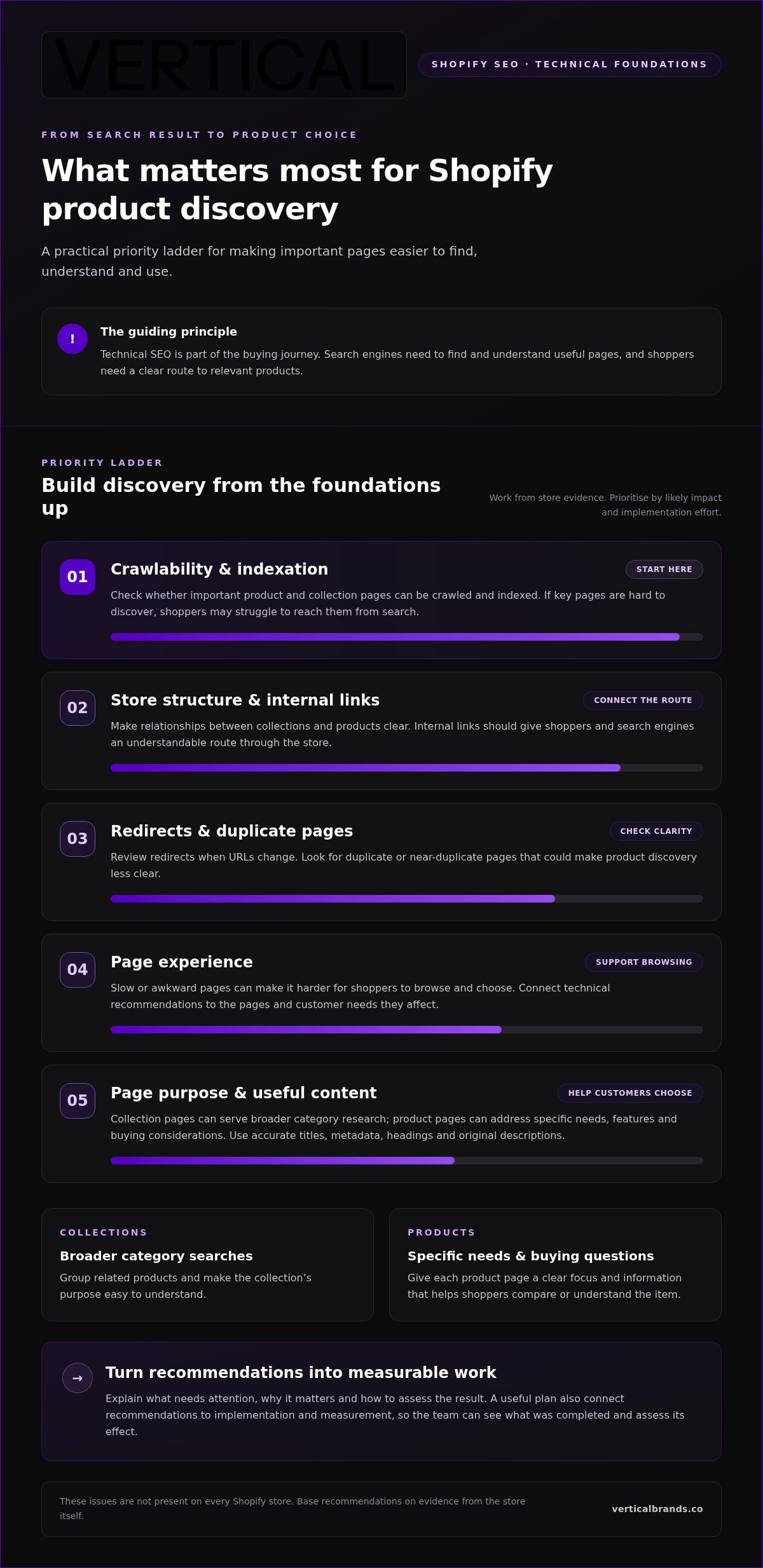
Organic product discovery depends on more than strong copy. Search engines need to find and understand useful pages, while shoppers need a clear route from a search result to products that meet their needs. Crawlability, indexation, site structure and page experience work together. A problem in one area can make relevant pages harder to discover or use.
Clear site architecture helps search engines interpret how pages relate and helps shoppers reach the products and categories they came to find. That makes technical SEO part of the buying journey, not a separate platform checklist. A Shopify SEO agency UK should connect technical recommendations to specific pages and customer needs.
Which Shopify technical SEO foundations matter?
Check whether important pages can be crawled and indexed, and whether internal links give visitors and search engines a clear route through the store. Review redirects when URLs change, and look for duplicate or near-duplicate pages that could make discovery less clear. These issues aren’t present on every Shopify store, so recommendations should be based on evidence from the store itself.
Prioritise fixes by likely impact and implementation effort. For example, resolving an issue affecting important product or collection pages may take precedence over a lower-impact refinement. Page experience matters too: slow or awkward pages can make it harder for shoppers to browse and choose. Good technical recommendations explain what needs attention, why it matters and how to assess the result.
How should product and collection pages earn organic visibility?
Give every important page a clear purpose. Collection pages group related products and can address broader category searches. Product pages should focus on the specific item and the questions a shopper may have before buying. The page title, metadata, headings and internal links should accurately describe that purpose, rather than force the same keyword onto every page.
Useful descriptions give customers information that helps them compare or understand products. Thin copy repeated across collections, or descriptions copied between similar products, gives shoppers little reason to stay or choose. Search-led content can answer questions earlier in the buying journey, then guide readers towards relevant categories or products. Strong pages are specific, original and written for people first.
Technical fixes and content improvements need to work as one system. A well-written page has limited value if it’s difficult to discover; a technically accessible page still needs useful information to meet search intent. For a joined-up approach to organic visibility and e-commerce SEO strategy, connect site structure, page content and implementation priorities.
How to compare Shopify SEO agencies beyond rankings
Rankings can indicate whether visibility is changing, but they don’t show the full value of SEO. Compare the thinking behind the work, whether recommendations are implemented, and how reporting connects progress to business priorities. A Shopify SEO agency UK should explain the link between activity and outcomes, including where the evidence has limits.
Use a consistent framework to assess the work:
| Area | What strong work looks like | What to look for |
|---|---|---|
| Strategic diagnosis | Analysis of the store’s starting position, search opportunities and constraints. | Priorities tied to business goals, rather than a generic checklist. |
| Implementation | Recommendations are translated into clear tasks, owners and dependencies. | Evidence of completed work, not just audit findings. |
| Communication | Updates explain progress, blockers and decisions in plain language. | Clear next actions and visibility of what needs the store team’s input. |
| Outcome measurement | Reporting connects organic performance with relevant commercial measures. | Context for changes, limitations and what happens next. |
What evidence should an agency provide?
Useful evidence explains the starting position, the work completed and the results measured. Rankings are one indicator, but they need context: which pages or queries changed, and did qualified organic traffic or other business-relevant measures move as well? The right outcome measures depend on the store’s objectives and available data.
Evidence should relate to the work described. A change in organic performance doesn’t automatically prove that one activity caused it. Credible reporting separates observed results from interpretation, notes limitations and sets out the next step. Case studies can help when their scope and outcomes are clearly explained, but unsupported claims or impressive figures without context offer little basis for comparison.
Can Shopify apps or an in-house team do the same job?
Sometimes, yes. Apps can support specific tasks, and an in-house team may have strong product knowledge and the capacity to manage ongoing improvements. Neither automatically replaces the strategic work of deciding what matters most, why it matters and how progress will be measured.
Specialist analysis or implementation can add value when internal capacity is stretched, priorities are unclear or technical work needs extra expertise. Agency support isn’t a universal requirement. The decision should reflect the store’s capabilities and workload. Reporting should make priorities, progress, constraints and next actions clear, so the business can direct effort where it is most useful.
What a Shopify SEO engagement should look like from audit to measurement
A useful SEO engagement follows a clear sequence. It starts with business goals, not a list of keywords. The agency needs to understand which products and categories matter, what growth objectives the store is pursuing, and what resource is available to implement changes. From there, it can diagnose the store, agree priorities, support implementation and review results.
Diagnosis should consider search demand alongside technical needs and operational capacity. A recommendation may be worthwhile in principle but impractical if it depends on development time the team doesn’t have. A strong Shopify SEO agency UK explains the trade-offs, clarifies what needs to happen first and adapts the plan as new evidence emerges.
How should an agency prioritise Shopify SEO work?
Group recommendations by relevance to business goals, expected effort, dependencies and urgency. A technical issue affecting important landing pages may need attention before a longer-term content programme. Content development or authority-building activity may still be valuable, but it often requires planning and sustained resource. Prioritisation makes those differences visible.
For each proposed task, explain why it matters, what it depends on and who needs to act. If a development change competes with another business priority, make the trade-off clear rather than treating every recommendation as equally urgent. The findings then informs a practical sequence the team can act on, not an unranked backlog.
Which measures belong in a Shopify SEO review?
Choose measures that reflect the agreed objectives. Organic visibility can show whether relevant pages are appearing for target searches. Landing-page traffic helps indicate whether people are reaching the right parts of the store. Conversion behaviour adds context about what visitors do after arriving. No single measure explains performance on its own, and changes should be interpreted alongside factors such as seasonality, site updates or shifts in demand.
Review SEO alongside paid media and CRM reporting to understand how channels contribute to acquisition and customer activity. Keep the results distinct: paid clicks aren’t organic visits, and CRM engagement doesn’t prove an SEO change caused a sale. Shared business objectives can guide channel planning without blurring attribution. Reporting should also separate observed results from forecasts, and state where data or implementation limits the conclusions.
A useful SEO reporting cycle reviews agreed measures, explains what changed, records constraints and sets the next actions. That gives stakeholders a clear view of progress without promising a fixed result. To align SEO priorities with wider growth goals, discuss your growth strategy with Vertical Brands.
How Vertical Brands connects Shopify SEO with wider e-commerce growth
Organic search performs best as part of a coherent growth plan, not an isolated stream of recommendations. Vertical Brands connects SEO with relevant capabilities across paid media, Klaviyo and CRM management, growth advisory, and website design and development. The aim is joined-up planning, with organic search retaining its own priorities and measures.
For brands considering a Shopify SEO agency UK, strategic fit matters as much as platform familiarity. The work should start with the store’s commercial goals and constraints, then turn diagnosis into a prioritised plan the team can put into action. Reporting should show what has been done, what has changed and what needs attention next, without claiming results that haven’t been demonstrated.
Why connect SEO with paid media, CRM and web development?
Each channel contributes differently. Paid search data can offer useful insight into search terms and customer intent, helping inform organic research. It doesn’t make paid and organic interchangeable: paid activity buys placement, while SEO develops organic visibility over time.
SEO may bring new visitors to relevant pages. Email and CRM activity can support communication with customers after that visit, helping connect acquisition with retention. Website development matters too. Technical recommendations often depend on changes to the site, and development decisions can affect usability as well as how easily SEO work is implemented. Coordinated planning helps teams understand dependencies, while the objectives for each channel stays distinct.
What should the next step be for a Shopify brand?
Start by setting out the growth priorities the SEO strategy needs to support. Note current constraints, such as limited development capacity or competing marketing activity, and identify the questions you need the work to answer. This gives the strategy a practical starting point and helps keep recommendations focused on the business, not generic platform tasks.
Assess the approach against three tests: strategic fit with your goals, the capability to move recommendations into implementation, and transparent measurement of progress. Vertical Brands brings SEO together with website development and wider growth capabilities, so channel plans can work towards shared commercial priorities without blurring attribution.
Build a clearer route from organic discovery to e-commerce growth. Discuss your e-commerce growth strategy with Vertical Brands.
Make organic search part of your next growth move
Effective Shopify SEO connects technical foundations, useful product and collection pages, and measurement tied to business priorities. Choosing a Shopify SEO agency UK partner means looking beyond rankings to strategic fit, implementation capability and clear reporting. Recommendations should reflect what customers are searching for and what your team can put into action.
Organic search also has a role within a wider e-commerce plan. Vertical Brands offers SEO alongside paid social and paid search, with Klaviyo and CRM management to support customer retention. Website design and development can help put technical recommendations into practice and improve the store experience. These channels can support shared growth objectives whilst keeping each channel’s contribution distinct. The strongest plans connect acquisition, implementation and retention around clear priorities.
Set out the growth questions your store needs to answer, then build a plan around them. Discuss your e-commerce growth strategy with Vertical Brands and take a clear next step towards sustainable organic growth.
Frequently Asked Questions
What does a Shopify SEO agency do?
A Shopify SEO agency helps improve a store’s organic visibility and makes it easier for relevant shoppers to discover products. The work can include technical analysis, site structure, product and collection page optimisation, search-led content, implementation planning and performance review. Strong support connects these activities to business objectives. It goes beyond installing an app or supplying an audit, with clear priorities and reporting on what was completed and what changed.
How do I choose a Shopify SEO agency in the UK?
Assess a Shopify SEO agency UK businesses can rely on by looking for strategic diagnosis, practical implementation and transparent measurement. The agency should explain the store’s starting position, why it recommends particular work and how it will report progress. Look beyond rankings: assess how it will measure relevant organic visits and business outcomes, and how it will distinguish results from estimates or assumptions. Strategic fit and delivery capability matter as much as platform knowledge.
Is Shopify good for SEO?
Shopify can support a sound SEO strategy, but the platform alone doesn’t determine organic performance. Results also depend on whether important pages can be discovered and indexed, how the store is organised, the usefulness of its product and collection pages, and the experience shoppers get. Review the individual store rather than assuming it has a platform-wide problem. A clear structure, relevant content and well-prioritised technical work can all support product discovery.
Can I do Shopify SEO myself?
Yes. A store team can manage SEO in-house if it has the time and skills to research search intent, improve pages, review technical issues and track performance. Shopify apps may assist with specific tasks, but they don’t decide which work should come first or whether it supports commercial goals. Agency support can add specialist analysis or implementation capacity when priorities are unclear or internal resource is limited. It isn’t essential for every store.
How long does Shopify SEO take to work?
There’s no reliable fixed timeframe for SEO results. Progress depends on the store’s starting position, the changes required, how quickly recommendations are implemented, search competition and how demand changes. Some technical improvements may be completed before their effect on organic performance is clear. Set a baseline, agree what to measure and review changes over time. Treat forecasts as estimates, not guaranteed outcomes, and use reporting to adapt priorities as evidence develops.
What should Shopify SEO reporting include?
Useful reporting covers agreed objectives, work completed, organic visibility, relevant landing-page traffic and conversion behaviour. It should explain what changed, where results are uncertain and what the next actions are. Rankings can offer context, but they don’t show the whole commercial picture. Compare performance over suitable periods and note relevant changes to the site or business. The right measures depends on the store’s goals and the data available.
Do Shopify SEO agencies also help with paid media and email marketing?
Some agencies provide SEO alongside paid media and email marketing, but their services vary. Vertical Brands offers SEO, paid social and paid search, as well as Klaviyo and CRM management. Paid search can inform understanding of search intent, whilst email and CRM can support customer retention after an organic visit. These channels can align around shared business goals, but their performance should be reported distinctly rather than treated as interchangeable.

Other posts


























































Stay ahead with better decisions.
Get business insights today.
