Klaviyo vs Mailchimp for E-commerce: The Strategic Comparison for 2026
Your email list is not an asset if it is merely a static database of names. In 2026, a list without deep data integration is a liability. A drain on resources. Choosing between Klaviyo vs Mailchimp for e-commerce is no longer about aesthetics. It is about which technical infrastructure can actually...

Your email list is not an asset if it is merely a static database of names. In 2026, a list without deep data integration is a liability. A drain on resources. Choosing between Klaviyo vs Mailchimp for e-commerce is no longer about aesthetics. It is about which technical infrastructure can actually turn your customer data into revenue. Neither platform is perfect for every brand. The choice you make today determines your ceiling for the next three years.
You likely feel the pressure of fragmented data. You cannot trigger complex automated flows based on specific purchase behaviour. A common friction point whilst trying to scale. This article provides the clarity you need. We move from a startup mindset to a disciplined scaling phase. Discover which platform delivers the unified customer view required to increase your repeat purchase rate. We examine the latest 2026 pricing updates, Mailchimp's restricted free plan, and Klaviyo's new Flows 2.0 engine to find a better ROI for your spend.
Key Takeaways
• Identify why list-based architecture in Mailchimp creates data silos that restricts your growth.
• Understand how Klaviyo vs Mailchimp for e-commerce boils down to the depth of your behavioural triggers and automated flows.
• Learn why migration is a strategic re-architecting of your data rather than a simple list transfer.
• Evaluate the 2026 pricing tiers to determine which platform offers the most structural integrity for your specific volume.
• Discover how dynamic segmentation ensure your marketing remains relevant as customer behaviour evolves.
Beyond the Inbox: Why Your Choice of ESP Defines Your Growth Ceiling
Your choice of email service provider (ESP) dictates your revenue potential. It is the foundation of your digital shop. Many brands treat their ESP as a utility. A simple way to send newsletters. This is a strategic error. The difference between Klaviyo vs Mailchimp for e-commerce are significant for scaling brands. Mailchimp began as a generalist tool. It was built for newsletters. Klaviyo was engineered for e-commerce data from the ground up. This distinction defines your growth ceiling.
The Evolution of E-commerce Email Marketing
The market in 2026 does not tolerate generic messaging. Static lists are obsolete. Modern email marketing requires granular customer journeys. You must move from batch-and-blast to behaviour-based triggers. Vertical Brands views email as the core of your growth engine. It is not a siloed channel. It is the connective tissue between paid social and retention. Without precision data, your performance marketing lacks the feedback loop required for profitability. Personalisation is no longer a luxury whilst competing for attention in a crowded inbox.
Defining the Growth Ceiling
Growth brands often hit a wall with generalist tools. You want to personalise at scale but the system cannot keep up. Signs of a growth ceiling include fragmented customer data and delayed syncing. If your store data takes hours to reach your email tool, you lose revenue. Real-time syncing is non-negotiable. Many founders choose Mailchimp because it is "easy to use". As your team expands, this simplicity become a liability. It lacks the technical depth needed for complex automation.
Strategic alignment between your CRM and performance marketing is the key. You cannot scale efficiently if your data is trapped in a newsletter tool. When evaluating Klaviyo vs Mailchimp for e-commerce, consider the depth of your future roadmap. Klaviyo provides the infrastructure to build a unified customer view. This is how you lower customer acquisition costs. It is how you drive repeat purchases. High-growth brands, such as the hand-made furniture specialists Urban Reclamation, don't just send emails. They architect revenue engines.
Data Architecture and Integration: Static Lists vs Dynamic Customer Profiles
Data is the fuel for your growth engine. Architecture is the engine itself. Many brands overlook this fundamental truth when comparing Klaviyo vs Mailchimp for e-commerce. They focus on email templates or user interfaces. This is a strategic mistake. The way a platform stores and processes data determines your ability to scale. Static lists create friction. Dynamic profiles drive revenue. Structural integrity is the foundation of high-performance marketing.
Understanding List-Based vs Profile-Based Systems
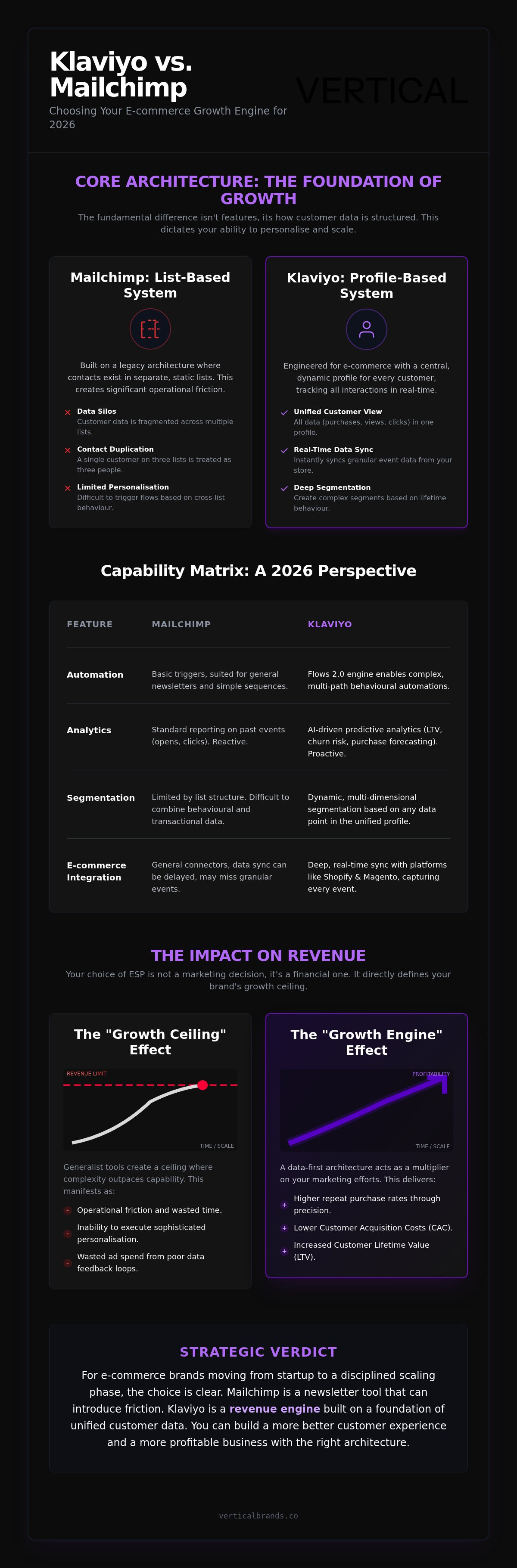
Mailchimp operates on a legacy list-based architecture. This often leads to significant data silos. If a customer exists on three separate lists, they are treated as three distinct entities. This duplication creates a fragmented view of the customer journey. It makes cross-channel personalisation nearly impossible. You cannot track a single user across their entire lifecycle with precision. This leads to redundant messaging and wasted spend. It’s a common frustration for scaling brands.
Klaviyo provide a central customer profile. It tracks every interaction in one place. Website visits. Product views. Abandoned baskets. Past purchase behaviour. All of it is unified. This profile is essential for omnichannel growth strategies. It ensures your data integrity remains high across every touchpoint. High-quality data is the bedrock of every successful paid social campaign. Without it, your targeting is mere guesswork. If you need to align your data with your growth goals, our growth advisory team can audit your current infrastructure. We focus on removing technical friction.
Predictive Analytics and AI in 2026
The 2026 landscape is defined by predictive capabilities. Mailchimp offers standard reporting. It tells you what happened in the past. It is reactive. Klaviyo utilises AI-driven insights to forecast the future. It is proactive. You can accurately forecast customer lifetime value (LTV) and churn risk. This allows you to intervene with a targeted offer before a customer leaves. It identifies your most valuable segments automatically based on purchase frequency and spend. To push these boundaries, Navo Inc. offers specialised coaching on deploying AI agents that can manage and act upon this data autonomously.
Deep integration with platforms like Shopify and Magento is non-negotiable for performance. Klaviyo syncs data in real-time. This includes granular event data that generalist tools often miss. You can use these insights to inform your broader search engine optimisation strategy. Identifying high-intent search terms based on actual purchase patterns. When you understand what your best customers want, you can build a more better content strategy. Data architecture is not a technical detail. It is a decisive strategic advantage.
Automation and Segmentation: Scaling Revenue Through Precision Behavioural Triggers
Precision is the method. Revenue is the objective. When evaluating Klaviyo vs Mailchimp for e-commerce, automation is where the gap widens. Mailchimp offers basic triggers. Abandoned carts. Welcome sequences. These are entry-level requirements. High-growth brands need more. They need multi-branch logic that reacts to specific user behaviours in real time. Neither platform are identical in their execution of these tasks. Strategic automation is the engine of repeat purchase rates. It transforms a one-time buyer into a loyal advocate.
The Power of Behavioural Triggers
Browse abandonment is a core revenue driver. It captures intent before the basket. Cross-sell flows leverage past purchase data to increase average order value. This allow for a highly personalised experience. You must align your Klaviyo automation flow setup with your broader growth goals. SMS should not be an afterthought. It is a high-urgency channel. It works best when integrated directly into your email flows. A unified journey reduces friction. Advanced flows like price drop alerts and back-in-stock notifications drive direct revenue without manual intervention. These triggers ensure you capture every possible conversion opportunity.
Dynamic Segmentation for Personalisation at Scale
Segmentation is the only way to combat rising customer acquisition costs (CAC). In Klaviyo, segments are dynamic. Users move between them based on their latest actions. You can target by LTV, purchase frequency, or engagement levels. This level of granularity is missing in list-based systems. It allows you to exclude unengaged users automatically. This protects your deliverability. Use these segments to improve your paid search campaigns. Sync your high-value segments to Google or Meta. This ensures your ad spend is focused on profiles with the highest conversion probability. Personalisation at scale is a technical challenge. It requires a disciplined approach to data. Without it, you are just guessing. Dynamic segmentation ensures your marketing remains relevant as customer behaviour evolves.
Pricing and ROI: Calculating the Real Cost of Operational Friction
Cost is a secondary metric. Revenue is the primary objective. Many founders choose their tech stack based on the monthly subscription fee. This is a narrow view. When comparing Klaviyo vs Mailchimp for e-commerce, you must look beyond the invoice. You must calculate the cost of lost opportunity. A cheaper platform that lacks deep data integration is an expensive mistake. Operational friction is a silent tax on your growth. Neither platform are equal when it comes to generating a measurable return on investment.
Subscription Costs vs Revenue Generation
Mailchimp pricing appears lower at entry levels. It scales aggressively as your contact volume grows. In 2026, the Mailchimp free plan is a trap for growing brands. It was reduced to 250 contacts and 500 monthly sends. Essential features like automations and A/B testing were removed. This forces you into paid tiers earlier than expected. An Essentials plan starts at approximately £10 per month for 500 contacts. However, the lack of advanced e-commerce triggers limits your upside.
Klaviyo pricing reflects its value as a revenue engine. A plan for 500 contacts starts at approximately £16 per month. This is a higher upfront cost. Yet, the technical infrastructure allows for a more better ROI. You aren't just paying to send emails. You are paying for a data platform that drives repeat purchases. High-growth brands often see a revenue lift within 90 days of migration. The value generated usually far outweighs the monthly fee. We help our clients justify this investment through clear ROI forecasting and performance audits.
The Operational Efficiency Factor
Manual workarounds are expensive. If your team spends hours syncing lists or building basic segments, you are losing money. Professional management ensures you are getting the most from your tech stack. It removes the burden of campaign execution from your internal resources. Strategic alignment reduces the time spent on manual management. It allows for faster business scaling. Efficiency is not just about saving time. It is about removing the barriers to execution.
A platform that works for you is an asset. A platform you have to work for is a liability. If you are ready to stop fighting your tools, our growth advisory team can help you transition to a more robust infrastructure. We focus on performance-first results. We ensure your CRM is a decisive driver of progress rather than a source of friction. Scaling requires a disciplined approach to both tech and strategy. Don't let a lower monthly fee cap your brand's potential.
Strategic Execution: Why High-Growth Brands Migrate to Klaviyo
Migration is not a simple data transfer. It is an architectural overhaul. When brands evaluate Klaviyo vs Mailchimp for e-commerce, they often focus on the effort of moving. This is a tactical mistake. The real focus should be on re-architecting your data for scale. A successful transition requires a direct guide to Klaviyo migration to ensure no revenue is left behind. Brands that switch usually see an immediate increase in attributed revenue. This is the result of moving from a static list to a dynamic revenue engine.
The Migration Decision Matrix
Timing is a critical strategic factor. Moving from Mailchimp to Klaviyo should happen before your growth hits a plateau. Staying on an inadequate platform during peak seasons like Black Friday is a high-stakes gamble. You cannot afford data delays whilst your competitors are using real-time triggers. Neither platforms are suited for every stage of growth. If you feel limited by your current segments, the time to move was yesterday. Prepare your team for an operational shift. It requires a move away from "sending emails" towards "managing customer lifecycles". Vertical Brands provide the technical roadmap to navigate this transition without friction.
Partnering for Growth
Owning a sophisticated tool is not the same as mastering it. A specialist agency is essential for high-level CRM management. You need a partner who understands the mechanics of e-commerce growth. This means integrating your email strategy with paid social and search engine optimisation. A siloed strategy is a weak strategy. We ensure your data flows seamlessly between channels to lower your CAC and increase LTV. Vertical Brands act as a decisive driver of progress for our partners. This data allow for a level of precision that generalist teams cannot match. This Klaviyo vs Mailchimp for e-commerce comparison highlights that success depends on implementation. Strategic migration is the first step toward a higher revenue ceiling.
Building Your Revenue Engine for 2026
The choice between Klaviyo vs Mailchimp for e-commerce are clear for those focused on revenue. A generalist tool is a barrier to scale. You need a platform that treats data as a strategic asset. Static lists are a relic of the past. Unified customer profiles are the future. This structural integrity is what allows you to drive repeat purchases and lower your CAC effectively. Scaling requires more than just software. It requires a disciplined strategy.
Vertical Brands are specialists in Klaviyo migration for high-growth brands. We deliver performance-driven results across CRM and paid media. Our comprehensive growth advisory ensures your technical infrastructure aligns with your D2C scaling goals. We remove the operational friction that holds your brand back. Partner with Vertical Brands for Strategic Klaviyo Management to unlock your full potential. Your next phase of growth starts with a decisive move toward better data. We are ready to lead the way.
Frequently Asked Questions
Is Klaviyo better than Mailchimp for e-commerce in 2026?
Klaviyo is superior for e-commerce due to its profile-based data architecture. It allows for deeper segmentation and more complex automation than Mailchimp. Mailchimp remains a generalist tool whilst Klaviyo is built specifically for the e-commerce growth engine. The choice depends on your scale. Scaling brands requires the technical depth that Klaviyo provides. Neither platform are perfect for every business, but Klaviyo vs Mailchimp for e-commerce wins on revenue generation.
Can I migrate my Mailchimp data to Klaviyo without losing history?
Yes, you can migrate your data whilst maintaining historical integrity. Klaviyo has a native integration that pulls in lists, segments, and engagement history from Mailchimp. This include open and click data. It is a strategic re-architecting of your database. A successful transition usually takes between 4 to 8 weeks for mid-sized merchants. We ensure your data flows seamlessly to prevent any revenue gaps during the switch.
How does Klaviyo’s pricing compare to Mailchimp for large lists?
Klaviyo is often more expensive upfront but offer higher value. For 5,000 contacts, Klaviyo costs approximately £80 per month. Mailchimp Essentials starts at roughly £10 for 500 contacts but scales aggressively. The real comparison is the cost of operational friction. Klaviyo’s pricing is based on active profiles. This model ensures you only pay for engaged users. The revenue generated usually far outweighs the subscription fee for high-growth brands.
Do I need a developer to set up Klaviyo for my Shopify store?
No, a developer is not strictly required for a basic setup. Klaviyo has a "one-click" integration with Shopify. It syncs historical data and real-time events automatically. However, custom events and advanced technical integrations often require specialist expertise. Our team provide the technical support to ensure your CRM and website development are perfectly aligned. This removes the friction of manual data management from your internal team.
Does Mailchimp have better email templates than Klaviyo?
Mailchimp traditionally focused on user-friendly design templates for general newsletters. Klaviyo has closed this gap with its new template library and custom HTML blocks. In 2026, Klaviyo provides professionally designed templates that are optimised for conversion. The focus is on performance rather than just aesthetics. Data-driven design is the key. You can build complex, personalised layouts that react to specific customer behaviour without needing deep coding knowledge.
Is Klaviyo difficult to learn for a small marketing team?
Klaviyo has a steeper learning curve because it offers more technical depth. It is a data platform first and an email tool second. Small teams may find the advanced segmentation and flow logic overwhelming initially. However, the interface is intuitive for those focused on growth metrics. A disciplined approach to learning the system pays off in higher ROI. Vertical Brands provide managed services to help teams skip the learning curve.
Can I manage both SMS and email marketing in Klaviyo?
Yes, Klaviyo is a fully integrated omnichannel platform. You can manage email, SMS, and push notifications from a single interface. This allows for a unified customer view. You can trigger an SMS if an email remains unopened after 24 hours. This level of coordination is essential for modern D2C brands. SMS pricing is usage-based and billed separately. This data allow your marketing to remain relevant across every high-urgency channel.
What is the typical ROI increase after switching to Klaviyo?
Most mid-sized merchants see a measurable revenue lift within 60 to 90 days of migration. Whilst specific results vary, the increase in attributed revenue is driven by more precise automation. Advanced flows like browse abandonment and price drop alerts capture intent that generalist tools miss. You can expect a higher repeat purchase rate and lower acquisition costs. Vertical Brands focus on performance-first growth advisory to maximise your return on investment.

Other posts



























































Stay ahead with better decisions.
Get business insights today.
