Online Course Pricing: A Practical Guide to Getting It Right

Price your online course by outcome and buyer wallet, not by hours of video or module count. Most self-paced flagship courses sell in the $197 to $497 range, and creators who keep their top offer under $50 typically report much lower lifetime earnings than those pricing at $2,500 and above. Skip that trap from day one.
Three starting bands cover most situations:
- Mini-course or lead offer: $47 to $97, built to convert cold traffic into buyers, not to fund your business.
- Flagship self-paced course: $197 to $497, the range where most solo creators find their footing.
- Cohort or premium program: $997 to $2,500+, justified by live access, coaching, or a defined outcome.
Pro Tip: Don’t guess your price. Pre-sell to a small batch of real buyers before you build anything, and let their willingness to pay set your floor.
Before you lock a number, work through this checklist:
- Pick a starting band based on delivery format and support level.
- Validate it with a pre-sell or a handful of direct willingness-to-pay conversations.
- Add at least one payment-plan option to your checkout.
- Set a 90-day window to test, measure, and adjust price once, not repeatedly.
Key Takeaways
Course pricing works best when it’s set by outcome and buyer wallet, validated through pre-sells, and tested once every 90 days rather than adjusted on impulse.
| Point | Details |
|---|---|
| Price by outcome, not hours | Anchor your number to the buyer’s transformation and wallet, never to content length. |
| Avoid the under-$50 trap | Courses priced under $50 correlate with far lower lifetime earnings than offers above $2,500. |
| Use a three-tier ladder | Standard, Plus, and VIP tiers with anchoring drive more revenue than a single flat price. |
| Validate before building | Pre-sell to 10 to 20 buyers before finishing production to confirm real demand. |
| Get help scaling the system | Vertical Brands combines pricing strategy, funnel build, and paid media for creators ready to launch at scale. |
Table of Contents
- How Do You Choose an Online Course Pricing Strategy?
- How Should You Structure Pricing Tiers for a Course?
- How Do You Test and Optimize Course Pricing After Launch?
- Which Pricing Model Fits Your Course: One-Off, Subscription, or Cohort?
- How Do You Calculate the Right Price From Your Revenue Goal?
- What Are Current Price Benchmarks by Course Type?
- How Do Payment Plans and Subscriptions Affect Conversions?
- What Are the Most Common Course Pricing Mistakes?
- When Should You Hire an Agency to Help Price and Launch Your Course?
- What Does a Practical Pricing Approach Look Like in Practice?
- Ready to Turn Your Course Pricing Into a Growth Strategy?
- Sources
How Do You Choose an Online Course Pricing Strategy?
Value-based pricing beats cost-based or competitor-based pricing for nearly every course creator, because it ties your number to what a buyer gains, not to how long you spent recording videos. A step-by-step pricing framework built around outcome and purchasing power tends to land on sweet spots like $197, $297, and $497 for creator-led courses. Those numbers aren’t arbitrary. They reflect what buyers in specific niches have already shown they’ll pay for a specific transformation.
Four factors should drive your band before you settle on a figure:
- Outcome specificity: A course that promises “get your first three freelance clients in 30 days” supports a higher price than one promising general knowledge, because the buyer can measure the return.
- Buyer wallet: A course for corporate managers with expense accounts can charge more than one for college students paying out of pocket, regardless of content quality.
- Support level: Self-paced video only sits at the low end of your range. Add office hours, community access, or feedback, and you justify the middle to top of it.
- Your authority: A track record, case studies, or a visible audience lets you charge a premium that an anonymous creator selling the same content cannot.
Cost-based pricing, where you tally hours spent creating content and multiply by an hourly rate, undervalues almost every course because production time has no relationship to buyer outcome. Competitor-based pricing, where you match whatever similar courses charge, has its place when you’re entering a saturated niche and need a fast reference point, but it caps your upside and ignores your own differentiation. Practitioner guidance from marketers like Chris Lema consistently flags both as the most common pricing mistakes new creators make.
Read your early signals before locking anything in. A pre-sell campaign that converts a handful of buyers at your target price is worth more than any competitor spreadsheet. If ten people pay before the course exists, you have real data. If nobody does at $297, that’s data too, and it’s cheaper to learn now than after you’ve built the whole curriculum.
How Should You Structure Pricing Tiers for a Course?
A three-tier ladder, Standard, Plus, and VIP, tends to outperform a single flat price because it lets buyers self-select based on how much support they want, and it uses anchoring to push more people toward your middle option. Market analysis of course pricing consistently finds Standard, Plus, and VIP structures among the most effective revenue models available to creators at any stage.

Your entry tier should contain the core curriculum and nothing else, the plus tier should add community access or group coaching calls, and your VIP tier should add direct feedback or 1:1 time. Adding group coaching to a base course commonly supports a 40% to 60% price uplift over the standalone content, while adding real 1:1 access can justify doubling or tripling the base price, depending on how much of your time it consumes.
| Tier | What’s included | Suggested price band |
|---|---|---|
| Standard | Core video curriculum, workbook, lifetime access | $197 to $297 |
| Plus | Everything in Standard, plus community and group calls | $197 to $497 |
| VIP | Everything in Plus, plus 1:1 feedback or coaching sessions | $997 to $2,500+ |
The middle tier is where most of your sales should land, and that’s by design. A VIP option priced high enough to feel like a stretch makes your Plus tier look like the obvious, reasonable choice, a classic anchoring effect that works in course pricing exactly the way it works in retail. Skip the anchor tier entirely and you lose that lift, even if you never expect anyone to buy VIP.
How Do You Test and Optimize Course Pricing After Launch?
Run a pre-sell before you build the full course, and treat 10 to 20 paid buyers as your validation threshold before committing further production time, a benchmark practitioner guidance supports as a reliable signal without requiring a large audience. If you can’t get a handful of people to pay upfront, no amount of polish later will fix a demand problem.
Once you’re live, a few experiments consistently move the needle:
- Test your price anchor by showing a higher “regular” price crossed out next to your actual price, even on a first launch.
- Test payment plan visibility. Some creators find showing the monthly option first, with the full price secondary, increases conversion without changing total revenue.
- Test urgency mechanics like a cohort cutoff date or a bonus that expires, since limited-availability offers have been shown to support a 20% to 30% price premium in market-anchor pricing analysis.
- Test copy on your pricing page that leads with outcome language versus feature lists.
Track four numbers through each test: conversion rate on your sales page, average order value once payment plans are factored in, refund rate in the first 30 days, and lifetime value by cohort if you sell repeatedly to the same list. Set a 90-day cadence: run one pricing test at a time, give it enough traffic to read clearly, then lock in the winner before testing the next variable. Changing price weekly makes it impossible to tell what actually moved the number, and it erodes trust with an audience that notices.
| Test area | What to change | Primary metric |
|---|---|---|
| Anchoring | Show a crossed-out “regular” price | Conversion rate |
| Payment plans | Lead with monthly option vs. full price | Average order value |
| Scarcity | Add a cohort deadline or bonus expiration | Conversion rate, refund rate |
| Page copy | Outcome-first vs. feature-first headline | Conversion rate |
Which Pricing Model Fits Your Course: One-Off, Subscription, or Cohort?
Each pricing model carries a different revenue pattern, and the delivery format you’ve built should decide which one fits, not the other way around.
- One-off payment: Best for self-paced flagship courses. Simple to set up, revenue is immediate, but there’s no recurring income once the buyer pays.
- Payment plan: A one-off price split into 3 or 4 installments. Widens your buyer pool without changing your total price, though it adds a small default-risk cost.
- Subscription or membership: Best for ongoing content libraries or communities. Predictable monthly revenue, but churn risk is real if content updates slow down.
- Cohort-based: Best for live, coached programs. Supports the highest prices because it’s scarce and time-bound, but it’s the most operationally demanding to run.
- Pay-what-you-want: Rare outside of nonprofit or portfolio-building contexts. Useful for audience growth, unreliable for revenue planning.
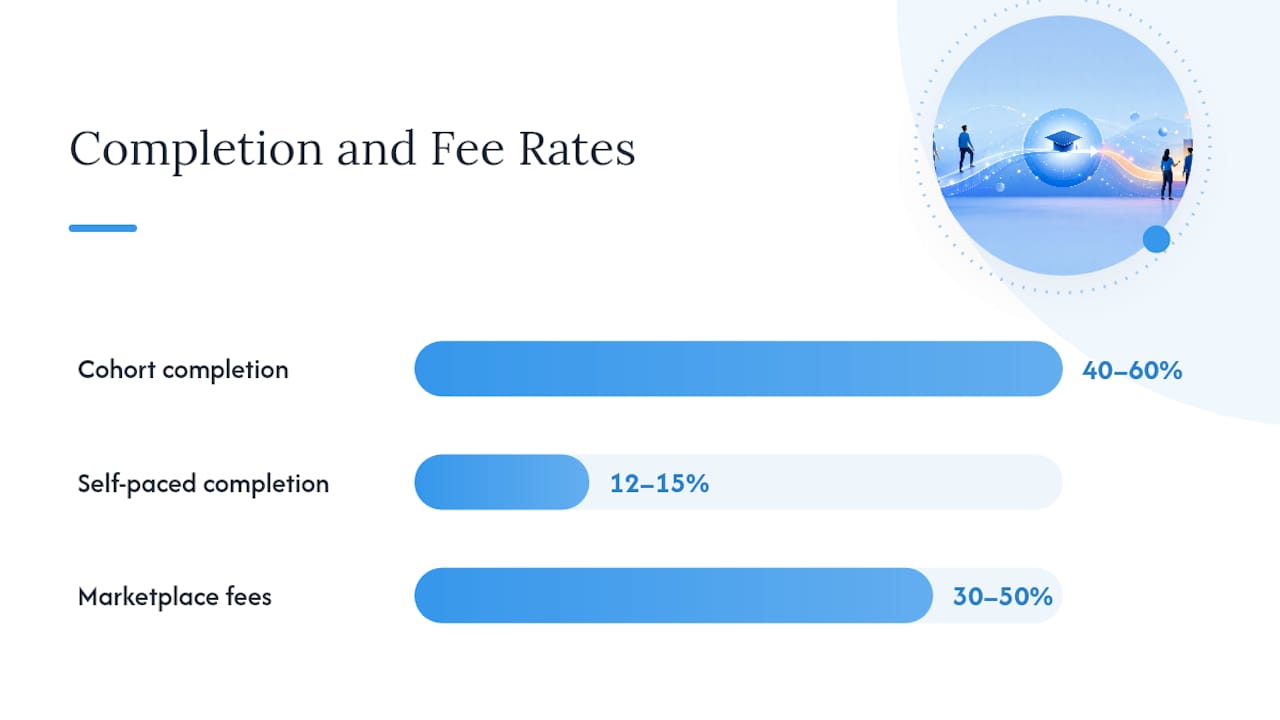
Cohort and community-backed formats justify a premium because they deliver measurably better results. Circle’s platform data shows community-backed and cohort formats reaching completion rates around 40% to 60%, compared with the 12% to 15% typical of unsupported self-paced courses. That completion gap is exactly what buyers are paying for when they choose a cohort over a self-study version of the same content.
Whatever model you pick, subtract platform and payment processing fees before you calculate net revenue. A $497 course sold through a marketplace platform can lose 30% to 50% of that to fees and revenue share, while a self-hosted checkout typically costs you standard payment processing fees alone.
How Do You Calculate the Right Price From Your Revenue Goal?
Start with a simple formula: divide your annual revenue goal by your expected number of buyers, then adjust the result down for refunds and platform fees, and up if you’re planning a payment-plan take rate. That target price, not a competitor’s price or a “feels right” gut check, is your starting anchor.
Example one, small list: You have 500 email subscribers and want $30,000 in course revenue this year. $30,000 divided by 10 buyers is a $3,000 target price, which only works with a premium, high-touch cohort offer, not a self-paced course sold to a cold list that size.
That’s 100 buyers, putting your target price at $300, comfortably inside the flagship self-paced band.
| Input | Small list example | Established audience example |
|---|---|---|
| Revenue goal | $30,000 | $30,000 |
| Audience size | 500 | a few hundred or more |
| Conversion rate | 2% | 1% |
| Expected buyers | 10 | 100 |
| Target price | $3,000 | $300 |
Before you commit to either number, stress-test four assumptions:
- Is your conversion rate based on real launch data, or an industry average that may not apply to your niche?
- What refund rate should you build in, typically 5% to 10% for most self-paced courses?
- How many promotional pushes will it take to hit your buyer count, and does your list have the reach to support that cadence?
- What percentage of buyers will choose a payment plan, and how does that affect your cash flow timing versus your total revenue?
What Are Current Price Benchmarks by Course Type?
Mini-courses and lead offers cluster at $47 to $97, priced to convert quickly rather than to fund your business. Self-paced flagship courses land at $197 to $497, with $197, $297, and $497 showing up repeatedly as common sweet spots across creator-led niches. Cohort-based programs with live coaching run $997 to $2,500, and premium or done-with-you programs can exceed $2,500 when the outcome is high-stakes enough, career changes, revenue-generating skills, or credentialing.
Pro Tip: If your top offer sits below $50, you’re likely building a marketing funnel, not a business. Kajabi’s platform data shows creators topping out under $50 report far lower lifetime earnings than creators pricing offers above $2,500.
Where you host your course changes what buyers expect to pay. Marketplace platforms like Udemy expose your course to built-in discovery traffic, but that audience is trained to expect steep discounts, often pushing effective prices toward $10 to $30 regardless of your list price. Coursera leans similarly discount-driven but carries more credibility for certificate-style content, supporting slightly higher effective prices. Self-hosted platforms like Teachable, Thinkific, LearnDash, or a BuddyBoss-powered membership site let you keep your full list price and build direct buyer relationships, at the cost of having to drive your own traffic.
The same course content, in other words, can reasonably be priced at $19 on a marketplace and $297 on your own site, because the two channels are selling to buyers with completely different expectations.
How Do Payment Plans and Subscriptions Affect Conversions?
Payment plans widen your buyer pool without lowering your total price, and they typically carry a small installment premium, often 10% to 15% above the one-off price, to offset default risk and processing costs across multiple charges.
- 3x or 4x payment plans: Split your price into three or four equal charges over 60 to 90 days. Works well for courses priced $497 and above.
- Monthly subscription: Fits ongoing content libraries better than one-time courses. Price it against expected retention, not against a one-off equivalent.
- Clear total cost copy: Always show the full total next to the per-installment amount so buyers never feel misled at checkout.
- Simple refund rules: State them plainly before purchase. Ambiguity here drives disputes, not fewer refunds.
Pro Tip: Subscriptions increase lifetime value when your content library keeps growing. They create churn risk fast if buyers finish the material and see no reason to keep paying.
What Are the Most Common Course Pricing Mistakes?
Avoid pricing by content hours, defaulting to discounts on every launch, changing your price every few weeks, and ignoring what your specific buyer can actually afford.
- Pricing by hours of video, not outcome.
- Discounting by default instead of as a planned, limited event.
- Adjusting price too often to read clean test data.
- Ignoring buyer wallet in favor of a “nice round number.”
To raise price safely: announce the increase two to four weeks ahead, grandfather existing buyers at their original rate, and raise only after your data shows consistent demand, like a pre-sell or launch that sold out faster than expected, not on a hunch.
When Should You Hire an Agency to Help Price and Launch Your Course?
Agency support earns its cost once your launch gets complicated, multiple price tiers, a B2B or corporate buyer, paid acquisition layered on top of an email list, or a cohort model with real logistics behind it. Below that complexity, a solo creator running their own pre-sell can usually manage without outside help.
A typical engagement scope covers:
- Pricing strategy grounded in your specific buyer’s wallet and outcome, not generic benchmarks.
- Funnel and landing page build tied directly to the pricing tiers you’ve chosen.
- Paid acquisition to fill a cohort or launch window on a deadline.
- Conversion optimization on the pricing page itself, tested rather than guessed.
- Full launch execution, coordinating email, ads, and page changes on one timeline.
Before hiring any agency, ask direct questions:
What Does a Practical Pricing Approach Look Like in Practice?
The biggest gap I see between creators who price well and those who don’t isn’t confidence, it’s specificity. Vague outcomes get vague prices. A course that promises “learn video editing” competes on hours and features, and loses that fight every time. A course that promises “cut your editing time from six hours to ninety minutes” gets to compete on results, and results support real prices.
The decision I trust most is the one made from a pre-sell, not a pricing calculator. I’ve watched creators talk themselves out of a $497 price because it “felt high,” only to sell out a small cohort at that exact number within days once real buyers, not hypothetical ones, weighed in. The number itself matters less than whether you tested it before betting your launch on it.
Ready to Turn Your Course Pricing Into a Growth Strategy?
Getting your price right on paper is one thing. Getting a full funnel, paid acquisition, and conversion-tested pricing page working together to actually hit your revenue goal is a different problem, and it’s the one Vertical Brands solves for course creators who’ve outgrown a solo launch.
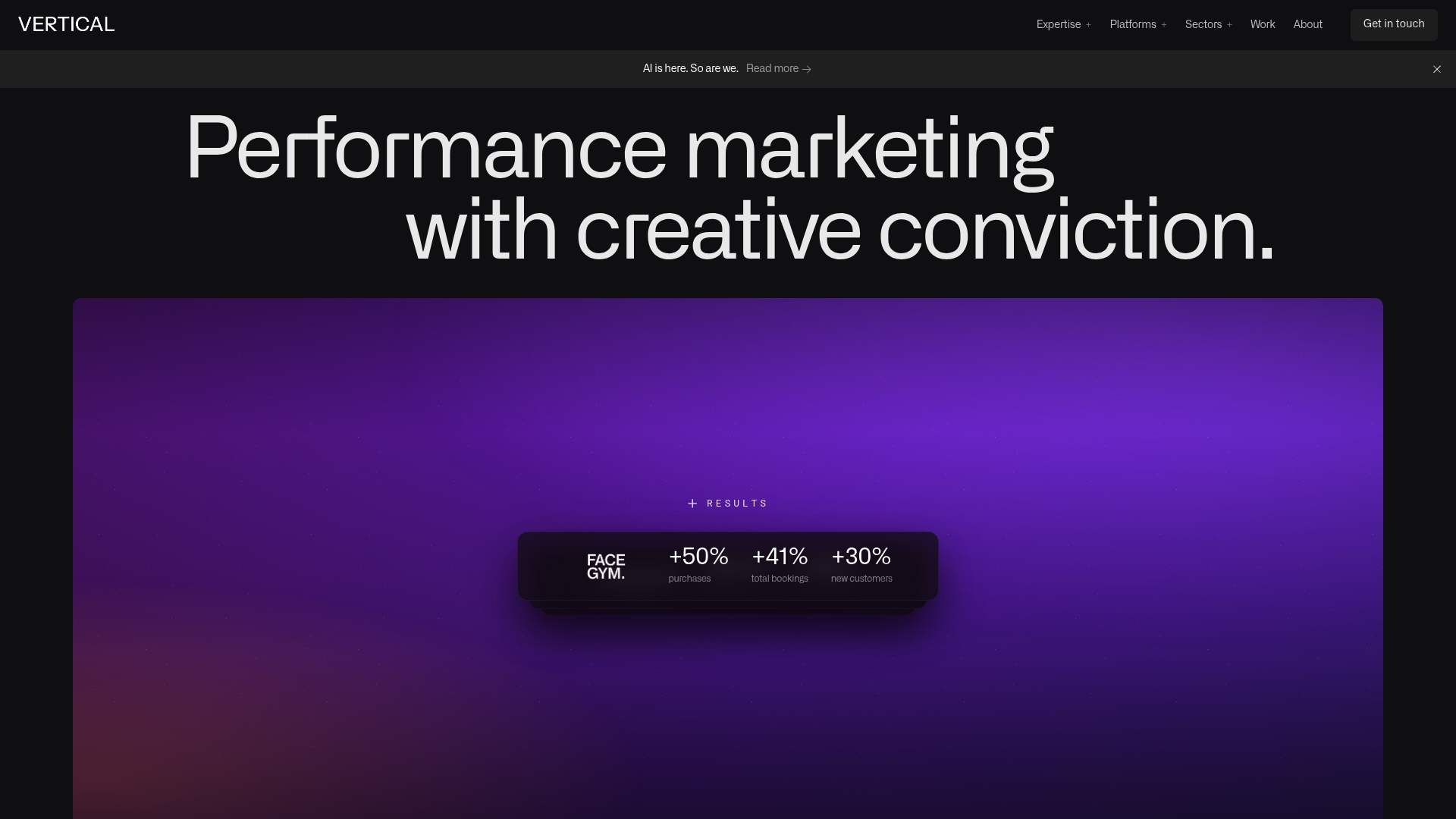
Where most creators stall is the gap between “we picked a good price” and “we built a system that consistently sells at that price.” Vertical Brands brings pricing strategy, paid media, creative, and web development together under one team, so your pricing tiers, your landing page copy, and your acquisition campaigns are built to work as one system rather than three disconnected efforts stitched together after the fact.
If your course is ready to scale past pre-sells and word-of-mouth, talk to Vertical Brands about pricing strategy, conversion optimization, and launch execution built around your specific revenue goal.
Sources
- How much should I charge for an online course? — Kajabi
- How to Price Your Online Course: A Step-by-Step Framework — Course in 30
- Online Course Pricing Calculator (2026) | Price Your Course Right — Learning Revolution
Recommended

Other posts




























































Stay ahead with better decisions.
Get business insights today.
