High Converting E-Commerce Landing Pages: Strategic Architecture and Real Examples for 2026
Aesthetic design does not sell products; operational discipline does. Whilst standard Shopify storefronts hover at a median 1.40% conversion rate, high converting e-commerce landing pages achieve upwards of 6% by systematically stripping away cognitive friction. You already know the daily reality of...
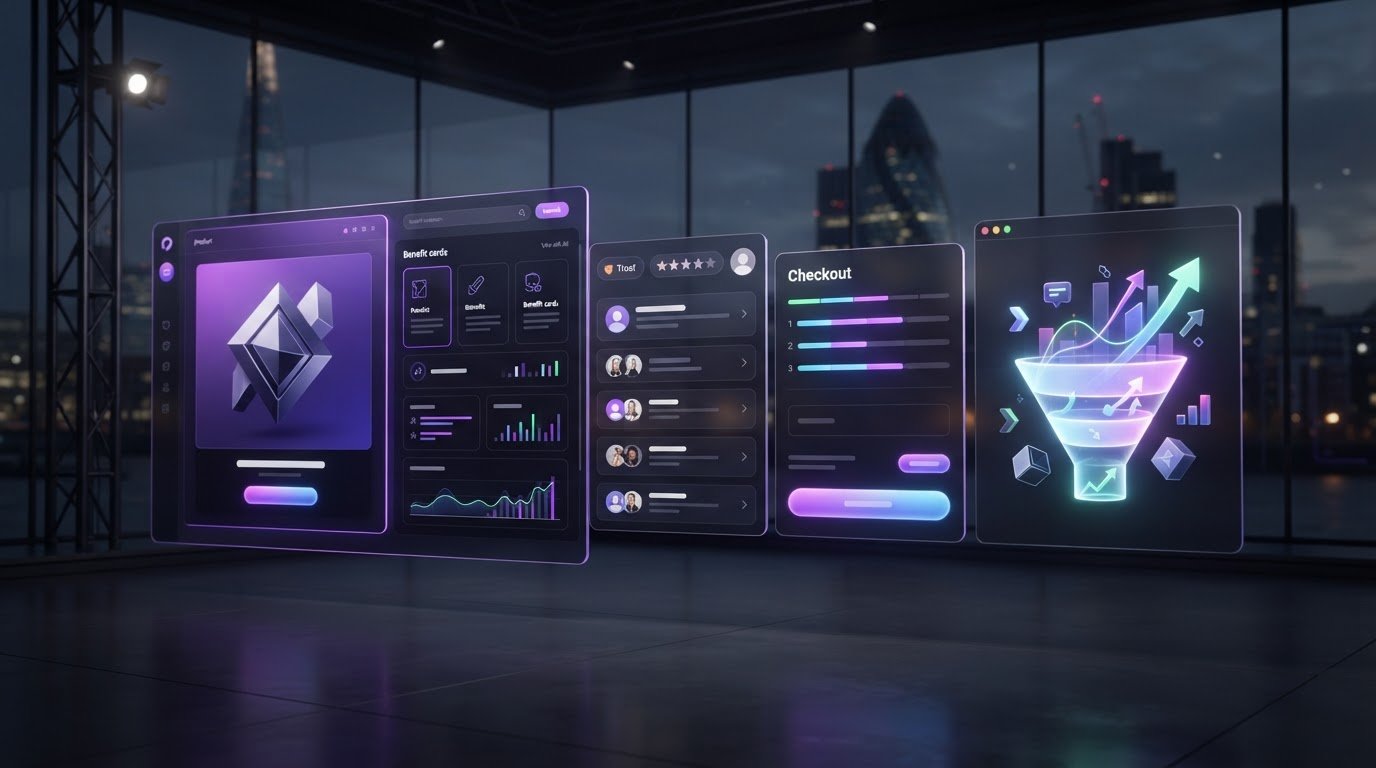
Aesthetic design does not sell products; operational discipline does. Whilst standard Shopify storefronts hover at a median 1.40% conversion rate, high converting e-commerce landing pages achieve upwards of 6% by systematically stripping away cognitive friction. You already know the daily reality of escalating customer acquisition costs across paid channels. Routing qualified traffic to generic, bloated product detail pages bleeds margin rapidly, particularly when the destination fails to honour the specific hook promised in your ad creative.
Scaling commercial growth requires treating the post-click experience as a unified operational bridge between paid media spend and retention marketing. There is several structural frameworks that separate high-velocity direct-to-consumer brands from stagnant storefronts. Master the architectural principles, mobile speed thresholds, and rigorous testing methodologies that drive acquisition efficiency and scale revenue. Ahead, we dissect the exact technical components, teardowns, and execution strategies required to turn paid traffic into commercial momentum.
Key Takeaways
• Discover how high converting e-commerce landing pages isolate user attention by stripping out leaky storefront navigation in favour of clear transactional pathways.
• Master the six non-negotiable architectural sections engineered to resolve customer friction and validate buying decisions.
• Map specific paid media traffic across four proven page archetypes to match customer purchase intent precisely.
• Protect advertising spend by enforcing strict message match, because minor discrepancies in ad promises immediately inflates acquisition costs.
• Implement a disciplined conversion rate optimisation framework that prioritises structural experimentation over cosmetic guesswork.
What Defines High Converting E-Commerce Landing Pages in 2026?
High converting e-commerce landing pages are dedicated commercial entry points engineered specifically to convert paid traffic into customers by isolating a single offer and eliminating browse distractions. While standard catalogue pages encourage aimless exploration, conversion architecture focuses entirely on the transaction. The purpose centres on maintaining absolute message match from the initial ad impression straight through to checkout.
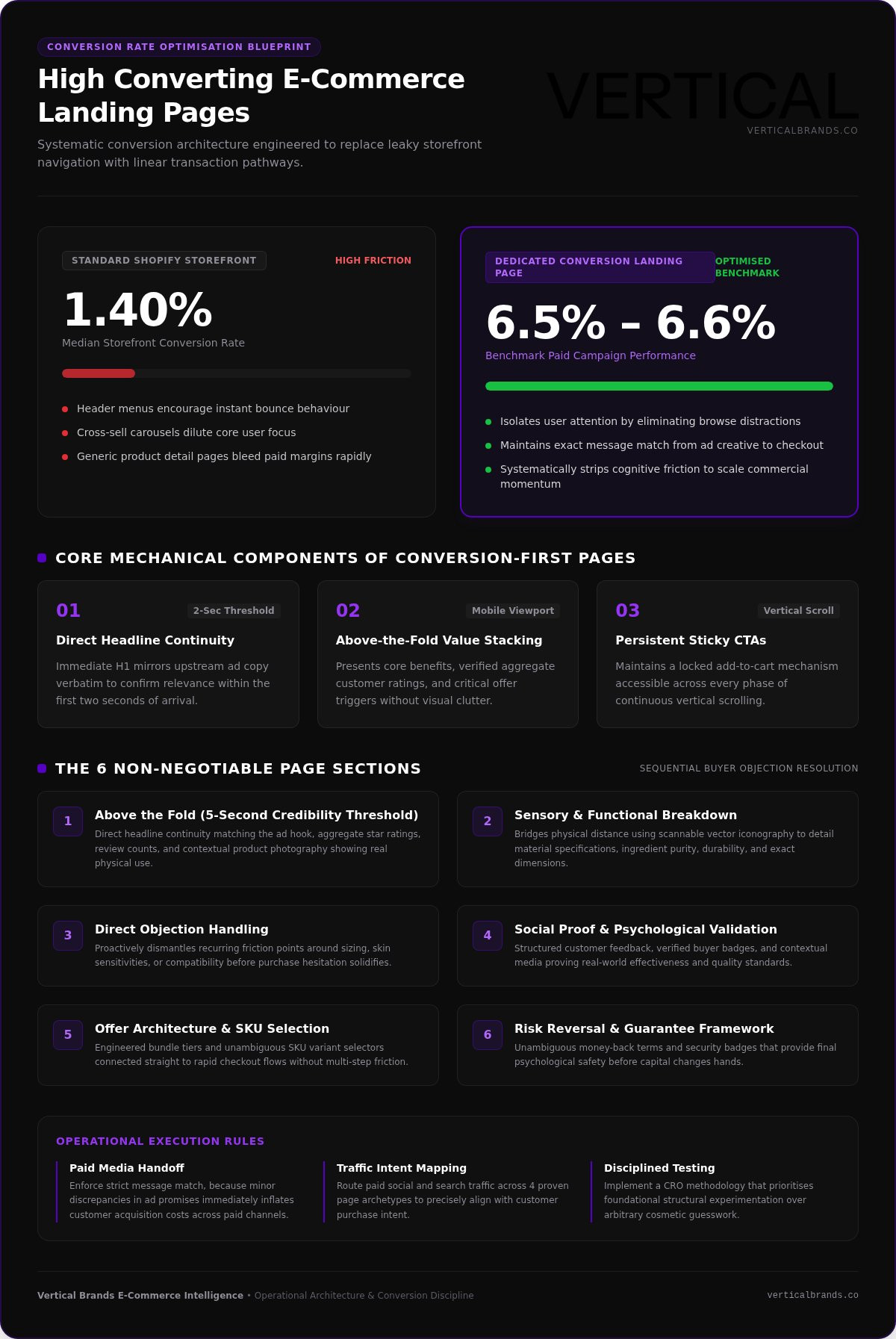
Generic landing page software often treats e-commerce like simple lead generation. That approach fails. Physical products require catalogue logic, precise SKU variant selection, and rapid checkout integration. Industry data indicates that while general storefronts convert at a median 1.40%, properly architected dedicated landing pages achieve benchmark conversion rates between 6.5% and 6.6% across paid campaigns. Removing friction changes everything.
To see how these principles are applied directly within an e-commerce framework, watch this practical walkthrough:
The Structural Flaws of Standard Product Detail Pages
Standard Shopify product detail pages leak ad spend. Header menus encourage instant bounce behaviour, tempting cold visitors to click away into unrelated collections before intent solidifies. Cross-sell carousels and competing product recommendations further dilute focus. Each of these distracting elements increase cognitive load. When paid social traffic lands on a sprawling catalogue page, the direct correlation between your ad hook and the product promise breaks down immediately.
The Core Mechanical Components of Conversion-First Pages
High converting e-commerce landing pages replace multi-directional navigation with a strict, linear hierarchy. They rely on three foundational technical mechanics:
Direct Headline Continuity
An immediate H1 that mirrors the ad copy verbatim. This confirms relevance within the first two seconds.
Above-the-Fold Value Stacking
Highlighting core benefits, customer ratings, and key offer triggers without cluttering the mobile viewport.
Persistent Sticky CTAs
A locked add-to-cart button that remains accessible throughout continuous vertical scrolling sessions.
These components preserve operational momentum. By locking the user into a focused conversion funnel, brands protect their paid media investment and reduce acquisition waste across all acquisition channels.
Anatomy of an E-Commerce Landing Page: The 6 Non-Negotiable Sections
High converting e-commerce landing pages do not rely on artistic flair. They operate through systematic psychological validation. Every section must dismantle a specific buyer objection before physical capital changes hands. When architecting direct-to-consumer layouts, structure determines commercial velocity. Building within a validated conversion rate optimization framework ensures user hesitation is addressed sequentially down the page.
Above the Fold: The 5-Second Credibility Threshold
Clarity precedes persuasion. Within five seconds, mobile visitors must grasp the exact product promise. Headline copy should mirror the upstream creative hook rather than hiding behind conceptual brand slogans. Position trust badges, aggregate star ratings, and total review counts directly beside the title hierarchy. Pair this with clean, contextual product photography that shows the item in active physical use, establishing immediate scale and operational quality.
Sensory and Functional Breakdown Sections
Online transactions carry sensory deficits. Customers cannot touch, hold, or test physical goods prior to purchase. High converting e-commerce landing pages bridge this perceptual gap using structured visual proof:
Material and Build Specifications
Use scannable vector iconography to communicate ingredient purity, component durability, and functional dimensions rapidly.
Direct Objection Handling
Tackle persistent friction points around sizing, skin sensitivity, or technical compatibility directly within the body flow.
Video Demonstration
Deploy raw user-generated content and short video breakdowns to authenticate claims, because customer footage validates real-world performance instantly.
Frictionless Offer and Guarantee Architecture
Never leave order volume to chance. Modern commercial pages deploy tiered bundle builders displaying explicit savings badges to expand average basket sizes. A single SKU purchase option should sit alongside curated two-pack and three-pack configurations, framing multi-unit purchases as the natural, high-value decision. Eliminate lingering purchase hesitations by highlighting unconditional returns policies, clear warranty terms, and prompt dispatch windows. For brands seeking to modernise their underlying front-end systems, mastering Performance driven web design provides the foundation needed to handle this dense visual architecture efficiently.
Each component must guide the consumer toward checkout with zero visual ambiguity. If your team is struggling to unify these operational touchpoints, auditing your tech stack through specialised growth advisory ensures technical execution matches aggressive media acquisition targets.
4 Proven E-Commerce Landing Page Examples and Archetypes
Directing paid traffic to an inappropriate layout destroys performance media efficiency. Customer intent is not uniform; a shopper clicking a high-intent Google Search ad requires a completely different architectural flow than someone interrupted on Meta. Selecting the wrong page archetype directly waste ad spend across performance channels. High converting e-commerce landing pages align layout structure with customer readiness.
| Archetype | Primary Use Case | AOV Impact | Core Conversion Mechanism |
|---|---|---|---|
| Advertorial / Listicle | Cold paid social prospecting | Moderate | Educational narrative solving a root problem |
| Dedicated Bundle Page | Warm prospecting and scale offers | High | Volume tiered pricing and free gift thresholds |
| Comparison Matrix | High-intent paid search intercept | Moderate to High | Direct feature contrast against incumbents |
| Pre-Cart Funnel | Customised or variant-heavy goods | High | Step-by-step interactive configuration |
Regardless of the chosen format, every template must strictly align with technical Core Web Vitals performance benchmarks to avoid losing impatient mobile visitors during transit.
The Long-Form Advertorial and Listicle Page
Cold audiences on paid social rarely purchase based on product specifications alone. Advertorials rely on editorial journalism to frame a persistent lifestyle problem before positioning your SKU as the definitive solution. High converting e-commerce landing pages utilising this format integrate direct buy buttons and mini product cards mid-article, ensuring readers can transition directly into checkout without losing their place.
The Dedicated Bundle and Offer Landing Page
Escalating acquisition costs demand higher order values. Bundle pages eliminate single-unit purchasing friction by default. They employ visual value ladders, such as buy two save 15% or buy three receive a complimentary gift. Pre-selecting the middle tier guides buyer psychology and accelerates order completion.
The Product Comparison and Alternative Matrix Page
Search campaigns targeting competitor keywords require decisive proof. Comparison matrix pages deploy detailed side-by-side battlecards. They contrast proprietary specifications, ingredient quality, and warranty guarantees against category incumbents. Transparent tables combined with independent testing verification remove consumer scepticism and drive immediate commercial decisions.
Optimising the Paid Traffic Handoff: Message Match and Technical Speed
A landing page cannot convert if upstream ad promises contradict destination content. When creative messaging fractures during transit, customer acquisition costs spike immediately. Cold paid traffic arrives with razor-thin patience; any discrepancy between visual expectation and on-screen reality triggers instant bounce behaviour. High converting e-commerce landing pages function as an unbroken bridge between performance media investment and backend commercial conversion. For brands seeking to unify these disciplines, discover Troyer Websites for specialist web design and online marketing services.
Preserving Creative Alignment Across the Funnel
Ad algorithms reward continuity. When deploying campaigns via paid social management, the exact hook, colour palette, and talent featured in your top video ad must appear above the fold on the destination page. If your Meta asset promises a 20% introductory bundle discount, displaying full retail pricing upon arrival introduces cognitive friction. Total message alignment ensures the prospect feels they landed in precisely the right environment.
Technical Speed Benchmarks for Mobile Shoppers
Latency kills transactional momentum. Research shows that mobile pages loading within 1.0 second produce conversion rates between 2.5 to 3 times higher than those taking 5.0 seconds. Every additional second of delay deteriorates conversion rates by an average of 4.42%. Meeting modern technical thresholds requires aggressive front-end engineering:
Interaction to Next Paint (INP)
Maintain responsiveness below 200 milliseconds by eliminating unoptimised third-party scripts.
Largest Contentful Paint (LCP)
Render core visual assets within 2.5 seconds or faster on standard cellular networks.
Cumulative Layout Shift (CLS)
Keep layout shifts under 0.1 to avoid erratic movement during asset loading.
Unoptimised JavaScript execution and bulky tracking pixels degrade Core Web Vitals rapidly, causing bounce rates to escalate before visitors even view your product catalog.
Zero-Party Data Capture and Exit-Intent Systems
Not every qualified visitor completes a transaction during their initial visit. When bounce intent is detected, high converting e-commerce landing pages hedge acquisition spend by capturing zero-party data. Interactive product quizzes and routine-builders collect preferences, sizing requirements, and email addresses. These details feed directly into automated lifecycle flows managed via Klaviyo migration services, ensuring unconverted media spend is transformed into long-term owned equity.
To eliminate front-end friction and align your tracking architecture for scale, partner with our team for specialised website design & development.
Building a Disciplined Conversion Rate Optimisation Framework
Random experimentation drains operational resources. Button colour tests and minor font tweaks rarely move commercial needles. High converting e-commerce landing pages emerge from disciplined, empirical hypotheses that target structural customer friction. Instead of cosmetic alterations, high-growth direct-to-consumer operators deploy structured testing roadmaps tied directly to revenue per session.
Step 1 to 3: Research, Hypothesis, and Test Prioritisation
Effective testing begins with thorough diagnostic discovery. Reviewing drop-off metrics across key funnel milestones reveals exactly where intent dissipates:
Quantitative Funnel Auditing
Track drop-off percentages between landing, bundle selection, and checkout initiation to pinpoint structural blockages.
Qualitative Behavioural Analysis
Review session recordings and heatmaps to observe cursor hesitation and mobile scroll termination points.
Impact Prioritisation
Score testing hypotheses using frameworks that balance expected revenue lift against engineering complexity, ensuring high-leverage friction points gets resolved first.
Step 4 to 5: Test Execution and Commercial Analysis
Statistical discipline protects against false discoveries. Running clean split tests requires pre-calculating necessary sample sizes based on current transaction volume rather than ending tests prematurely. Track revenue per session and total basket value rather than isolated click-through rates; an experiment that increases clicks while depressing margins represents a net operational loss. When a variation proves statistically superior across distinct buying cycles, commit the structural adjustments directly to your base code to permanently elevate commercial baselines.
Aligning Page Strategy with Growth Advisory
Landing page architecture cannot exist in isolation from paid acquisition and lifecycle systems. An isolated test that drives immediate conversions but increases returns or hurts retention ultimately damages customer lifetime value. Sustainable scale demands engineering expertise combined with performance media acumen. Access strategic conversion audits and operational support by exploring Vertical Brands web development and growth advisory.
Engineering Your Architecture for Predictable Commercial Scale
Superficial website redesigns will never solve systemic customer acquisition challenges. High converting e-commerce landing pages succeed because they treat the post-click experience as an uncompromising operational system. Aligning paid campaign creative with dedicated page archetypes eliminates cognitive dissonance, whilst ruthless front-end speed optimisation protects commercial margins from immediate mobile abandonment.
Sustainable expansion across competitive direct-to-consumer categories demands total alignment between paid media acquisition and technical web engineering. Deploying these structural mechanics ensure that every pound spent on advertising generates measurable commercial return. Focus relentlessly on net contribution margin, average basket values, and the systematic elimination of checkout friction.
Stop bleeding qualified traffic through leaky, generic storefront layouts. Partner with Vertical Brands to engineer high-converting web architecture through an integrated framework uniting paid media management, custom web development, and lifecycle retention.
Frequently Asked Questions
What is the primary difference between a product detail page and an e-commerce landing page?
A standard product detail page functions as a catalogue node designed for general browsing, containing global menus, footer links, and related item recommendations. In contrast, an e-commerce landing page isolates a singular campaign offer. It removes all non-essential navigation links, focusing exclusively on leading the visitor toward a direct purchase while preserving creative alignment with incoming advertisements.
What is considered a strong conversion rate for e-commerce landing pages?
While standard Shopify storefronts typically convert at a median baseline of 1.40%, high converting e-commerce landing pages consistently generate conversion rates between 6.5% and 6.6% across paid campaigns. Top-decile brands frequently achieve rates exceeding 8% to 10% on targeted direct-response funnels by eliminating friction and delivering precise message matching on cold paid traffic.
How many product options or variants should be displayed on a single landing page?
Limit options strictly to three or four clear choices to avoid decision fatigue. Presenting excessive flavour variations, colours, or sizing configurations paralyzes buyer action. High-performing direct-to-consumer funnels structure choices around curated package tiers, such as single-unit starter packs alongside discounted two-unit bundles, pre-selecting the optimal value tier to accelerate checkout velocity.
Should e-commerce brands remove website navigation menus on paid traffic landing pages?
Yes, global navigation menus should be stripped out completely. Every external link to an "About Us" page, catalogue index, or corporate blog provides an exit ramp that siphons paid intent. Forcing traffic through an isolated, linear layout ensures visitors evaluate the core value proposition without succumbing to unnecessary distractions.
How long should an e-commerce landing page be to maximise purchase conversions?
Page length must correspond directly with buyer awareness and price point. Low-cost impulse items require compact, concise layouts focused heavily on mobile visual proof and rapid checkout buttons. Conversely, higher-ticket goods or unfamiliar product categories require long-form modular layouts that systematically dismantle objections through clinical ingredient breakdowns, third-party comparisons, and comprehensive guarantee statements.
Can custom landing pages be built and hosted directly on Shopify stores?
Custom landing pages can be developed directly within Shopify using custom Liquid templates, JSON sections, or headless front-end builds. Full-service digital teams such as Agency 6 often leverage native development or bespoke webshop architecture to preserve your unified checkout pipeline, inventory management, and backend tracking mechanics without introducing the architectural bloat associated with disjointed external page building software.
How much traffic is required before running split tests on e-commerce landing pages?
Valid split testing requires sufficient transaction density rather than vanity traffic numbers. A practical testing rule requires at least several hundred completed conversion events per variation across distinct purchasing cycles. Without adequate sales volume, running split tests produce inconclusive findings that mislead commercial decision-making and waste media resources.

Other posts



















































Stay ahead with better decisions.
Get business insights today.
