E-commerce search engine optimisation: A Strategic Framework for Scaling in 2026
Paid social is no longer a sustainable engine for growth. Rising customer acquisition costs are eroding margins across the UK retail sector. You have likely noticed that optimising product descriptions yields diminishing returns. It's a common frustration. Stagnant traffic and technical debt shouldn...

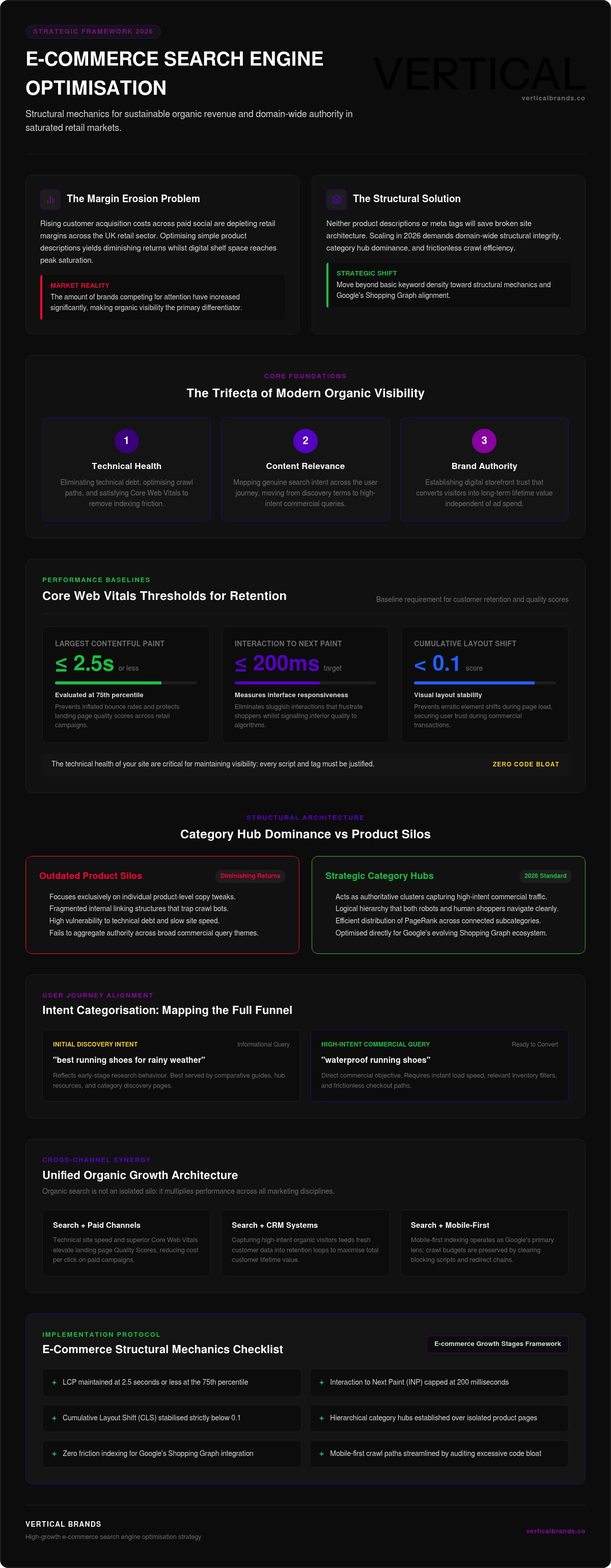
Paid social is no longer a sustainable engine for growth. Rising customer acquisition costs are eroding margins across the UK retail sector. You have likely noticed that optimising product descriptions yields diminishing returns. It's a common frustration. Stagnant traffic and technical debt shouldn't be the status quo for your brand. This article provides a definitive framework for E-commerce search engine optimisation designed for the 2026 landscape. We will move beyond basic keyword placement.
You will learn to master the structural mechanics of organic growth. Neither the product descriptions or the meta tags will save a broken architecture. We promise a clear roadmap to drive sustainable revenue without relying on paid media. The data shows that technical debt are slowing down your progress. This guide covers technical rigour, category hub dominance, and the integration of Google’s Shopping Graph. Every element of your site must align with market demand. Let's build a machine that scales.
Key Takeaways
• Understand why E-commerce search engine optimisation in 2026 requires a shift from product-level tweaks to domain-wide structural integrity.
• Eliminate technical debt by prioritising Core Web Vitals and site speed as essential baselines for performance.
• Discover why category hubs are more effective than product silos for capturing high-intent commercial traffic.
• The amount of brands competing for attention have increased significantly, making revenue-focused metrics essential for survival.
• Integrate search, paid social, and CRM data to maximise customer lifetime value and drive sustainable organic revenue.
What is e-commerce search engine optimisation in 2026?
E-commerce search engine optimisation is the strategic alignment of your digital storefront with the specific needs of your target market. It is more than just ranking. It is about visibility for the right queries. In 2026, the density of brands competing for digital shelf space has reached an all-time high. This saturation makes a lean, technical approach mandatory. The amount of brands competing for attention have increased significantly this year, making organic visibility a primary differentiator for high-growth retailers.
Modern success relies on a trifecta of technical health, content relevance, and brand authority. By refining these pillars, you reduce your dependence on increasingly expensive paid channels. This shift is essential for protecting your bottom line. To understand the foundations of search engine optimization, we must look at how crawling and indexing have evolved to favour user experience over simple keyword density.
To better understand this concept, watch this helpful video:
The shift from keywords to search intent
The "what" matters less than the "why". A search for "waterproof running shoes" reflects a different intent than "best running shoes for rainy weather". You must map the entire user journey. Start at initial discovery. End at the final transaction. Identifying high-intent commercial queries allows you to capture users ready to convert. Guessing is no longer an option for serious operators. Effective E-commerce search engine optimisation requires precise data to align product offerings with actual human behaviour.
The role of organic search in the growth ecosystem
Organic search is not a silo. It builds foundational trust amongst new visitors. A high ranking signals authority. This trust translates into long-term profitability. SEO is a core component of the e-commerce growth stages framework. It provides the stability needed to scale. Without it, your growth is tethered to your ad spend. Technical site speed are also a major factor in keeping those visitors on the page once they arrive. High-level execution ensures that organic search supports brand awareness and conversion simultaneously.
Building structural integrity through technical excellence
Technical SEO is the infrastructure of your digital storefront. It ensures search engines can crawl and index your products with zero friction. Site speed is no longer a competitive advantage. It's a baseline requirement for customer retention. If your site is slow, your visitors will leave. Mobile-first indexing is now the primary lens through which Google evaluates your domain. You must eliminate every obstacle in the crawl path to protect your crawl budget. Following SEO best practices for ecommerce sites is the first step toward structural integrity.
The technical health of your site are critical for maintaining visibility. Every tag and script need to be justified. Excessive code bloat creates friction. Friction kills growth. High-level E-commerce search engine optimisation demands a lean, performance-driven backend that prioritises the user. Interaction to Next Paint (INP) is now a core metric. A good threshold is 200 milliseconds. This measures responsiveness. Sluggish interfaces frustrate users whilst signalling poor quality to search algorithms.
Core Web Vitals and user experience
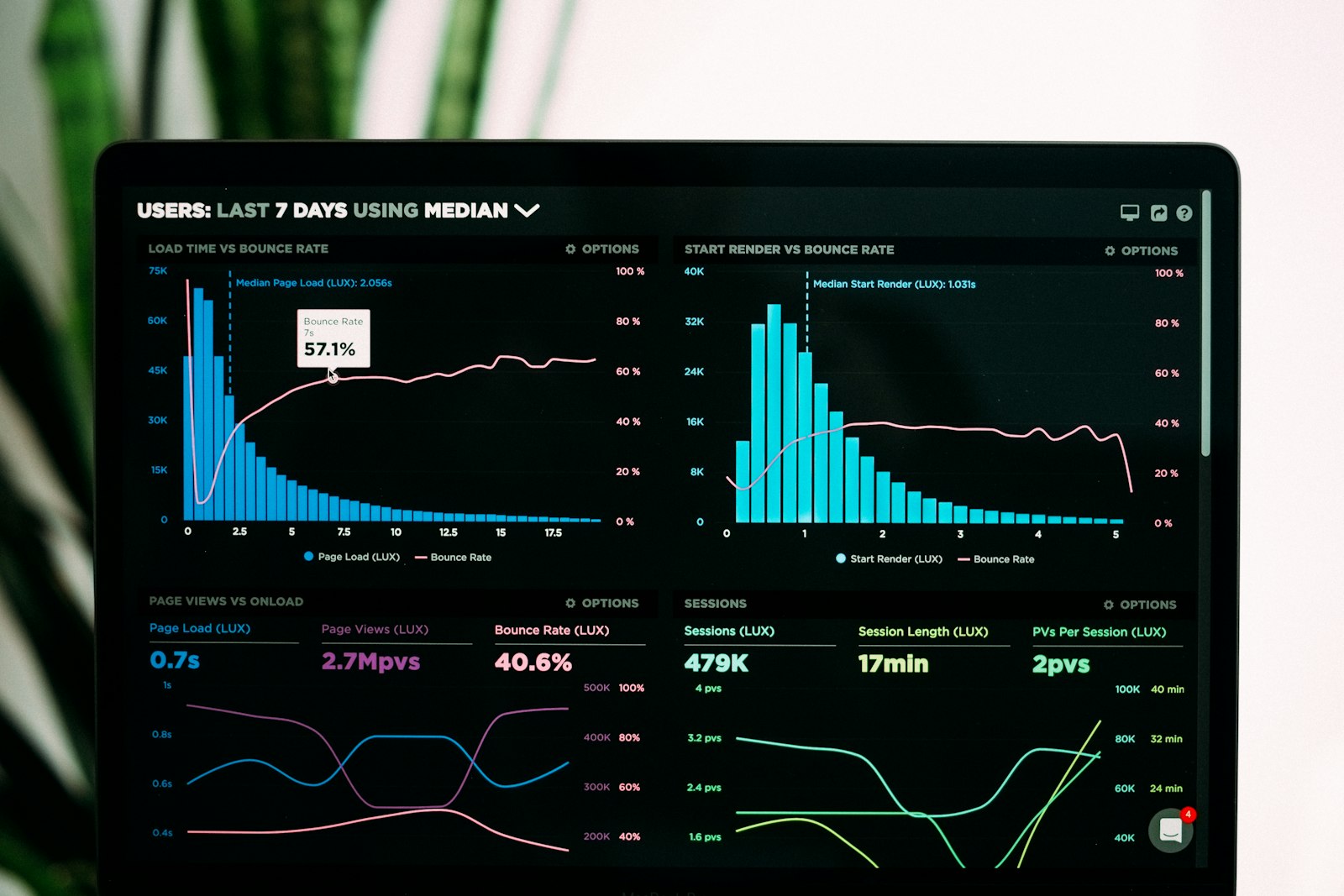
Focus on Largest Contentful Paint (LCP) and Cumulative Layout Shift (CLS). A good LCP threshold is 2.5 seconds or less at the 75th percentile. CLS should remain below 0.1 to ensure visual stability. Each of these performance metrics have a direct impact on organic revenue generation across competitive retail categories. High technical debt in these areas will inflate your bounce rates. This also impacts your paid search management guide performance. Quality scores suffer when landing pages are sluggish. Efficient E-commerce search engine optimisation requires a fast, stable environment for every user.
Site architecture and internal linking
Build a logical hierarchy. Robots and humans should follow the same path. Use breadcrumbs to distribute authority across your domain. Descriptive anchor text is essential. Faceted navigation is a common pitfall. It creates duplicate content that wastes your crawl budget. Use selective canonicalisation and server-side controls to manage these filters. Over 70% of high-intent traffic lands on category pages. Your architecture must reflect this reality. Data shows that domain-level compliance across CWV metrics correlates with a 12% lower mobile bounce rate. If you want to audit your current structure, consider a strategic technical review to identify immediate growth opportunities.
Strategic architecture: Prioritising category pages over product silos
Stop wasting resources on individual product detail pages (PDPs). They are transient inventory endpoints. Category pages are your most important assets. They capture broad commercial keywords with high volume. Over 70% of high-intent non-brand traffic lands on these hubs. This is the foundation of scaling e-commerce SEO in a competitive market. Organise your taxonomy to reflect how customers actually search. Don't rely on internal jargon. Use the language of your market.
Every category serve a specific search intent or need. Don't create pages for the sake of it. Map your structure to user demand. This insulates your domain from index bloat and 404 churn. Seasonal stock disappears. Categories remain. This is how you build a machine that scales. Effective E-commerce search engine optimisation treats category pages as evergreen landing zones that consolidate internal page rank. It ensures that your most powerful pages are always live and relevant.
Optimising the category experience
Integrate high-value content strategically. Place brief, punchy copy at the top. Put detailed guides at the bottom. Use dynamic filters to create indexable sub-categories. This captures long-tail intent without manual effort. You must manage faceted navigation with care. Utilise selective canonicalisation and server-side parameter controls. This prevents duplicate URLs from wasting your crawl budget. Balance these requirements with a clean, professional user interface. Don't let SEO requirements clutter the visual experience. Search engine visibility should be invisible to the user but obvious to the robot.
Product page best practices for conversion
PDPs still play a role. They are the final conversion step. Write unique descriptions. Focus on benefits. Features are secondary. Implement JSON-LD schema markup. Google requires specific properties like Offer, price, and availability status. Displaying these directly in search results delivers a 20% to 35% higher organic click-through rate. Leverage UGC content. Reviews and customer photos build authenticity. They provide the social proof needed to close the deal. The data shows that technical debt are slowing down your progress in this area. Fix the structure first. Then refine the details. Every product variant should use ProductGroup markup to index variations without needing unique individual URLs.
Beyond the silo: Integrating search with performance media and CRM
SEO does not exist in a vacuum. It must align with your total marketing spend to be effective. For too long, retailers have treated organic traffic as a separate entity. This is a strategic mistake. Integrating these channels are essential for success in a competitive market. E-commerce search engine optimisation provides the raw intent data that informs your paid social management creative. If customers are searching for specific benefits, those benefits should be the focus of your ad copy. This creates a unified brand voice across the entire funnel.
Search data provides the insights needed to inform your strategy, but it also help you identify gaps in your product offering. It captures top-of-funnel awareness. This awareness is then converted by your CRM flows. Without this integration, you are leaving revenue on the table. A disciplined approach ensures that every pound spent on acquisition contributes to long-term organic growth. It is about building a cohesive ecosystem where every channel supports the others. This removes friction from the customer journey and maximises the return on every digital touchpoint.
The SEO and Paid Search feedback loop
Use PPC data to identify high-converting keywords. This is your testing ground. Don't guess which terms will drive revenue. Validate them through paid search before committing to a long-term organic strategy. Search query intent data informs PPC bidding on high-converting keywords, whilst paid search testing validates landing page architecture before technical SEO deployment. Dominating the SERP requires appearing in both paid and organic positions. This increases your total click-through rate. SEO also improves your landing page relevance. This reduces your cost-per-click by boosting your quality score. It is a virtuous cycle of efficiency and impact.
Leveraging search intent for CRM and Klaviyo
Capture leads through search-optimised content. This fuels your email lists with high-intent prospects. You can personalise your email flows based on the specific search terms that drove the visit. First-party customer data from CRM systems informs faceted navigation indexing to match repeat customer purchase patterns. If a user lands on a category page for sustainable footwear, your welcome sequence should reflect that interest. This level of precision is covered in our direct guide to Klaviyo migration. SEO contributes to customer lifetime value by ensuring the first touchpoint is relevant and authoritative. If you are ready to align your channels for maximum impact, book a strategic growth audit with our team today.
Executing an outcome-focused SEO strategy with Vertical Brands
Vertical Brands operates with a single objective. We drive revenue growth. We move away from vanity metrics like keyword rankings in isolation. If visibility doesn't result in transactions, it is a failure. Our approach combines technical precision with high-level growth advisory. We remove the friction between your digital storefront and your potential customers. This is a disciplined focus on the structural mechanics of scaling your D2C brand. E-commerce search engine optimisation is the catalyst for this transformation. We don't just provide a service. We act as a partner in your commercial evolution.
Our methodology for e-commerce growth
Success begins with a comprehensive audit. We evaluate your structural integrity. We scrutinise Core Web Vitals, indexation health, and site architecture. Your content strategy must align with actual market demand. We don't rely on intuition. We use data. Our process ensures that every category and product page serves a commercial purpose. Continuous optimisation is based on real-world performance data. The data shows that technical debt are slowing down your progress in many cases. We identify these bottlenecks. We remove them. This methodology ensures your organic presence is both resilient and scalable whilst maintaining a lean operational profile.
Why a strategic partner is better than a generic agency
Generic agencies focus on tactical execution. We understand the operational reality of scaling a business. We act as a high-level strategic guide. Our team provides integrated management across search, social, and CRM channels. This alignment is essential for modern growth. We provide direct and assertive guidance to ensure you reach your growth targets. We have no patience for inefficiency or unnecessary complexity. Our focus is entirely on the mechanics of success. The amount of brands competing for attention have increased significantly this year. You cannot afford a partner who prioritises marketing pleasantries over results. We are a decisive driver of progress for brands ready to dominate their sector.
Future-proofing your organic revenue stream
Scaling a D2C brand in 2026 requires more than tactical adjustments. It demands a structural overhaul. You must prioritise category architecture to capture high-volume intent. Technical excellence is no longer optional. It is the foundation of every transaction. E-commerce search engine optimisation must integrate with your CRM and paid channels to maximise total lifetime value. The data shows that technical debt are holding back your growth. We specialise in removing these barriers. Vertical Brands provides performance-driven search strategies and specialist Klaviyo and CRM management to drive retention. Our expert D2C growth consultancy focuses on the mechanics of scaling. If you are ready to stop relying on rising paid acquisition costs, it is time for a disciplined approach. You can book a strategic growth advisory session with Vertical Brands today. Your site performance and conversion rate is critical for long-term success. Let's build a machine that delivers sustainable results.
Frequently Asked Questions
What is the difference between e-commerce SEO and traditional SEO?
E-commerce SEO focuses on product taxonomy and transactional intent whilst traditional SEO often targets informational queries. Success requires managing thousands of URLs and faceted navigation. Structural integrity is the primary priority here. Traditional informational sites often lack the complex crawl paths found in online stores. We ensure your architecture supports both robots and humans effectively to drive revenue. Every technical decision must serve a commercial goal.
How long does it take to see results from e-commerce search engine optimisation?
Results typically materialise within three to six months. Technical E-commerce search engine optimisation often produces faster gains by removing crawl friction. Structural changes to category hubs require more time for search engines to re-evaluate authority. The amount of brands competing for attention have increased significantly, so consistency is mandatory. We focus on long-term revenue growth rather than overnight vanity metrics. Results depend on your current technical health.
Should I focus on product pages or category pages for SEO?
Category pages are your most powerful assets. They capture broad commercial keywords that drive the highest volume of traffic. Product pages are often transient and expire with stock changes. You should consolidate authority into evergreen category hubs. This prevents index bloat and protects your crawl budget. Every category serve a specific search intent or commercial need. Focus your resources where they deliver the most impact.
How does site speed affect my organic rankings and sales?
Site speed is a primary ranking factor and a conversion driver. Google uses Core Web Vitals like Largest Contentful Paint to measure performance. A slow site increases bounce rates and erodes trust. Data shows that a one-second delay can significantly reduce conversion rates. We prioritise technical site speed to ensure your organic traffic actually converts into revenue. Speed is a baseline requirement for retention and long-term scaling.
Is content marketing necessary for an e-commerce store?
Content marketing is essential for capturing top-of-funnel awareness. It supports your category pages by building topical authority. Guides and blogs help educate customers before they reach the point of purchase. This content also fuels your CRM and Klaviyo email flows. It provides the value needed to turn first-time visitors into loyal repeat customers. Integrated content strategies are mandatory for scaling. High-quality assets build trust and authority amongst new audiences.
What are the most common technical SEO mistakes for online shops?
Common mistakes include duplicate content from faceted navigation and poor mobile rendering. Many retailers ignore index bloat caused by unnecessary filter URLs. Slow script execution also damages the user experience. Technical debt are slowing down your progress if these issues remain unaddressed. We focus on eliminating these frictions to maximise your crawl budget and improve rankings. Strategic technical health is the foundation of organic growth and structural efficiency.
How do I measure the ROI of my e-commerce SEO efforts?
Measure ROI by tracking organic revenue and customer acquisition costs. Move beyond simple traffic numbers. Focus on the value of the transactions driven by organic search. We look at customer lifetime value (LTV) when combined with CRM data. This provides a clear picture of how SEO contributes to your total profitability. Strategic growth requires a focus on these commercial outcomes and long-term scaling. Performance data must drive every investment decision.
Can SEO help reduce my customer acquisition costs on paid ads?
Yes, SEO reduces CAC by improving landing page relevance. Higher relevance scores lead to lower cost-per-click in paid search. Better organic visibility also means you rely less on expensive paid acquisition for every sale. Integrating search data across your marketing spend ensures maximum efficiency. It allows you to dominate the SERP whilst protecting your margins. This synergy is essential for high-growth brands aiming for efficiency and sustainable market share.

Other posts


























































Stay ahead with better decisions.
Get business insights today.
