Measure AI Search Visibility Fast: Audit, Fix Rendering, Win Citations

AI search visibility measures whether generative platforms like ChatGPT, Gemini, and Perplexity mention or cite your brand when answering a relevant question. It runs on a citation model, not a ranking model, so a page can sit in position one on Google and still never appear in an AI-generated answer. The first move for any marketing team: run a baseline check of your brand across multiple AI engines this week and confirm your core pages are indexed and eligible to show with a snippet.
TL;DR:
- A strong organic search rank no longer guarantees visibility in AI-generated answers, which depend on whether your content is cited or mentioned and its source transparency.
- AI search citations favor answer-focused, fact-dense content early in pages and high-authority third-party placements that boost your chances of being pulled into responses.
- Monitoring should cover multiple platforms like ChatGPT, Gemini, and Google AI Overviews, focusing on citation quality, share of voice, and consistent coverage across engines for effective tracking.
- Technical SEO fixes such as indexation, fast page rendering, and answer-first content are crucial to increase the likelihood of your pages being cited by AI systems.
- Prioritize building high-trust citations through original data, expert contributions, and media placements, and track your AI visibility with multi-engine, trend-aware tools for continuous improvement.
Table of Contents
- What Is AI Search Visibility and How Does It Differ From SEO?
- Why Does AI Search Visibility Matter for Conversions?
- How Do You Measure AI Search Visibility?
- What Steps Make a Page Eligible for AI Citation?
- Which Content Formats and Tactics Build AI Citations Fastest?
- How Vertical Brands Applies This Playbook for Clients
- What Should Marketing Teams Prioritize Right Now?
- Get an AI Visibility Audit From Vertical Brands
- Where to Learn More
- Sources
- FAQ
What Is AI Search Visibility and How Does It Differ From SEO?
Traditional SEO rewards a page with a ranked position. AI search visibility works differently: a brand is either included in a synthesized answer or it isn’t; there’s no position ten to settle for. Generative engines pull from dozens of sources at once and blend them into a single response, which is why strong organic rank often fails to predict whether you show up in that response at all.
The variation across platforms is where this gets complicated. Some engines, like Perplexity, cite sources heavily and transparently. Others, like parts of Gemini’s output, lean more on internal model knowledge and cite sparingly. ChatGPT sits somewhere in between depending on whether it’s using browsing tools or its base training. Claude tends to be conservative with citations unless a query clearly demands current information.
Google’s AI Overviews complicate the picture further because they draw directly from the Search index. That means:
- Ranking well in traditional search still helps, since pages must be indexed and eligible to show with a snippet to appear in AI Overviews at all.
- Being indexed is necessary but not sufficient. Plenty of well-ranked pages never get pulled into a synthesized answer.
- AI Overviews visibility and third-party engine visibility (ChatGPT, Perplexity, Claude) are separate problems that need separate monitoring.
Rank still matters. It just stopped being the whole game.
Why Does AI Search Visibility Matter for Conversions?
A citation in an AI answer isn’t just exposure. It’s a referral with unusually high intent, because the person reading it already got a synthesized recommendation before they clicked through to you.
Mentions and citations are not the same thing, and the difference changes what you should optimize for. A mention is your brand name appearing in the generated text. A citation is a linked reference the reader can click. Practitioners consistently find that citations correlate far more strongly with referral traffic and conversion than raw mention counts, which means a strategy chasing volume of mentions while ignoring linked citations is optimizing for the wrong number.

Pro Tip: When you audit an AI response that features your brand, check whether your name is a live link or just plain text. If it’s plain text, that’s a mention worth noting but not a channel worth reporting as traffic.
Where should AI visibility sit in your channel mix? Prioritize it now if:
- Your category involves comparison or research-heavy buying decisions (software, health, finance, travel).
- Competitors are already showing up in AI answers for your branded or category terms and you aren’t.
- Your organic traffic has plateaued despite stable rankings, which often signals AI-driven query deflection.
How Do You Measure AI Search Visibility?
Measurement starts with naming the right metrics, because “we got mentioned somewhere” isn’t a program you can report on month over month.
The core metrics worth tracking:
- AI Visibility Score: a composite, often scaled 0 to 100, reflecting how consistently your brand appears across sampled prompts and engines.
- Mentions: raw count of your brand name appearing in generated answers.
- Citations: linked references back to your domain, the metric most tied to referral quality.
- Share of voice: your citation frequency relative to named competitors on the same set of prompts.
- Citation quality: whether the surrounding context is accurate, favorable, and current.
- Platform coverage: how consistently you appear across engines rather than dominating just one.
Platform coverage deserves its own attention because measuring AI visibility requires multi-platform tracking rather than a single spot check. The engines worth monitoring on a recurring basis: ChatGPT, Gemini, Perplexity, Google AI Overviews, Claude, and Copilot where your audience uses Microsoft’s ecosystem.
Before you commit budget to a monitoring tool, confirm it offers:
- Multi-engine polling on a recurring schedule, not a one-time snapshot.
- A prompt library you can customize to match how your actual buyers phrase questions.
- Historical trend data, since outputs are stochastic and single-instance checks are unreliable.
- Prompt-to-citation mapping so you know exactly which query triggered which mention.
- API access or data exports for reporting into your existing dashboards. A resource like our marketing dashboard KPI guide is a useful reference for slotting these new metrics next to the ones you already track.
What Steps Make a Page Eligible for AI Citation?
Getting cited starts with getting seen by the crawler in the first place. Run through these steps in order.
- Confirm indexation and snippet eligibility. Check Google Search Console for indexing errors and verify your meta directives aren’t blocking snippets. Google is explicit that pages need to be indexed and snippet-eligible to have any shot at AI Overviews inclusion.
- Close JavaScript-rendering gaps. Many AI crawlers do not execute JavaScript, so content that only appears after client-side rendering may be invisible to them. Server-side rendering or prerendering key pages ensures better visibility. If you’re mid-rebuild or planning a platform change, our site migration SEO checklist covers how to protect these signals during the switch.
- Hit real speed targets. Faster First Contentful Paint correlates with higher citation counts in industry analysis, likely because crawlers favor content that resolves quickly and reliably.
- Write answer-first, fact-dense content. Put the direct answer near the top of your section, ideally within the first few sentences. Cited passages often come from the beginning portion of a page, so burying your best insight deeper can reduce the chance of citation.
- Earn mentions on domains AI models already trust. Original data, case studies, and expert commentary placed on high-authority third-party sites increase the odds your brand gets pulled into a synthesized answer, even when your own site isn’t the source cited.
Pro Tip: Run a technical audit before you touch a single word of content. If crawlers can’t reliably render or load your pages, no amount of answer-first rewriting will fix the underlying eligibility problem. Our technical SEO audit guide walks through exactly what to check first.
Which Content Formats and Tactics Build AI Citations Fastest?
Not every content format earns citations equally. AI engines gravitate toward pages that answer a specific question cleanly, which favors a few formats over others.
Prioritize:
- Data-led posts built around original numbers, since generic advice is easy for a model to paraphrase without linking back to you.
- Concise comparison answers that settle a specific “X vs. Y” question in the first few sentences.
- FAQ sections structured around real questions, in the format you’re reading right now.
- Industry roundups that position your brand alongside recognized names in a factual, non-promotional context.
Citations also come from outside your own domain. Earned media placements, contributions to authoritative guides, and co-branded research with partners all build the third-party footprint that generative engines draw on. This is also where shifting from rank-chasing toward genuine, first-hand authoritativeness pays off, since commodity content rarely earns a citation when a more original source exists.
Monitoring cadence matters as much as the tactics themselves. Sample daily for volatile, high-priority prompts. Review trends weekly to catch early shifts before they become a quarter-long problem. Reserve monthly reviews for strategic calls: which prompts to add, which content needs a refresh, and where competitors gained ground.
Pro Tip: Test content variants the same way you’d test an ad creative. Our creative testing framework applies just as well to testing which page structure earns more citations over a monitoring cycle.
How Vertical Brands Applies This Playbook for Clients
Vertical Brands runs AI visibility work as one connected engagement rather than a stack of disconnected vendors: technical SEO to fix indexation and rendering gaps, content built answer-first for citation eligibility, PR and partner placements to build third-party authority, and measurement that tracks mentions, citations, and share of voice together.
Clients typically start with:
- A technical and content audit scoped to indexation, rendering, and answer structure.
- A prioritized roadmap ranking fixes by citation impact, not just SEO convention.
- Early metrics within the first reporting cycle: baseline AI Visibility Score, current share of voice, and a short list of quick technical wins.
What Should Marketing Teams Prioritize Right Now?
Measure before you rewrite everything. Most teams jump straight to content overhauls when the real blocker is a rendering or indexation issue a crawler never gets past. Treat each AI engine as its own channel with its own taste in sources, refresh cornerstone content on a real schedule, and judge success by citation quality over mention volume every time.
— Alex
Get an AI Visibility Audit From Vertical Brands
Vertical Brands provides integrated services handling technical fixes, content structure, and measurement. That matters here specifically because AI visibility problems are rarely one issue. A rendering gap, a thin content structure, and a missing measurement dashboard usually show up together, and fixing one without the others leaves you guessing why citations still aren’t moving.
A typical first engagement starts with an audit covering indexation, rendering, and page speed, moves into a prioritized roadmap, and runs a pilot to show progress before a longer program. If your team is ready to see where your brand currently stands across ChatGPT, Gemini, Perplexity, and Google AI Overviews, start a project with Vertical Brands and get your baseline audit scoped this month.
Where to Learn More
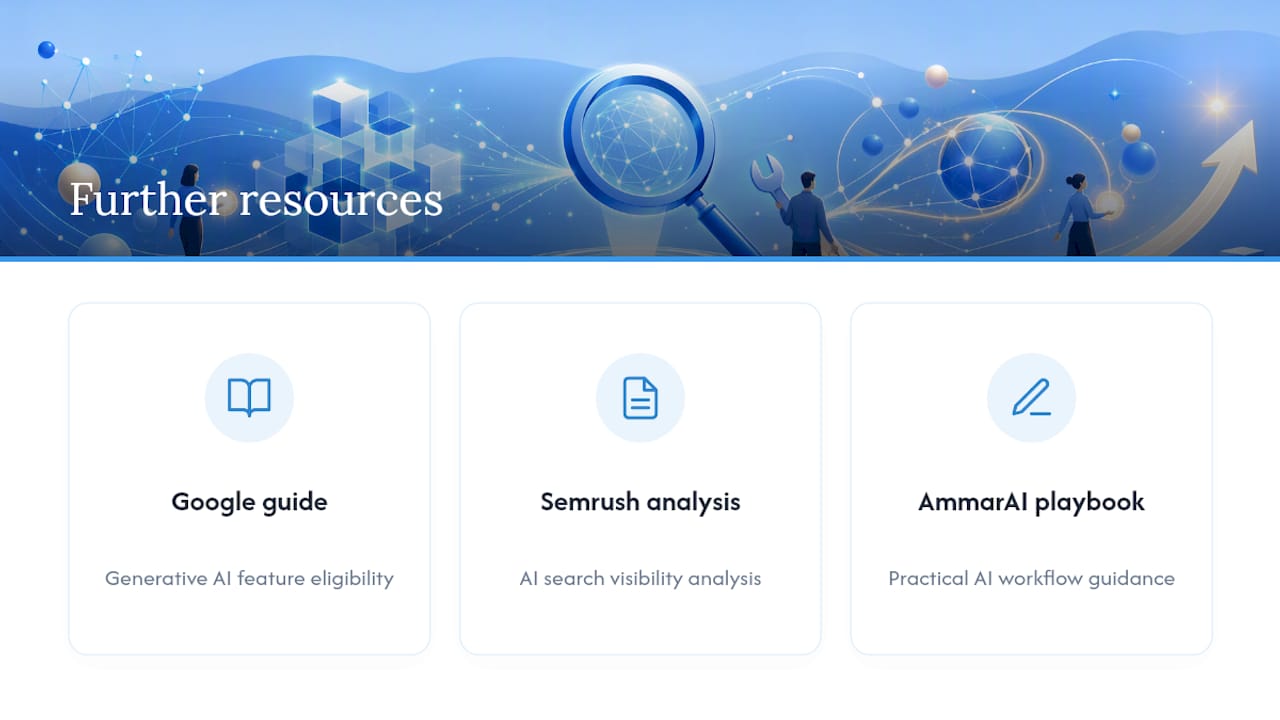
For deeper technical detail, review Google’s guide to generative AI feature eligibility, industry tool breakdowns like the Semrush AI search visibility analysis, and practical AI workflow guidance from AmmarAI’s SEO playbook.
Sources
- What Is AI Visibility? The Complete Guide to Getting Cited by AI Search Engines (2026)
- Google’s Guide to Optimizing for Generative AI Features on Google Search
- How to optimize your website for AI search (HubSpot)
- Characterizing web search in the age of generative AI (ACL findings)
FAQ
How Do I Check My AI Search Visibility?
Run a set of real customer questions through ChatGPT, Gemini, Perplexity, and Claude, then log whether your brand appears, whether it’s linked, and how it’s framed. Repeat this weekly rather than once, since outputs are stochastic and single-instance checks are unreliable.
What Is the 30% Rule in AI Search?
The “30% rule” generally refers to the pattern that cited passages disproportionately come from the opening portion of a page, roughly the first third. It’s a practical argument for putting your direct answer in the first 40 to 60 words of any section you want an AI engine to quote.
How Do You Increase AI Search Visibility?
Fix technical eligibility first (indexation, rendering, page speed), then restructure content to lead with direct answers, and build citations on high-trust third-party domains through earned media and original research. Vertical Brands runs all three in a single engagement rather than three separate vendor relationships.
What Are the Best Tools for AI Search Visibility?
Tools like Semrush’s AI visibility tracking and platform-specific trackers are worth evaluating, but prioritize capability over brand name: look for multi-engine polling, historical trend data, and prompt-to-citation mapping rather than a single-snapshot score.
Recommended

Other posts



























































Stay ahead with better decisions.
Get business insights today.
