Performance marketing agency: how to choose the right growth partner in 2026
An impressive channel plan can still be the wrong growth plan. Choosing a performance marketing agency based on polished case studies or platform expertise alone may leave the real constraints untouched: disconnected channel activity, unclear measurement or a website that loses demand. The question...

An impressive channel plan can still be the wrong growth plan. Choosing a performance marketing agency based on polished case studies or platform expertise alone may leave the real constraints untouched: disconnected channel activity, unclear measurement or a website that loses demand. The question isn’t simply who can run your campaigns. It’s who can connect delivery to the commercial outcome you need.
Agency claims can be difficult to compare. One team may focus on paid media, whilst another combines channel delivery with CRM, SEO and growth advisory. A dashboard of clicks and attributed conversions doesn’t prove that marketing is driving profitable, incremental growth. Clear scope, shared objectives and accountable reporting matter just as much as specialist knowledge.
This guide gives you a practical framework for comparing agency models and alternatives, testing measurement and communication, and defining responsibilities before work begins. You’ll see how to assess a partner against your actual growth constraints, rather than choosing a service list that looks impressive. For brands that need coordinated strategy and delivery across paid social, paid search, SEO, Klaviyo email and CRM, we’ll also consider when an integrated partner such as Vertical Brands may be a fit.
Key Takeaways
• Define the business outcome first, then assess whether a performance marketing agency can connect its proposed activity to that goal.
• Check strategy, measurement, communication and delivery ownership before comparing proposals or channel credentials.
• Compare an agency with in-house, freelance and specialist options against your capabilities, internal workload and need for control.
• Give each shortlisted agency the same objectives, constraints and data context to make proposals easier to evaluate.
• The right operating model depends on your growth priorities. Integrated support may suit brands whose channel decisions rely on shared customer and performance insight.
What a performance marketing agency should deliver beyond campaign activity
A performance marketing agency plans and delivers marketing against measurable business objectives, then reports how its work contributes to them. The distinction matters. Campaign launches, clicks and impressions describe activity. On their own, they don’t show whether marketing is attracting valuable customers or creating qualified demand.
Performance-based advertising describes advertising linked to measurable actions. In practice, assessing an agency’s contribution also means looking beyond platform results to outcomes such as customer value, acquisition efficiency and revenue contribution. Those outcomes depend on commercial context, data quality, budget, the strength of the offer and execution. No agency can responsibly guarantee them.
For a useful introduction to the agency model, watch this video:
Which business problems can an agency help solve?
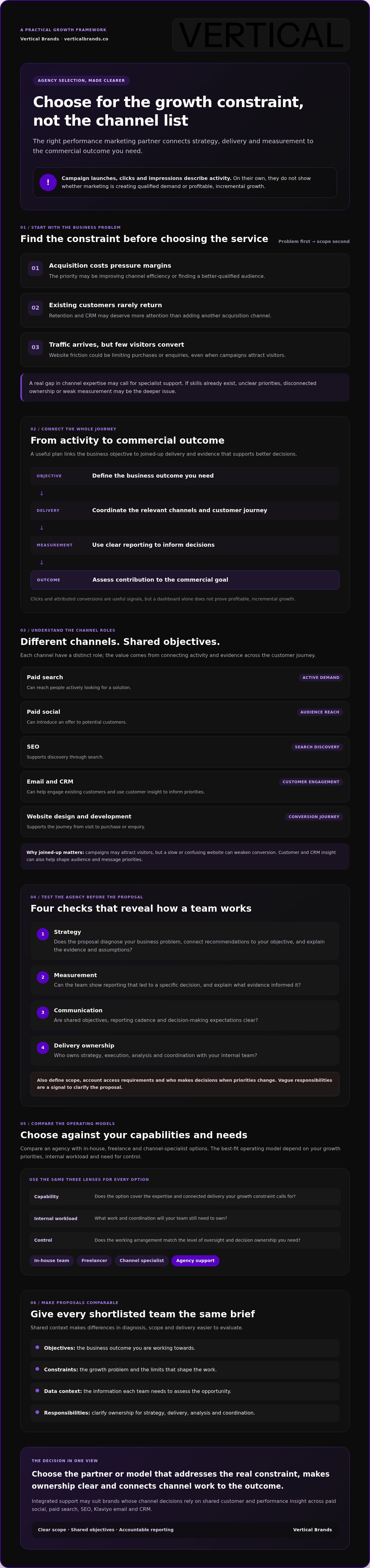
Start with the constraint, not the service list. If acquisition costs are putting pressure on margins, the priority may be improving channel efficiency or finding a better-qualified audience. If existing customers rarely return, retention and CRM may deserve attention. If traffic arrives but few visitors purchase or enquire, friction on the website could be limiting growth.
The right scope depends on your growth stage and internal capabilities. A genuine gap in channel expertise may call for specialist support. But if your teams already have the skills, the bigger issue could be unclear priorities, disconnected ownership or weak measurement. In that case, adding another supplier may not solve the underlying problem.
What does performance marketing include?
Services can span paid social, paid search, search engine optimisation (SEO), email and CRM management, and conversion-focused website design and development. Their roles differ. Paid search can reach people actively looking for a solution, whilst paid social can introduce an offer to potential customers. SEO supports discovery through search, whilst CRM and email can help engage existing customers. You can read more about specialist search and performance strategies to see how those channels function in practice. Website improvements support the journey from visit to purchase or enquiry.
These channels work best when objectives and evidence connect them. Campaigns may attract visitors, for example, but a slow or confusing website can weaken conversion. Customer and CRM insight may also help determine which audiences or messages to prioritise. A report that shows channel activity without linking it to commercial outcomes leaves decision-makers with only part of the picture.
How to assess a performance marketing agency before you compare proposals
Before comparing fees or channel plans, test how each agency thinks. A strong proposal should start with a diagnosis of the business problem, not a preset package of tactics. Ask the team to explain how its recommendations connect to your objective, what evidence supports them and what assumptions still need validating.
Apply the same discipline to delivery. Clarify who owns strategy, execution, analysis and coordination with your internal team. Confirm the proposed scope, account access requirements, reporting cadence and who makes decisions when priorities change. If a proposal leaves these responsibilities vague, ask for them to be defined before assessing the agency’s fit.
Which questions reveal how an agency works?
Ask how the agency would investigate a constraint before selecting channels. If qualified enquiries are down, for example, would it examine the audience, offer, campaign activity and customer journey, or jump straight to increasing spend? Request a relevant example of reporting that led to a specific decision. Verify any client details, and ask the agency to explain what it did, what changed and what evidence informed the next step.
Use questions that reveal ownership, not just credentials:
• Who sets the strategy, and who carries out the agreed work?
• How will your team coordinate with our internal staff and other suppliers?
• What decisions can the agency make independently, and which need our approval?
• How will you flag risks, tracking gaps or changes in the evidence?
How should you judge reporting and measurement?
Start with the objective. If the priority is qualified demand, a report focused on clicks alone is insufficient. Ask how proposed KPIs relate to the commercial goal and whether your available data can support that assessment. Adobe’s overview of performance marketing metrics can help frame the discussion, but the measures still need to fit your business.
Ask how the team handles attribution limits, tracking gaps and conflicting platform reports. A credible answer distinguishes observed results from assumptions and explains what the data can’t establish. Platform-reported conversions may not tell the whole story, for example, if several channels influence the same customer journey. Ask what additional evidence the agency would use before recommending a change to investment or activity.
Use this checklist for every candidate. Mark each item as clear, unclear or not applicable, then record follow-up questions. Don’t turn it into an arbitrary score.
• Business objective and diagnosis are explicit.
• Scope, responsibilities and access requirements are defined.
• KPIs connect to the objective and available evidence.
• Reporting cadence and decision-making process are agreed.
• Risks, measurement limits and dependencies are disclosed.
For a closer look at specialist channel scope, use a paid search management discussion to clarify what is included and how it connects to wider priorities. A partner offering strategy alongside channel delivery, such as Vertical Brands, may be relevant if that matches your needs. Clear answers give you a stronger basis for comparison than a polished proposal alone.
Performance marketing agency vs in-house team, freelancer, or channel specialist
There’s no universally best way to deliver marketing. An in-house team offers direct control and business context. A freelancer or channel specialist can add focused expertise. An integrated agency may coordinate several capabilities under shared objectives. The right model depends on your priorities, resources and operational complexity, not the label on the proposal.
| Model | Capabilities and coordination | Control and internal workload | Accountability to assess |
|---|---|---|---|
| In-house team | Builds knowledge of the business; channel coverage depends on team skills. | High day-to-day control, with internal responsibility for management and delivery. | Clarify ownership across roles, priorities and performance reporting. |
| Freelancer | Often brings focused individual expertise; wider coordination may sit with your team. | Direct working relationship, but internal staff may need to brief and align other contributors. | Agree the scope, outputs, availability and how work will be reviewed. |
| Channel specialist | Concentrates on a defined channel or capability, such as paid search. | Offers focused input, whilst cross-channel decisions may need internal coordination. | Set channel measures and define how the specialist shares insight with other teams. |
| Integrated agency | Can bring multiple capabilities together when governance connects them to shared objectives. | May reduce coordination across suppliers, but requires clear access, decision rights and collaboration with your team. | Confirm who owns strategy, delivery, analysis and joined-up reporting. |
An integrated agency isn’t automatically joined up. Channel teams can still optimise separately unless one agreed plan sets priorities, responsibilities and how decisions are made. A performance marketing agency should be able to explain how its work connects across channels, rather than treating each activity as an isolated account.
When does an in-house team make sense?
Internal teams can apply close knowledge of products, customers and commercial priorities. They also work directly with colleagues across the business. Before expanding that team, assess the skills already available, management capacity and channel coverage needed. External support can complement internal expertise by filling a defined specialist gap or providing strategic input, rather than replacing the team.
When should you choose a specialist or integrated agency?
Choose a specialist when you have a clear channel objective or a capability gap, and someone internally can coordinate the wider plan. Consider integrated support if acquisition, retention and website experience depend on shared customer insight. Paid activity may bring visitors to a site, whilst CRM activity supports customer retention. Vertical Brands offers paid social, paid search, SEO, Klaviyo email and CRM management, and website design and development, which may suit brands seeking coordinated capabilities.
If a Klaviyo platform change is part of your requirements, use a Klaviyo migration services discussion to clarify scope and responsibilities. The right choice depends on your internal capacity and how closely the work needs to connect.
How to shortlist and compare performance marketing agencies
A fair comparison starts with a consistent brief. Give every candidate the same growth objective, constraints, data context and evaluation questions. That makes differences in diagnosis, proposed scope and working model easier to see. Without a shared brief, the most polished proposal can appear strongest simply because it answers a different question.
Use this process to move from a broad search to a practical fit assessment:
1. Define the brief.
State the business priority, what’s limiting progress, the channels already in use and the capabilities available internally. Include relevant data and constraints, not just a list of desired services.
2. Set comparable questions.
Ask each candidate how they would diagnose the issue, what they recommend first and what evidence would inform that choice.
3. Review the proposal.
Check whether it responds to your brief or presents a generic service menu. Look for clear scope, responsibilities, reporting arrangements and review points.
4. Test the assumptions.
Ask what the plan depends on, including data quality, internal approvals, creative input or website changes. Treat guaranteed outcomes or unexplained forecasts as prompts for scrutiny.
5. Assess the working fit.
Confirm who owns decisions and delivery, how the agency will collaborate with your team, and how it would adapt if priorities or evidence change.
What should a strong agency proposal make clear?
A useful proposal shows the connection between your brief, the diagnosis and the recommended work. It should state what is included, what remains your team’s responsibility, how progress will be reviewed and what access is needed. It should also make uncertainty visible. A performance marketing agency can set out a reasoned plan, but results depend on factors beyond the proposal itself.
How can you test strategic and operational fit?
Ask candidates how they’d prioritise if channels compete for resources or attention. For example, what would change if a paid campaign needed more investment but the website experience was weakening conversion? The answer should explain the trade-off and who decides, not simply advocate for one channel.
Before appointment, agree communication routes, approval responsibilities, account access and dependencies on your team. If the brief includes organic search, use an e-commerce search engine optimisation discussion to clarify how the work fits your priorities. A strong proposal makes responsibilities and assumptions easy to challenge before delivery begins.
If you’re weighing up your options, discuss your growth priorities with Vertical Brands and consider whether its paid social, paid search, SEO, Klaviyo email and CRM, or website capabilities fit the brief.
Choosing a performance marketing agency that can support joined-up growth
The right partner fits the business problem, not just the channel list. Look for alignment between your growth priorities, the agency’s capabilities and the way success will be measured. Clear ownership and a workable relationship matter too. Without them, even capable teams can end up working towards separate goals.
Joined-up support can be useful when decisions in one area affect another. Paid media may bring new visitors to a website, whilst search engine optimisation supports ongoing discovery. CRM and email can help a business communicate with existing customers. When these activities use shared customer and performance insight, teams can make decisions with a broader view of the journey instead of relying on isolated channel reports.
Where can integrated capabilities add value?
Consider where information or execution currently breaks between channels. If campaign activity generates interest but the website experience creates friction, improving media alone may not address the constraint. If customer behaviour points to a retention opportunity, CRM insight could inform priorities beyond acquisition. The aim isn’t to combine services for their own sake. It’s to connect the capabilities that need to work together for your objective.
Vertical Brands lists paid social, paid search, SEO, Klaviyo email marketing and CRM management, website design and development, influencer marketing, UGC content and growth advisory among its capabilities. That mix may be relevant if your priorities call for both strategic input and coordinated channel delivery. It won’t be the right fit for every business, so assess the proposed scope against your needs and internal resources.
What should the next step with an agency look like?
Bring a clear summary of your objectives, current constraints, existing channels and measurement concerns. Explain what your team can manage and where you need additional capability. Use the discussion to test how the agency would connect its recommendations to your priorities, what evidence it would use and what information or decisions it would need from you.
Before implementation begins, agree the scope, responsibilities, reporting expectations and decision-making process. Make dependencies explicit, including access, approvals and internal input. These details create a practical basis for collaboration and make it easier to assess whether the relationship is working as intended.
The right combination of capabilities depends on your growth priorities and constraints. If you’re assessing whether Vertical Brands may be a fit, discuss your growth priorities with Vertical Brands before committing.
Choose a growth partner built around your priorities
The right performance marketing agency isn’t simply the one with the broadest service list. Choose a partner whose scope addresses a real business constraint, whose team can explain how it will measure progress, and whose responsibilities are clear. Compare proposals on those fundamentals, then select the operating model that fits your resources and the complexity of your growth priorities.
Joined-up capabilities can be useful when customer and performance insight needs to inform decisions across channels. Vertical Brands lists paid social, paid search, SEO, website development, growth advisory, and Klaviyo email marketing and CRM management among its services. The value is clearest when channel activity, customer relationships and website experience are considered together, rather than managed as disconnected work. Fit still depends on your requirements, internal capacity and agreed scope.
Before committing, share your objectives, current constraints and measurement concerns. Agree what the work includes, who owns each responsibility and how you’ll review progress. A clear brief is a strong starting point for a focused growth decision.
Frequently Asked Questions
What does a performance marketing agency do?
A performance marketing agency plans and manages marketing against measurable objectives, then reports on activity and outcomes. Depending on the agreed scope, its work may include paid social, paid search, SEO, CRM or website development. The important distinction is accountability: clicks and impressions are activity measures, not proof of commercial impact. Assess them alongside outcomes such as qualified demand, customer value or revenue contribution. Results depend on business context and execution, so they can’t be guaranteed.
How do I choose a performance marketing agency?
Choose a partner whose capabilities address a defined growth constraint, and whose proposed work connects to a business objective. Give candidates the same brief, including your priorities, current channels, internal resources and measurement concerns. Ask how they would diagnose the issue, what evidence would guide their plan and who owns delivery and reporting. Compare the clarity of their answers, not just their service list or presentation. A good fit should make responsibilities and assumptions clear.
Is a performance marketing agency better than an in-house team?
Neither model is automatically better. An in-house team can offer close business knowledge, direct control and day-to-day collaboration. An agency may bring specialist skills or coordinate work across several capabilities. Your choice depends on available expertise, management capacity and the complexity of your marketing operation. You can also combine models: an internal team might own priorities and customer insight, whilst an external partner such as NSPYRE Digital Marketing Agency supports specific channels such as paid search, SEO, or paid social campaigns.
What should a performance marketing agency proposal include?
A proposal should show how the agency interprets your brief and why its recommendations fit the business objective. Look for a clear scope, responsibilities, required access, reporting approach and review process. It should identify assumptions and dependencies, such as internal approvals or data availability. Ask for clarification on forecasts or promised outcomes that lack an explanation. A credible proposal distinguishes what the agency can control from results that also depend on your offer, budget and wider commercial conditions.
How do performance marketing agencies measure success?
Agencies should agree measures with you before work begins and link them to commercial priorities. Depending on the objective, these might include qualified enquiries, customer acquisition efficiency, customer value or revenue contribution, alongside channel indicators such as clicks and conversions. Ask how tracking gaps, attribution limits and conflicting platform reports will be handled. Reporting should explain what the data can support, where uncertainty remains and how findings inform decisions. The right measures depend on your objective and available data.
Can one performance marketing agency manage multiple channels?
Yes, if the agency has relevant capabilities and the agreed scope covers them. Vertical Brands lists paid social, paid search, SEO, Klaviyo email marketing, CRM management and website design and development among its services. Multi-channel support can help align activity when decisions rely on shared customer or performance insight. Confirm who coordinates the work, how priorities are set and how each channel contributes to shared objectives. Managing several channels alone doesn’t ensure joined-up execution.
How long does it take to see results from a performance marketing agency?
There isn’t one reliable timeframe. Results depend on the starting point, channel, budget, data quality, offer, implementation requirements and how success is defined. Some activity may produce early indicators, whilst assessing its contribution to business outcomes can require more evidence. Before work starts, agree which measures will be reviewed, how often reporting will happen and what decisions the data can inform. Treat fixed timelines or guaranteed results cautiously unless their assumptions are clearly explained.

Other posts
































































Stay ahead with better decisions.
Get business insights today.
