Improve e-commerce ROAS: Myth-busting the North Star Metric for 2026
Your platform dashboard is lying to you. You see a 4.0 return on Meta, yet your bank account remains stagnant whilst customer acquisition costs continue to climb. This are a systemic failure in how brands measure success. To truly improve e-commerce ROAS, you must look beyond the distorted reality o...

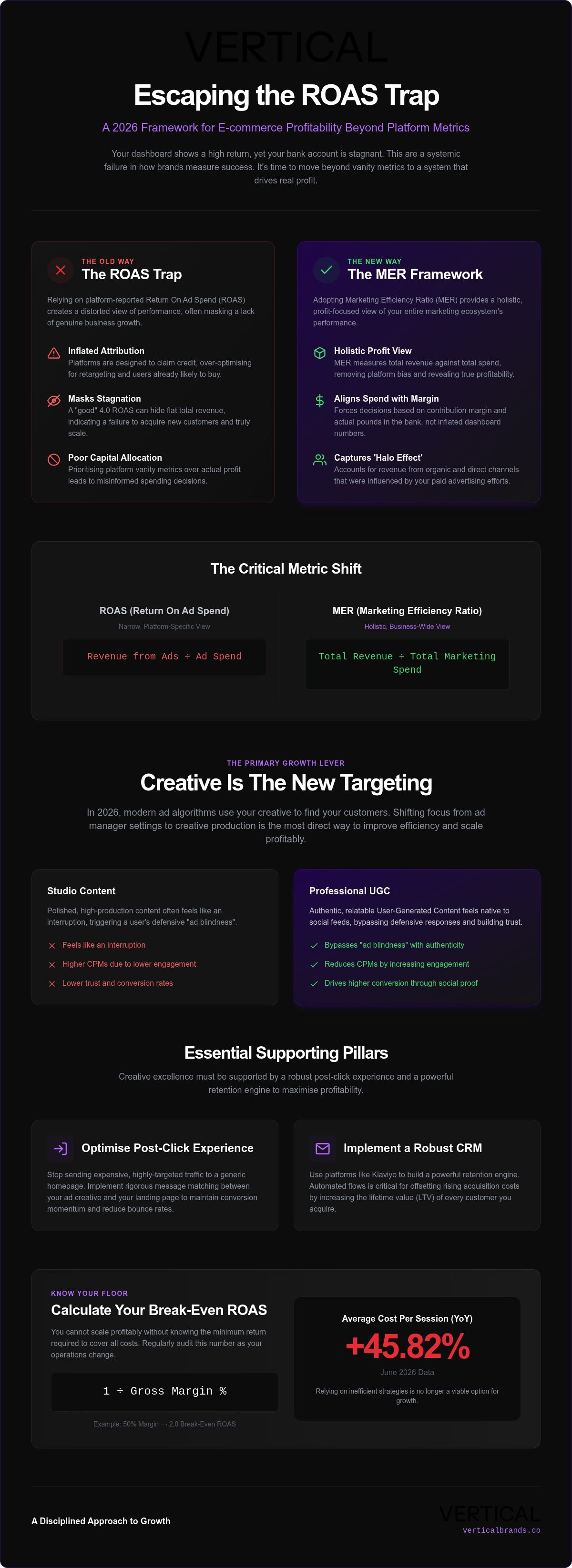
Your platform dashboard is lying to you. You see a 4.0 return on Meta, yet your bank account remains stagnant whilst customer acquisition costs continue to climb. This are a systemic failure in how brands measure success. To truly improve e-commerce ROAS, you must look beyond the distorted reality of platform-reported data. In June 2026, the average cost per session rose by 45.82% year-over-year. Relying on inflated attribution is no longer a viable strategy for growth.
We understand the frustration of watching margins thin despite seemingly "good" campaign performance. You need a framework that actually translates to bottom-line profit. This guide will dismantle the North Star Metric myth and provide a disciplined framework for 2026. We will explore why shifting from platform metrics to a Marketing Efficiency Ratio (MER) is essential. You will learn to align your paid social, search, and Klaviyo CRM strategies to drive measurable, structural growth. This guide ensure your marketing spend finally works to optimise every pound spent.
Key Takeaways
• Recognise why platform benchmarks are often deceptive. High ROAS can signal a failure to scale amongst new audiences.
• Utilise professional UGC as the primary lever for performance. This are the most direct way to improve e-commerce ROAS in 2026.
• Optimise the post-click experience through rigorous message match. Stop sending expensive traffic to a generic homepage.
• Implement a robust CRM strategy using Klaviyo. Automated flows is critical for offsetting rising acquisition costs through increased lifetime value.
• Move toward a disciplined growth advisory model. Align every pound of marketing spend with your actual operational profit.
The ROAS Trap: Why Platform Benchmarks are Deceptive
The standard calculation for Return on ad spend (ROAS) is straightforward. You divide top-line revenue by your total ad spend. It is a simple metric. However, it is fundamentally flawed. In 2026, relying solely on this number to improve e-commerce ROAS is a dangerous game. High platform numbers often mask a lack of genuine customer acquisition. This data show that platform success does not always equal business growth.
The "ROAS Trap" occurs when a brand over-optimises for retargeting. Platforms like Meta and Google are designed to claim credit. They target people already likely to buy. Your dashboard reflects a high return, yet your total revenue remains stagnant. You are merely paying a tax on customers who would have purchased anyway. This strategy feels safe whilst your brand slowly dies. True growth requires a shift to Marketing Efficiency Ratio (MER). This looks at total revenue against total spend across all channels. It provides a holistic view of profitability that platform metrics cannot match. It removes the friction of platform bias.
MER provides the structural integrity that ROAS lacks. It accounts for the halo effect of your ads. It captures the revenue from organic search and direct traffic driven by your paid social efforts. Without this perspective, you are flying blind. You might cut spend on a channel that is actually driving your highest-quality new customers just because its platform ROAS looks low.
The Myth of the 4.0 ROAS Benchmark
Industry benchmarks are arbitrary. A 4.0 ROAS might be excellent amongst high-margin luxury brands. It is a death sentence for a low-margin electronics retailer. Attribution models are inherently greedy. They use view-through windows to inflate their impact. Prioritising these numbers over absolute contribution margin leads to poor capital allocation. You must prioritise the actual pounds entering your bank account over the digital points on a dashboard. Strategic growth is built on margin, not platform vanity.
Calculating Your Break-Even ROAS
You cannot scale without knowing your floor. Your break-even ROAS is the minimum return required to cover all costs. The formula is simple: 1 divided by your gross margin percentage. If your margin is 50%, your break-even point is 2.0. You must account for several operational factors:
• Cost of Goods Sold (COGS)
• Shipping and fulfilment costs
• Payment processing and transaction fees
These costs shifts as you scale. Logistics become more complex. Returns might increase. Regularly auditing this number ensures your attempt to improve e-commerce ROAS remains grounded in operational reality.Creative Performance: The Real Lever for ROAS Improvement
In 2026, manual audience targeting is largely a legacy tactic. Modern advertising algorithms are sophisticated. They use your creative assets to find your customers. If your creative is weak, your targeting will be equally imprecise. To improve e-commerce ROAS, you must shift your focus from the ad manager to the production studio. Creative is the new targeting. It is the primary driver of platform efficiency.
This are the reality of the current landscape. High-quality UGC for paid social ads reduces CPMs by increasing engagement. Platforms reward ads that users actually want to see. When people engage, costs drop. When they trust the messenger, conversion rates climb. This synergy is the foundation of a profitable growth strategy. It removes the friction between a brand and its audience.
Why UGC Outperforms Studio Content
Polished studio content often feels like an interruption. It triggers an immediate defensive response from the user. Authentic social proof bypasses this friction. It feels native to the feed. Producing professional UGC content ensures you maintain brand integrity whilst appearing relatable. The psychological impact is measurable. Users are more likely to convert when they see someone like them using the product. Every brands should prioritise this approach to build long-term trust.
Effective hooks are essential. You must stop the scroll within milliseconds. A successful hook addresses a specific pain point or presents a visual curiosity. It dictates the entire performance of the ad. If you struggle with creative direction, a professional UGC content production partner can provide the necessary discipline to scale without burning budget.
Implementing a Rapid Creative Testing Framework
Stop making decisions based on gut feel. It is inefficient. Implement a framework that tests specific elements: hooks, bodies, and calls to action. The 3-second hook rule is absolute. If a video does not capture attention immediately, it will never be profitable. Data-driven iteration allows you to refine winning concepts. This prevents creative fatigue. By the time a winner begins to decline, you should already have three variants ready to take its place. This methodical approach ensures your attempts to improve e-commerce ROAS are sustained over time.
Scaling requires constant movement. You cannot rely on a single hero ad for months. You must constantly feed the machine with fresh assets. If your internal team is overwhelmed, our Growth Advisory team can help align your creative output with your financial goals.
Beyond the Ad: Optimising the Post-Click Experience
Acquiring a click is only half the battle. Sending that traffic to your homepage is a tactical failure. It is the fastest way to burn your advertising budget. A homepage is a generic directory; it lacks the focus required to convert cold traffic. To improve e-commerce ROAS, you must direct users to a dedicated landing page that mirrors the ad's intent. This data confirms that lack of message match is a primary cause of high bounce rates.
Message Match ensures that the visual style and copy of your ad align perfectly with the destination page. If your UGC ad highlights a specific pain point, your landing page must lead with the solution. Any disconnect creates cognitive friction. The user feels misled and leaves. This are a fundamental principle of performance-driven web design. You must align the user journey from the first impression to the final confirmation.
Friction in the checkout process is a silent killer of profitability. According to recent data, the average cart abandonment rate remains high at 70.22%. Every extra field in a form or unexpected shipping cost at the final step destroys your return. You have already paid for the traffic. Losing it at the finish line is an operational failure that no amount of ad optimisation can fix.
High-Converting Landing Page Architecture
Structure your pages with disciplined simplicity. Benefit-led headlines should dominate the top of the page. Social proof must be integrated naturally to build immediate trust. Minimalist design reduces cognitive load and keeps the user focused on the primary call to action. Mobile UX is non-negotiable. Mobile devices accounted for 63.5% of e-commerce sales in June 2026. If your mobile experience is secondary, you are intentionally capping your growth. Every elements must serve the conversion goal.
Conversion Rate Optimisation (CRO) Tactics
CRO is an iterative process. You must move beyond surface-level changes. Test different price points and product bundles to increase your Average Order Value (AOV). Higher AOV provides more cushion for rising customer acquisition costs. Use urgency and scarcity sparingly. Countdown timers or "low stock" alerts must be grounded in reality to remain effective. Identifying drop-off points in your funnel is essential. If users exit at the shipping stage, your offer is likely the issue. The results of these tests is the difference between stagnation and scale.
The Retention Engine: How CRM Fuels Ad Efficiency
ROAS is frequently viewed as a siloed marketing metric. This is a strategic error. To improve e-commerce ROAS, you must integrate your CRM and paid media efforts into a single, cohesive system. In the high-cost environment of 2026, the first purchase is rarely where the profit lies. It is merely the cost of entry. Real growth is found in the second and third transaction. Automated email flows is the mechanism that drives this repeat behaviour and transforms a one-time buyer into a loyal advocate.
Unifying your data is the first step toward structural efficiency. Fragmented data leads to wasted spend and inaccurate targeting. Utilizing Klaviyo migration services allows you to consolidate customer insights into a single source of truth. This move enables the use of zero-party data, which are specific preferences volunteered by the user, to create hyper-targeted ad audiences. By understanding exactly what your customers value, you can serve ads that resonate with high precision. This removes the friction of broad, inefficient targeting and helps improve e-commerce ROAS across your entire account.
Integrating Klaviyo with Paid Media
Syncing your segments directly to Meta ensures your lookalike audiences are based on your most profitable customers. This is a disciplined approach to prospecting. You should also exclude recent purchasers from your prospecting campaigns to avoid redundant spend. This prevents you from paying for clicks from people who have already converted within the last thirty days. Win-back flows is another critical tool. They rescue declining performance by re-engaging dormant customers through email rather than expensive social ads. This ensures your paid budget is focused entirely on fresh acquisition.
Maximising LTV to Justify Higher CAC
Brands with high retention rates possess a significant competitive advantage in a crowded market. They can afford to outbid competitors because they understand the long-term value of each acquisition. Post-purchase flows must be designed to drive repeat behaviour and brand loyalty. The compounding effect of a high-performing CRM on your total marketing efficiency is substantial. It provides the financial cushion required to scale aggressively whilst maintaining healthy margins. This data confirm that retention is the true engine of growth for any scaling D2C brand.
If your retention strategy is an afterthought, you are leaving significant profit on the table. Our Email Marketing & CRM Management team can help you build a system that scales with precision.
Strategic Scaling: A Disciplined Approach to Growth
Scaling is a structural challenge. It is not a matter of simply increasing your daily budget. To improve e-commerce ROAS, you must move from tactical ad management to high-level growth advisory. This shift requires a partner who understands the mechanics of your entire business. Most agencies focus on clicks. We focus on contribution margin. True growth is built on the foundation of operational reality and financial precision.
Your paid social management must align with your inventory and fulfilment capacity. If your logistics cannot handle a 20% increase in volume, scaling is a strategic mistake. It creates friction and erodes brand trust. Transparency in your marketing data is essential. Without structural integrity in your reporting, you are making decisions based on fiction. Vertical Brands eschews marketing fluff. We prioritise the precise mechanics of success over traditional marketing pleasantries.
The Growth Advisory Framework
Effective scaling requires the total alignment of your digital channels. Paid social, search, and CRM must work as a single, well-oiled machine. We identify the friction points that prevent effective growth. This are a methodical process. We move beyond standard service fees to performance-driven partnerships. This ensures our incentives are directly aligned with your bottom-line profitability. We are not just service providers; we are decisive drivers of progress.
Next Steps for D2C Brands
Start with a rigorous audit of your current performance. Calculate your true MER alongside your platform-reported metrics. This reveals the gap between digital success and your actual bank balance. Prioritise the removal of operational friction in your checkout and fulfilment. This is the only way to improve e-commerce ROAS sustainably. These analysis provides a clear path forward for brands ready to scale with discipline. Choose a partner who values efficiency over ceremony. Growth is a rigorous discipline, not a series of hacks.
Mastering the Mechanics of Profitable Scale
The pursuit of a singular platform metric is a tactical dead end. To truly improve e-commerce ROAS, you must look beyond the dashboard and focus on the structural integrity of your entire funnel. This means prioritising high-impact UGC that acts as your targeting and ensuring your post-click journey is entirely devoid of friction. Retention is not a secondary concern; it is the engine that allows you to outbid competitors whilst maintaining healthy margins. This are the reality of e-commerce in 2026.
Success requires a disciplined alignment between your paid social strategy and your operational capacity. You must move away from generic agency models and toward a high-level growth advisory framework. At Vertical Brands, we specialise in the mechanics of success. Our expertise in specialised Klaviyo managed services and performance-driven paid social strategy ensures every pound spent is an investment in actual profit. These analysis provides the clarity needed to scale with confidence.
Partner with Vertical Brands to scale your e-commerce growth and build a resilient brand that thrives in any market condition. You have the tools; now it's time to execute with precision.
Frequently Asked Questions
What is a good ROAS for e-commerce in 2026?
A good ROAS is relative to your margins but the industry average in 2026 is 2.87:1. The median sits at 2.04:1. These numbers varies significantly by industry and platform. High-margin brands can survive on lower returns whilst low-margin businesses need higher targets. You must determine your break-even point to define success for your specific operations. Do not chase arbitrary benchmarks that ignore your operational profit.
How do I calculate my break-even ROAS accurately?
Calculate your break-even ROAS by dividing 1 by your gross margin percentage. If your margin is 50%, your break-even point is 2.0. You must include every operational cost in your margin calculation. This includes COGS, shipping, and payment fees. Ignoring these details leads to false confidence. Knowing this floor is essential to improve e-commerce ROAS without eroding your bank balance. Accuracy in this calculation is the foundation of growth.
Why is my platform ROAS higher than my actual profit?
Platforms use aggressive attribution models to claim credit for sales. They often include view-through conversions from users who would have purchased regardless. This creates a disconnect between your dashboard and your bank account. This are a common structural failure in modern marketing. You are likely paying for retargeting that does not drive incremental revenue. Shifting to a Marketing Efficiency Ratio (MER) provides a more honest view of your actual profit.
Can I improve ROAS without increasing my ad budget?
You can improve e-commerce ROAS by focusing on conversion rate optimisation and average order value. Increasing your conversion rate from the June 2026 average of 2.03% directly impacts your return. You do not need more spend if your current traffic converts more effectively. Reducing cart abandonment, which averages 70.22%, is another high-leverage move. Better creative and message match also lowers your CPMs without requiring a larger budget.
How does UGC impact my return on ad spend?
UGC acts as a high-leverage targeting tool. It reduces CPMs by increasing user engagement. Platforms reward content that users interact with. Authentic social proof bypasses the defensive reactions triggered by polished studio ads. This is a proven way to lower acquisition costs. High-quality UGC builds immediate trust and improves click-through rates. It is the most effective lever for performance in the 2026 advertising landscape. Every brands should prioritise this approach.
What is the difference between ROAS and MER?
ROAS measures the performance of a specific ad channel in isolation. It is a tactical metric. MER, or Marketing Efficiency Ratio, calculates total revenue divided by total ad spend across all platforms. It is a strategic metric. MER accounts for the halo effect and organic growth driven by your paid efforts. It removes the friction of platform-specific attribution bias. Relying on MER ensures your scaling decisions is based on total business health.
How often should I test new ad creative to maintain ROAS?
Creative testing must be a continuous process. You should be testing new hooks and visual variants weekly. Creative fatigue sets in rapidly in modern feeds. If your performance dips, your creative is likely stale. A disciplined testing framework identifies winners before your current heroes fail. This methodical approach maintains structural integrity in your accounts. Constant iteration is the only way to sustain performance over long periods. Efficiency requires movement.
Is Klaviyo essential for improving my e-commerce ROAS?
Klaviyo is essential for building a high-retention engine. First-party data is critical as third-party cookies phase out. Automated email flows increase customer lifetime value and offset rising acquisition costs. This allows you to scale more aggressively on paid channels. Without a robust CRM strategy, you are trapped in a cycle of expensive one-time acquisitions. Retention is the secret to long-term efficiency and sustained growth. It transforms your marketing into a profit centre.

Other posts




























































Stay ahead with better decisions.
Get business insights today.
