CRM for Ecommerce: Shortlist and How to Choose
A practical CRM shortlist for UK eCommerce by revenue stage: what each platform does well, what it costs and how to choose.

For most UK online stores, a purpose-built ecommerce CRM that unifies order data, browsing behavior, and customer service in one place is the clearest path to better retention and higher repeat revenue. A traditional B2B CRM won’t cut it: it lacks real-time order sync, native lifecycle automation, and the segmentation depth that ecommerce teams actually need.
Here’s a practical shortlist by stage:
- Small shop (under £1M revenue): Klaviyo or Omnisend. Both connect natively to Shopify and WooCommerce, handle abandoned cart flows out of the box, and stay affordable at low contact volumes. Klaviyo’s data model is deeper; Omnisend is faster to set up.
- Growth stage (£1M–£20M revenue): ActiveCampaign or Drip. These give you more sophisticated segmentation, multi-channel automation, and CRM-style contact management without enterprise pricing. Drip is purpose-built for ecommerce; ActiveCampaign suits stores that also run B2B or wholesale.
- Enterprise (£20M+ or complex operations): Salesforce Marketing Cloud or HubSpot CRM. Both handle high contact volumes, complex data models, and multi-brand or multi-region setups. Salesforce is the more powerful data engine; HubSpot is faster to onboard and easier for marketing teams to own.
As the right CRM depends on your store size, budget, and growth goals, the single most useful next step is running the decision checklist in the “How to choose” section below, or booking a discovery call with a specialist who can map your stack.
UK stores must also verify GDPR compliance and PCI DSS alignment before signing any vendor contract. Both are non-negotiable, and several platforms handle them differently.
Key Takeaways
A purpose-built ecommerce CRM that unifies order data, behavioral signals, and service interactions in one place is the clearest lever for improving retention, recovering cart revenue, and scaling repeat purchase rate for UK online stores.
| Point | Details |
|---|---|
| Match CRM to your stage | Small stores suit Omnisend or Brevo; growth brands suit Klaviyo or Drip; enterprise needs HubSpot or Salesforce. |
| Native integrations are non-negotiable | Real-time order sync via a native Shopify, WooCommerce, or BigCommerce connector beats middleware every time. |
| GDPR compliance before go-live | Sign a UK GDPR DPA with your vendor and confirm your data transfer mechanism before importing any customer data. |
| ROI shows in 2–3 months | Measurable ROI from lifecycle automation typically appears within 2–3 months when the data layer is set up correctly. |
| Vertical for full-stack CRM | Vertical delivers CRM strategy, implementation, and optimization alongside performance marketing for UK ecommerce brands. |
Table of Contents
- How do leading CRM platforms for UK ecommerce compare?
- What does each CRM actually do for your ecommerce store?
- What is an ecommerce CRM, and how does it differ from a B2B CRM?
- What core features does every ecommerce CRM need?
- Why do traditional CRMs fall short for ecommerce?
- What tangible benefits does a purpose-built ecommerce CRM deliver?
- How do you choose a CRM for your UK ecommerce store?
- What does a solid CRM implementation checklist look like?
- Which integrations does your ecommerce CRM need to support?
- When should you hire an agency vs. go DIY?
- What support and training options exist after go-live?
- How do you measure ROI and KPIs after CRM deployment?
- What data security and privacy obligations go beyond GDPR?
- What we’ve seen go wrong, and what actually works fast
- Vertical handles the complexity so you don’t have to
- Sources
How do leading CRM platforms for UK ecommerce compare?
The table below covers the ten platforms most commonly shortlisted for UK online retailers. Pricing reflects publicly listed entry tiers as of early 2026 and will vary by contact volume and feature tier.
| Platform | Best for | Entry pricing (approx.) | Key ecommerce integrations | Personalization & segmentation | Automation & journeys | Customer service features | Reporting & revenue attribution | Ease of setup | GDPR / UK data readiness |
|---|---|---|---|---|---|---|---|---|---|
| Klaviyo | Growth-stage DTC brands | Free up to 250 contacts; paid from ~£15/mo | Shopify (native), WooCommerce, BigCommerce | Predictive LTV, RFM, behavioral segments | Abandoned cart, post-purchase, winback flows | Basic; integrates with Gorgias | Revenue attribution per flow/campaign | Moderate (1–2 weeks) | EU/UK DPA available; data processed in US — check transfer mechanism |
| Omnisend | Small-to-mid stores needing quick setup | Free tier; paid from ~£16/mo | Shopify, WooCommerce, BigCommerce, Wix | Product-based segments, lifecycle stages | Pre-built ecommerce automations | Basic inbox; integrates with helpdesks | Sales dashboard, campaign revenue | Fast (under 1 week) | GDPR-compliant; EU data centers available |
| ActiveCampaign | Stores with mixed B2B/B2C or wholesale | From ~£29/mo | Shopify, WooCommerce, BigCommerce via Zapier/native | Deep tagging, lead scoring, custom fields | Visual automation builder, CRM pipelines | Basic CRM; integrates with Zendesk | Deal/pipeline reporting; limited ecommerce revenue | Moderate (2–3 weeks) | EU/UK DPA; data residency options available |
| Drip | Pure-play ecommerce brands | From ~£39/mo | Shopify, WooCommerce, Magento | Ecommerce-native segments, purchase intent | Ecommerce workflows, multi-step journeys | No native helpdesk | Revenue reporting per automation | Fast-moderate (1–2 weeks) | GDPR-compliant; EU data processing available |
| HubSpot CRM | Mid-market and enterprise; omnichannel | Free CRM tier; Marketing Hub from ~£45/mo | Shopify (native), WooCommerce, BigCommerce | Smart lists, behavioral scoring | Workflow builder; strong for lifecycle | Shared inbox, live chat, ticketing | Attribution reporting; revenue dashboards | Moderate (2–4 weeks) | UK GDPR DPA; EU data centers; strong compliance docs |
| Salesforce Marketing Cloud | Enterprise, multi-brand, complex data | Custom pricing; typically £1,000+/mo | Shopify, Magento, custom via API | Advanced AI segmentation (Einstein) | Journey Builder; complex multi-step flows | Service Cloud integration | Advanced analytics, Einstein attribution | High (2–6 months) | UK GDPR DPA; data residency options; robust compliance |
| Klaviyo B2C CRM | DTC brands wanting unified marketing + service | Included in Klaviyo plans | Same as Klaviyo above | Unified profile across marketing and service | Shared across marketing and service layers | Customer profiles, service view | Unified revenue view | Moderate | Same as Klaviyo |
| Gorgias | Customer service-first ecommerce teams | From ~£10/mo | Shopify (deep native), WooCommerce, BigCommerce | Order-aware ticketing, customer history | Automated ticket routing, macros | Full helpdesk: email, chat, social, SMS | Ticket revenue attribution | Fast (under 1 week) | GDPR-compliant; EU data centers |
| Brevo (formerly Sendinblue) | Budget-conscious SMBs | Free tier; paid from ~£19/mo | Shopify, WooCommerce, PrestaShop | Basic segmentation, contact scoring | Email/SMS automation, transactional | Basic CRM, live chat | Campaign reporting | Fast (under 1 week) | EU-headquartered; strong GDPR posture; UK DPA available |
| Zoho CRM | SMBs wanting an all-in-one suite | Free tier; paid from ~£14/mo | Shopify, WooCommerce via Zoho Commerce | Segmentation, scoring, custom modules | Workflow rules, Blueprint journeys | Zoho Desk integration | Zoho Analytics integration | Moderate (2–3 weeks) | GDPR-compliant; EU data centers; UK DPA |
| Voyado | Nordic/European retail and loyalty-heavy brands | Custom pricing | Shopify, custom integrations | Loyalty-native segmentation, member tiers | Lifecycle automation with loyalty triggers | Basic CRM view | Loyalty and revenue reporting | Moderate-high (4–8 weeks) | EU-headquartered; strong GDPR posture |
A few UK-specific notes worth flagging:
- Klaviyo processes data in the US by default. UK stores must confirm a valid UK-to-US data transfer mechanism (UK IDTA or UK Addendum to EU SCCs) is in place before going live.
- Brevo and Voyado are EU-headquartered, which simplifies data residency conversations for UK stores post-Brexit.
- Salesforce and HubSpot both offer UK-specific Data Processing Addenda. Request these before signing.
- Gorgias is the strongest pure customer service option but is not a full marketing CRM. Most stores pair it with Klaviyo.
What does each CRM actually do for your ecommerce store?
Klaviyo
Klaviyo is the default choice for DTC brands on Shopify, and for good reason. Its data model is built around ecommerce events: purchases, product views, cart additions, and refunds all feed directly into customer profiles. Segmentation is genuinely powerful, including predictive lifetime value (LTV) scoring and RFM (recency, frequency, monetary) modeling. The abandoned cart flow is one of the best pre-built automations in the market.
- Best for: Growth-stage DTC brands on Shopify or WooCommerce
- Pricing shape: Free up to 250 contacts; scales with list size, which can get expensive above 50,000 contacts
- Standout feature: Predictive LTV and revenue attribution per automation, not just per campaign
- GDPR note: Data is processed in the US. UK stores need a UK IDTA or UK Addendum to EU SCCs in place. Klaviyo provides a DPA, but you must request and countersign it.
- Setup: Shopify integration takes under an hour. Full automation setup typically runs 1–2 weeks with a developer for custom events.
Omnisend
Omnisend is the fastest platform to get running. Its pre-built ecommerce automations (abandoned cart, order confirmation, winback) work without custom development, and the interface is clean enough for a non-technical marketer to own. It lacks Klaviyo’s depth on predictive analytics, but for stores under £5M revenue that need results quickly, it’s a strong pick.
- Best for: Small-to-mid stores that need fast time-to-value
- Pricing shape: Free tier available; paid plans scale by contact volume
- Standout feature: Pre-built automation library with SMS and push notification channels included
- GDPR note: EU data centers available; GDPR-compliant by design
- Setup: Under one week for most Shopify or WooCommerce stores
ActiveCampaign
ActiveCampaign sits at the intersection of CRM and marketing automation. It’s not purely ecommerce-native, but its visual automation builder and deep tagging system make it genuinely flexible. Stores that also run B2B accounts, wholesale, or subscription models alongside DTC will find it handles the complexity better than most ecommerce-first tools.
- Best for: Mixed-model stores (DTC plus wholesale or B2B)
- Pricing shape: Entry from ~£29/mo; scales by contacts and feature tier
- Standout feature: CRM pipelines alongside marketing automation in one interface
- GDPR note: EU/UK DPA available; data residency options exist at higher tiers
- Setup: 2–3 weeks for a full ecommerce integration; Shopify native connector available
Drip
Drip is built specifically for ecommerce, and it shows. Every feature from segmentation to reporting is oriented around purchase behavior. It doesn’t try to be a B2B CRM or a helpdesk. That focus is its strength and its limit: if you need ticketing or complex CRM pipelines, you’ll need to integrate another tool.
- Best for: Pure-play ecommerce brands that want a focused tool
- Pricing shape: From ~£39/mo; flat pricing by contact count
- Standout feature: Ecommerce-native workflow triggers (specific product purchased, category browsed, LTV crossed a threshold)
- GDPR note: EU data processing available; GDPR-compliant
- Setup: 1–2 weeks; WooCommerce and Shopify integrations are well-documented
HubSpot CRM
HubSpot’s free CRM tier is genuinely useful, but the ecommerce power lives in the paid Marketing Hub. The platform excels at omnichannel lifecycle management and is the easiest enterprise-grade option for marketing teams to own without heavy IT involvement. Revenue attribution reporting is solid, and the shared inbox and ticketing features mean you can consolidate service alongside marketing.
- Best for: Mid-market brands wanting one platform for marketing, CRM, and service
- Pricing shape: Free CRM; Marketing Hub from ~£45/mo; scales significantly at enterprise
- Standout feature: Unified contact timeline across marketing, sales, and service
- GDPR note: UK GDPR DPA available; EU data centers; strong compliance documentation
- Setup: 2–4 weeks for a full ecommerce stack; Shopify native integration available
Salesforce Marketing Cloud
Salesforce is the most powerful option on this list and the most complex. Journey Builder handles multi-step, multi-channel campaigns at a scale no other platform matches. Einstein AI adds predictive segmentation and send-time optimization. The trade-off is implementation time: a full Salesforce deployment for an ecommerce brand typically runs 2–6 months and requires a specialist.
- Best for: Enterprise brands with complex data models, multiple regions, or high SKU counts
- Pricing shape: Custom; typically starts at £1,000+/mo at meaningful scale
- Standout feature: Journey Builder combined with Einstein AI for predictive personalization
- GDPR note: UK GDPR DPA available; data residency options; robust compliance framework
- Setup: 2–6 months; requires a certified Salesforce partner or in-house specialist
Gorgias
Gorgias is not a marketing CRM. It’s a customer service platform built for ecommerce, and it’s the best in that category. Every ticket shows the customer’s full order history, making support faster and more personal. It integrates deeply with Shopify and pairs well with Klaviyo for stores that want best-of-breed across service and marketing.
- Best for: Ecommerce teams where customer service volume is high and speed matters
- Pricing shape: From ~£10/mo; scales by ticket volume
- Standout feature: Order-aware ticketing with Shopify data surfaced directly in the ticket view
- GDPR note: GDPR-compliant; EU data centers available
- Setup: Under one week for Shopify stores
Brevo
Brevo (formerly Sendinblue) is the strongest budget option on this list. EU-headquartered, GDPR-friendly by design, and with a free tier that includes email, SMS, and basic automation, it suits small UK stores that need to get started without a large upfront commitment. Its segmentation is less sophisticated than Klaviyo’s, but for stores under £500K revenue, it covers the essentials.
- Best for: Budget-conscious SMBs getting started with email and SMS automation
- Pricing shape: Free tier; paid from ~£19/mo
- Standout feature: Transactional email and SMS in one platform, EU-hosted
- GDPR note: EU-headquartered; strong GDPR posture; UK DPA available
- Setup: Under one week
Zoho CRM
Zoho CRM is the most complete all-in-one suite for SMBs that want CRM, marketing, helpdesk, and analytics under one vendor. It’s not as ecommerce-native as Klaviyo or Drip, but its breadth is hard to match at the price point. UK stores already using Zoho’s broader suite (Zoho Books, Zoho Desk) will find the integration straightforward.
- Best for: SMBs wanting a full business suite with CRM at the center
- Pricing shape: Free tier; paid from ~£14/mo
- Standout feature: Native integration across Zoho’s full product suite
- GDPR note: GDPR-compliant; EU data centers; UK DPA available
- Setup: 2–3 weeks; ecommerce integrations require some configuration
Voyado
Voyado is a loyalty-first CRM built for retail and ecommerce brands that treat membership and loyalty programs as a core growth lever. It’s less well-known in the UK than in Scandinavia, but its loyalty-native segmentation and lifecycle automation are genuinely differentiated for brands where repeat purchase rate and member LTV are the primary KPIs.
- Best for: Retail and ecommerce brands with active loyalty programs
- Pricing shape: Custom pricing
- Standout feature: Loyalty-native segmentation that triggers automations based on member tier, points balance, and redemption behavior
- GDPR note: EU-headquartered; strong GDPR posture
- Setup: 4–8 weeks; custom integrations typically required
Pro Tip: Before committing to any platform, ask the vendor for a UK-specific Data Processing Addendum and confirm whether your customer data will be processed outside the UK. Under UK GDPR, transfers to countries without an adequacy decision require a valid transfer mechanism. Getting this wrong at setup is far more expensive to fix later.
What is an ecommerce CRM, and how does it differ from a B2B CRM?
An ecommerce CRM centralizes individual customer profiles, purchase history, browsing behavior, and service interactions to enable 1:1 personalization and lifecycle automation at scale.
That’s the definition. Here’s why it matters in practice: a traditional B2B CRM is built around accounts, deals, and sales pipelines. They track which company is at which stage of a sales cycle. An ecommerce CRM is built around individual consumers, real-time events, and purchase patterns. The data model is fundamentally different, and so are the automations it enables.
The practical differences:
- Data model: B2B CRMs organize data around accounts and contacts in a hierarchy. Ecommerce CRMs organize data around individual customers, their order history, cart events, product views, and LTV. A single customer might have 50 orders and 500 browsing events. A B2B CRM has no native structure for that.
- Scale and performance: B2B CRMs handle hundreds or thousands of accounts. Ecommerce CRMs handle hundreds of thousands or millions of individual contacts, with real-time event streams. The infrastructure requirements are different.
- Native integrations: Ecommerce CRMs connect natively to Shopify, WooCommerce, and BigCommerce. B2B CRMs typically require custom middleware or heavy engineering to ingest order-level data.
- Automation types: B2B CRMs automate lead nurturing and deal progression. Ecommerce CRMs automate abandoned cart recovery, post-purchase sequences, winback campaigns, and loyalty triggers. These are consumer lifecycle flows, not sales pipeline stages.
- Customer hub and self-service: Ecommerce CRMs often include or integrate with customer portals where shoppers can view orders, manage returns, and update preferences. B2B CRMs have no equivalent.
The concrete data points that make an ecommerce CRM valuable: purchase frequency, average order value, product category affinity, cart abandonment rate, and predicted LTV. None of these live natively in a B2B CRM without significant custom development.
What core features does every ecommerce CRM need?
Ecommerce CRMs track purchase history, abandoned carts, and browsing patterns to enable precise audience segmentation and personalized campaigns. But the feature set goes deeper than that. Here’s what to look for, and why each one affects your bottom line:
- Unified customer profile (data layer): Every customer’s orders, browsing events, service tickets, and marketing interactions in one record. Without this, your marketing team is working from a different dataset than your service team, and neither has the full picture.
- Real-time order sync: Order data must flow into the CRM as it happens, not in nightly batches. Batch sync means your abandoned cart email fires 24 hours late, or your post-purchase flow triggers after the customer has already contacted support.
- Segmentation and predictive LTV: The ability to build audiences based on purchase behavior, product affinity, and predicted future value. Predictive LTV lets you identify your top 10% of customers before they become your top 10%.
- Automation and lifecycle journeys: Abandoned cart, post-purchase, winback, and VIP flows. These are the highest-ROI automations in ecommerce and should be available without custom development.
- Email, SMS, and messaging channels: Multi-channel reach matters. Customers who receive both email and SMS from a relevant sequence convert at higher rates than single-channel recipients.
- Customer hub and service inbox: A shared inbox where service agents see the full customer profile, order history, and previous tickets. This reduces handle time and improves resolution quality.
- Returns and workflow automation: Automated returns initiation, status updates, and refund confirmations reduce inbound ticket volume and improve post-purchase satisfaction.
- Attribution and revenue analytics: The ability to tie revenue back to specific flows, campaigns, and channels. Without this, you’re optimizing blind.
- Loyalty and subscription support: Native or integrated support for loyalty programs and subscription billing. Repeat purchase rate is the primary lever for ecommerce profitability.
- API and webhooks: The ability to push and pull data in real time with your existing stack. This is non-negotiable for any store with a custom tech stack or multiple sales channels.
Statistic callout: According to Vtiger’s ecommerce CRM research, implementation of targeted lifecycle automation typically shows measurable ROI within 2–3 months of go-live, provided the data layer is set up correctly from day one.
Pro Tip: Design every automation with a control group from the start. After 60 days, you’ll have clean revenue-lift data that justifies the CRM investment to your CFO and tells you which flows to scale.
Why do traditional CRMs fall short for ecommerce?
Traditional B2B CRMs often need heavy engineering to handle B2C volume and real-time order events, and that engineering cost is rarely visible in the vendor’s pitch. Here’s where the gaps show up in practice:
- Weak real-time order sync: Most B2B CRMs ingest order data via scheduled imports or middleware. That means your customer profile is always slightly out of date, and time-sensitive automations like abandoned cart or post-purchase flows either don’t fire or fire late.
- Limited marketing automation channels: B2B CRMs are built for email sequences tied to deal stages. They don’t natively handle SMS, push notifications, or on-site personalization. Adding those channels requires third-party tools and custom integrations.
- Poor segmentation at scale: Segmenting a database of 500,000 consumers by purchase frequency, product category, and predicted LTV is a different computational problem than segmenting 2,000 B2B accounts. B2B CRMs often time out or produce stale segments at consumer scale.
- No customer hub: Ecommerce customers expect self-service: order tracking, returns initiation, and preference management. B2B CRMs have no native equivalent. Building one on top of a B2B CRM is a significant engineering project.
- Revenue attribution gaps: B2B CRMs report on pipeline and deal value. They don’t natively attribute email or SMS revenue to specific campaigns or flows. That gap makes it nearly impossible to optimize marketing spend.
Red flags to watch for in vendor demos:
- The vendor relies on CSV imports or nightly batch syncs for order data
- There’s no native connector for Shopify, WooCommerce, or BigCommerce
- Basic abandoned cart automation requires custom development or a third-party app
- Segmentation is limited to static lists rather than dynamic behavioral audiences
- Revenue attribution is not available at the campaign or flow level
The operational cost of using the wrong CRM is real: marketing teams spend hours manually exporting and importing data, campaigns launch late, and service agents work without order context. That friction compounds over time. A store doing £5M in revenue with a mismatched CRM is typically leaving a meaningful share of repeat purchase revenue on the table simply because their lifecycle flows are slow, generic, or broken.
What tangible benefits does a purpose-built ecommerce CRM deliver?
The business case for a purpose-built ecommerce CRM comes down to five measurable outcomes:
- Higher retention and repeat purchase rate: Lifecycle automation keeps your brand present at the right moments: post-purchase, at the point of potential churn, and when a customer’s purchase pattern suggests they’re ready to buy again. Retention is cheaper than acquisition, and a CRM is the primary tool for improving it.
- Higher average order value via cross-sell and upsell: Behavioral segmentation lets you identify customers who bought product A and are statistically likely to need product B. That’s a targeted cross-sell sequence, not a generic newsletter.
- Recovered cart revenue: Abandoned cart flows are the highest-ROI automation in ecommerce. A well-configured three-step sequence (email at 1 hour, email at 24 hours, SMS at 48 hours) recovers a meaningful share of carts that would otherwise be lost.
- Improved customer service efficiency: When service agents see the full customer profile, order history, and previous interactions in one view, handle time drops and first-contact resolution improves. Gorgias users on Shopify see this most clearly: the order data is surfaced directly in the ticket.
- Better ROI on marketing spend: Attribution reporting tells you which flows and campaigns are generating revenue. That data lets you reallocate budget from underperforming campaigns to high-performing ones, improving overall marketing efficiency.
Statistic callout: Proper CRM integration can improve collaboration, marketing effectiveness, and inventory planning, and enables a single source of truth that powers omnichannel experiences across every customer touchpoint.
For the first 90–180 days post-implementation, track these KPIs: abandoned cart recovery rate, repeat purchase rate (30-day and 90-day cohorts), email revenue per recipient, average handle time for service tickets, and marketing-attributed revenue as a percentage of total revenue. These are the metrics that tell you whether the CRM is working, not open rates or list size.
How do you choose a CRM for your UK ecommerce store?
There is no single best CRM for every ecommerce business. The right choice depends on your store size, your existing tech stack, and where you want to be in 18 months. Here’s a prioritized decision framework:
Decision checklist (in priority order)
- Integrations: Does it connect natively to your ecommerce platform (Shopify, WooCommerce, BigCommerce)? Native beats middleware every time.
- Data model: Can it ingest real-time order events, browsing behavior, and LTV? If the answer is “via a third-party connector,” ask how fresh the data actually is.
- Automation depth: Can you build abandoned cart, post-purchase, and winback flows without a developer? What’s the trigger logic like?
- Service features: Does it include a shared inbox, or does it integrate with your helpdesk? Can service agents see order history in the ticket view?
- Analytics and attribution: Can you attribute revenue to specific flows and campaigns? Can you build cohort reports?
- Security and compliance: Does the vendor offer a UK GDPR DPA? Where is data processed? What’s their PCI DSS posture if they touch payment data?
- Total cost of ownership: What does the platform cost at 2x your current contact volume? What’s the implementation cost? What ongoing support is included?
Questions to ask vendors in demos
Marketing team:
- Show me how I build an abandoned cart flow. How many steps does it take?
- How does segmentation work? Can I build a dynamic segment based on predicted LTV?
- How does revenue attribution work at the flow level?
Operations and engineering:
- How does order data get into the CRM? Is it real-time or batch?
- What’s the API rate limit? Do you support webhooks?
- How long does a typical Shopify integration take?
Legal and compliance:
- Do you offer a UK GDPR Data Processing Addendum?
- Where is customer data processed and stored?
- How do you handle data subject access requests?
Typical selection timeline
A realistic CRM selection process for a UK ecommerce store runs 4–8 weeks:
- Week 1–2: Internal audit (current stack, data quality, team requirements)
- Week 2–3: Longlist to shortlist (3–4 vendors, initial demos)
- Week 3–5: Deep demos, technical evaluation, compliance review
- Week 5–6: Reference checks, commercial negotiation, DPA review
- Week 6–8: Contract signed, implementation planning begins
Buyer persona guidance:
- Small shops: Prioritize speed to value and native integrations. Don’t over-engineer. Omnisend or Brevo gets you running in a week.
- Fast-growing brands: Prioritize data model depth and automation flexibility. You’ll outgrow a simple tool faster than you think. Klaviyo or Drip is the right bet.
- Enterprise: Prioritize data governance, multi-region support, and the vendor’s professional services team. Salesforce or HubSpot at this scale is a multi-month project, not a plugin install.
What does a solid CRM implementation checklist look like?
Effective implementation requires establishing a single source of truth where customer profiles are enriched with order status, lifetime value, and browsing patterns. Here’s the step-by-step process:
Implementation steps
- Audit current data: Export your existing customer database. Identify duplicates, missing fields, and data quality issues. A CRM built on dirty data produces unreliable automations from day one.
- Map your customer schema: Define the fields that matter: order count, LTV, last purchase date, product categories purchased, subscription status, loyalty tier. Map these to the CRM’s data model before importing anything.
- Plan integrations: Identify every system that needs to connect: ecommerce platform, payment gateway, subscription platform, helpdesk, loyalty program. Confirm which connections are native and which require custom development.
- Export and clean data: Clean before you import. Deduplicate contacts, standardize email formats, and remove hard bounces and unsubscribes. Importing a dirty list into a new CRM is a GDPR risk and a deliverability risk.
- Set up staging environment: Configure the CRM in a staging environment before touching production. Test every integration, every automation trigger, and every data field mapping.
- Test end-to-end: Place test orders, trigger abandoned cart events, submit test service tickets. Verify that data flows correctly from your ecommerce platform into the CRM and that automations fire at the right time.
- Switch over: Time the cutover for a low-traffic period (midweek, outside peak trading). Have a rollback plan: know exactly how to revert to your previous setup if something breaks.
- Document and train: Document every automation, every segment, and every integration. Train your marketing and service teams before go-live, not after.
Testing checklist
- Message previews render correctly across email clients and devices
- A/B test variants are set up with statistically meaningful split sizes
- Event firing is verified (abandoned cart, purchase, refund events all trigger correctly)
- End-to-end order lifecycle tested: purchase confirmation, shipping notification, post-purchase flow
- Unsubscribe and consent mechanisms work correctly and are logged
UK GDPR-specific actions
- Record all processing activities in your Record of Processing Activities (ROPA)
- Sign a Data Processing Addendum with your CRM vendor before going live
- Confirm the data transfer mechanism if data is processed outside the UK (UK IDTA or UK Addendum to EU SCCs)
- Implement cookie consent correctly: CRM tracking pixels and behavioral tracking require explicit consent under UK GDPR
- Build a data subject request workflow: you need to be able to respond to access, erasure, and portability requests within 30 days
- Confirm data residency: where are customer records stored, and is that compliant with your privacy policy?
Pro Tip: Don’t import your full historical database on day one. Start with active customers (purchased in the last 12 months) and build your automations on clean, recent data. Expand to older segments once you’ve validated that the data model and integrations are working correctly.
Which integrations does your ecommerce CRM need to support?
Consolidated ecommerce CRMs that include email, SMS, and messaging channels can substantially lower total stack costs and reduce the number of separate tools merchants must manage. But the integration layer is where most implementations succeed or fail.
Priority integrations (critical for most stores):
- Ecommerce platform: Shopify, WooCommerce, or BigCommerce. This is the primary data source. Native connectors are always preferable to middleware. Real-time webhooks beat batch sync.
- Payment gateway: Stripe, PayPal, or Klarna. Payment data enriches customer profiles with transaction-level detail and enables payment-method-based segmentation.
- Email and SMS: Either native (Klaviyo, Omnisend) or via integration (Mailchimp, Dotdigital). Multi-channel reach is table stakes for ecommerce lifecycle marketing.
- Helpdesk: Gorgias, Zendesk, or Freshdesk. Service data needs to flow into the CRM so marketing and service teams share the same customer view.
- Analytics and BI: Google Analytics 4, Looker Studio, or a dedicated BI tool. CRM data alone is not enough; you need to connect it to site behavior and revenue data.
Nice-to-have integrations (depending on business model):
- Subscription platform: Recharge, Chargebee, or Recurly. Critical for subscription-first brands; less relevant for one-time purchase stores.
- Loyalty platform: LoyaltyLion, Smile.io, or Yotpo. Loyalty data enables tier-based segmentation and loyalty-triggered automations.
- PIM and inventory: Akeneo, Linnworks, or Brightpearl. Product and inventory data enables back-in-stock flows and product recommendation personalization.
- Ad platforms: Meta, Google Ads, TikTok. CRM audience syncs let you suppress existing customers from acquisition campaigns and build lookalike audiences from your best buyers.
- CMS: Contentful, Shopify’s native CMS. Useful for on-site personalization tied to CRM segments.
Technical notes:
Real-time webhooks are the standard for ecommerce CRM integrations. Batch sync (nightly or hourly) is acceptable for inventory data but not for order events or behavioral triggers. If a vendor’s Shopify integration relies on batch sync for order data, that’s a red flag.
API rate limits matter at scale. If you’re processing thousands of orders per day, confirm the CRM’s API rate limits and whether they’ll cause delays in data ingestion during peak periods (Black Friday, Boxing Day).
Custom connectors for non-standard integrations typically take 2–4 weeks of developer time. Budget for this in your implementation plan.
Statistic callout: Proper CRM integration improves collaboration, marketing effectiveness, and inventory planning, and creates a single source of truth that powers omnichannel experiences. The integration layer is not a one-time project; it requires ongoing maintenance as your stack evolves.
When should you hire an agency vs. go DIY?
The honest answer: most ecommerce stores underestimate the complexity of a CRM implementation and overestimate their internal capacity to manage it.
Hire an agency when:
- Your integration requirements are complex (multiple platforms, custom data models, subscription plus DTC plus wholesale)
- Your internal team doesn’t have a dedicated CRM or marketing automation specialist
- You need fast ROI and can’t afford 3–6 months of trial and error
- You’re migrating from an existing CRM and need to preserve historical data and automations
- You’re at enterprise scale and the implementation cost of getting it wrong is significant
Go DIY when:
- You’re on Shopify with a straightforward product catalog and a single sales channel
- You’re implementing Omnisend, Brevo, or Klaviyo with pre-built templates and no custom event tracking
- You have a technically capable marketing manager who can own the platform
- Your budget is genuinely limited and you’re willing to trade speed for cost
What a good agency engagement looks like:
- A clear discovery phase (2–4 weeks) that audits your data, maps your stack, and produces a written implementation plan
- Defined milestones with measurable deliverables (not just “CRM set up”)
- Knowledge transfer: your team should be able to own the platform after the agency engagement ends
- A measurement plan agreed before go-live: what KPIs will be tracked, how, and by whom
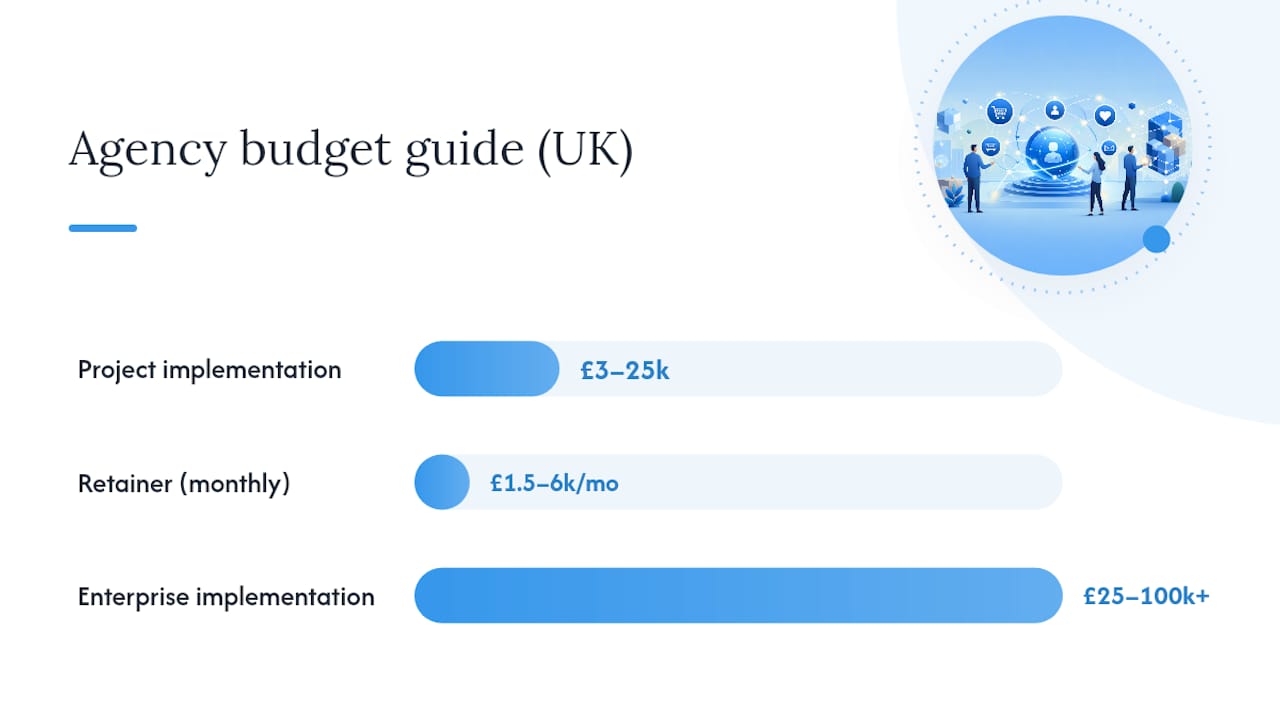
Budget guide for UK stores:
- Project-based implementation: £3,000–£25,000 depending on complexity
- Retainer (ongoing optimization): £1,500–£6,000/mo for a specialist agency
- Enterprise engagements: £25,000–£100,000+ for full Salesforce or HubSpot implementations
That kind of result comes from combining CRM strategy with performance marketing and creative, not from CRM implementation in isolation.
Pro Tip: Ask any agency you’re evaluating for a sample measurement plan from a previous CRM engagement. If they can’t show you how they tracked ROI on a past project, they won’t be able to track it on yours.
What support and training options exist after go-live?
Go-live is not the finish line. The first 90 days after launch are when most CRM implementations either compound their value or quietly stall.
Platform-provided support:
Most platforms offer tiered support: email-only at entry level, live chat at mid-tier, and a dedicated customer success manager at enterprise. Klaviyo, HubSpot, and Salesforce all offer onboarding programs with structured training. Klaviyo’s Academy is particularly strong for self-directed learning. HubSpot Academy is one of the most comprehensive free training resources in marketing technology.
Self-implementation support:
If you’ve gone DIY, the most valuable resources are the platform’s own documentation, community forums, and YouTube channels. Klaviyo’s community forum is active and well-moderated. Shopify’s App Store reviews for each CRM integration often surface real-world implementation issues that documentation doesn’t cover.
Agency-led support:
A retainer engagement with a specialist agency typically covers ongoing automation optimization, A/B testing, list hygiene, deliverability monitoring, and reporting. The value of a retainer versus a one-time project is continuity: someone who knows your data model and your automations is far more effective than a fresh engagement every quarter.
Internal ownership:
Regardless of whether you use an agency, someone on your team needs to own the CRM. That means a named individual responsible for data quality, automation performance, and compliance. Without internal ownership, CRM platforms drift: automations go stale, segments become inaccurate, and compliance gaps appear.
How do you measure ROI and KPIs after CRM deployment?
The metrics that matter in the first 90–180 days are not vanity metrics. Here’s what to track and why:
Primary KPIs:
- Abandoned cart recovery rate: The percentage of abandoned carts that result in a completed purchase after a CRM-triggered sequence. This is the fastest and clearest proof of CRM value.
- Repeat purchase rate (30-day and 90-day cohorts): Are customers who received lifecycle automation buying again at a higher rate than those who didn’t? Cohort analysis answers this.
- Email revenue per recipient: Total email-attributed revenue divided by the number of recipients. This normalizes for list size and lets you compare campaign performance accurately.
- Average handle time (service): If you’ve integrated a helpdesk, is service resolution faster now that agents have full customer context?
- Marketing-attributed revenue as a percentage of total revenue: This is the headline CRM ROI metric. It should grow over the first 6–12 months as automations mature and segments become more accurate.
Attribution methodology:
Most ecommerce CRMs use last-click attribution by default. That overstates email’s contribution and understates the role of paid channels. Set up a multi-touch attribution model (or at minimum, compare last-click to first-click) so you’re making budget decisions on accurate data.
Reporting cadence:
- Weekly: deliverability metrics, automation performance, ticket volume
- Monthly: cohort repeat purchase rate, revenue attribution, list growth and health
- Quarterly: LTV by acquisition channel, automation ROI, compliance audit
The 90-day mark is when most stores have enough data to make meaningful optimization decisions. Before that, you’re mostly validating that the integrations are working and the automations are firing correctly.
What data security and privacy obligations go beyond GDPR?
UK GDPR is the baseline, not the ceiling. Ecommerce stores handling payment data, high volumes of personal data, or sensitive customer information face additional obligations.
PCI DSS:
If your store processes, stores, or transmits cardholder data, PCI DSS (Payment Card Industry Data Security Standard) applies. Most Shopify and WooCommerce stores offload payment processing to Stripe or PayPal, which means PCI DSS compliance is largely handled by the payment provider. But if your CRM stores any payment-related data (even partial card numbers or payment method tokens), you need to confirm your PCI DSS scope with your payment provider and your CRM vendor.
UK GDPR specifics:
- Data minimization: only collect and store the customer data you actually use. A CRM that ingests every available data point without a clear use case is a compliance liability.
- Retention policies: define how long you retain customer data and build automated deletion or anonymization into your CRM workflows.
- Data subject rights: your CRM must support data subject access requests (DSARs), erasure requests, and data portability requests within the statutory 30-day window.
- Consent management: behavioral tracking (browsing events, on-site behavior) requires explicit consent under UK GDPR. Your CRM’s tracking pixel must be gated behind a compliant consent mechanism.
Data residency:
Post-Brexit, the UK has its own adequacy framework. Transfers of personal data from the UK to countries without a UK adequacy decision require a valid transfer mechanism: the UK IDTA or the UK Addendum to EU SCCs. Several CRM vendors (particularly US-based ones) process data in the US. Confirm the transfer mechanism before signing.
Additional standards:
- ISO 27001: Enterprise CRM vendors should hold ISO 27001 certification. This is a signal of mature information security management.
- SOC 2 Type II: US-based vendors should provide a SOC 2 Type II report on request. This covers security, availability, and confidentiality controls.
What we’ve seen go wrong, and what actually works fast
Most CRM failures aren’t technology failures. They’re data and governance failures.
Common mistakes:
- Automating before cleaning data. Sending a “welcome back” flow to customers whose last purchase was three years ago, using a name field that’s 40% blank, is worse than sending nothing. Clean data first.
- Over-automating promotions. Stores that turn every automation into a discount sequence train their customers to wait for offers. Post-purchase flows, educational content, and loyalty triggers don’t need a discount to convert.
- Ignoring post-purchase flows. The abandoned cart gets all the attention. The post-purchase sequence (order confirmation, shipping update, review request, cross-sell) is where repeat purchase rate is actually built.
- No internal owner. A CRM without a named internal owner drifts within six months. Automations go stale, segments become inaccurate, and no one notices until deliverability drops.
- Skipping the control group. Without a holdout group, you can’t prove the CRM is generating incremental revenue. That makes it very hard to justify the investment at renewal.
Quick wins with immediate impact:
- Abandoned cart sequence (3-step): Email at 1 hour, email at 24 hours, SMS at 48 hours. This is the fastest revenue recovery available in ecommerce.
- Post-purchase NPS survey (day 7): Surfaces dissatisfied customers before they churn and generates social proof from happy ones.
- VIP reactivation flow: Identify customers who were in your top 20% by LTV but haven’t purchased in 90 days. A targeted reactivation sequence with a personalized message (not a generic discount) recovers a meaningful share.
- Welcome series for new subscribers: A 3–5 email welcome series that introduces your brand, your best products, and your values converts new subscribers at 3–5x the rate of a single welcome email.
- Back-in-stock alerts: If you have inventory constraints, back-in-stock automations are high-intent, low-effort, and convert at rates that most promotional campaigns can’t match.
On governance: the most effective CRM teams have a weekly 30-minute review where marketing, service, and ops look at the same dashboard together. That shared visibility prevents the data silos that kill CRM value over time.
Vertical handles the complexity so you don’t have to
Selecting and implementing a CRM for ecommerce is a multi-month project with real commercial risk. The platforms covered in this guide are all capable tools, but the gap between a CRM that’s installed and a CRM that’s generating measurable revenue is strategy, data architecture, and ongoing optimization.
Vertical is a growth marketing agency that handles CRM strategy, platform selection, integration, and ongoing optimization as part of a full-stack engagement. The team combines performance marketing, creative, and CRM expertise in one place, which means your email flows, paid media, and customer data strategy are aligned from day one rather than managed by three separate vendors.
If you’re evaluating CRM platforms for your UK ecommerce store or planning a migration, book a discovery call with Vertical to get a clear implementation plan and a shortlist matched to your specific stack and growth goals.
Sources
- Ecommerce CRM integration (Benefits + Your Options) - BigCommerce
- Ecommerce CRM: What is an ecommerce CRM? A complete guide - Vtiger
Recommended

Other posts























































Stay ahead with better decisions.
Get business insights today.
