How to Build UGC for Paid Social Ads That Actually Scale
Traditional creative is failing. You are likely seeing performance plateau on Meta and TikTok whilst production costs for glossy video continue to rise. Creative fatigue is a silent killer of growth. Most brands treat UGC for paid social ads as a lottery. They send product to influencers and hope fo...

Traditional creative is failing. You are likely seeing performance plateau on Meta and TikTok whilst production costs for glossy video continue to rise. Creative fatigue is a silent killer of growth. Most brands treat UGC for paid social ads as a lottery. They send product to influencers and hope for a viral hit. This approach is inefficient. It is impossible to scale.
We agree that relying on inconsistent creator quality is unsustainable. You need a repeatable engine. Not a lucky break. This guide provides the operational framework to master sourcing, structuring, and testing content that drives measurable growth. We will show you how to build a system that delivers high-ROAS creative and lower customer acquisition costs.
The following sections breaks down the mechanics of professional production management and creative testing. You will learn to turn a authentic brand presence into a disciplined driver of progress. Success in 2026 requires more than just content; it requires a high-velocity creative testing engine.
Key Takeaways
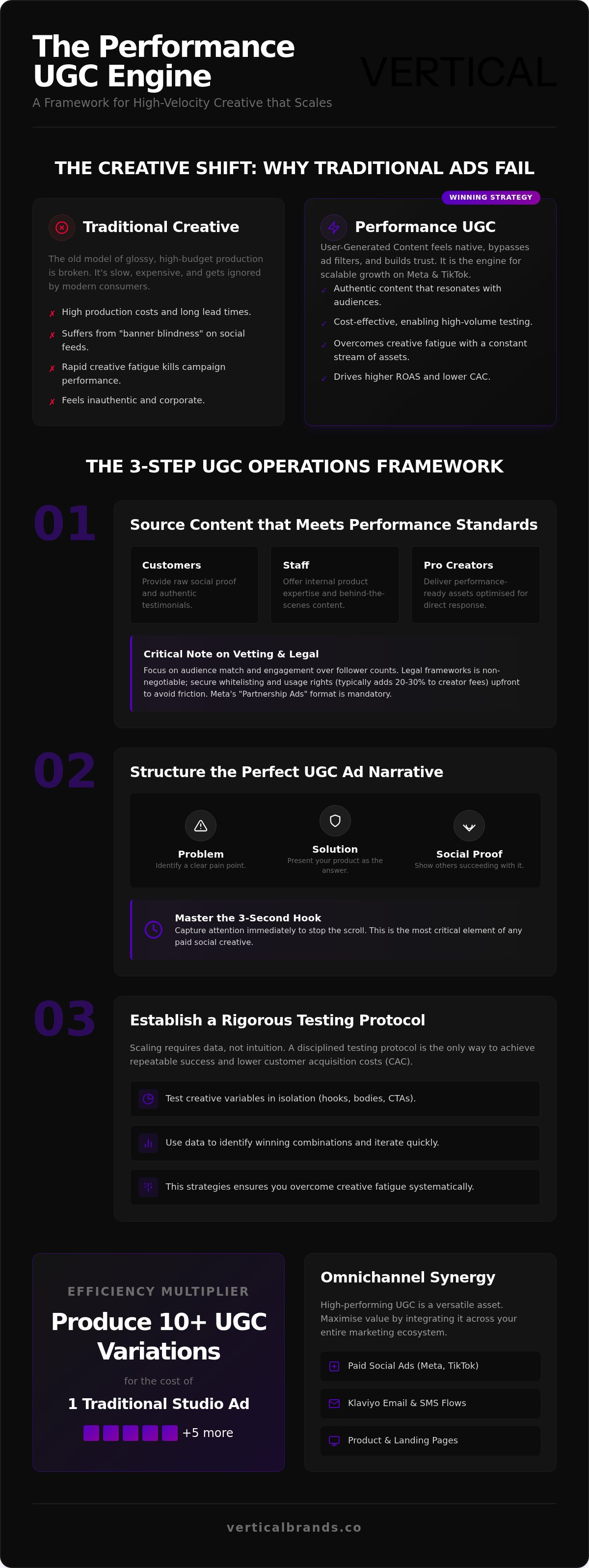
• Define UGC as a primary lever for performance. This strategies ensures you overcome creative fatigue on modern social platforms.
• Build a repeatable framework for sourcing UGC for paid social ads. Prioritise creators who understand the performance mindset over mere aesthetics.
• Master the 3-second hook to capture attention. Use a disciplined narrative of problem, solution, and social proof to drive measurable growth.
• Establish a rigorous protocol for testing creative variables in isolation. Data-led decisions are the only way to scale with confidence.
• Every high-growth brands should synergise ad creative with Klaviyo email flows. Maximise retention by creating a seamless omnichannel journey.
Defining the Role of UGC in Modern Performance Marketing
Performance marketing has shifted. Glossy production is no longer the gold standard. It is often a liability. Modern consumers have developed a sophisticated "ad filter." They ignore high-budget studio content. UGC for paid social ads bypasses this resistance. It feels native to the platform. It looks like content from a friend. This authenticity is the new authority. It is the primary lever for overcoming creative fatigue on Meta and TikTok.
High-growth brands requires a consistent stream of customer-led assets. You cannot rely on a single quarterly shoot. Creative fatigue happens in days; not months. To scale, you need volume. You need a machine that produces raw, relatable content. Understanding What is User-Generated Content? is the first step toward building this engine. It is not just about reviews. It is about strategic asset creation. Every successful brand in 2026 treats content as a commodity to be optimised.
There is a distinct shift from influencer content to creator content. Influencers focus on their own brand. Creators focus on your product's performance. The latter drives better ROAS. One is a vanity play. The other is a growth lever. Creators understand the platform's rhythm. They know how to stop the scroll without looking like a corporate pitch.
Why Traditional Ads are Failing High-Growth Brands
Professional studio production is slow. It is also expensive. By the time the edit is finished, the trend has passed. Consumers see a polished logo and immediately scroll. This is banner blindness in the social age. Traditional ads scream "I am selling you something." UGC whispers "I am helping you." It fits the feed. It engages the user before they realise they are viewing an ad. The rising cost of studio work simply does not match the performance return in a high-velocity environment.
The Strategic Advantage of Performance UGC
Efficiency is the core of this approach. You can produce ten UGC variations for the cost of one traditional TVC. This allows for rapid creative iteration. You test hooks. You test bodies. You find the winner through data, not intuition. These assets also has a long shelf life. They work in ads. They work in Klaviyo email flows. They work on product pages. This integrated approach lowers CAC whilst building a library of high-converting assets. Scaling is about removing friction. Performance UGC for paid social ads is the lubricant for that process.
Sourcing Content That Meets Performance Standards
Sourcing is a tactical operation. It is not a talent search. You need a diverse mix of creators to maintain high-velocity volume. Customers provide raw social proof. Staff offer internal product expertise. Professional creators deliver performance-ready assets that understands the nuances of the platform. Prioritise partners who value direct response over aesthetic. A beautiful video that fails to convert is a wasted investment.
Building a scalable pipeline requires movement from organic tagging to structured paid partnerships. Start by identifying customers already talking about your brand. Transition them into a formalised creator programme. This approach ensures a consistent stream of assets. Every high-growth brands needs this constant influx of fresh perspectives to combat creative fatigue. Without a system, your creative engine will stall.
Legal frameworks are non-negotiable. Usage rights are a critical cost factor that many brands ignore. In 2026, securing licensing for UGC for paid social ads typically adds a fee of 20-30% of the creator's base rate per month. Meta now mandates that all creator-led promotions utilise the "Partnership Ads" format. Failure to comply leads to ad rejection and platform penalties. Secure whitelisting permissions during the initial contract phase to remove operational friction later.
Vetting Creators for Brand Alignment
Ignore follower counts. They are vanity metrics. Focus entirely on engagement and content quality. Does the creator's audience match your primary customer profile? A creator with 100,000 followers is useless if their demographic does not buy your product. Professional UGC content production ensures your brand values remains intact whilst driving measurable growth. Look for creators who can articulate a problem and present your product as the definitive solution.
The Operational Reality of Sourcing
Logistics often kills scale. You must manage product shipping and content deadlines with military precision. Establish a rigorous feedback loop. Review every asset against real-time performance data. Manual outreach build stronger relationships, but platforms are necessary for high-volume execution. Find the balance that suits your current growth stage. The goal is a repeatable system that delivers quality assets without constant manual intervention. Efficiency in sourcing is the foundation of a successful creative strategy.
Structuring the Perfect UGC Ad: Hooks and Body
Structure is the architecture of conversion. Without a disciplined framework, even the most authentic content fails to perform. UGC for paid social ads requires a methodical approach to narrative flow. You must guide the viewer from initial curiosity to final action. This framework ensure that every second of the video serves a strategic purpose. Success is not accidental; it is engineered.
The 3-second rule is absolute. Data from Meta and TikTok confirms that the hook accounts for roughly 70% of an ad's success. If you fail to stop the scroll, the rest of the content is irrelevant. Once the viewer is engaged, the narrative must follow a linear progression: Problem, Solution, Benefits, and Social Proof. This sequence builds logical momentum. It removes friction from the decision-making process. End with a direct CTA. Tell the user exactly what to do next. Do not be vague.
Incorporating brand elements is a delicate balance. You must maintain a native feel whilst establishing authority. Use subtle brand colours or text overlays that match the platform's UI. This approach keeps the content looking organic. It prevents the "ad" filter from triggering in the consumer's mind. Every creators need to understand this balance to deliver high-performing assets.
Winning Hook Strategies for 2026
Visual hooks must be immediate. The "result first" approach is currently outperforming traditional unboxing videos. Show the transformation in frame one. Auditory hooks are equally vital. Use direct-to-camera questions to provoke an immediate internal response. Text overlays should frame the problem instantly. Use high-contrast, platform-native fonts to ensure readability. These elements must work in unison to command attention in a saturated feed.
Assembling the Performance Creative Brief
A vague brief produces mediocre content. You must provide creators with a rigorous template that defines the non-negotiables whilst allowing for authentic expression. Your brief should include specific requirements for:
Lighting
Natural light is preferred; avoid harsh shadows.
Audio
Crystal clear voiceovers with minimal background noise.
Background
Clean, relatable environments that match the product's use case.
Timing
Specific benchmarks for the hook, body, and CTA.
Provide examples of "good" versus "bad" content. This reduces revisions and streamlines the production cycle. High-growth brands don't leave content quality to chance. They dictate the standards of professional production management from the outset. A precise brief is the foundation of a scalable creative testing engine.
The Testing Protocol for UGC Creative
Data don't lie. Establishing a rigorous testing framework is the only way to scale. You cannot rely on gut feeling. Testing variables in isolation is mandatory. If you change the hook, the body, and the CTA at once, you learn nothing. Isolation provides clarity. Clarity drives growth. High-performing UGC for paid social ads is the result of a disciplined process; not a lucky creative strike.
Performance metrics for UGC for paid social ads are specific. Thumbstop Rate is your primary filter. It measures the percentage of people who stopped scrolling to watch the first three seconds. A low Thumbstop Rate indicates a hook problem. Hold Rate measures retention. It shows how many people stayed from the 3-second mark to the 15-second mark. High retention suggests your body content is engaging. If your metrics are off, your creative is failing.
Scaling winners is a transition of capital. Move from 'test' budgets to 'performance' budgets once a creative proves its efficiency. Do not hesitate. Speed is a competitive advantage. If a creative hits your target CPA, pump it. This is the operational reality of high-ROAS scaling. You must be prepared to kill underperforming assets quickly to protect your margins.
Analyzing Creative Performance Metrics
Distinguish between a hook problem and a product problem. If users stop but don't click, your offer or product value proposition might be weak. Use platform analytics to pinpoint where users are dropping off. Qualitative feedback also plays a role. Read the comments. They reveal friction points that data might miss. Each of these metrics provide a piece of the puzzle. You must look at the whole picture to optimise effectively.
Rapid Iteration for Long-Term ROAS
Winning hooks are assets. Repurpose them across different product categories. Mix and match creator assets to build 'Frankenstein' ads. This method maximises the value of every clip you buy. It is the core of effective paid social management. Constant iteration prevents creative fatigue. It keeps your CAC low and your ROAS high. These assets has a long shelf life when used correctly.
Strategic growth requires a partner who understands these mechanics. You need a disciplined approach to creative testing. If your current strategy lacks this rigour, it is time to evolve. Audit your creative engine to identify where you are leaving money on the table.
Integrating UGC with Omnichannel Growth Strategy
Scaling requires more than a single high-performing ad. UGC for paid social ads is merely the start of the customer journey. It is the handshake. The real growth occurs when this creative energy is integrated across the entire ecosystem. This strategies ensures that the momentum generated on social media is not lost at the point of conversion. You must think beyond the click.
Synergising ad creative with Klaviyo email flows is essential for maximum retention. If a user clicks a creator-led ad, they expect that same authenticity in their inbox. Using UGC in 'Abandoned Cart' flows provides the final social proof needed to close the sale. It replaces corporate reassurance with peer-to-peer validation. This alignment reduces friction whilst increasing the lifetime value of every customer acquired. Success is found in the gaps between channels.
A growth consultancy acts as the strategic architect in this process. We align these channels to remove operational silos. The goal is a seamless transition from a platform-native ad to a high-converting CRM sequence. Every touchpoints must feel consistent and purposeful. When your creative and your data are in sync, scaling becomes a predictable outcome rather than a gamble.
From Paid Social Click to CRM Conversion
Consistency is non-negotiable. You must ensure a uniform visual language from the initial ad to the landing page. Using creator content to personalise the email welcome sequence builds immediate rapport. It humanises the brand from day one. If you are struggling with technical implementation, our guide on Klaviyo migration services provides a clear roadmap for high-growth brands. Integration is the lubricant for scalable growth.
The Future of Integrated Performance Content
UGC evolves as your brand scales. It moves from a tactical ad asset to a core component of your omnichannel presence. Maintaining structural integrity across all digital touchpoints is the only way to protect your brand equity. The data suggests that every touchpoints contribute to the final decision. Vertical Brands is the partner for strategic e-commerce scaling. We provide the operational rigour required to turn creative assets into measurable growth. The future is integrated; not isolated.
Dominating the Creative Ecosystem in 2026
Scaling isn't a matter of chance. It's a result of structural integrity. You now have the operational framework to master UGC for paid social ads. This process requires moving beyond basic content creation and into high-velocity testing. Every successful brands understands that creative is the primary lever for performance. By sourcing the right creators and following a disciplined narrative structure, you remove the friction that stalls growth.
Integration remains the final frontier. Your creative efforts must align with your CRM strategy to maximise retention. Vertical Brands is the partner for this transition. We're specialists in Klaviyo and Paid Social integration. Our focus on strategic advisory ensures your content drives measurable results. We provide expert UK-based performance content production that's grounded in operational reality. These framework provides the clarity needed to lead your sector.
The path to lower customer acquisition costs is clear. It starts with a system that prioritises data over ego. Scale your brand with performance-led UGC creative from Vertical Brands and secure your market position. You're ready to build an engine that actually scales.
Frequently Asked Questions
Is UGC for paid social ads better than professional studio content?
UGC for paid social ads typically delivers a higher ROAS because it bypasses the "ad filter" of modern consumers. It feels native to the platform feed. Professional studio content often triggers immediate resistance by looking too corporate. This leads to higher bounce rates and lower engagement. Performance-led creative prioritises authenticity over polish. This assets is essential for high-growth brands looking to scale their creative testing engine efficiently.
Can I use customer reviews as UGC for my Meta ads?
Customer reviews are a powerful form of social proof. You can use them effectively by overlaying static text on video or featuring them in the ad's body. Video testimonials are superior to static text because they build deeper trust with the viewer. Every brands should incorporate these reviews into their creative testing engine. This provides the final validation needed to convert prospects whilst maintaining a native feel.
How much should I pay a creator for a UGC video in the UK?
Industry rates for creators depend on experience and usage requirements. Beginner creators typically charge between £50 and £150 per video. Intermediate creators ask for £150 to £350. Experienced professionals command £350 to £500 or more. Secure usage rights for paid social ads usually adds a licensing fee of 20-30% of the base rate per month. It's important to remember that these costs are investments in performance; not just content.
What happens if a creator doesn't follow my performance brief?
A failed brief is an operational friction point. You must establish a rigorous feedback loop to address content that misses the mark. Professional production management involves providing clear examples of "good" versus "bad" content before filming begins. If a creator fails to follow the performance brief, request a revision based on specific data points. This disciplined approach ensures that every asset aligns with your strategic growth objectives and performance standards.
How many UGC variations should I test at once?
We recommend testing 3 to 5 variations in a single flight. Focus on testing hooks in isolation to identify what stops the scroll. Testing too many variables at once creates noise in your data. High-velocity testing is about finding a winner and then scaling the budget. Once you identify a high-performing hook, you can mix and match it with different bodies. This methodical approach ensures a high-ROAS creative engine without overwhelming the algorithm.
Is whitelisting necessary for a successful UGC campaign?
Whitelisting is essential for modern performance scaling. Meta's Partnership Ads format is now a requirement for creator-led promotions. It allows you to run ads directly through the creator's handle. This adds a layer of authenticity that standard brand ads cannot replicate. It also provides access to the creator's audience data for more precise targeting. Whitelisting removes the "corporate" feel and improves overall campaign engagement by appearing as a genuine peer recommendation.
Can UGC work for high-end luxury brands?
Luxury brands can utilise UGC to humanise their image whilst maintaining an aspirational feel. The content must be "elevated" but authentic. Avoid overly polished studio looks in favour of high-quality, relatable storytelling. Luxury consumers value transparency and peer validation. UGC for paid social ads provides this by showing the product in real-world scenarios. This approach drive growth without diluting brand equity. It bridges the gap between high-end branding and platform-native engagement.
How do I measure the ROI of my UGC content production?
Measure ROI by tracking Thumbstop Rate and Hold Rate alongside your ROAS. These metrics indicate if your creative is stopping the scroll and maintaining attention. Connect this data to your customer acquisition costs. By integrating your ads with Klaviyo email marketing flows, you can track the long-term impact on revenue. This holistic view provides the intellectual rigour needed to scale. Every high-growth brands needs this level of transparency to succeed.

Other posts

























































Stay ahead with better decisions.
Get business insights today.
