Klaviyo Automation Flow Setup: The Strategic Blueprint for 2026
Most e-commerce brands treat their CRM like a digital filing cabinet instead of a high-performance revenue engine. This is a strategic failure. A flawed Klaviyo automation flow setup does more than just miss sales; it creates technical debt and erodes customer trust. The data doesn't lie, but it oft...

Most e-commerce brands treat their CRM like a digital filing cabinet instead of a high-performance revenue engine. This is a strategic failure. A flawed Klaviyo automation flow setup does more than just miss sales; it creates technical debt and erodes customer trust. The data doesn't lie, but it often mislead when your architecture is fragmented. You likely recognise the frustration of overlapping flows and the constant anxiety of accidentally spamming your audience with redundant messaging.
We agree that managing complex conditional split logic shouldn't feel like a guessing game. This article promises to provide the technical architecture and strategic logic required to build a sophisticated automation engine for 2026. Each of these flows require precision to drive consistent growth. We will preview the exact steps to transition from manual campaign reliance to a "set and forget" system that organises data and maximises lifetime value. It is time to stop guessing and start scaling through structural integrity. Precision is the only path to scale.
Key Takeaways
• Distinguish between one-off campaigns and evergreen flows. Build a structural foundation for scalable growth.
• Master trigger logic and filters. A precise Klaviyo automation flow setup prevent technical debt and customer fatigue.
• Deploy the five essential revenue flows. Capture high-intent shoppers through refined checkout abandonment logic.
• Prioritise Revenue Per Recipient (RPR). This metric provide the ultimate clarity on automation performance.
• Align CRM management with paid social. Integrated strategies are the only path to superior lifetime value.
Defining the Architecture of Klaviyo Automation
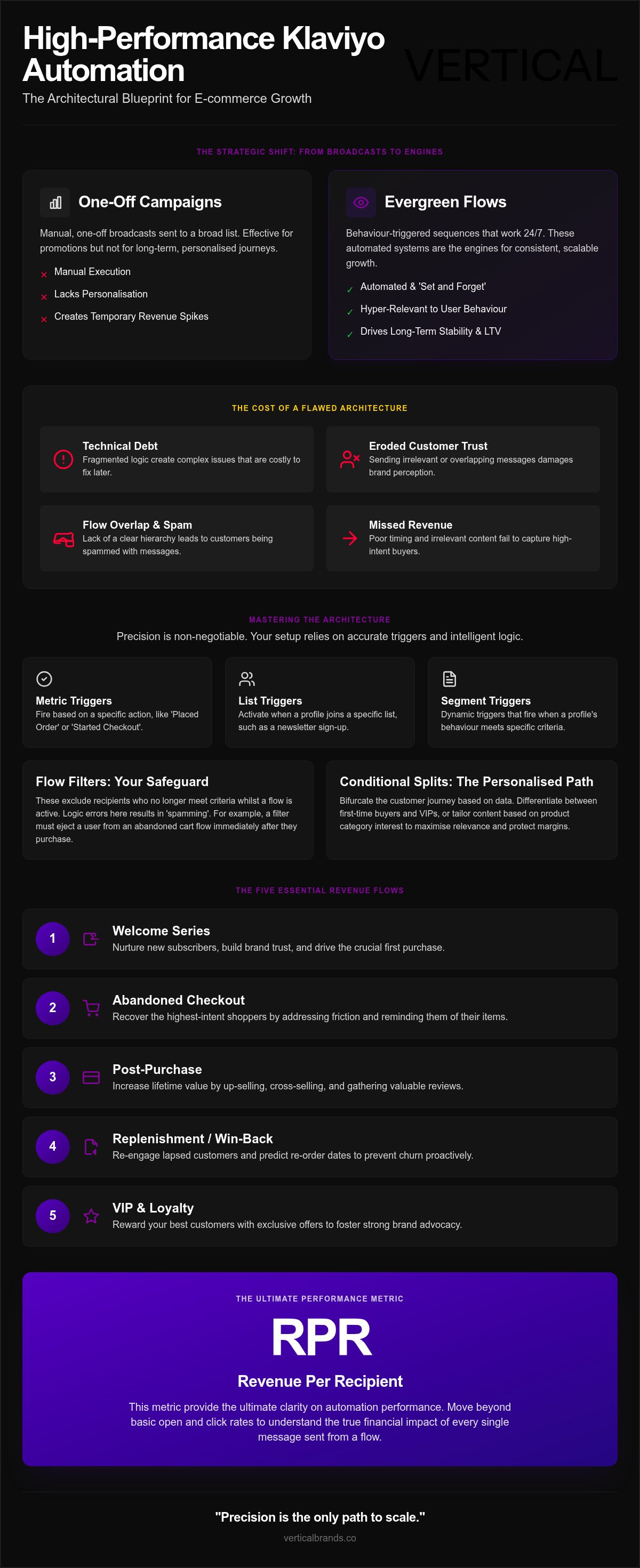
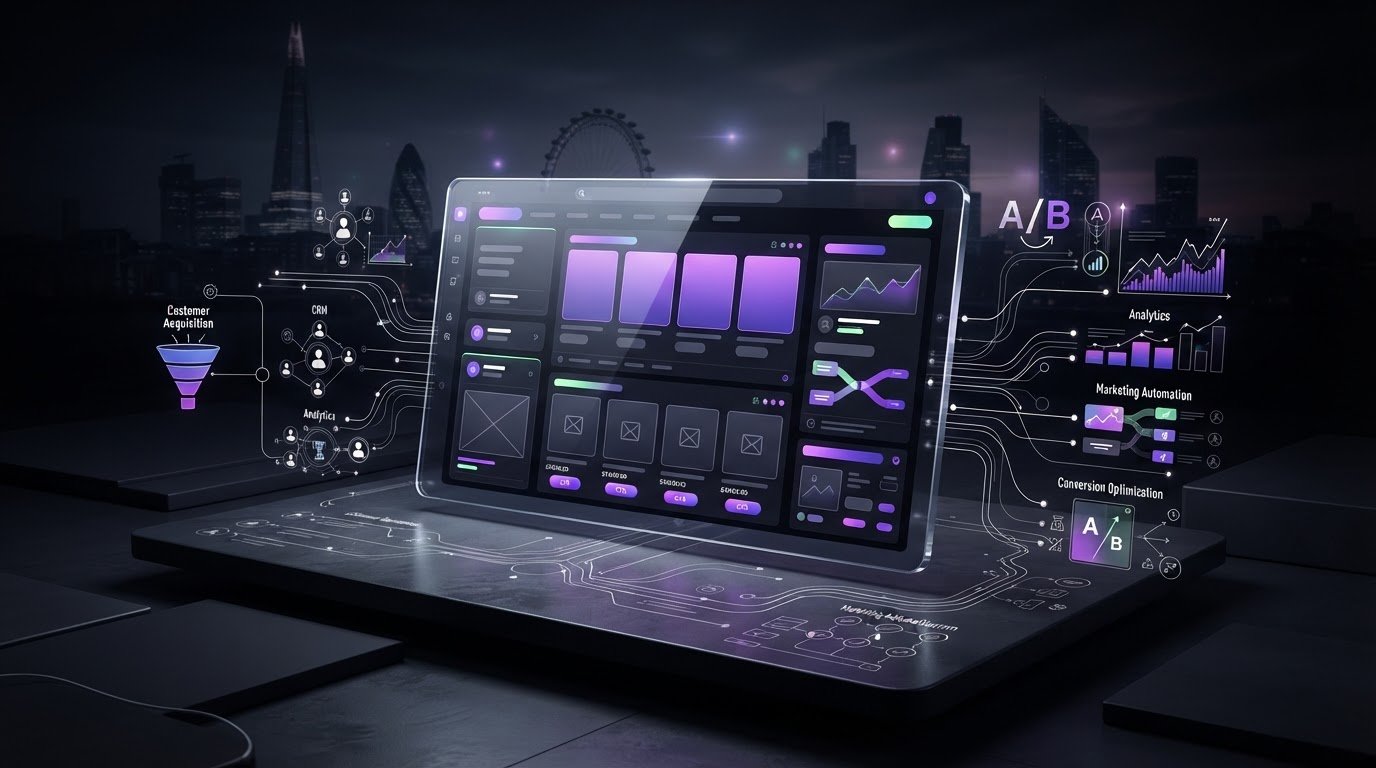
A Klaviyo flow is a behaviour-triggered sequence. It mirrors the customer journey with precision. Unlike campaigns, which are one-off broadcasts, flows are evergreen revenue engines. They work whilst you sleep. In 2026, a high-performance strategy using marketing automation platforms is no longer optional. It is the baseline for e-commerce profitability. Many brand fails to distinguish between these two modes of operation. Campaigns drive temporary spikes. Flows drive long-term stability.
The strategic shift in 2026 moves beyond basic time-delays. We are now in the era of data-driven, dynamic logic. Your Klaviyo automation flow setup must account for real-time customer signals and predictive behaviour. This architecture acts as the automated nervous system of your business. It removes the friction of manual execution. It replaces guesswork with structural certainty. Automation is the bridge between expensive paid social acquisition and long-term retention.
The Role of Flows in Customer Lifetime Value
Automated touchpoints are the primary defence against churn. They increase repeat purchase rates by delivering the right message at the exact moment of intent. This isn't just marketing; it is a core business asset. High-performing flows directly impact business valuation. Professional investors look for predictable, automated revenue. We are moving from broad broadcasts to hyper-targeted interactions. Personalisation is now the standard. Every touchpoint must add value or it risks being ignored. Flows allow you to scale this relevance without increasing your headcount.
Structural Integrity: Avoiding Flow Overlap
Email fatigue is a silent killer of retention. It occurs when uncoordinated automations fire simultaneously. You cannot afford to send a discount code whilst a customer is receiving a post-purchase sequence. It looks amateur. It creates friction. Establishing a hierarchy of flows ensures message clarity. This structure prevent overlap and protects the customer experience. Flow hierarchy is the prioritisation of high-intent triggers over general engagement. Much like how Swiss Build Ltd maintains the structural integrity of high-quality construction projects, a clean Klaviyo automation flow setup requires a disciplined approach to logic. You must audit your triggers regularly to ensure they remain aligned with the customer journey. Failure to manage this leads to technical debt. It leads to a fragmented brand voice and a decline in engagement rates.
Precision is non-negotiable. A robust Klaviyo automation flow setup relies entirely on the accuracy of your triggers. There are three primary types. Metric triggers fire based on specific actions like "Placed Order" or "Started Checkout". List triggers activate when a profile joins a specific group. Segment triggers are dynamic; they fire when a profile's behaviour meets specific criteria. Many operator fails to use trigger filters to narrow the scope from the start. For example, a "Placed Order" trigger should often be filtered by specific product categories to ensure the follow-up content is relevant. This prevents broad, inefficient flows that drain resources.
Flow filters are your primary safeguard. They exclude recipients who no longer meet your criteria whilst the flow is active. If a customer buys during an abandoned cart sequence, the flow filter must eject them immediately. Logic errors here results in "spamming" and brand damage. Implementing effective marketing automation tactics requires a deep understanding of these exclusionary rules. You must audit your nesting logic to avoid broken paths or circular triggers. These loops can destroy your sender reputation in a matter of hours.
Conditional Splits: Personalising the Path
Splits allow you to bifurcate the journey based on real-time data. You should differentiate between first-time buyers and your VIP cohort. High-value customers don't need the same aggressive discounting as a price-sensitive prospect. Branching logic can also follow product category interest. If a customer views specific collections, don't send them irrelevant content. Use splits to address discount sensitivity. This ensures you protect your margins whilst still driving the conversion. It is about delivering the right incentive to the right person.
Zero-Party Data and Dynamic Triggers
Strategic growth in 2026 relies on zero-party data. Quiz results and preference centres provide the raw material for hyper-relevance. You can trigger tailored flows based on specific preferences or skin types. Predictive analytics take this further. Klaviyo's "Expected Next Order Date" allows you to fire a replenishment flow before the customer even thinks about churn. AI agents now assist in managing these complex journeys by adjusting send times based on individual engagement patterns. Maintaining data hygiene across integrated platforms is vital for flow speed. Latency in data syncing means your "Abandoned Cart" email might arrive after the customer has already purchased elsewhere. For those seeking to refine these mechanics, our team provides expert Klaviyo CRM management to ensure technical integrity.
The Five Essential Flows for Scaling E-commerce Revenue
Success in e-commerce is built on five structural pillars. Every brand need these five pillars to survive. A professional Klaviyo automation flow setup ensures these sequences work in harmony to maximise revenue. Your Welcome Series acts as the first impression. It sets the brand tone and focuses on driving that critical second purchase. The data suggests that automated email flows generated nearly 41% of email revenue from just 5.3% of sends in 2026. This efficiency is why these flows are the backbone of your CRM.
Distinguish between Abandoned Cart and Checkout Abandonment. The former captures interest when a user adds an item; the latter targets high-intent shoppers who have already entered their details. Browse Abandonment captures early-stage interest without being intrusive. It is a soft nudge. Post-Purchase Nurture turns customers into advocates by requesting reviews and UGC. Finally, the Win-Back Engine uses data-driven re-engagement to target dormant profiles before they churn permanently. Implementing these sequence require precision.
Step-by-Step Setup: The Abandoned Checkout Framework
Checkout abandonment is your highest-ROI opportunity. Follow this disciplined framework to capture lost revenue:
Step 1
Define the trigger as "Started Checkout" to capture the highest intent.
Step 2
Apply a flow filter for "Placed Order zero times since starting this flow" to prevent redundant messaging.
Step 3
Organise time delays to match your typical consideration period. Usually, 30 to 60 minutes is optimal for the first touchpoint.
Step 4
Incorporate dynamic blocks to show the exact items left behind. Visual reminders remove friction.
Integrating SMS and Push Notifications
Urgency requires a cross-channel approach. Use SMS for urgent cart recovery when the consideration window is tight. It bypasses crowded inboxes. You must balance cross-channel frequency to avoid brand annoyance. Over-saturation leads to unsubscribes. Use webhooks to trigger external actions like direct mail or loyalty rewards for your highest-value customers. This creates a seamless experience whilst maintaining flow speed. A well-oiled machine uses every channel with purpose. It does not spam; it assists the customer journey through logical alignment.
Optimising Flow Performance via A/B Testing and Analytics
Every brands need a rigorous schedule to avoid stagnation. Data interpretation is the difference between a static list and a growth engine. Whilst Open Rate and Click-Through Rate provide engagement signals, Revenue Per Recipient (RPR) is the ultimate North Star. It measures the direct impact of your Klaviyo automation flow setup on the bottom line. If a flow has a high open rate but zero RPR, the strategy is failing. You must identify where the friction occurs. Is it the offer? Or is the content misaligned with the trigger intent?
Smart Send Time and AI-driven delivery optimisation remove the guesswork from scheduling. Klaviyo's algorithms analyse historical engagement to determine when a recipient is most likely to act. This automation ensures your message lands at the peak of relevance. It is a structural solution to the problem of declining attention spans. By leveraging these tools, you ensure that your technical architecture remains responsive to real-time consumer behaviour.
Testing Beyond the Subject Line
Subject line tests are basic. To truly scale, you must test structural variables. A/B test your "Time Delay" to find the optimal conversion window. Does a 30-minute delay outperform a 2-hour delay? Test your "Conditional Split" thresholds. A £50 cart value might require a different incentive than a £100 cart. Evaluate fixed amount discounts against percentage-based offers. This data points to what actually moves the needle for your specific audience. Precision in these tests eliminates wasted margin and maximises return on every send.
Long-term Flow Hygiene and Maintenance
Technical debt accumulates quickly without oversight. Perform quarterly audits to ensure content remains relevant and links are active. Identify and remove "dead" steps that no longer contribute to revenue. These abandoned paths clutter your architecture and slow down performance. Monitoring deliverability metrics is vital to protect your sender reputation. A single broken flow can trigger spam filters across your entire account. For brands serious about performance, our email marketing and CRM management services ensure your automation remains lean and profitable. Discipline in maintenance is the only way to sustain high-level results.
Strategic CRM Management: Beyond Basic Flow Implementation
Stop viewing your account as a series of isolated triggers. It is a unified growth system. A professional Klaviyo automation flow setup is only the starting point. True scale requires continuous alignment with your broader marketing engine. Vertical Brands acts as a strategic guide. We remove operational friction. We ensure your CRM works in lockstep with your paid social and search efforts. Professional management is a high-ROI investment. It is not a cost centre. Whilst others focus on volume, we focus on structural integrity. The data suggests that integrated systems is the key to outperforming the market.
The Omnichannel Growth Framework
Syncing Klaviyo segments with Meta and Google Ads is essential. This allows for precise retargeting. It lowers your customer acquisition cost (CAC). Flow data should also inform your UGC content production. If a specific product has a high browse abandonment rate, your influencer briefs must address the friction points. Creating a unified experience across every touchpoint is the only way to build brand equity. Every touchpoint must be an intentional move toward a conversion. This holistic approach ensures that your data isn't just sitting in a silo; it is actively driving performance across every digital channel.
Securing Your Competitive Advantage
Bespoke flow logic beats generic templates every time. Templates ignore the nuances of your specific customer journey. They create technical debt. You need a partner who understands the mechanics of business growth. A high-performance Klaviyo automation flow setup require the intellectual rigour we provide. We focus on structural integrity. We remove the clutter that slows down your operations. It is time to move beyond the basics. Every brands must evolve or face obsolescence in a crowded market. Scale your e-commerce revenue with Vertical Brands and secure your market position. Growth is a disciplined process. It is not a matter of luck.
Dominating the 2026 E-commerce Landscape
Precision in your Klaviyo automation flow setup is the only way to secure a competitive advantage. We have defined the architecture and mastered the logic filters required for true scale. You now understand why Revenue Per Recipient (RPR) beats vanity metrics every time. The transition from basic email sequences to an integrated growth system is no longer optional. It is the baseline for survival. Vertical Brands provide the specialised expertise needed to remove operational friction and drive measurable outcomes.
Our results-driven growth consultancy focus on D2C brands that value structural integrity. We integrate performance marketing and SEO strategies with sophisticated CRM management to protect your margins. This holistic approach ensures every touchpoint is an intentional move toward a conversion. Each of these flows require technical excellence and disciplined execution to succeed. It is time to stop guessing and start scaling through a professional architecture. Optimise your Klaviyo automation with Vertical Brands. Your growth engine is ready for deployment.
Frequently Asked Questions
How many emails should be in a Klaviyo welcome flow?
A standard welcome series should consist of 3 to 5 emails. The first touchpoint delivers the initial incentive whilst subsequent messages build brand authority and trust. You don't want to overwhelm new subscribers with excessive volume in the first week. Focus on driving the second purchase through educational content and social proof. A concise Klaviyo automation flow setup ensures these emails fire at the peak of interest. Quality always outperforming quantity in retention strategies.
Can I set up Klaviyo flows without a developer?
You can manage basic implementations through the visual builder without a developer. The platform is designed for accessibility and ease of use. However, scaling a complex system require technical oversight to manage custom objects and webhooks effectively. For those on platforms like Shopify or WooCommerce, working with an agency like Digital Junction ensures the underlying technical architecture is sound. Professional management removes the risk of technical debt. Vertical Brands provides the structural expertise needed for high-level execution. This ensure your data architecture remains lean and effective for the 2026 landscape.
Trigger filters determine who enters a flow at the exact moment of the event. A flow filter check the recipient's status before every single email is sent. For example, a trigger filter might target only high-value carts. A flow filter ensure the customer is removed if they purchase whilst the sequence is active. This distinction is vital for maintaining structural integrity and avoiding redundant messaging that irritates your audience.
How do I prevent customers from receiving too many automated emails?
Use Klaviyo's Smart Sending feature to prevent over-saturation. This setting ensures a profile doesn't receive multiple messages within a specified window, such as 16 hours. You should also implement flow filters to exclude active recipients from receiving general marketing broadcasts. Managing these overlapping paths is essential for protecting your sender reputation. It prevents the "spamming" behaviour that erodes customer lifetime value and leads to high unsubscribe rates.
Why is my Klaviyo flow not triggering for certain customers?
Triggers often fails when data syncing is delayed or filters are too restrictive. Check your trigger filters to ensure they aren't accidentally excluding your target audience based on faulty logic. Smart Sending might also be blocking messages if the recipient recently received another email. Audit your integration status to confirm that events like "Started Checkout" are firing correctly. Precision in logic is the only way to ensure consistent delivery.
How often should I update my automation flow content?
Perform a comprehensive audit every quarter to maintain performance. You must verify that all dynamic blocks are functioning and that links remain active. Refresh your UGC content and influencer testimonials to keep the messaging current. A stagnant Klaviyo automation flow setup eventually loses its effectiveness as consumer behaviour shifts. Regular maintenance prevent your revenue engine from becoming obsolete. It is a disciplined process required for long-term growth.
What is a good revenue per recipient (RPR) for an abandoned cart flow?
Revenue Per Recipient (RPR) is the most reliable indicator of performance. Whilst benchmarks vary by industry, high-intent flows like abandoned cart sequences often generate significantly higher RPR than standard campaigns. In 2026, automated flows accounted for nearly 41% of total email revenue according to industry data. Focus on optimising your offers and timing to maximise this metric. RPR provide the ultimate clarity on whether your automation logic is actually driving profitable growth.
Can I use Klaviyo flows to collect reviews and UGC?
You can definitely use post-purchase flows to gather reviews and user-generated content (UGC). This is a priority strategy for building brand authenticity. Trigger these requests after the typical delivery window to ensure the customer has experienced the product. Integrating these sequences with your broader CRM strategy turns buyers into advocates. It is a structural solution for scaling your social proof whilst reducing manual content production. This automation logic ensures consistent data collection.

Other posts




















































Stay ahead with better decisions.
Get business insights today.
