Marketers: Make Brand and Performance Marketing Pay Off in 60–90 Days

Brand marketing builds future demand; performance marketing captures demand that already exists. Both are necessary, and neither works at full strength alone. The smartest budgets treat them as one connected system, not two competing line items, with brand work compounding the efficiency of every performance dollar spent 60 to 90 days later. What follows breaks down the metrics, the budget math, and a working checklist for making that system real.
TL;DR:
- Brand marketing builds future demand and takes months to show results, requiring long-term investment in awareness and preference.
- Performance marketing captures immediate demand through channels like paid search and social, with results visible within days or weeks.
- Coordinating both requires shared creative roles, testing calendars, and unified dashboards reviewed weekly and monthly to ensure mutual reinforcement.
- Over-reliance on last-touch attribution often underestimates brand’s contribution, making multi-touch and modeling essential for accurate measurement.
- Budget allocation should shift based on company stage, with early focus on performance, a balanced mix during growth, and increased brand spend for mature brands.
Table of Contents
- Brand vs Performance Marketing at a Glance
- What Do Brand Marketing and Performance Marketing Actually Mean?
- Where Brand and Performance Actually Diverge
- How Do You Measure Brand and Performance Marketing?
- When Should You Prioritize Brand Over Performance?
- How Do You Run Brand and Performance as One System?
- A Real Example: How Coordinated Marketing Moved the Needle for FACEGYM
- Where Marketing Teams Get This Wrong
- How Vertical Brands Builds Integrated Brand and Performance Programs
- Sources
- FAQ
Brand vs Performance Marketing at a Glance
The two disciplines answer different questions, on different clocks, using different scorecards. Brand marketing asks “will people choose us later?” Performance marketing asks “will people act right now?”
- Goal: Brand builds preference and mental availability; performance drives an immediate, trackable action like a purchase or sign-up.
- Timeline: Brand pays off over months or quarters; performance shows results within days or weeks.
- Channels: Brand often leans on video, sponsorships, and social storytelling; performance leans on paid search, paid social, and retargeting.
- KPIs: Brand tracks awareness, favorability, and share of search; performance tracks ROAS, CPA, and conversion rate.
Channel labels are not fixed roles. YouTube can build brand awareness with a 30-second story or capture a sale with a shoppable ad. The channel doesn’t decide which job it’s doing. The brief does.
What Do Brand Marketing and Performance Marketing Actually Mean?
Brand marketing builds awareness, preference, and what researchers call mental availability: the likelihood your business comes to mind when a buyer has a need. It’s slow by design. You’re planting an idea in someone’s head that pays off the next time they’re ready to buy, not necessarily today.
Performance marketing measures itself in real time. Every dollar ties to a KPI like return on ad spend (ROAS) or cost per acquisition (CPA), and campaigns get judged, adjusted, or killed based on those numbers within days, according to Shopify’s breakdown of the two disciplines.
Here’s the part most budget conversations miss: the overlap.
- A well-made brand video can also drive direct-response conversions if it ends with a clear offer.
- A performance ad campaign that runs long enough builds recognition, whether that was the intent or not.
- The Ciente analysis of funnel strategy argues upper-funnel work should be treated as “demand manufacturing,” not vanity impressions, because it directly shapes how easily performance campaigns convert later.
Where Brand and Performance Actually Diverge
The differences that matter aren’t philosophical. They show up in how you plan, brief creative, and read a dashboard.
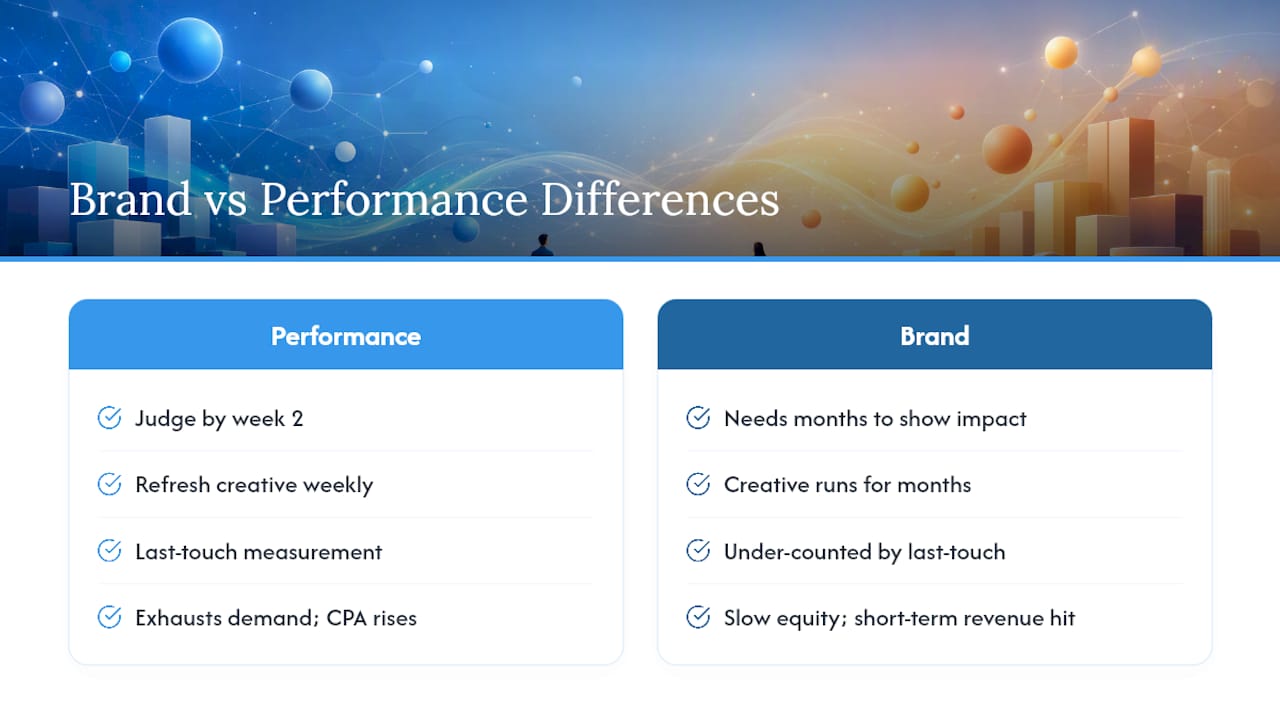
Timelines create mismatched expectations. A performance campaign that isn’t converting by week two gets paused. A brand campaign that isn’t “working” by week two is just getting started. Judging both on the same 14-day report is the single most common reason brand budgets get cut first when finance asks for savings.
Creative cadence runs at different speeds. Performance creative needs constant refreshing, often weekly, to fight ad fatigue and keep CPA stable. Brand creative can run for months because its job is repetition and recognition, not novelty.
Measurement pulls in opposite directions. Performance dashboards reward last-touch attribution because it’s clean and immediate. That same lens systematically undercounts brand’s contribution, since brand rarely gets the final click. Marketers who read only last-touch data will conclude brand “isn’t working” when it’s actually setting up every conversion performance ads later claim credit for.
Over-investing in either side creates real risk. Lean too hard into performance and you exhaust existing demand, driving up CPA as you scrape the bottom of an intent pool that isn’t refilling. Lean too hard into brand and you starve the near-term revenue that funds the business while brand equity slowly compounds. AiDigital’s comparison notes that over-reliance on performance channels alone tends to erode baseline sales and drive customer acquisition costs higher over time.
How Do You Measure Brand and Performance Marketing?
Each discipline needs its own scorecard, and trying to force one set of metrics onto both is where most measurement programs break down.
Brand metrics worth tracking:
- Aided and unaided awareness
- Brand favorability or preference scores
- Share of search relative to competitors
- Branded search volume growth over time
Performance metrics worth tracking:
- ROAS and CPA by channel and campaign
- Conversion rate and average order value
- Customer acquisition cost (CAC) trend over time
- Marginal return on ad spend at increasing budget levels
Connecting the two requires attribution that goes beyond last click. Multi-touch attribution (MTA) credits multiple touchpoints across a customer’s path, while marketing mix modeling (MMM) uses statistical analysis to isolate the effect of each channel, including brand spend that never gets a direct click. Holdout tests, where you pause spend in a matched market and measure the drop in branded search or direct traffic, are the cleanest way to prove incrementality, according to guidance on upper and lower funnel measurement.
A workable cadence: review performance KPIs weekly, review brand metrics monthly, and run a holdout or MMM analysis quarterly to check whether the two are actually reinforcing each other. Tools that measure brand awareness using AI-driven analytics can speed up the monthly brand read without adding headcount to a marketing dashboard.
When Should You Prioritize Brand Over Performance?
Allocation should shift with company stage, not stay fixed at some universal ratio.
- Pre product-market fit: Weight budget toward performance, often 70 to 80 percent, to generate fast signal on what messaging and audiences actually convert.
- Growth stage: Move toward a more even split, commonly cited around 60 percent brand to 40 percent performance, following frameworks like the Binet and Field model referenced in Rule1’s guidance on balancing both.
- Mature, category-leading brand: Shift further toward brand investment to defend share of search and keep CAC from creeping up as paid channels saturate.
Margins matter too. A high-margin subscription product can absorb a longer brand payback window better than a low-margin retail item. Seasonality and category familiarity matter as well: a well-known category needs less brand education, freeing budget for performance.
Before locking any split, ask three questions: Is CAC rising quarter over quarter with no change in creative? Is branded search volume flat or declining? Would a 20 percent cut to either budget change revenue in 90 days or in 12 months? The honest answers usually reveal which side is underfunded.
How Do You Run Brand and Performance as One System?
Coordination isn’t a mindset. It’s a set of operating habits.
- Brief creative with a stated role. Every creative brief should name whether the asset’s job is awareness, consideration, or conversion, because the channel it runs on won’t tell you.
- Run a shared testing calendar. Test awareness video creative that feeds retargeting pools at the same time you A/B test landing pages tied to paid social audiences, so brand and performance learnings compound instead of running in isolation, an approach detailed in Ciente’s funnel analysis.
- Sequence for lead time. Treat brand investment as a leading indicator that shows up in performance efficiency 60 to 90 days later, not immediately.
- Build a shared reporting cadence. Put brand and performance metrics on the same dashboard reviewed by both teams, and route sales feedback (what prospects say in calls, what language they use in RFPs) back into brand messaging.
Pro Tip: Run a controlled experiment: cut performance spend 20 to 30 percent in one matched market for 8 to 12 weeks and watch branded search and organic conversions. If they hold steady, you’ve found redundant spend brand is already covering, a test method outlined in Rule1’s practical framework.
A creative testing framework built around role-based briefs makes step one far easier to enforce week to week.
A Real Example: How Coordinated Marketing Moved the Needle for FACEGYM
FACEGYM, a fitness and skincare brand, needed both stronger brand presence and better conversion performance, not a choice between the two. An integrated marketing program spanning creative, media, and performance channels under one strategy rather than treating brand and acquisition as separate contracts was built.
The reported results: a 50 percent increase in purchases and a 41 percent rise in bookings.
Three takeaways apply beyond this one case. First, a single strategy owner across brand and performance removes the finger-pointing that happens when two agencies claim credit for the same conversion. Second, creative built with a clear role, awareness versus conversion, performs better in both directions than creative trying to do everything at once. Third, tracking bookings and purchases together, rather than in separate dashboards, is what surfaced the connection between the two in the first place.
Where Marketing Teams Get This Wrong
The most common trap isn’t ignorance. It’s organizational structure. Brand and performance sit in different teams, report to different metrics, and get judged by different quarterly reviews, so nobody owns the connection between them. Last-touch attribution makes this worse by handing performance all the credit for conversions brand quietly made possible.
A simple framework fixes most of it: one shared calendar, one dashboard, one owner who reviews both weekly. Leadership’s job is holding the line on measurement discipline when someone proposes cutting brand spend because performance “won the quarter.”
— Alex
How Vertical Brands Builds Integrated Brand and Performance Programs
Most agencies split brand strategy, media buying, and tracking across separate vendors, forcing you to stitch the story together yourself. Vertical Brands runs brand strategy, media planning, paid social, paid search, and tracking and attribution under one team, so the creative that builds awareness and the campaigns that convert it are built by people talking to each other daily, not handed off between agencies with different incentives.
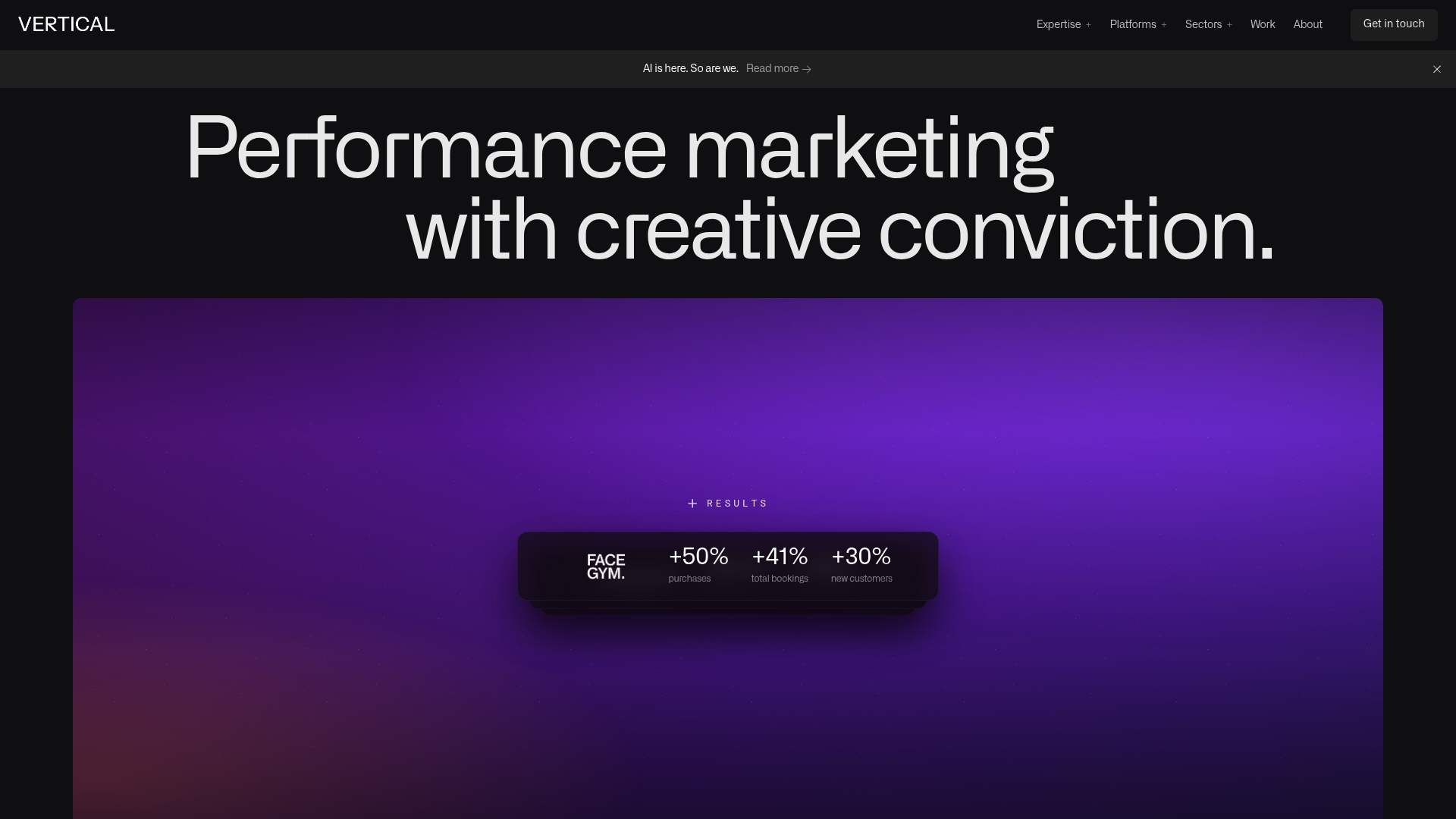
The FACEGYM results above (50 percent more purchases, 41 percent more bookings) came from exactly this kind of integrated build: one strategy, one measurement view, one accountable team. If your brand and performance budgets currently live in separate reports with separate agencies, that’s usually the first sign they’re not reinforcing each other. Start with a review of your current channel mix and attribution setup at Verticalbrands to see where a coordinated program would close the gap.
Sources
- How Brand Building and Performance Marketing Can Work Together - HBR
- Lower V/s Upper Funnel Marketing And The Missing Nuance That’s Killing Your Pipeline - Ciente
- Performance marketing vs brand marketing: when to use each and how to balance both | Rule1
- Brand marketing vs performance marketing: Examples + tips - Shopify
FAQ
What Is the Difference Between Brand and Performance Marketing?
Brand marketing builds long-term awareness and preference; performance marketing drives immediate, measurable actions like sales or sign-ups. They use different KPIs, on different timelines, but work best when planned together rather than as separate budgets.
What Is the 3-3-3 Rule for Marketing?
The 3-3-3 rule isn’t a standardized industry framework with one fixed definition. Marketers use several versions of it for content or campaign planning, so treat any specific version you see as one team’s shorthand rather than a universal standard.
What Are the 5 C’s of Branding?
There’s no single, universally agreed-upon “5 C’s of branding” framework used consistently across the industry. Different agencies and consultants use their own versions, so it’s worth asking which specific model a source means rather than assuming one canonical list.
What Is the 40-40-20 Rule in Marketing?
Like the 3-3-3 rule, the 40-40-20 rule has multiple informal versions circulating in marketing, often applied to audience, offer, and creative weighting in direct response work. It isn’t a fixed standard, so confirm which definition a specific source is using before applying it to your budget.
How Much Budget Should Go to Brand vs Performance?
It depends on company stage: early-stage companies often lean 70 to 80 percent toward performance for fast signal, while growth-stage companies commonly move toward a more even split, near 60 percent brand to 40 percent performance, based on frameworks like Rule1’s stage-based guidance. Mature brands typically shift further toward brand to protect long-term efficiency.
Recommended

Other posts



























































Stay ahead with better decisions.
Get business insights today.
