A Creative Testing Framework Marketers Can Run This Week
A creative testing framework is a repeatable system for turning ad creative decisions into evidence: you write a falsifiable hypothesis, isolate one variable, run it through a sized experiment, and apply a pre-committed decision rule before you scale or kill it. The single most important discipline inside that system is isolating one variable per test. Change the hook, the offer, and the CTA at once, and you’ll never know which one moved the number.
Here’s the checklist we use to get a first test live inside a day:
- Write the hypothesis. State what you’re changing, why, and what result would prove or disprove it.
- Pick one KPI. Match it to funnel stage, not to whatever metric looks best in the dashboard.
- Design isolated variants. One variable changes; everything else stays identical.
- Choose a method and size it. Decide A/B, holdout, or bandit, then calculate how many conversions you need before reading results.
- Set decision gates before launch. Define what “win,” “lose,” and “inconclusive” mean numerically, in advance.
Starter hypothesis template: “If we change [element] from [A] to [B], [KPI] will improve by [X%] because [reasoning tied to audience behavior], measured over [timeframe] with [sample size] conversions per variant.”
The 3-2-1 starter matrix works well for teams with limited production capacity: 3 hooks, 2 body/message variations, 1 fixed offer and CTA. That gives you six creative combinations without triggering a multivariate mess, and it’s small enough to launch inside a week using Meta Experiments or a manual split test.

Key Takeaways
A creative testing framework works because it replaces gut-feel creative decisions with pre-committed hypotheses, isolated variables, and decision rules set before results ever appear.
| Point | Details |
|---|---|
| Isolate one variable | Change exactly one element per test, hook, body, offer, or CTA, never several at once. |
| Pre-commit decision rules | Define scale, kill, and retest thresholds before launch, not after seeing the dashboard. |
| Size tests properly | Target 20 to 50 conversions per variant and 95% confidence before reallocating meaningful budget. |
| Read diagnostics in order | Check attention metrics, then intent metrics, before reading the primary conversion KPI. |
| Systematize winners | Tag every result in a searchable creative library so learnings compound across campaigns. |
| Get expert support | Vertical Brands runs creative testing audits that map this framework to your budget, delivering a gap analysis, sample roadmap, and briefing within 30 minutes. |
Table of Contents
- Why a Creative Testing Framework Matters More Than Any Single Ad
- Core Components Every Creative Testing Framework Needs
- How Do You Set Objectives and KPIs That Tie to Business Outcomes?
- Designing Creative Variants: What to Change and How Many to Run
- Which Testing Method Should You Use, and When?
- Operationalizing Creative Tests Across an Entire Program
- How to Read Test Results and Decide What Happens Next
- Turning a Winning Test Into an Optimization
- An 8-Week Roadmap and Templates You Can Copy Today
- How Vertical Brands Applied This Framework: The FACEGYM Case
- Your First Seven Days: A Starter Action Plan
- Balancing Speed and Rigor: An Agency’s Take
- Get a Creative Testing Audit From Vertical Brands
- Sources
Why a Creative Testing Framework Matters More Than Any Single Ad
Most accounts don’t have a creative problem. They have a learning problem: every ad is treated as a one-off bet instead of a data point in a system that should get smarter over time. A creative testing framework converts scattered creative production into compounding knowledge, because each test either confirms or kills an assumption you can reuse on the next brief.
Meta’s Experiments tool illustrates why structure matters here. It randomizes audiences into non-overlapping splits, runs conversion-optimized tests over 7 to 14 days, and asks for roughly 20 to 50 conversions per variant before you can trust the read. Skip any one of those conditions and you’re not testing anything. You’re guessing with extra steps.
A test only counts as reliable when it includes all four of these:
- An isolated variable, avoiding simultaneous changes
- Equalized spend and audience size across variants
- A minimum runtime or conversion volume set before launch, not adjusted mid-flight
- A decision rule written down before you saw a single result
Most creative testing programs fail for the same handful of reasons, and they’re avoidable once you name them:
- No hypothesis. The team tests “new creative” against “old creative” with no stated reason to expect a difference.
- Overlapping audiences. Two ad sets compete for the same people, and Meta’s delivery system muddies the comparison before you even look at the data.
- Stopping early. A variant looks like it’s winning on day three, so someone kills the test and reallocates budget, before the sample size means anything.
- Reading the wrong metric first. Teams check CPA before confirming the test ran cleanly, which means a broken test can look like a real result.
The research is blunt on one point in particular: running too many low-value tests wastes more resources than running fewer, well-sized ones. Harvard Business Review’s analysis of over-testing argues that marketers frequently test marginal variations that were never going to move the needle, while starving the high-impact variables of the budget and runway they need to reach statistical confidence.
Core Components Every Creative Testing Framework Needs
A framework is only as strong as its weakest component. Skip the sample-size rules and your “wins” won’t replicate. Skip the tagging system and your library becomes unusable within a quarter. Here’s the full inventory.
Hypothesis library. A running document of every hypothesis tested, its result, and the reasoning behind it, so nobody re-runs a test you already have an answer to.
KPI mapping. A fixed table that ties funnel stage to primary metric, so a hook test isn’t accidentally judged on ROAS.
Variant taxonomy. A shared vocabulary for what counts as a hook, an angle, a format, an offer, and a CTA, so two people building briefs mean the same thing by “variant.”
Test method registry. A short reference for which method (A/B, holdout, bandit, sequential) applies to which situation, so method selection isn’t reinvented every time.
Sample-size rules. Pre-agreed minimums for conversions per variant and runtime, based on your typical CPA and budget, rather than a stopping point.
Tagging and asset naming conventions. A consistent system so a creative’s performance history is instantly searchable months later.
Decision gates. Numeric thresholds for scale, kill, or iterate, set before launch, not negotiated after seeing the dashboard.
Creative library. A centralized, tagged repository of every asset tested, linked to its results, so patterns become visible over time instead of living in someone’s memory.
A variant taxonomy is easiest to picture as a matrix. Here’s a simple hook by body by CTA structure for a mid-funnel retargeting test:
| Hook | Body message | CTA |
|---|---|---|
| Problem/agitation | Social proof (reviews, UGC) | “Shop Now” |
| Curiosity/question | Feature/benefit walkthrough | “Learn More” |
| Bold claim/stat | Founder story or origin | “Get Started” |
Assigning ownership keeps the framework from decaying into a document nobody maintains:
- Owner: builds the hypothesis and brief, usually a performance marketer or creative strategist.
- Reviewer: checks the test design for isolated variables and correct sizing before launch.
- Approver: signs off on budget allocation and the decision-gate thresholds.
- Scheduler: manages the calendar so tests don’t collide or compete for the same audience.
How Do You Set Objectives and KPIs That Tie to Business Outcomes?
The single biggest mistake in creative testing is picking a KPI that doesn’t match the funnel stage the creative is actually operating in. A hook test judged on ROAS will almost always look like a failure, because a hook’s job is to earn attention, not close a sale three clicks later.
- Match KPI to funnel stage. Attention-stage tests (hooks, thumb-stops) should be judged on hook rate or 3-second video views. Consideration-stage tests (angle, format) should read on click-through rate. Conversion-stage tests (offer, CTA, landing experience) should read on CPA or ROAS.
- Calculate a minimum detectable effect (MDE) before you launch. If your baseline CTR is 1.2% and you need to prove a meaningful lift, decide what counts as meaningful. A jump to 1.3% might not justify the sample size required to prove it’s real; a jump to 1.6% probably is worth the test. Work backward from your typical monthly spend and traffic to figure out whether you can even detect the effect size you care about within a reasonable window.
- Separate primary from secondary metrics. Your primary KPI decides the winner. Secondary metrics (thumb-stop rate, hold rate, add-to-cart rate) explain why a variant won or lost, which matters when you’re briefing the next round of creative.
- Build a diagnostic reading order. Even when CPA is your primary metric, check attention metrics first. A variant with a strong hook rate but weak CPA tells you the message or offer is the problem, not the creative’s ability to earn a scroll-stop.
This diagnostic order (attention, then intent, then conversion) becomes the backbone of how you interpret every test later, so it’s worth memorizing now rather than reconstructing it under deadline pressure each time.
Designing Creative Variants: What to Change and How Many to Run
Not every creative element carries the same weight. Testing the wrong variable wastes a test slot that could have produced a real answer.
Here’s the rough hierarchy of impact, based on where creative testing frameworks consistently find the biggest swings:
- Hook (first 1 to 3 seconds or the headline). Usually the single highest-leverage variable, since it determines whether anyone sees the rest of the ad.
- Angle or message. The argument or emotional frame the ad makes, often the second-biggest driver of performance.
- Format. Static versus video, UGC versus produced, carousel versus single image.
- Offer. Discount structure, bundling, urgency mechanics.
- CTA. Usually the smallest lever, though it can matter more at the bottom of funnel.
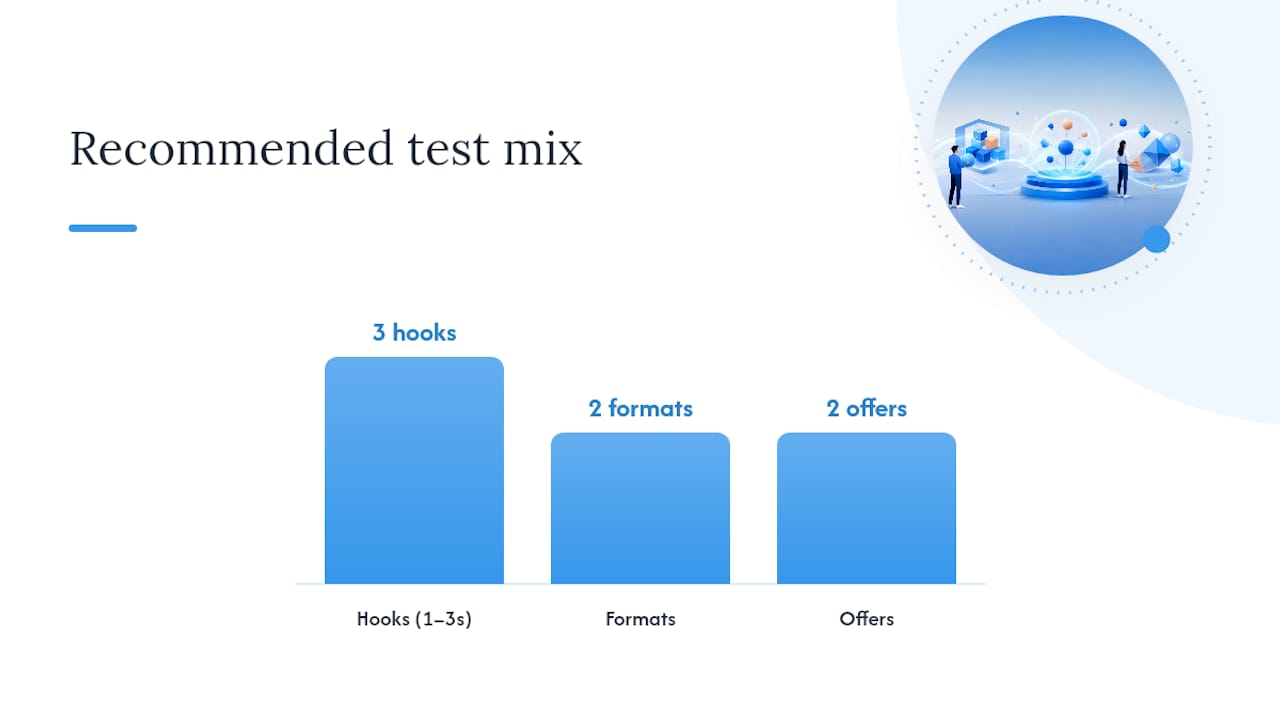
Practitioner frameworks generally organize testing volume around production capacity and budget. The 3-2-2 method, a middle-ground approach, tests 3 hooks, 2 formats, and 2 offers, giving you meaningful coverage without demanding a full production sprint. It sits between the leaner 3-2-1 approach built for tighter budgets and the higher-volume 3-3-3 matrix designed for accounts with strong production throughput. A 3-Phase model, pre-flight, new-versus-business-as-usual, and scaling, works well when you want distinct budget tiers and decision gates at each stage rather than one flat test structure.
One rule matters more than which matrix you choose: change exactly one variable per test. A matrix helps you plan multiple simultaneous but isolated comparisons, not a single ad with five things different at once.
Pro Tip: Name every asset with a fixed convention before you launch, something like HOOK03_BODY01_CTA02_v1, so that six months from now anyone on the team can look at a filename and know exactly what variable it was testing without opening the file.
Version control matters as much as naming. When a “quick edit” gets uploaded mid-test to fix a typo, you’ve likely introduced a second variable without meaning to, and the test result is now unreadable. Good asset hygiene, including consistent photography and production standards like those covered in Ken Jones NYC’s guide to producing photo ad campaigns that convert, keeps your variants clean enough to trust.
Which Testing Method Should You Use, and When?
Method choice depends on how fast you need an answer, how much budget you’re willing to risk, and how much statistical certainty the decision actually requires.
| Method | When to use | Speed to insight | Cost/media impact | Statistical robustness | Operational complexity |
|---|---|---|---|---|---|
| A/B (Meta Experiments) | Concept-level decisions that need a defensible answer | Moderate (7 to 14 days) | Moderate, requires equal spend split | High, randomized non-overlapping audiences | Low to moderate |
| Multivariate | Testing several variables’ interactions at once | Slow, needs large sample | High, splits budget across many cells | Moderate, risk of underpowered cells | High |
| Holdout | Measuring incrementality of a channel or campaign | Slow (weeks) | High, withholds spend from a segment | High for incrementality questions | Moderate |
| Bandit (algorithmic) | Execution-level optimization, ongoing creative rotation | Fast, continuous | Low, self-optimizing | Lower for causal claims, better for allocation | Low |
| Sequential testing | Early directional reads with smaller budgets | Fast (early signal) | Low | Lower, needs confirmatory follow-up | Moderate |
A few practical notes worth keeping close. Meta Experiments is the gold-standard choice for concept-level tests where the result needs to hold up to scrutiny, because it randomizes and prevents audience overlap in a way manual campaign splits often can’t guarantee. Algorithmic ad-ranking, or letting Meta’s delivery system optimize across an ad set, works better for execution-level decisions once you already know the winning concept and just need the system to find the best-performing combination at scale. ABO (ad set budget optimization) gives you tighter control over spend per variant, which matters for a clean test; CBO (campaign budget optimization) tends to favor whichever variant gets early signal, which can bias results before you’ve reached a reliable sample.
Selecting a method: quick decision checklist
- Do you need a defensible, board-ready answer? Use Meta Experiments or a manual randomized split.
- Are you optimizing an already-validated concept across many combinations? Use bandit-style algorithmic delivery.
- Do you need to prove incrementality against doing nothing? Use a holdout test.
- Is budget too tight for a full experiment? Use sequential testing for a directional read, then confirm the winner with a proper A/B before scaling.
- Are you testing more than one variable’s interaction on purpose? Only then consider multivariate, and budget for the sample size it demands.
Statistically, aim for roughly 20 to 50 conversions per variant before reading results, and treat 95% confidence as your threshold before reallocating meaningful budget. A test that “shows a trend” at 8 conversions per side isn’t a result. It’s noise wearing a result’s clothing.
Operationalizing Creative Tests Across an Entire Program
Running one clean test is a skill. Running fifteen concurrent tests across six ad accounts without them contaminating each other is an operations problem, and it’s where most teams lose the discipline they had at small scale.
Workflow checklist for running tests at scale:
- Keep campaigns separated by objective so a hook test in one campaign doesn’t compete with a CTA test in another for the same audience.
- Allocate a fixed exploration budget, separate from your proven, scaling budget, so new tests aren’t starved of spend by campaigns already known to perform.
- Set a scheduling cadence (weekly or biweekly) so new tests launch on a rhythm instead of whenever someone remembers to brief them.
- Log every test’s start date, hypothesis, and decision gate in a shared tracker before it goes live, not after.
Tooling matters here, and it’s worth being specific about what each layer does. Celtra handles dynamic creative production and assembly at scale, useful when you’re generating dozens of variant combinations from a shared set of components rather than building each one by hand. Dragonfly AI analyzes creative before it ever reaches an audience, using attention-prediction modeling to flag whether a hook or layout is likely to earn a scroll-stop, which helps filter weak variants out of your test queue before you spend media budget proving they don’t work. Beyond production and pre-testing tools, you’ll still need a dedicated experimentation platform (Meta Experiments or an equivalent) for the actual randomized comparison, and an analytics layer to house your tagged creative library and test history. Reviews of creative operations tooling on platforms like G2 consistently point to the same lesson: integration with your existing analytics and asset library matters more than any single feature, since a tool that doesn’t talk to your reporting stack just creates a second source of truth nobody trusts.
Launch QA checklist, run through every single time:
- Confirm audience sets don’t overlap between variants.
- Confirm the optimization event matches your primary KPI.
- Confirm budgets are equal across variants, not just similar.
- Confirm an end date is set before launch, not decided reactively.
- Confirm no one can swap creative assets mid-flight without flagging it as a new test.
How to Read Test Results and Decide What Happens Next
A result only means something once you’ve confirmed the test ran cleanly. Skip this step and you risk declaring a winner based on a broken comparison.
Analysis checklist, in order:
- Confirm the audience split was genuinely non-overlapping and spend was equalized.
- Confirm you hit your pre-set minimum conversions per variant, generally in the 20 to 50 range for a Meta Experiments read.
- Check your primary metric first, exactly as defined before launch.
- Then read diagnostic layers in order: attention (hook rate, hold rate), intent (CTR, add-to-cart), conversion (CPA, ROAS).
A basic reporting structure keeps a test result defensible when you present it to a client or a budget owner:
For borderline results, where the lift is real but confidence sits below your threshold, resist the urge to call it a win just because the pressure to ship a decision is high. Label it a directional result rather than a confident one, and treat directional wins as candidates for a confirmatory test with a larger sample rather than an immediate rollout decision. Anything short of both stays in the “iterate and retest” bucket, no matter how good the trend line looks on a Tuesday afternoon.
Turning a Winning Test Into an Optimization
A win only creates value once it’s rolled out correctly and used to inform the next round of creative. This is the step most teams under-invest in, treating a winning test as an endpoint instead of the start of a new cycle.
- Choose a rollout pattern. A clean, high-confidence winner can graduate directly into business-as-usual budget. A directional winner with real but unconfirmed lift should scale in stages, often through CBO or Meta’s Advantage+ campaign structures, while you watch for performance decay at higher spend. Anything ambiguous gets a confirmatory A/B before you touch the budget at all.
- Prioritize the next round of tests. An ICE-style score (Impact, Confidence, Ease) works well for deciding what to test next when you have more hypotheses than production capacity. Score each candidate hypothesis on expected impact, your confidence it’ll actually move the metric, and how easily your team can produce the variant, then rank and pick the top few.
- Write the next-test brief from the winning insight. If a curiosity-driven hook beat a bold-claim hook by a meaningful margin, the next brief shouldn’t just repeat that hook. It should test why curiosity worked: was it the question format, the specific words used, or the visual pairing? Turn a winning hook into two or three execution-level variants that isolate the next layer of the “why.”
An 8-Week Roadmap and Templates You Can Copy Today
Most teams don’t fail at creative testing because they lack ideas. They fail because they never build the scaffolding: a hypothesis template, a naming system, and a rough timeline for how much testing happens when.
Sample 8-week roadmap:
- Weeks 1 to 2, Discovery. Audit past creative performance, build the initial hypothesis library, set up tagging conventions. Output: a prioritized hypothesis backlog of 10 to 15 entries.
- Weeks 3 to 4, Exploration. Launch lean tests (3-2-1 matrix) across your top 3 to 5 hypotheses using a smaller exploration budget separate from proven spend. Output: directional signal on which hooks and angles resonate.
- Weeks 5 to 6, Validation. Take directional winners into confirmatory A/B tests via Meta Experiments, sized to 20 to 50 conversions per variant. Output: confident winners cleared for scale, with a documented decision rationale.
- Weeks 7 to 8, Scaling. Roll confident winners into CBO or Advantage+ structures, monitor for performance decay, and feed diagnostic learnings into the next hypothesis batch. Output: updated creative library and a fresh backlog for the next 8-week cycle.
Copyable hypothesis template:
“If we change [specific element] from [current state] to [new state], [primary KPI] will move by [expected direction/magnitude] because [audience insight or behavioral reasoning]. We will measure this over [timeframe] using [test method], requiring [sample size] conversions per variant, and will call it a win if [decision threshold].”
Naming and tagging checklist:
- Include variable type in every filename (HOOK, BODY, FORMAT, OFFER, CTA).
- Include a version number so edits never overwrite test history.
- Tag every asset in your creative library with its hypothesis ID, test date, and result.
- Keep a single master spreadsheet or database linking filenames to hypotheses, so nothing lives only in someone’s memory.
How Vertical Brands Applied This Framework: The FACEGYM Case
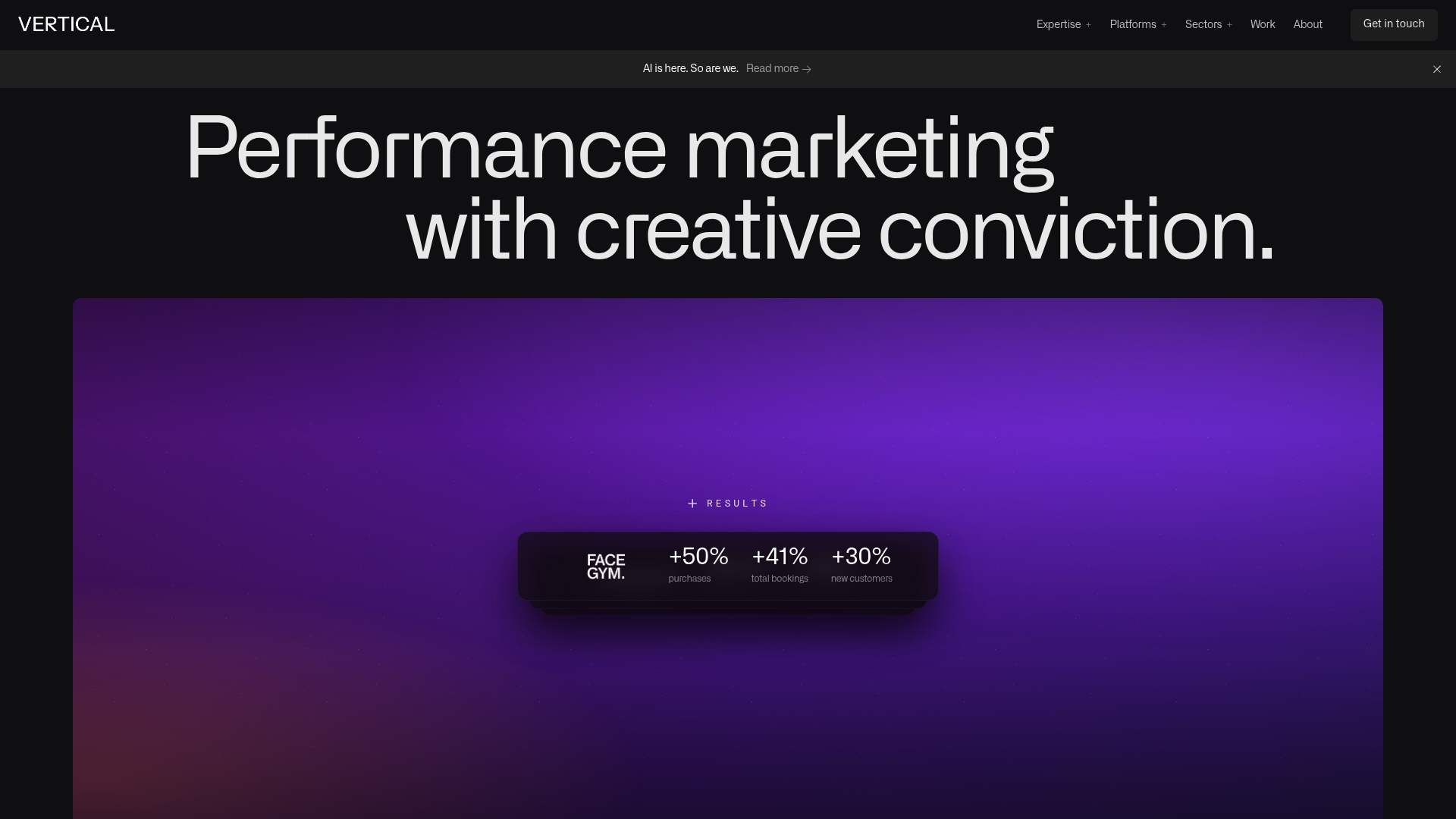
Client results make the abstract version of a framework concrete, and FACEGYM’s numbers show what disciplined creative testing produces when it’s tied to real business outcomes rather than vanity metrics. Working with FACEGYM, Vertical Brands applied a hypothesis-first testing structure that produced a 50% increase in purchases and a 41% rise in bookings.
How the framework mapped to the outcome:
- Hypothesis. Rather than testing broad creative refreshes, the team isolated specific variables tied to purchase and booking intent, starting with hook and offer framing rather than aesthetic changes alone.
- Test method. Concept-level comparisons ran through structured, isolated-variable experiments before scaling, avoiding the trap of shipping a “refreshed” campaign with five simultaneous changes and no way to attribute the lift.
- Decision gate. Winners were identified against pre-set KPI thresholds tied to purchases and bookings specifically, not generic engagement metrics that look good in a screenshot but don’t move revenue.
- Rollout. Confirmed winners graduated into broader budget allocation, with the underlying insight feeding the next round of creative briefs instead of being treated as a one-off success.
What to copy from this case: tie your primary KPI to the actual business outcome the client cares about (purchases and bookings, not impressions or engagement), and make sure your decision gate is defined against that same outcome before you look at a single result.
Pro Tip: When a test wins on a business outcome metric like purchases or bookings, document the diagnostic layer underneath it (which hook, which offer framing) immediately. Six months later, “the FACEGYM campaign worked” is a much weaker note than "curiosity-framed hooks paired with urgency-based offers drove the lift."
Your First Seven Days: A Starter Action Plan
You don’t need a fully built program to start generating defensible results. You need one clean test, run correctly, this week.
- Write one falsifiable hypothesis and pick one KPI. Use the copyable template above, and match the KPI to the funnel stage the creative actually operates in, not the metric that’s easiest to report.
- Build a 3-2-1 variant set and launch through Meta Experiments (or an equivalent randomized split). Three hooks, two body variations, one fixed offer and CTA. Set your minimum conversion count and confidence threshold before the test goes live.
- Pre-commit your decision rule and check it against the 8-week roadmap above. Decide right now what counts as a scale, kill, or retest outcome, and copy the naming convention and hypothesis template from the templates section so your first test feeds directly into a searchable creative library instead of disappearing into a folder.
Every rule in this framework comes back to the same two commitments: pre-commit your thresholds before you see results, and only scale what clears them.
Balancing Speed and Rigor: An Agency’s Take
Every agency feels the tension between “ship it now” and “test it properly,” and the honest answer is that you don’t have to choose between them if you structure the budget correctly. The mistake I see most often isn’t a lack of rigor. It’s applying full experimental rigor to every single creative decision, which slows a team down so much that they stop testing altogether and drift back to gut-feel briefs.
The fix that actually works: separate an exploration budget from a scaling budget. Let the exploration slice run leaner, faster tests, sequential reads, smaller sample thresholds, directional calls, because the cost of being wrong there is low. This alone resolves most of the speed-versus-rigor argument that eats up agency planning meetings.
Where agencies can safely cut friction without cutting test integrity:
- Run parallel production streams so creative isn’t the bottleneck holding up a test that’s otherwise ready to launch.
- Use sequential testing for early directional reads on cheap variables (headline wording, minor visual swaps), and reserve full experiments for concept-level or offer-level decisions.
- Standardize the hypothesis template and naming convention across every client account, so account teams aren’t reinventing structure client by client.
Where agencies typically cut corners, and shouldn’t: the biggest offender is killing a test early because a client wants an update before the sample size is there. A close second is bundling multiple creative changes into one “refresh” because production time ran short, which erases your ability to attribute any lift to a specific decision. Both shortcuts feel like they save time. Both actually cost more time later, because the team ends up re-running a test they thought they’d already answered.
A workable cadence for client communication: a weekly directional update (what’s exploring, what’s trending) paired with a biweekly or monthly confirmed-results readout (what cleared the decision gate and what’s scaling). This keeps clients informed without pressuring the team to call winners before the data supports it.
Get a Creative Testing Audit From Vertical Brands
Building a hypothesis library, a tagging system, and decision gates from scratch takes weeks most performance teams don’t have to spare. Vertical Brands runs creative testing audits that hand you a working framework instead: a gap analysis of your current testing practice, a sample roadmap sized to your budget, and a 30-minute briefing that walks through exactly what to test first.
This isn’t theoretical. An audit from Vertical Brands includes a review of your current hypothesis process, a tagging and naming system your team can adopt immediately, and a sample 8-week roadmap scaled to your actual media budget rather than a generic template.
If your team is running creative tests without decision gates, or scaling winners without confirmatory reads, that’s exactly the gap an audit is built to close. Request a creative testing audit from Vertical Brands and get a working roadmap back within the briefing, not weeks later.
Sources
- Run a Meta creative test that proves something | AdSights
- You’re probably A/B testing too much. Here’s what to do instead | HBR
- Creative Testing Framework: How to Build a Post-Andromeda Testing System | AdMove
Recommended

Other posts





























































Stay ahead with better decisions.
Get business insights today.
