Marketers: Run a Causal Test This Quarter to Fix Data Driven Marketing

Data-driven marketing means using customer, behavioral, and operational data to make marketing decisions that can be measured and verified, rather than decisions based on instinct or convention. Done well, it lifts return on ad spend, sharpens targeting, and shortens the time between a hypothesis and a confirmed result. The immediate next step for any team starting out is simple: pick one business outcome, then measure its incremental lift, not just its correlation with a campaign.
TL;DR:
- Regularly run small, structured incrementality tests to validate whether marketing channels truly drive additional sales, not just correlate with existing trends.
- Prioritize cleaning and unifying customer data before investing heavily in dashboards or new tools to prevent inaccurate insights from flawed records.
- Ask measurement vendors for uncertainty intervals alongside lift estimates to gauge the reliability of attribution results and avoid overconfidence in noisy data.
- Focus on matching your data sources to a single primary KPI, and build decision triggers based on those specific metrics to maintain effective, actionable dashboards.
- Start with one comprehensive causal experiment each quarter and address key data hygiene issues to build a solid foundation for scalable, responsible data-driven marketing.
Table of Contents
- What Data-Driven Marketing Actually Changes
- The Real Benefits, and Where They Fall Short
- How Measurement Actually Works Now
- Building a Data-Driven Marketing Strategy Step by Step
- The Technology Stack: What to Buy and Why
- Privacy and Legal Guardrails You Cannot Skip
- Common Pitfalls That Undercut Good Data
- What Integrated Data-Driven Marketing Looks Like in Practice
- What Marketing Leaders Should Prioritize Next Quarter
- How Vertical Brands Turns This Into a Working Program
- Sources
- FAQ
What Data-Driven Marketing Actually Changes
Traditional marketing runs on judgment calls. A creative director likes an ad, a media buyer trusts a channel that “always performs,” and budgets get set by precedent. Data-driven marketing replaces those guesses with a measurable loop: collect signals, build profiles, activate campaigns, then feed results back into the next decision.
That loop has four working parts marketers need to understand clearly:
- Signals are the raw behavioral and transactional events, a click, a purchase, a support ticket, that tell you what a customer actually did.
- Profiles stitch those signals into a coherent view of one person or account across devices and channels.
- Activation is where the profile becomes an action, a targeted ad, an email trigger, a personalized landing page.
- Feedback loops close the circle, feeding outcome data back into targeting and budget models so the next campaign starts smarter than the last.
The bigger shift, and the one most teams still get wrong, is moving from correlational thinking to causal thinking. Knowing that customers who saw a retargeting ad also bought more tells you almost nothing on its own. Many of those customers would have bought anyway. Data-driven marketing at its best asks a harder question: what happened because of the marketing, versus what would have happened regardless? That distinction drives everything in the measurement section below.
The Real Benefits, and Where They Fall Short
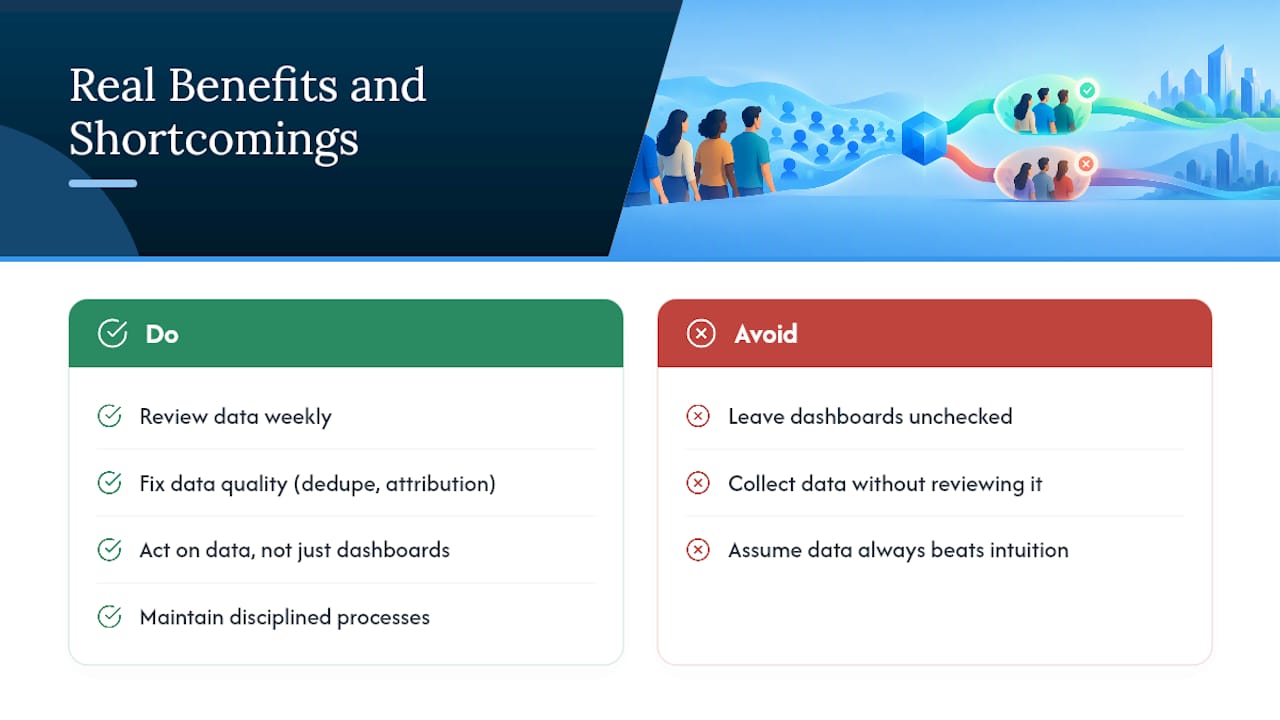
The efficiency case for data-driven marketing is strong but not universal. A survey of marketers by Adobe found that a majority cite improved marketing efficiency as the top benefit of a data-driven approach, spanning faster decisions, tighter targeting, and better budget allocation.
That statistic tells only half the story. The same research found a meaningful share of marketers review their data infrequently, which creates a gap between having data and acting on it. Dashboards that nobody checks weekly are not a data-driven marketing analytics strategy. They are decoration.
Poor data quality compounds the problem. The Adobe research documents financial losses tied to bad data issues among marketers surveyed, including duplicate customer records and mismatched attribution windows. Data-driven marketing does not automatically outperform intuition. It only outperforms intuition when the underlying data is accurate, current, and actually reviewed on a regular cadence. Efficiency gains and data-quality failures show up in the same organizations, often simultaneously. Which side you land on depends almost entirely on discipline, not on how much data you collect.
How Measurement Actually Works Now
Attribution has gone through three generations, and most teams are still running the oldest one. Last-click attribution gives 100% of the credit to the final touchpoint before conversion, which flatters cheap, bottom-funnel channels like branded search and punishes awareness spend that set up the sale weeks earlier. Data-driven attribution models, the kind built into major ad platforms, distribute credit algorithmically across the path, an improvement, but still vulnerable to the platform’s own incentive to claim credit for itself.
Marketing mix modeling (MMM) takes a different approach entirely, using aggregated, time-series data to estimate each channel’s contribution to sales without relying on individual-level tracking. It works well for top-down budget planning but moves slowly and struggles with granular, weekly optimization. Incrementality testing, structured holdouts where you turn a channel off for a defined group and measure the difference, gives you the cleanest causal read available, but it requires planning and patience most teams skip.
The frontier right now is hybrid measurement. Causal-driven attribution (CDA) methods estimate each channel’s causal contribution using aggregated, impression-level data instead of individual user paths, which makes them notably more resilient in a world where cookies and device identifiers keep disappearing. Layer that with an AIMx-style architecture that combines MMM, multi-touch attribution, and incrementality testing, and forecasting accuracy and resource allocation both improve compared with relying on any single measurement tool in isolation. Our own breakdown of marketing mix modeling walks through how to set one up without a data science team.
When you ask a vendor or an internal team about their measurement setup, demand three specific outputs, not a vague promise of “better attribution”:
- Incremental ROAS (iROAS), the return generated by spend that would not have happened organically.
- Lift, expressed as a percentage change against a genuine holdout, not a modeled baseline.
- Uncertainty intervals, because a single point estimate without a confidence range is a guess dressed up as a statistic.
Pro Tip: Ask any measurement vendor to show you their uncertainty intervals before you ask about their lift numbers. A model that reports precise lift with no range around it is usually hiding how noisy the underlying data really is.
Building a Data-Driven Marketing Strategy Step by Step
A data-driven marketing strategy fails most often not from lack of data but from lack of sequence. Teams buy a platform before they define an objective, then wonder why the dashboards feel disconnected from decisions. Work through these steps in order.
- Define the business outcome first. Revenue, retention, customer acquisition cost, pick one primary KPI before you touch a single tool. Every downstream data source and dashboard should trace back to that number.
- Audit and prioritize your data sources. CRM records, web and app analytics, point-of-sale data, and offline conversions (in-store visits, phone bookings) rarely live in one place. Rank them by how directly they connect to your chosen KPI, not by how easy they are to access.
- Fix identity and hygiene before scaling anything. Deduplicate customer records, standardize field formats, and decide how you will match a single person across devices. A customer data platform (CDP) can centralize this, but only after you know what “clean” looks like for your business.
- Design incrementality tests on a fixed cadence. Run at least one structured holdout per quarter on a channel you suspect is overvalued. Pre-register the metric and timeline before launch so you cannot rationalize the result afterward.
- Build dashboards around triggers, not vanity metrics. A dashboard that displays numbers without a corresponding action rule is noise. If cost per acquisition crosses a threshold, define in advance whether that pauses a campaign automatically or triggers a same-day human review.
- Run a weekly decision ritual. Thirty minutes, same day each week, where the team reviews the KPI, checks any triggered alerts, and commits to one change. Momentum in data-driven marketing comes from cadence, not from the sophistication of the model.
Pro Tip: Before you build a single new dashboard, list every decision your team actually makes in a typical month. If a proposed metric doesn’t map to one of those decisions, cut it. This one exercise eliminates most dashboard bloat.
Experimentation deserves its own discipline inside this process. Our creative testing framework gives teams a structure for running quick creative experiments without waiting on a full incrementality study, useful for the weeks between quarterly holdout tests.
The Technology Stack: What to Buy and Why
Tool selection should follow strategy, never the other way around. Four categories do the real work in a modern data-driven marketing analytics strategy, and each earns its place for a specific reason.
- Customer data platforms (CDPs) unify identity across sources, creating the single profile that activation depends on. Skip this layer and every other tool works off fragmented, contradictory customer records.
- Analytics platforms track behavior in real time, web sessions, app events, conversion paths, and feed the raw signals everything else consumes.
- Business intelligence (BI) tools turn that raw data into reporting structures leadership can actually read, connecting marketing performance to revenue and margin.
- Experimentation platforms run and score the A/B tests and holdouts that generate causal evidence, rather than the correlational reporting BI tools produce on their own.
Beyond category, three integration questions decide whether a stack actually works in production. How fast does data move from source to activation, in near real time, or with a lag that makes the insight stale by the time it reaches a campaign manager? Can the platform scale to your data volume without silently dropping records during peak traffic? And does it expose enough activation endpoints to actually push a segment into your ad platforms and email tools, not just display it in a report?
Governance features matter just as much as speed. Require audit logs that show who accessed or modified customer data, and privacy controls that let you honor deletion and opt-out requests without an engineering ticket. A stack that cannot prove compliance on demand is a liability wearing an analytics dashboard. For teams operating without stable device identifiers, our guide to cookieless marketing covers how to architect measurement when third-party cookies are no longer a reliable input.
Privacy and Legal Guardrails You Cannot Skip
Under UK GDPR, profiling for direct marketing carries specific obligations most teams underestimate. Using or inferring special category data, health status, political opinion, sexual orientation, within a profiling model requires explicit consent, not the implied consent many marketing teams assume covers general personalization. Individuals also hold a standing right to object to profiling used for direct marketing, and that objection must be honored without hurdles or delay.
Build these practical steps into your governance process rather than treating them as a compliance afterthought:
- Run a Data Protection Impact Assessment (DPIA) before launching any high-risk profiling activity, a requirement the ICO’s direct marketing guidance spells out clearly.
- Write privacy notices in plain language that explain what data feeds a given campaign, not legal boilerplate nobody reads.
- Set retention limits on customer data and enforce them automatically rather than relying on manual cleanup.
- Make opt-outs immediate and frictionless across every channel you use, email, SMS, paid social retargeting.
Common Pitfalls That Undercut Good Data
Most data-driven marketing programs fail from a handful of repeatable mistakes, not from a lack of sophistication.
- Attribution bias toward last-click. Run small holdout tests quarterly to check whether your top-credited channel actually drives incremental sales.
- Poor data hygiene left unmanaged. Schedule recurring deduplication and validation checks rather than fixing records only when a report looks obviously wrong.
- Dashboards with no path to action. Codify decision triggers, if a metric crosses X, then Y happens automatically or a specific person reviews it within 24 hours.
What Integrated Data-Driven Marketing Looks Like in Practice
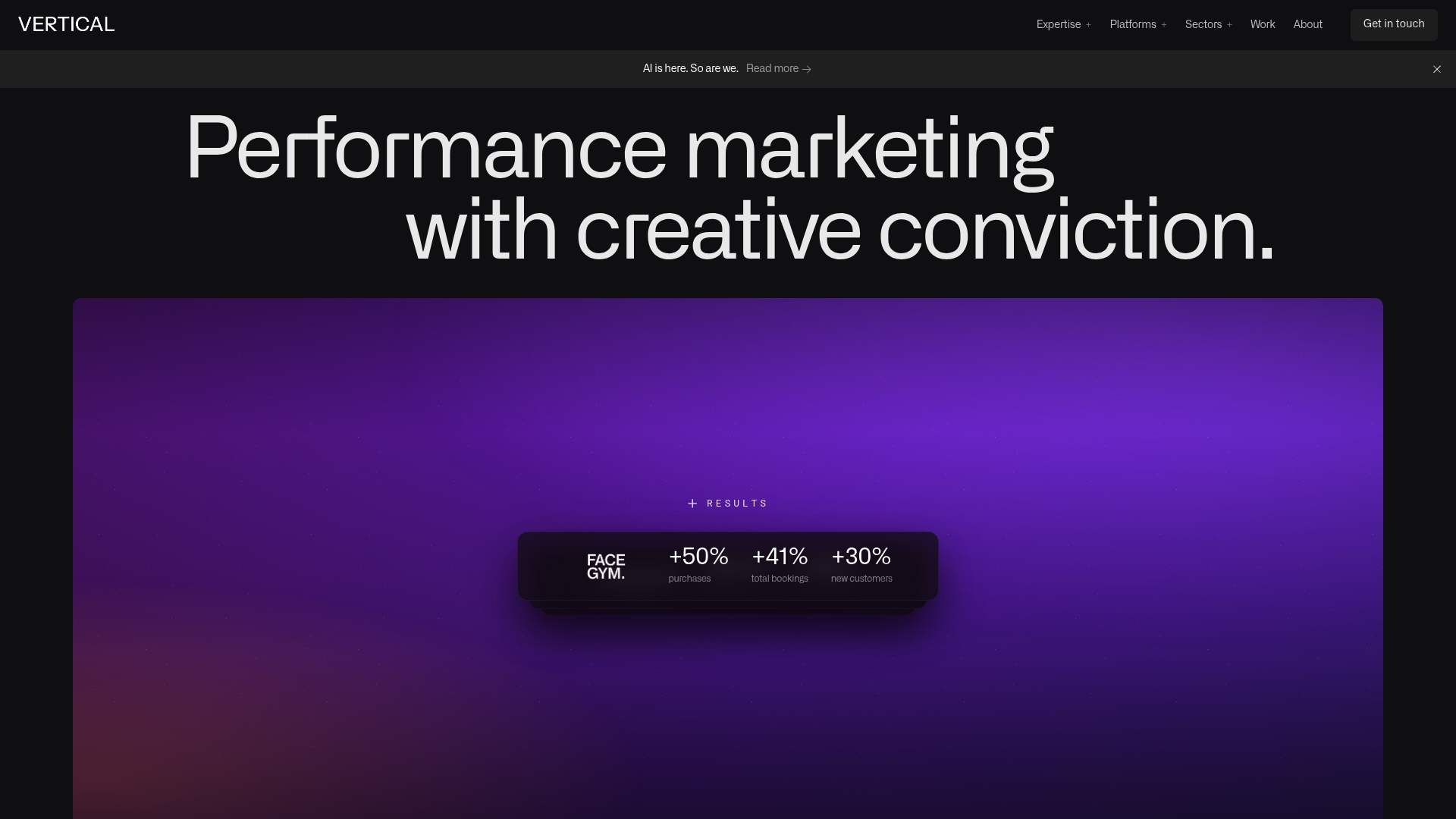
FACEGYM’s results show what happens when strategy, creative, and measurement work from the same data, rather than three separate playbooks.
The gains did not come from a single channel tweak. They came from aligning creative testing, media allocation, and measurement around the same customer data, so decisions in one area reinforced results in the others instead of working against them.
That kind of outcome is what an integrated data-driven marketing strategy is supposed to produce: creative and media decisions informed by the same measurement framework, rather than a media team and a creative team optimizing against different numbers.
What Marketing Leaders Should Prioritize Next Quarter
Pick one causal experiment and run it this quarter, not next year. While you’re at it, fix your two worst data hygiene problems, they’re probably duplicate records and mismatched conversion windows. Invest in unified customer profiles before buying another dashboard, and write down exactly what triggers action when a metric moves.
— Alex
How Vertical Brands Turns This Into a Working Program
An integrated approach eliminates the need to hire separate vendors for strategy, media, and measurement, enabling one team to run all three against the same data so insights from incrementality tests effectively inform creative and media decisions, rather than getting lost between agencies.
A typical engagement starts with an audit of your existing data sources and measurement gaps, moves into a structured experiment to validate what’s actually driving results, then scales the channels and creative that prove out. That sequence maps directly to services including digital marketing strategy, media planning, paid social, and analytics work, all coordinated by one team instead of stitched together across vendors who rarely compare notes. If your dashboards are full of numbers nobody acts on, or your attribution model still hands all the credit to branded search, get in touch through the services page and start with an audit of where your current setup is actually losing you signal.
Sources
Key references to include ICO guidance on profiling and direct marketing, causal attribution research from arXiv, the AIMx measurement framework, and Adobe’s marketer survey, alongside a broader analytics ROI perspective.
- What 400 successful marketers reveal about data-driven marketing
- Information Commissioner’s Office guidance on profiling and direct marketing
FAQ
What Is a Data-Driven Marketing Strategy?
A data-driven marketing strategy uses customer and operational data, rather than instinct or precedent, to set objectives, target audiences, and measure results. It typically starts with a defined KPI, maps the data sources that inform it, and builds a testing cadence to validate what actually drives that outcome.
What Is the 3-3-3 Rule for Marketing?
The 3-3-3 rule isn’t a standardized measurement framework covered by established marketing research, and definitions vary depending on the source. Rather than repeat an unverified rule, focus on the causal measurement approaches, incrementality testing, MMM, and CDA, covered earlier in this guide, since those carry actual research backing.
What Are the Steps of Data-Driven Decision Making in Marketing?
The core sequence runs: define the business outcome, audit and prioritize data sources, clean and unify customer identity, design a test to validate causality, and act on the result through a predefined trigger. Skipping the identity and hygiene step is the most common reason teams get unreliable results even with good data.
What Is an Example of Data-Driven Marketing?
FACEGYM’s work with Vertical Brands is a concrete example: aligning creative testing, media allocation, and measurement around shared customer data produced significant increases in purchases and bookings. The result came from integrating strategy and measurement, not from one isolated tactic.
Recommended

Other posts

































































Stay ahead with better decisions.
Get business insights today.
