Food and Beverage Marketing Agency UK: A Growth Framework for 2026
A first order is a signal, not a growth strategy. Finding a food and beverage marketing agency UK brands can grow with means looking beyond campaign delivery. Acquisition creates lasting value when it connects to repeat purchases, customer retention and an ecommerce experience that helps visitors ma...

A first order is a signal, not a growth strategy. Finding a food and beverage marketing agency UK brands can grow with means looking beyond campaign delivery. Acquisition creates lasting value when it connects to repeat purchases, customer retention and an ecommerce experience that helps visitors make a decision.
Choosing the right partner can feel difficult when agency specialisms split responsibility across channels and food and drink brands have different products, audiences and sales routes. The challenge is making sure someone owns the joined-up plan, not just individual campaigns.
This guide gives you a practical framework for assessing strategic and channel fit. You’ll learn how to evaluate whether an agency can align acquisition, CRM and ecommerce with your commercial priorities, and how to look beyond short-term activity towards sustainable growth. We’ll cover questions that reveal who sets the direction, how performance is measured and whether channel decisions support repeat purchase as well as customer acquisition. The aim is to help you see what a productive agency relationship should deliver and how the pieces fit together.
Key Takeaways
• Assess an agency’s strategic ownership against your product, purchase frequency and sales channels, not just its list of services.
• Map discovery, consideration, first purchase and repeat purchase to see where paid social, paid search and SEO each contribute.
• Compare directory listings, specialist partners and integrated support by how they handle strategy, channel coordination, measurement and execution.
• Set a business objective, map the customer journey, choose relevant measures, then review and adapt. Separate early signals from commercial outcomes.
• Use a food and beverage marketing agency UK framework to judge whether growth advisory, CRM, paid media, SEO and ecommerce work towards shared priorities.
Why food and beverage marketing in the UK needs a connected growth plan
Food and drink growth is not measured by campaign activity alone. The commercial picture depends on what a brand sells, how customers buy it and whether they come back. A food and beverage marketing agency UK brands can grow with should connect strategic priorities, channel decisions and measurement, rather than treating each campaign as a separate outcome.
A campaign delivers activity; an integrated growth partner aligns strategy, channels and measurement to build customer value over time. That distinction matters when acquisition looks healthy but repeat purchases remain weak, or when website changes and media spend are judged against different goals. To understand the value of a first order, brands need to consider what happens afterwards and how revenue relates to the contribution left after relevant costs.
What makes food and drink marketing commercially distinct?
There is no single buying pattern across the category. Some products are discovered through a new flavour or format, then purchased occasionally. Others are replenished regularly. A product bought as a gift may have a different decision cycle from an everyday staple. These distinctions affect the message, timing and customer journey to prioritise. Food Marketing Principles offers an overview of concepts such as segmentation and the marketing mix, which can help frame those choices.
Sales routes change the task, too. A direct-to-consumer brand can use its website and customer relationship management (CRM) data to understand online behaviour and encourage a next purchase. A brand sold through retail may need to build awareness and preference, while the retailer owns much of the transaction data. Some businesses use both routes, so their plan needs to reflect what each channel can reveal and influence.
Planning must also account for the trading calendar. Seasonality can shift demand, while a product launch may need a distinct sequence of discovery, explanation and follow-up. Priorities differ by brand. A fixed campaign calendar can overlook stock, launch timing and the product’s natural purchase cycle.
Why disconnected agency activity can limit growth
When acquisition, website experience and retention are managed against separate targets, each team can report progress while the overall growth picture remains unclear. Paid activity may bring visitors to a product page that does not answer their questions. Email campaigns may promote a product to customers who have already purchased it, or overlook those ready to replenish. These are coordination problems, not proof that every brand needs every channel or a large agency team.
Inconsistent customer data adds another layer of friction. If channel reports use different definitions of a customer, order or conversion, teams can reach conflicting conclusions about what is working. A connected plan establishes shared measures and responsibilities. It gives decision-makers a clearer basis for adjusting spend, improving the ecommerce journey or strengthening post-purchase communication, without assuming one channel is right for every brand.
How an integrated food and beverage marketing strategy connects the customer journey
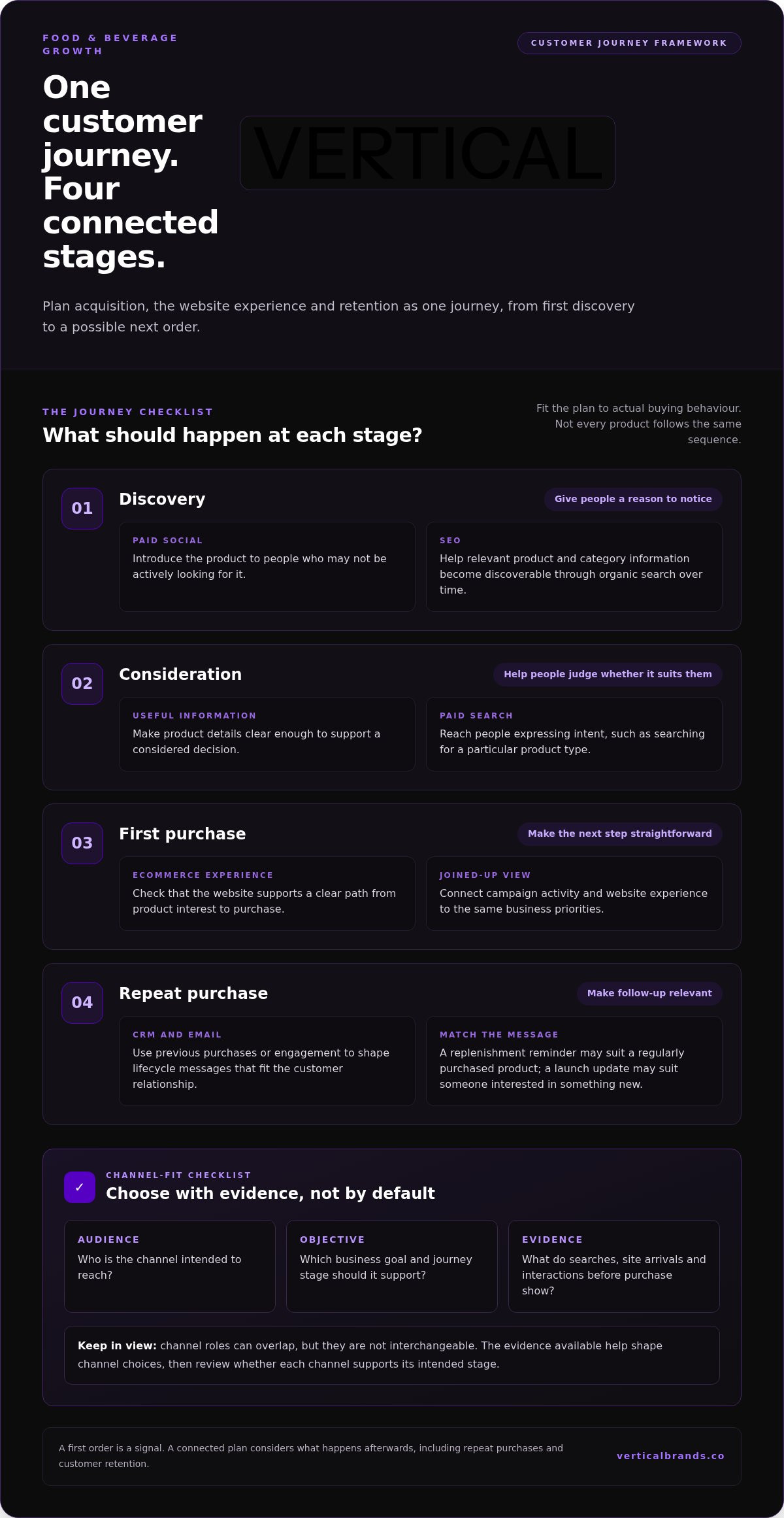
Customers rarely move from first seeing a product to buying it in one step. They discover, compare, purchase and, in some cases, return. A connected strategy plans for those stages as one journey, so the experience and measures make sense from first interaction through to the next order.
Start by identifying what a customer needs at each point. Discovery calls for a clear reason to notice the product. Consideration needs useful information to help someone judge whether it suits them. At purchase, the website must make the next step straightforward. Afterwards, relevant communication can help a customer decide whether to buy again. Not every product follows the same sequence, so map the journey to actual buying behaviour.
Where acquisition channels fit in the journey
Paid social can introduce a product to people who aren’t actively looking for it, using creative that makes its relevance clear. Paid search can reach people expressing intent through a search, such as looking for a particular product type. Search engine optimisation (SEO) helps relevant product and category information become discoverable through organic search over time. These roles can overlap, but they aren’t interchangeable.
Choose channels according to the audience, business objective and evidence available, not a default checklist. Review what people search for, how they arrive on the site and which interactions precede purchase. A food and beverage marketing agency UK brands work with should connect those findings to channel choices, then assess whether each channel is helping its intended stage of the journey.
How CRM and ecommerce keep the journey moving
Customer relationship management (CRM) data can help shape more relevant email communication. With Klaviyo, brands can manage customer data and automated email flows, using signals such as previous purchases or engagement to plan lifecycle messages. A replenishment reminder may suit a regularly purchased product; a launch update may be more useful to someone who has shown interest in something new. The message should fit the customer relationship, not simply follow a generic schedule.
The website is where interest meets practical decisions. Check whether landing pages explain the product clearly, key information is easy to find and the steps to checkout feel straightforward. If a campaign promise is missing from the page it leads to, or the purchase path introduces avoidable friction, more traffic alone will not resolve the issue. Web design and development can address usability and conversion as part of the wider journey.
A shared customer journey needs shared performance measures. Align channel reporting around consistent definitions of discovery, conversion and repeat purchase. This helps teams see where movement slows and what to improve next. Signals are more useful when considered together than when each channel reports success in isolation.
For brands looking to align channel choices with execution, Vertical Brands’ growth advisory can provide a strategic layer across acquisition, CRM and ecommerce priorities.
How to compare a food and beverage marketing agency with a directory or specialist partner
A directory helps you discover agencies. A specialist partner may bring depth in a defined discipline or category. Neither label, by itself, shows who will own the growth plan or connect activity to commercial outcomes. Start the comparison with your business model and the work you need done.
Before assessing options, define the requirement. Is the brief about communications, a specific channel or ecommerce growth across acquisition and retention? Then compare how each model handles strategic ownership, integration, measurement and execution.
| Option | Strategic ownership | Integration and measurement | Execution fit |
|---|---|---|---|
| Directory | Helps you find and compare providers, but does not itself own strategy. | Capabilities may be listed separately. You’ll need a plan for how the work connects. | Useful for discovery when you have a defined brief and can coordinate delivery. |
| Communications-led partner | Can suit a brief centred on brand communications and audience engagement. | Assess how its work connects to ecommerce, retention and commercial measures if those matter to the brief. | Relevant when communications are the primary requirement. |
| Single-channel specialist | Focuses on a defined need, such as paid search, SEO or CRM. | Clarify how performance will be assessed and how the work fits around other activity. | A strong fit for a discrete project or a clear capability gap. |
| Integrated growth partner | Connects priorities across channels and provides a clear point of strategic ownership. | Aligns reporting and execution around shared commercial objectives. | Suited to brands managing connected acquisition, retention and ecommerce needs. |
What to assess beyond an agency’s food and drink positioning
Sector language can be a useful starting point, but it isn’t evidence of strategic fit. Look for an understanding of your sales routes, customer behaviour, product priorities and internal constraints. Ask how decisions are made, who owns priorities and how performance reviews lead to action. A clear explanation matters more than a broad promise.
Vertical Brands connects growth advisory with Klaviyo CRM, paid media, SEO and web capabilities. This gives brands a way to align channel choices and execution around shared priorities, without assuming every business needs every service. The strongest fit comes from capabilities that address a defined commercial need and can be measured against it.
When integrated digital support is the stronger fit
A single-channel project can be the right choice when the objective and scope are clear. An ongoing growth requirement is different. If acquisition, customer communication and ecommerce experience affect the same commercial goal, coordination becomes part of the work. A food and beverage marketing agency UK brands assess should make ownership and measurement clear, rather than leaving integration as an assumption.
Use the framework to identify where strategy, channels and accountability need to connect. Explore Vertical Brands’ growth approach to see how growth advisory and digital execution can be aligned.
How food and drink brands can set priorities and measure marketing performance
Measurement is useful when it helps a team decide what to do next. Start with a commercial priority, then choose evidence that shows whether marketing is moving the business towards it. A dashboard full of channel figures isn’t a strategy. Each measure needs a clear purpose and owner.
Channel metrics only become meaningful when interpreted against the commercial objective they are meant to support. Use this four-step sequence to build a practical measurement plan:
Define the business objective.
Be specific about the change the business needs, such as improving first-purchase efficiency, encouraging repeat orders or supporting a product launch.
Map the customer journey.
Identify where marketing can influence discovery, consideration, purchase and retention, and note where the brand has useful data.
Choose measures.
Select a small set of indicators that connect channel activity to the objective. Make clear what each measure tells you and what it cannot show.
Review and adapt.
Compare results with the agreed priority, identify what needs investigation and decide which activity to continue, change or pause.
Choose measures that reflect the business objective
Leading indicators are early signals that activity may be progressing in the intended direction. Commercial outcomes show what happened for the business. For acquisition, qualified traffic, product-page engagement and conversion behaviour can help explain campaign delivery measures such as clicks. For retention, CRM data can show repeat-purchase behaviour and customer value over time. These measures answer different questions, so don’t treat an early signal as proof of commercial impact.
Use available first-party customer data, ecommerce analytics and campaign reporting together, while recognising that each source has limits. A direct-to-consumer brand may have order and customer records from its online shop. A brand selling through retail may have less visibility of individual purchases, so its measurement approach needs to reflect that sales model. Avoid setting targets or forecasts without a defensible baseline and evidence.
Build a review rhythm that supports decisions
Agree a regular review cadence that suits the business and the data available. Bring channel results, customer behaviour and current priorities into the same discussion. Check whether changes in performance align with campaign activity, product availability or website changes, rather than assigning every movement to one channel.
Use what you learn to adjust creative, audience choices, landing pages and CRM communications. If campaign engagement is healthy but fewer visitors progress to purchase, investigate the page and purchase journey. If existing customers aren’t returning as expected, review the relevance and timing of lifecycle messages alongside purchase patterns. The right review process depends on the setup. Measures should reflect how the brand sells and what its data can reliably show.
A food and beverage marketing agency UK brands assess should connect measurement to decisions, not just provide channel reports. Align your growth priorities and measurement with Vertical Brands’ digital growth support.
How Vertical Brands can support food and beverage growth across digital channels
Growth work is more effective when the business priority comes first. Before assigning activity to channels, clarify what needs to change, which customers matter and what evidence will show progress. This gives strategy and execution a shared direction, rather than allowing separate teams to optimise disconnected tasks.
Vertical Brands brings growth advisory together with digital delivery. A food and beverage marketing agency UK brand works with should relate channel choices to the customer journey and commercial objectives. The right approach depends on the brand’s sales model, data and constraints, not an assumed formula or fixed package of services.
What a connected agency relationship can cover
Strategic planning can set priorities across customer acquisition, retention and ecommerce before work is allocated. Relevant execution may include Klaviyo CRM management and automated email flows, paid social, paid search, search engine optimisation, and website design and development focused on user experience and conversion. Each discipline has a role when it supports the agreed objective.
Creative requirements can also shape the plan. Influencer marketing and user-generated content (UGC) may support a brief that needs creator-led or customer-style assets. They aren’t automatic additions. Choose channels according to the business need, available evidence and the part of the customer journey that requires attention. The priority is to make each activity contribute to a coherent plan, with ownership and measurement defined from the outset.
A connected relationship should make the operating model clear: who sets direction, who delivers each activity and how learning informs the next decision. That doesn’t mean every discipline must be included in every plan. A defined project may centre on one capability, while a broader growth requirement may need coordination across several. Scope should follow the objective.
How to take the next step with a growth partner
Prepare a concise view of the business challenge before shaping the work. Set out:
The objective
what commercial change matters most?
The constraints
what limits progress, such as available data, website functionality or internal capacity?
The customer behaviour
what would you like customers to do differently, from discovering a product to returning to purchase?
The evidence
what can current analytics, campaign reports and CRM records show?
This gives the discussion a practical starting point. Vertical Brands can shape an approach around the project, growth priorities and evidence available, then align strategy with relevant execution. The aim is a clear plan, realistic measures and channel activity that serves the business rather than the other way round.
Discuss your food and beverage growth priorities and identify the next step towards more connected growth.
Turn your next growth priority into a clear plan
Choose one commercial priority and make it the reference point for marketing decisions. That could mean understanding where the customer journey loses momentum or deciding what evidence is needed before investing further. Clarity at this stage helps ensure activity has a purpose and progress can be assessed honestly.
A food and beverage marketing agency UK brands work with should connect strategic direction to the execution required, without treating every channel as a default. Vertical Brands brings growth advisory together with Klaviyo email marketing and CRM management, paid social, paid search, SEO and website development. The aim is to shape the mix around your objectives and available evidence, not promise a predetermined result. The right priorities are those your business can act on and measure.
Set out the opportunity, the constraints and the customer behaviour you want to influence. Then make the next move with a plan grounded in your commercial reality. Discuss your food and beverage growth priorities and take a considered step towards sustainable growth.
Frequently Asked Questions
What does a food and beverage marketing agency do?
A food and drink marketing agency plans, coordinates or delivers marketing activity in line with a brand’s commercial goals. A food and beverage marketing agency UK businesses work with may support digital strategy, campaign execution, customer communications or ecommerce improvement. The scope should reflect the brief. For example, a launch plan could define who needs to hear about a product, what information they need and how the brand will assess the response.
How can food and drink brands measure marketing performance?
Measure performance by linking activity to a defined business outcome and reviewing relevant data together. For a product launch, examine campaign engagement, visits to launch pages and resulting orders, then separate first-time from returning customers where records allow. Compare campaigns only when the context is similar. A useful report explains what changed, what evidence supports the interpretation and what decision follows, rather than simply listing totals.
Can one agency manage both customer acquisition and retention?
Yes, one agency can support both, provided its scope and operating model cover the work behind each. Acquisition activity needs to connect with customer records and post-purchase communication, while retention insights can inform future campaign choices. Agree who owns shared priorities, how information moves between channel teams and how results are reviewed. A single contract alone doesn’t ensure coordination. Clear accountability does, especially when internal teams also manage ecommerce or product availability.
How should a food brand choose between paid social and paid search?
Choose based on how customers discover the product and what the campaign needs to achieve. Paid search can be relevant when people are already looking for a product or category. Paid social may suit a brief that needs to introduce a product or test creative with an audience. Review existing search demand, campaign history and available creative before committing. Choose measures according to the channel’s role, not just clicks or reach.
Is email marketing useful for food and drink ecommerce?
Email marketing can support ecommerce by giving a brand a direct way to communicate after someone subscribes or makes a purchase. Its value depends on the product’s buying cycle and the messages customers find useful. For example, a replenishment prompt may fit a regularly purchased product, while a product education email may help someone understand a less familiar item. Plan content and timing around customer relevance, not simply a fixed sending schedule.
What should a food and beverage marketing brief include?
Include the business objective, priority audience, product or offer, sales channels and the customer action you want to encourage. Add relevant context such as launch timing, stock considerations, existing campaign activity and any limits on data or internal capacity. State what work is in scope, who will approve it and what information is available for evaluation. A focused brief helps separate essential requirements from activity that can wait.
How can influencer marketing support a food or drink brand?
Influencer marketing can help a brand present a product through creator-led content that demonstrates its use, context or appeal to a relevant audience. Depending on the brief, it may support awareness, consideration or the creation of content for other digital activity. Set the intended role before selecting creators, then agree content requirements and how performance will be assessed. Measures might include engagement, site visits or use of the content in campaign activity.

Other posts































































Stay ahead with better decisions.
Get business insights today.
