Win AI Citations in 90 Days With LLM SEO for Marketers, Passage First

LLM SEO means structuring content so AI systems like ChatGPT, Perplexity, and Google AI Overviews can find, understand, and cite it as a source. The first move is not writing more content. It is confirming your pages are crawlable and indexed, then rebuilding your priority pages around answer-first capsules that a model can lift in one pass. Everything else in this playbook builds on that foundation.
TL;DR:
- Prioritize technical fixes such as ensuring pages are crawlable, indexable, and load quickly to improve chances of being cited by AI models.
- Structure content around clear question-answer capsules, using a direct lead answer and standalone full explanations to increase extractability.
- Focus on building authoritative, well-sourced content and maintain consistent external mentions to bolster credibility and citation likelihood.
- Regularly test retrieval-heavy engines like Perplexity weekly, and monitor training-dependent models less frequently, adjusting content updates accordingly.
- Answering user questions directly and precisely in natural language is more effective for LLM citation than traditional keyword targeting.
Table of Contents
- What Is LLM SEO and How Does It Differ From Traditional SEO?
- Why Do LLM Citations Matter for Marketing Now?
- What Technical Fixes Come Before Content Optimization?
- How Do You Write Content That Gets Cited?
- How Do External Signals Help You Get Cited?
- How Do You Measure LLM SEO Results?
- What Does a 90-Day LLM SEO Plan Look Like?
- Why Vertical Brands’ Client Results Back This Playbook
- How Should Keyword Research Change for LLM SEO?
- How Do Update Cycles Differ Across Large Language Models?
- How Does Semantic Search Change What You Optimize For?
- What Ethical Standards Apply to LLM SEO?
- How Do You Analyze Competitors’ LLM SEO Approaches?
- How Does User Intent Shape LLM-Driven SEO Outcomes?
- Prioritize Fundamentals Over Vendor Hype
- How Vertical Brands Helps You Get Cited by AI
- Sources
- FAQ
What Is LLM SEO and How Does It Differ From Traditional SEO?
Traditional SEO optimizes a page to rank. LLM SEO optimizes a passage to get quoted. That distinction changes almost everything about how you write and structure content.
A search engine ranks whole URLs against a query and hands the reader a list of links to click. A large language model works differently: it retrieves fragments, or passages, from across many sources, synthesizes them into a direct answer, and sometimes cites where the fragment came from. The consultant Ross Simmonds argues the unit of value has shifted from the page to the claim itself, meaning a single well-written paragraph buried on page four of your site can get cited even if the page never ranks on page one of Google.
This retrieval pattern, often built on retrieval-augmented generation, rewards content that stands on its own. A paragraph that needs three sentences of prior context to make sense is much harder for a model to extract cleanly than one that answers a question completely in isolation.
None of this replaces classic SEO fundamentals. If anything, it raises the floor:
- Crawlable, indexed pages remain the entry ticket. Nothing is cited if a model’s retrieval layer can’t reach it.
- Topical authority still matters. Models weigh source credibility much like search engines weigh domain authority and backlinks.
- Fast, mobile-friendly, well-structured pages still perform better across both ranking and retrieval systems.
Think of LLM SEO as a layer added on top of solid technical and content SEO, not a replacement for it. Sites with weak fundamentals rarely get cited no matter how well the prose is written.
Why Do LLM Citations Matter for Marketing Now?
Consumer behavior has already shifted, and the shift happened fast. A survey of 12,000 consumers found that a majority used generative AI tools for product or service recommendations by 2025, more than double the share who did so in 2023. That’s more than double in two years, and it means a growing share of your prospective customers are forming their first impression of your brand inside a chat window, not a search results page.
The engines don’t behave the same way, which matters for where you focus effort. Perplexity cites considerably more sources per answer on average than ChatGPT, roughly three times as many, and Perplexity leans more heavily on discussion platforms like forums and community threads. ChatGPT is pickier, favoring fewer, more authoritative-seeming sources. Google AI Overviews sits somewhere in between, still tied closely to its core index and snippet-eligibility rules.
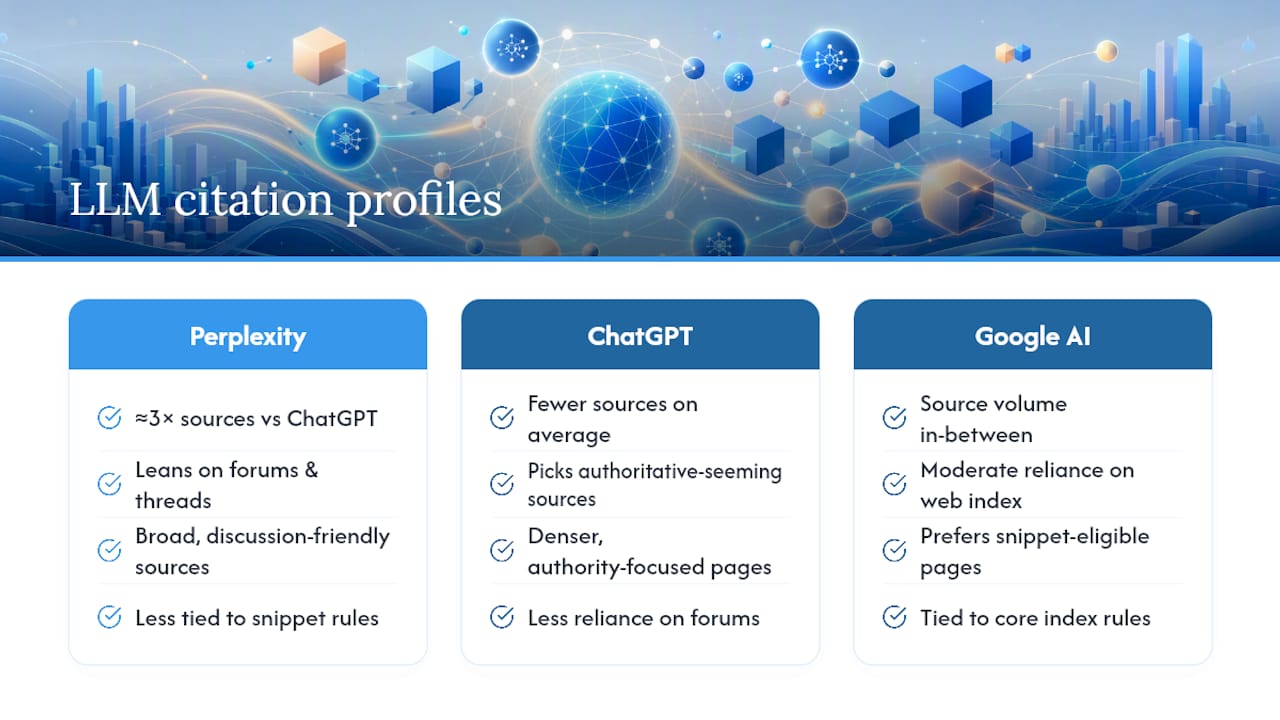
For a marketer, that means a one-size-fits-all approach underperforms. A brand chasing Perplexity visibility needs a presence on discussion-friendly platforms and forums. A brand chasing ChatGPT citations needs fewer, denser, more authoritative pages. Either way, the business case is direct: if a customer never sees your brand mentioned in the answer, they never click through, and you lose the sale before the funnel even starts.
What Technical Fixes Come Before Content Optimization?
No amount of well-written content earns a citation if the model’s retrieval system can’t reach the page in the first place. Technical readiness comes first, always.
Start with the basics that most teams assume are fine and rarely check. Google requires a page to be indexed and snippet-eligible before it can appear in AI Overviews, and the same logic extends to most other engines pulling from live web retrieval. If your robots.txt blocks a crawler, or a noindex meta tag sits on a page you actually want cited, none of the content work below matters.
- Audit robots.txt and meta robots tags on every priority page. Confirm you aren’t accidentally blocking the crawlers tied to the AI engines you care about, while deciding deliberately whether to allow training crawlers versus retrieval-only agents. That’s a real trade-off: allowing a training crawler feeds a model’s long-term knowledge base, while blocking it but allowing a retrieval agent still lets you show up in live, cited answers.
- Serve primary content in server-rendered HTML. Pages that depend on client-side JavaScript to render the main content risk being invisible to crawlers that don’t fully execute scripts. A technical SEO audit is the fastest way to find rendering gaps most teams don’t know they have.
- Check snippet eligibility. Confirm your meta descriptions and structured summaries aren’t set to
nosnippet, which silently disqualifies a page from AI Overviews regardless of content quality. - Fix page speed, specifically First Contentful Paint. Pages loading in under 0.4 seconds FCP averaged 6.7 ChatGPT citations, compared to 2.1 for pages slower than 1.13 seconds. That’s more than triple the citation rate tied to speed alone.
Pro Tip: Run your top twenty pages through a rendering test that disables JavaScript entirely. If the core answer disappears, so does your shot at getting cited, no matter how good the writing is underneath.
Site migrations are a common place this breaks silently. If you’ve recently replatformed or restructured URLs, a site migration SEO checklist will catch canonicalization and indexation issues before they cost you visibility for months.
How Do You Write Content That Gets Cited?
Structure is what separates a passage a model can quote from one it skips. The pattern that works consistently starts with a question-form heading, followed by a direct answer in the first 40 to 60 words, then a fuller 120 to 150 word passage that stands entirely on its own.
That last part matters more than most writers realize. Practitioner guidance recommends treating a page as a set of self-contained, liftable passages rather than one continuous argument. If a paragraph only makes sense after reading the three before it, a model’s retrieval system will likely skip it in favor of a competitor’s cleaner, standalone answer.
A few rules make this repeatable:
- Write one claim per sentence. Compound sentences that bundle two or three claims together are harder for a model to extract cleanly.
- Add named-source quotations and attributed statistics wherever you can. Research from Research from Princeton and related studies found this was among the highest-impact changes for boosting citations a writer can make to a page.
- Use FAQ and Article schema honestly, mirroring exactly what’s visible on the page rather than adding facts that only exist in the markup.
- Break long guides into modular sections, each answering one question fully, the same approach used when structuring a product page to convert around a single clear answer instead of scattered detail.
| Content element | What it does | Typical length |
|---|---|---|
| Lead answer | Direct response to the heading’s question | 40 to 60 words |
| Full capsule | Complete, standalone explanation with context | 120 to 150 words |
| Supporting table or list | Compresses comparative facts into scannable form | 3 to 7 rows or bullets |
Schema deserves a caution here. Evidence on structured data’s citation impact is mixed. One analysis found a modest lift, while a separate controlled test found no meaningful difference, and Google itself doesn’t require schema for AI Overviews eligibility. Treat it as hygiene, not a growth lever.
How Do External Signals Help You Get Cited?
A model’s willingness to cite you often comes down to whether your brand appears credible outside your own website, not just on it. Named mentions across independent, trustworthy sources function as a kind of corroboration layer that reinforces what your own content claims.
This is where a lot of teams underinvest, treating LLM SEO as a purely on-page exercise. It isn’t. Consider these outreach angles:
- Pitch relevant journalists and trade publications for quotes or data mentions tied to your area of expertise.
- Contribute to expert roundups where your name and company appear alongside other credible voices in your space.
- Keep a consistent, active presence on LinkedIn where industry discussion happens, since some engines weight discussion-heavy platforms more than others.
- Maintain accurate, complete review profiles on the platforms your industry actually uses, since inconsistent business details across the web can confuse entity recognition.
Pro Tip: Audit every place your company name appears online for consistency, the same founding year, the same address, the same spelling of your name. A model resolving “who is this company” from conflicting facts is less likely to trust any single source enough to cite it.
Author bylines matter more here than they used to. A consistent author page with a real name, a clear area of expertise, and matching biographical details across your site and third-party mentions makes it far easier for a model to treat your organization as a distinct, credible entity rather than an anonymous domain.
How Do You Measure LLM SEO Results?
You can’t optimize what you don’t track, and LLM SEO measurement looks nothing like traditional rank tracking. Rankings don’t exist in the same way. What you’re tracking instead is whether, and how, you get mentioned.
- Build a prompt panel. Assemble twenty to fifty real questions your customers would plausibly ask an AI engine, then run them consistently across ChatGPT, Perplexity, and Google AI Overviews on a fixed schedule, weekly or biweekly works well.
- Track three things per prompt run: whether your brand gets mentioned at all, whether that mention includes a link, and where in the answer it appears relative to competitors.
- Monitor server logs for AI-crawler activity. Rising hits from AI-specific bots on a given URL is an early, less-gamed signal that your page has entered a retrieval candidate pool, often visible well before citations show up in your prompt panel.
- Report on three core KPIs: citation rate (the percentage of panel prompts where you’re mentioned), share of voice against named competitors in those same prompts, and AI referral conversion rate measured through your analytics’ referral traffic segment.
Reporting this to stakeholders works best when you frame it the way you’d frame early-stage SEO: a leading indicator, not a revenue guarantee. Citation rate this month predicts referral traffic next quarter, the same lag structure that’s always existed between ranking improvements and organic traffic growth. Pair the prompt-panel data with server-log trends and you get a credible, defensible narrative rather than a single vanity number that’s easy to dismiss.
What Does a 90-Day LLM SEO Plan Look Like?
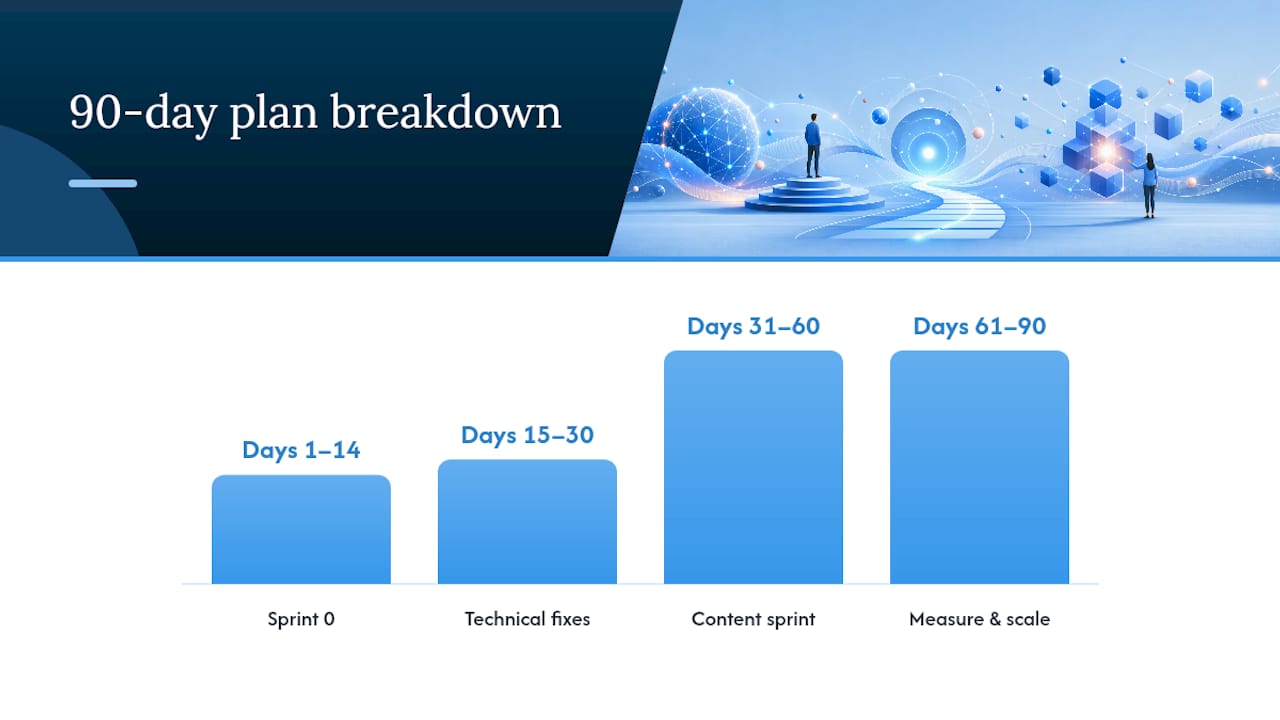
Sequencing matters here as much as the individual tactics. Fixing content before fixing crawlability wastes the effort; measuring before you’ve made changes wastes the baseline.
Sprint 0 (Days 1 to 14): Audit and setup
- Run a full crawlability and snippet-eligibility audit across your top 50 pages by traffic or revenue potential.
- Check page speed, specifically FCP, on the same page set and flag anything over one second.
- Build your prompt panel and run the first baseline test across all three major engines.
Days 15 to 30: Technical fixes
- Resolve robots.txt and meta robots issues found in the audit.
- Fix JavaScript-dependent rendering on any page where core content isn’t visible in raw HTML.
- Address the worst speed offenders first, prioritizing your highest-value pages.
Days 31 to 60: Content sprint
- Rewrite your top 15 to 20 pages using the answer-first capsule structure: a 40 to 60 word lead answer under a question-form heading, followed by a 120 to 150 word full passage.
- Add named-source quotations and attributed statistics to each rewritten page.
- Launch outreach: two to three expert roundup contributions and one press pitch tied to original data if you have any.
Days 61 to 90: Measure and scale
- Re-run the prompt panel and compare citation rate against your Day 14 baseline.
- Review server logs for AI-crawler trend changes on rewritten pages.
- Build a repeatable capsule-writing template and a distribution checklist so new content follows the same structure without a fresh audit every time.
By day 90 you should have a clear before-and-after on citation rate, not just a pile of rewritten pages.
Why Vertical Brands’ Client Results Back This Playbook
Proof matters more than theory when you’re asking a marketing leader to reprioritize a content roadmap.
That outcome didn’t come from a single tactic. It came from treating technical health, content structure, and measurement as one connected system rather than three separate projects. A technical SEO audit is often where this work should start, followed by content restructured around the capsule pattern, then a prompt-testing loop to confirm what’s actually moving. That’s the same 90-day sequence outlined above, just run by a team that’s done it repeatedly across different industries.
How Should Keyword Research Change for LLM SEO?
Keyword research doesn’t disappear under LLM SEO. It shifts from targeting search terms to targeting the actual questions behind them.
Traditional keyword tools show you what people type. What you need now is what people ask, which is often a longer, more conversational version of the same intent. Someone searching “best CRM small business” on Google might ask an AI engine, “What CRM should a 10-person company with a tight budget use?” Same intent, completely different phrasing, and your content needs to answer both forms.
Practical integration looks like this: take your existing keyword list and expand each core term into three to five natural-language questions a real person would ask a chatbot. Group those questions by the page or capsule that should answer them, then check whether your current content actually answers the question directly in the first sentence or two. Most existing SEO content buries the answer three paragraphs deep, which works for a human skimming but fails for a model looking for an immediately liftable passage.
Search volume still matters for prioritization, but treat it as a rough proxy rather than a precise target. A question with modest search volume but high commercial intent, the kind someone asks right before buying, is often worth more citation-focused attention than a high-volume, top-of-funnel query where dozens of competitors are already well optimized. This is where combining a partner strategy guide on LLM SEO with your own keyword data helps map informational gaps you might otherwise miss.
How Do Update Cycles Differ Across Large Language Models?
Not every model refreshes its knowledge or retrieval index on the same schedule, and that difference should shape how often you revisit your content.
Some engines rely heavily on live retrieval, pulling fresh web content at query time. Perplexity behaves this way, which is part of why it cites more sources per answer than ChatGPT: it’s actively pulling and synthesizing from the current web rather than leaning primarily on a fixed training snapshot. Content changes here can show up in citations within days or weeks.
Other systems lean more on training data baked in during a model’s build process, refreshed only at major version updates that happen on a slower, less predictable cadence. A change you make to a page today might not influence that model’s output until the next training cycle, which could be months away.
The practical implication is that your measurement cadence should match each engine’s update behavior rather than a single fixed schedule. Test retrieval-heavy engines like Perplexity weekly, since changes surface fast. Test training-dependent engines less frequently, since rapid week-to-week testing there just measures noise, not real change. Keep a simple log of when each engine’s underlying model last had a known major update, so a sudden citation shift can be checked against a real cause rather than assumed to be your content’s doing.
How Does Semantic Search Change What You Optimize For?
Semantic search means the system is matching meaning and intent, not just matching keywords. That has direct consequences for how you should be writing.
A page stuffed with exact-match keyword variations used to have a real advantage under older ranking systems. Under semantic and natural-language retrieval, that same page often reads as repetitive and thin, because the model is evaluating whether the passage actually answers the underlying question, not whether it contains a specific string of words.
Practically, this means writing for the full range of ways a question gets asked, rather than a single target phrase. If your keyword is “employee retention strategies,” a semantic-aware approach also covers the phrasing “how to stop good employees from quitting” and “why is turnover so high on my team,” because a natural-language query engine treats those as functionally the same question. Cluster your content planning around intent, not string matching.
This also rewards conversational, plain-language writing over stiff, formal keyword insertion. A capsule that reads naturally, the way you’d actually explain the answer to a colleague, tends to match a broader range of phrased questions than one written to hit a specific keyword density. Write the answer first, in language a person would actually use, and the semantic matching tends to follow.
What Ethical Standards Apply to LLM SEO?
Getting cited by an AI engine carries a different kind of responsibility than ranking on a search results page, because the model is often presenting your claim as fact without a visible link for the reader to verify it against.
That raises the bar on accuracy. A named statistic or quotation you add to boost citation odds needs to actually be accurate and sourced, not just plausible-sounding. Princeton’s citation-uplift research found real value in adding attributed statistics, but that value depends entirely on those statistics being genuine. Fabricating a data point to make a passage more quotable is a shortcut that damages trust the moment anyone checks it, and it damages your entity’s credibility with the models themselves over time as inconsistencies surface.
Schema deserves the same discipline. Structured data should mirror what’s visibly on the page, never claim facts that don’t appear in the actual content. Using FAQ schema to assert an answer your page doesn’t actually contain is a manipulation that can backfire when a model or a human cross-checks the source.
There’s also a quality floor worth holding regardless of citation strategy: content written purely to be liftable, at the expense of genuine usefulness, tends to read as hollow even when it technically follows the structural rules. The goal is content that’s genuinely useful to a person and happens to be structured well for extraction, not content engineered to game extraction while offering little real value underneath.
How Do You Analyze Competitors’ LLM SEO Approaches?
Understanding how competitors show up in AI answers tells you where the real gaps in your own content sit. Run your prompt panel with competitor names substituted for yours, or better, run the same customer-facing questions and note every brand that gets mentioned alongside or instead of you.
Look specifically at which of their pages appear to be getting cited, if the engine surfaces any link or attribution, and reverse-engineer the structure. Is it a comparison page? A data-backed report? An FAQ page answering the exact question you tested? That structural pattern tells you more than the competitor’s overall domain authority does, since citation is happening at the passage level, not the page level.
Pay attention to which engines favor which competitors, too. If a rival consistently shows up in Perplexity answers but rarely in ChatGPT’s, that’s a signal they’ve built a strong discussion-platform presence, forums, community threads, review sites, since Perplexity leans on those sources more heavily. If they show up more in ChatGPT, they’ve likely built fewer, denser, highly authoritative pages that fit ChatGPT’s more selective citation pattern.
Treat this as an ongoing check, not a one-time exercise. Competitive citation patterns shift as rivals publish new content and as models update their retrieval weighting. A quarterly re-run of your prompt panel with competitor tracking built in keeps this comparison current without turning into a full-time project.
How Does User Intent Shape LLM-Driven SEO Outcomes?
The question behind a prompt matters more in LLM SEO than in traditional search, because the model is trying to fully resolve intent in a single answer rather than offering ten links for the user to sort through themselves.
That means matching intent precisely carries a higher penalty for getting it wrong. If someone asks an AI engine a comparison question, “which of these two tools is better for a small team,” and your content only makes a soft, hedged case for your product without directly addressing the comparison, a model is less likely to lift your passage as the answer. Direct, decisive content that resolves the actual question asked outperforms content that talks around it.
Behavioral signals also feed back into this loop, even if indirectly. When users click through from an AI-generated citation and then quickly leave a page, or fail to find the specific answer the citation implied, that mismatch eventually shows up in engagement data that platforms and their retrieval systems can weigh over time. A citation that leads to a disappointing page is a broken promise, and broken promises erode the trust that led to the citation in the first place.
The practical takeaway: audit your top pages for intent match before you audit them for keyword coverage. Ask honestly whether the page delivers exactly what a specific question implies, in the order the reader would expect. A capsule that answers a slightly different question than the one being asked, even a closely related one, is a common and avoidable source of citation loss.
Prioritize Fundamentals Over Vendor Hype
The loudest advice in this space right now involves tactics that sound clever and deliver almost nothing. An llms.txt file, for instance, gets pitched by some vendors as a magic switch for AI visibility. No major engine has confirmed it meaningfully affects citation behavior. Spending a sprint on it instead of fixing actual crawlability is a wasted sprint.
Original research is worth the investment; distribution tactics for content that says nothing new are not. If your team has real data, survey results, usage patterns, internal benchmarks, publish it with named attribution. That’s what the citation research consistently rewards. If you don’t have original data, spend the budget on structural rewrites and technical fixes before you spend it on a shiny new tool promising AI visibility overnight.
For budgeting, treat this the way you’d treat any SEO investment with a lag before payoff: modest, consistent spend on fundamentals beats a large one-time spend on a trend that may not survive the next model update.
— Alex
How Vertical Brands Helps You Get Cited by AI
Fixing this yourself means juggling technical audits, content rewrites, and cross-engine testing on top of everything else already on your plate. Vertical Brands runs all three under one roof, so you’re not stitching together an SEO freelancer, a copywriter, and a developer to get one coherent result.
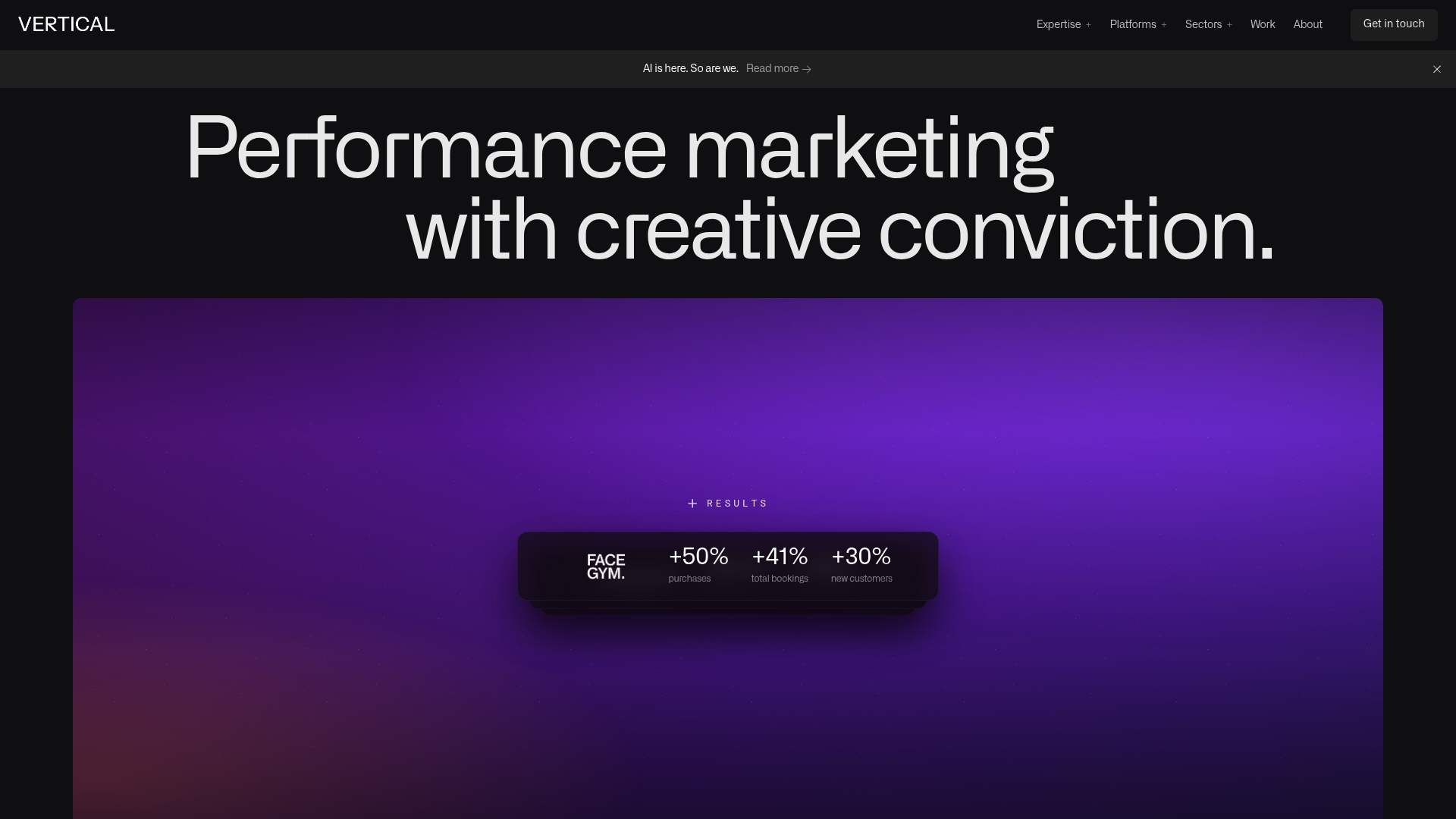
Technical audits identify the crawlability and rendering gaps blocking retrieval, the content team rebuilds priority pages into the answer-first capsule structure this playbook describes, and the measurement process runs the prompt-panel testing needed to prove it’s working before calling it done.
If your pages aren’t showing up in AI answers and you’re not sure whether that’s a technical problem, a content problem, or both, start with a conversation with Vertical Brands about what a focused audit would surface for your site.
Sources
- Harvard Business School Press: consumer GenAI usage stat (2025)
- Ross Simmonds: LLM SEO – unit of value is the claim (2026)
- HubSpot: How AI search behaves and what matters for visibility (2026)
- C-SEO Bench / GEO-related research (NeurIPS 2025)
FAQ
What Is LLM SEO?
LLM SEO is the practice of structuring and technically preparing content so large language models like ChatGPT and Perplexity can retrieve, understand, and cite it in AI-generated answers, rather than optimizing purely for search engine rankings.
What’s the Difference Between Traditional SEO and LLM SEO?
Traditional SEO optimizes whole pages to rank in a list of links, while LLM SEO optimizes individual passages and claims so a model can extract and cite them directly inside a synthesized answer, without the reader necessarily clicking through.
Which LLM Is Best to Optimize for First?
There’s no single best target since engines behave differently. Perplexity cites far more sources per answer and favors discussion platforms, while ChatGPT is more selective, so prioritize based on where your audience already searches before splitting effort across both.
Is SEO Going Away Because of AI?
No. Classic SEO fundamentals like crawlability, indexation, and page speed remain prerequisites for AI citation, since most engines still rely on the same underlying web infrastructure to retrieve content in the first place.
How Long Does It Take to See LLM SEO Results?
Most teams see measurable shifts in citation rate within 60 to 90 days when technical fixes and content rewrites are paired with regular prompt-panel testing, though retrieval-heavy engines like Perplexity tend to reflect changes faster than training-dependent models.
Recommended

Other posts






























































Stay ahead with better decisions.
Get business insights today.
