The Right Way to Build Abandoned Cart Emails That Recover Sales
The best abandoned cart emails follow a short two or three message sequence: an early reminder sent within one to four hours, a follow up with social proof or an answer to a likely objection, and an optional final nudge with a conditional incentive. Skip the discount in message one, watch for integration sync delays before that first send fires, and measure success by revenue per recipient rather than opens alone. Done well, this structure recovers a mid single digit percentage of abandoned carts without training customers to wait for a coupon.
TL;DR:
- Sending the first abandoned cart email within 1 to 4 hours increases the chance of recovery, but integration delays can cause missed opportunities.
- Personalization should reference the specific cart contents and include trust signals near the CTA to reduce hesitation.
- A three-message sequence typically results in higher recoveries than just two, with the final incentive email used only for high-margin or high-value carts.
- Technical setup, especially correct trigger logic, sync buffers, and tracking accuracy, is crucial for flow effectiveness and often overlooked.
- Focusing on improving technical foundations and segmentation yields more revenue than merely optimizing copy or design elements.
Table of Contents
- What Makes an Abandoned Cart Email Actually Work
- How Many Emails Should You Send, and When?
- Subject Lines, Hooks, and Templates You Can Copy Today
- Segmentation Tactics That Push Recovery Rates Higher
- Getting Discount Strategy Right Without Wrecking Margin
- The Technical Setup That Keeps Your Flow Reliable
- What to Measure and Which Tests Actually Move Revenue
- The Agency View: Why Most Flows Underperform on Fixable Problems
- Let Vertical Brands Fix What’s Actually Broken in Your Flow
- Where These Recommendations Come From
- Sources
What Makes an Abandoned Cart Email Actually Work
An abandoned cart email flow is a triggered sequence of messages sent to shoppers who added items to their cart but didn’t complete checkout. That’s the standard industry term for the automation, and it’s worth knowing because “abandoned cart emails” describes the messages themselves, while the “flow” or “sequence” describes the timed system behind them. Both matter, and marketers who only think about the email copy without engineering the sequence logic leave revenue on the table.
Every high-performing message in the sequence shares five structural elements, regardless of what industry you sell into.
The dynamic product block. This is the non-negotiable core of the email. It needs the product image, the exact name and variant (size, color, style) the shopper selected, the price they saw, and a direct “Return to your cart” link that drops them back into checkout with items already loaded. Static, generic product images that don’t match what the shopper actually chose kill trust immediately. Real send collections consistently show that showing the exact cart contents outperforms generic “you left something behind” messaging.

One CTA, not three. Every extra button is a decision the shopper has to make, and indecision is exactly what caused the abandonment in the first place. Put a single, high-contrast CTA directly below the product block, then repeat that same CTA (same text, same link) once more near the bottom for mobile scrollers. Don’t add a second competing action like “browse more” or “read our blog.”
Personalization beyond the first name. First-name personalization is table stakes. The lift comes from referencing the specific cart: “Your size 9 sneakers are still available” beats “Hey Sarah, you left something in your cart.” If you have purchase history, a line referencing a past order category adds a second layer without overcomplicating the copy.
Trust signals placed near the friction point. Shoppers abandon carts over shipping costs, return policy uncertainty, and payment security concerns more than almost anything else. Address that directly: a one-line returns policy note, an estimated delivery window, and a secure checkout badge near the CTA reduce hesitation better than any amount of persuasive copywriting.
Mobile-first formatting. Most cart recovery emails get opened on a phone first. That means:
- Single-column layout with the product block front and center
- CTA buttons at least 44 pixels tall for easy tapping
- Image file sizes optimized so the email loads before someone swipes away
- Subject lines and preview text that don’t truncate awkwardly at 30 to 40 characters
Pro Tip: Test your product block on a three-year-old Android phone with a slow connection before you launch. If the image doesn’t load in under two seconds, half your mobile opens will bounce before they ever see the CTA.
How Many Emails Should You Send, and When?
Two messages work for lean teams and lower-complexity catalogs. Three messages capture more of the recovery curve, particularly for higher-cost items where shoppers need more convincing. Klaviyo’s own guidance recommends a 2 to 3 message pattern, and Shopify’s best-practice framework lands on the same structure: an early reminder, a follow-up with social proof, and a final nudge.
Here’s the sequencing that tends to perform best:
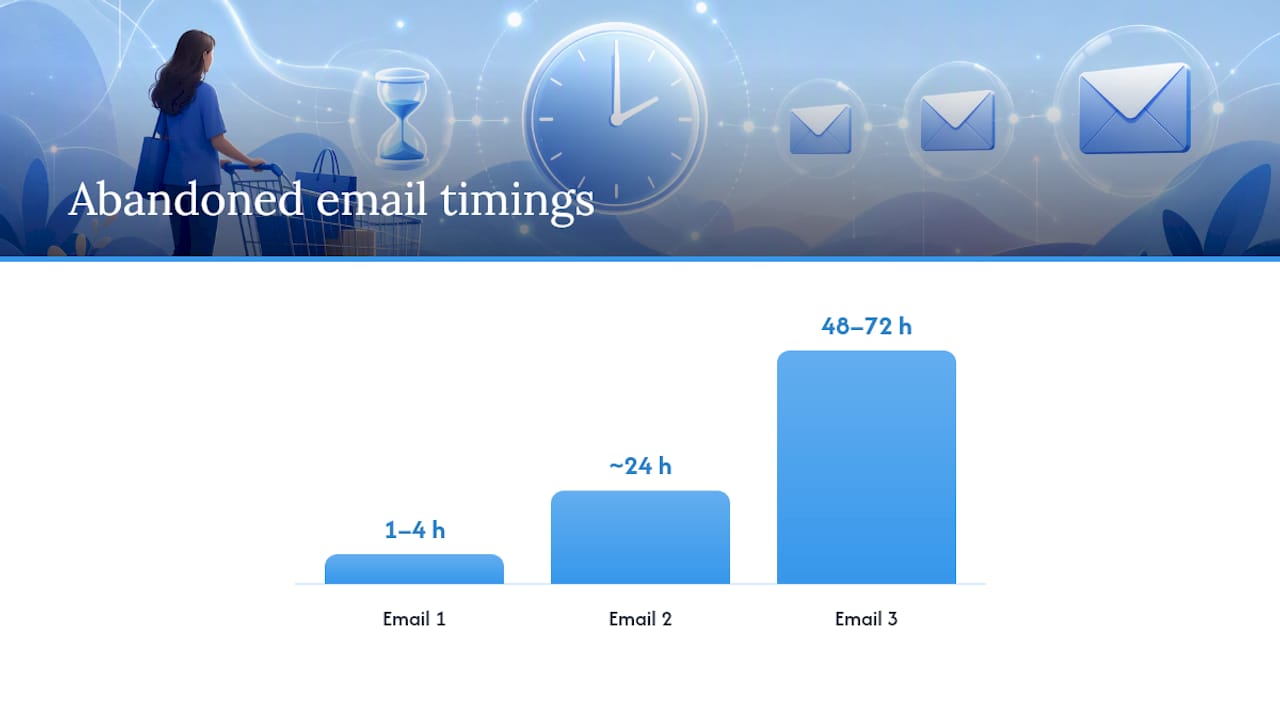
- Email 1, sent 1 to 4 hours after abandonment. This is the plain reminder. No discount, no urgency language, just the cart and a clear path back. Speed matters here because purchase intent decays fast, and collections of real sends show the earliest messages in a fast window consistently outperform anything sent a day later.
- Email 2, sent around 24 hours later. This is where you handle objections. Add a customer review, a trust badge, or a short line addressing shipping cost or delivery time. Still no discount for most segments.
- Email 3, sent 48 to 72 hours after abandonment. This is your last, optional touch. If you’re going to introduce any incentive, this is usually the message where it belongs, and only for segments where margin allows it.
Your trigger choice changes what data populates that first email. “Added to Cart” fires the moment a shopper puts an item in, which catches more volume but includes people who were never close to buying. “Started Checkout” fires only once someone enters checkout with contact details, which produces a smaller but far more qualified audience. Most established brands run both: an Added to Cart flow with a longer delay and softer tone, and a Started Checkout flow that moves faster and pushes harder toward completion.
The technical caveat that trips up more teams than any creative mistake: integration sync delays. If your ecommerce platform and your email service provider sync hourly rather than in real time, a trigger that fires “instantly” can actually fire before the purchase event has synced, meaning you email someone who already bought. Klaviyo’s own documentation recommends a minimum buffer of about 1 hour and 15 minutes when integrations run on hourly syncs, specifically to give the purchase event time to catch up before the first cart email goes out.
Cart recovery flows are among the highest-earning automations in ecommerce, and well-built sequences commonly recover between 3% and 11% of abandoned carts. That range depends heavily on your industry, average order value, and how tight your technical setup is, which is exactly why the sync buffer above matters more than most marketers assume.
SMS earns a place in the sequence once you have explicit consent and a genuine reason to add it, typically as a same-day nudge that runs alongside (not instead of) the email flow for higher cart values.
Subject Lines, Hooks, and Templates You Can Copy Today
The subject line’s only job is to get the email opened before the shopper forgets why they were on your site. Four formulas cover almost every situation you’ll face.
Personal plus product. Name the item, skip the cleverness. “Your [Product Name] is still in your cart” beats a generic “Did you forget something?” because it answers the shopper’s first question before they even open the email.
Urgency, used sparingly. “Only 3 left in your size” or “Your cart expires tonight” works when it’s true. Fabricated urgency (fake countdown timers on items that never actually sell out) erodes trust fast and shows up in unsubscribe rates within a few sends.
Curiosity. “We noticed you left something behind” or “One thing before you go” works well as a second-message hook once the shopper already knows the reminder is coming.
Social proof. “Join 12,000 happy customers who bought this” or referencing a specific review works best in message two, once you’ve already reminded them what’s in the cart and now need to answer “is this worth it?”
Here are three short templates, one per stage of the sequence:
Email 1 (reminder, 1 to 4 hours):
Subject: Still thinking it over? [Product image, name, price, variant] Your cart is saved and ready. Return to Cart. No pressure, just making sure it’s still here when you’re ready.
Email 2 (objection handler, ~24 hours):
Subject: Here’s what other customers are saying [Product block] plus a one-line review quote and a trust signal: free returns within 30 days, delivery in 3 to 5 business days. Complete Your Order.
Email 3 (final nudge, 48 to 72 hours):
Subject: Last chance: your cart expires soon [Product block] plus, for eligible segments only, a time-limited incentive. Claim Your Item.
Preview text should extend the subject line’s promise rather than repeat it. If your subject line is “Still thinking it over?”, the preview text can say “Your [product name] is waiting, plus free shipping on orders over $50” so the reader gets two pieces of information in the inbox preview before they even tap open. Keep preview text under about 90 characters so it doesn’t cut off on mobile inboxes, which is where most of these opens happen.
The strongest performing hooks aren’t generic reminders at all. They address the actual reason a specific shopper likely hesitated, whether that’s price, shipping cost, or simple distraction. Persuasive messaging that acknowledges the real point of friction, a principle covered well in format-3’s analysis of attention and messaging friction, consistently beats copy-pasted templates that ignore why the shopper actually left.
Segmentation Tactics That Push Recovery Rates Higher
Treating every abandoned cart the same way leaves money on the table. Cart value is the simplest and most reliable segmentation lever available, and it should change how aggressively you pursue the recovery.
- High-value carts deserve a higher-touch approach. Segmenting these shoppers into a slower, more personal flow (sometimes including a manual follow-up or a branded concierge-style outreach) preserves margin while capturing revenue that a blanket discount email would otherwise erode.
- Low-value or single-item carts can move through a faster, fully automated sequence since the cost of a discount matters less relative to the overall order.
- Past purchasers with product affinity respond better to copy that references their history: “Since you loved your last order, here’s what’s still in your cart” outperforms a cold reminder.
- First-time, anonymous carts (no account, no purchase history) need different framing than returning customer carts. A first-time buyer often needs reassurance about your brand’s credibility; a returning customer needs a nudge, not a pitch.
- Loyalty members should skip generic incentive language entirely if they already get standing perks, since offering them a “first-time buyer” discount undermines the loyalty program’s value.
Seasonal and occasion-based segmentation adds another layer worth testing. A cart abandoned during a holiday shopping window behaves differently than one abandoned in a slow month; shipping deadline anxiety, for instance, becomes a much stronger trigger for urgency messaging in the two weeks before major gift-giving holidays.
None of this works without proper consent. Every abandoned cart email needs a clear, functioning unsubscribe link, and you should only be messaging shoppers who gave you a legitimate basis to contact them, whether through account creation, checkout entry, or an explicit opt-in at some earlier point. Segmentation sophistication never substitutes for consent hygiene.
Getting Discount Strategy Right Without Wrecking Margin
Holding back the discount in your first message is one of the most consistently recommended practices across cart recovery guidance, and for good reason. Lead with a discount immediately and you teach shoppers to abandon on purpose, knowing a coupon is coming if they just wait a few hours. That habit is expensive to unwind once it forms across your customer base.
- Reserve incentives for message two or three, and only for segments where the math supports it.
- Free shipping tends to outperform percentage-off discounts because it addresses the single most common abandonment reason (unexpected shipping cost) without discounting the product itself.
- Unique, single-use discount codes generated per recipient prevent the code from leaking onto coupon aggregator sites, which is the fastest way to lose margin control entirely.
- Time-limited offers (“expires in 24 hours”) tend to convert better than open-ended ones, but only if the deadline is real and consistently enforced.
Good candidates for an incentive include low cart value orders where the discount cost is small relative to the sale, first-time anonymous shoppers who need a reason to trust a new brand, and high-shipping-cost categories where free shipping removes the actual objection rather than masking it with an unrelated discount.
Pro Tip: Before you build a discount into email three, calculate what percentage of your natural recovery already happens without one. If your no-discount reminder and objection-handler emails are already recovering most of what they’re going to recover, a blanket final discount might just be giving away margin on sales that were happening anyway.
The Technical Setup That Keeps Your Flow Reliable
Getting the trigger logic wrong is the single most common reason cart recovery flows underperform, often worse than any subject line or design mistake.
- Choose your trigger deliberately. Started Checkout catches shoppers who entered contact and shipping details, which produces a smaller but higher-intent list. Added to Cart catches a broader group earlier, useful for softer, longer-delay messaging. Running both, tuned differently, usually beats picking one.
- Exit on Placed Order, every time, before every send. Your flow needs to re-check purchase status immediately before each message fires, not just once at the start. A shopper who buys between email one and email two should never receive email two.
- Build in a sync delay buffer. If your platform and ESP sync hourly rather than instantly, a “1 hour” trigger might fire before the purchase event has actually registered. A minimum buffer, often cited around 1 hour and 15 minutes for hourly-sync setups, gives the purchase data time to catch up before the flow checks its exit condition.
- Investigate missing abandoners with server-side tracking. If a meaningful share of abandoners never enter your flow at all, the likely culprit is ad blockers or browser privacy settings interfering with client-side pixel tracking. Server-side event capture closes that gap and recovers volume that pure client-side tracking simply never sees.
- Protect deliverability with basic hygiene. Keep your sending list clean, configure DKIM and SPF properly so cart emails don’t land in spam, and make sure your unsubscribe link and physical mailing address (required under CAN-SPAM) appear in every send.
Sync gaps between your ecommerce platform and your ESP are a far more common failure point than most teams realize, and fixing that plumbing often lifts recoverable volume more than any creative or subject-line change you could make on top of it.
What to Measure and Which Tests Actually Move Revenue
Three numbers matter more than everything else combined: recovery rate (orders placed per recipient who received the flow), revenue per recipient (total revenue attributed to the flow divided by how many people received it), and the conversion rate from email click to completed purchase. Opens and clicks are useful diagnostic signals, but they don’t pay the bills, and teams that report success on open rate alone are measuring the wrong thing.
Attribution needs a consistent rule, usually a fixed lookback window (commonly 5 to 7 days from send) so you’re not double-counting a sale that would have happened anyway against both your cart flow and a separate retargeting campaign.
| Test priority | What to change | Why it matters |
|---|---|---|
| 1 | First-send delay (1 hour vs 4 hours) | Directly affects how many shoppers still have purchase intent when the email lands |
| 2 | Subject line formula | Cheapest test to run, fastest to read results, highest volume of learning per week |
| 3 | Offer placement (email 2 vs email 3) | Determines whether you’re giving away margin unnecessarily |
| 4 | Product block design | Affects click-through directly since it’s the primary visual anchor in the email |
Benchmarking data suggests cart flows can post opens near 50% with strong revenue per recipient compared to other automated flows, though your own baseline matters more than any external number. Judge a change as meaningful only once it moves revenue per recipient by a margin that clears your normal week-to-week variance, not just a single send that happened to land on payday.
The Agency View: Why Most Flows Underperform on Fixable Problems
Most cart recovery flows don’t fail because the copy is weak. They fail because nobody checked whether the trigger was firing correctly, whether the sync delay was set properly, or whether half the abandoners were even being tracked in the first place. That’s the uncomfortable truth conventional advice skips past: teams spend weeks perfecting subject lines on a flow that’s silently missing 30% of its intended audience due to a tracking gap nobody diagnosed.
When Vertical Brands worked with FACEGYM, the fix wasn’t a creative overhaul first. It started with an audit of the tracking setup, a patch to close gaps in event delivery, and only then a segmented flow built around cart value and purchase history, paired with ongoing creative testing.
Hiring outside help makes sense once your internal team is confident in the creative but uncertain about the technical layer, or once testing has stalled because nobody has bandwidth to run structured experiments alongside daily campaign work. A first engagement typically runs about 30 days: an audit of trigger logic and tracking accuracy, quick fixes to anything obviously broken, then a phased rollout of segmentation and creative testing once the foundation is solid.
Vertical Brands built its reputation on exactly that sequence: fix what’s broken structurally before optimizing what’s already visible. Clarity about what’s actually happening in the flow, not just what the dashboard reports, tends to matter more than any single template swap.
— Alex
Let Vertical Brands Fix What’s Actually Broken in Your Flow
Most teams optimize the parts of their cart flow they can see: subject lines, discount timing, template design. The revenue usually hiding is in the parts they can’t see: sync delays silently suppressing sends, tracking gaps that never register a third of your abandoners, or segmentation logic that treats a $40 cart the same as a $400 one. Vertical Brands starts with the plumbing, not the copy, because a beautifully written email that fires two hours late or never fires at all doesn’t recover anything.
The engagement path is straightforward: an audit of your current trigger setup and tracking accuracy, a set of quick fixes to close the gaps that are actively losing you revenue, then a phased rollout of segmented flows, creative testing, and measurement built to your catalog and cart values. If your cart recovery numbers have plateaued and you’re not sure whether the problem is creative or technical, Vertical Brands can run that audit and show you exactly where the leak is before recommending a single line of new copy.
Where These Recommendations Come From
The timing windows, trigger logic, and template guidance in this piece draw on a combination of platform documentation, published benchmarks, and real send analysis rather than any single source.
- Klaviyo’s abandoned cart flow guide for trigger setup, sync delay buffers, and sequence length recommendations
- Shopify’s abandoned cart email guide for the three-email pattern, benchmark context, and discount timing advice
- BadRep’s collection of real abandoned cart sends for practical subject-line and product-block examples
- format-3’s analysis of messaging and attention friction for deeper reading on persuasive hook design
Sources
- How to create an abandoned cart flow | Klaviyo Help Center
- Abandoned Cart Emails: Best Practices & Examples (2026)
- Abandoned Cart Email Examples: 200+ Real Sends | BadRep — BadRep Emails
Recommended

Other posts












































Stay ahead with better decisions.
Get business insights today.
