Klaviyo Partner Agency UK: How to Choose the Right Growth Partner
The strongest Klaviyo pitch isn’t the one with the biggest platform claims. It’s the one that shows how strategy, delivery and commercial priorities work together. Choosing a Klaviyo partner agency UK businesses can rely on takes more than checking platform expertise. You need to know who will own t...

The strongest Klaviyo pitch isn’t the one with the biggest platform claims. It’s the one that shows how strategy, delivery and commercial priorities work together. Choosing a Klaviyo partner agency UK businesses can rely on takes more than checking platform expertise. You need to know who will own the work, how it connects to your goals and what success will look like.
Agency claims can be difficult to compare like for like. When strategy, creative and platform management sit with different owners, gaps can appear quickly. Reports might list campaigns and automated flows yet leave the central question unanswered: what did the work change for the business? A partner’s ability to connect these elements matters more than a platform claim alone.
This guide gives you a practical framework for assessing an agency’s capability and fit. You’ll learn what to ask about scope, collaboration, reporting and accountability, so you can compare partners on the same terms. It also shows how to assess whether an agency can connect CRM strategy with wider growth priorities, helping you build a focused shortlist and choose a useful next step.
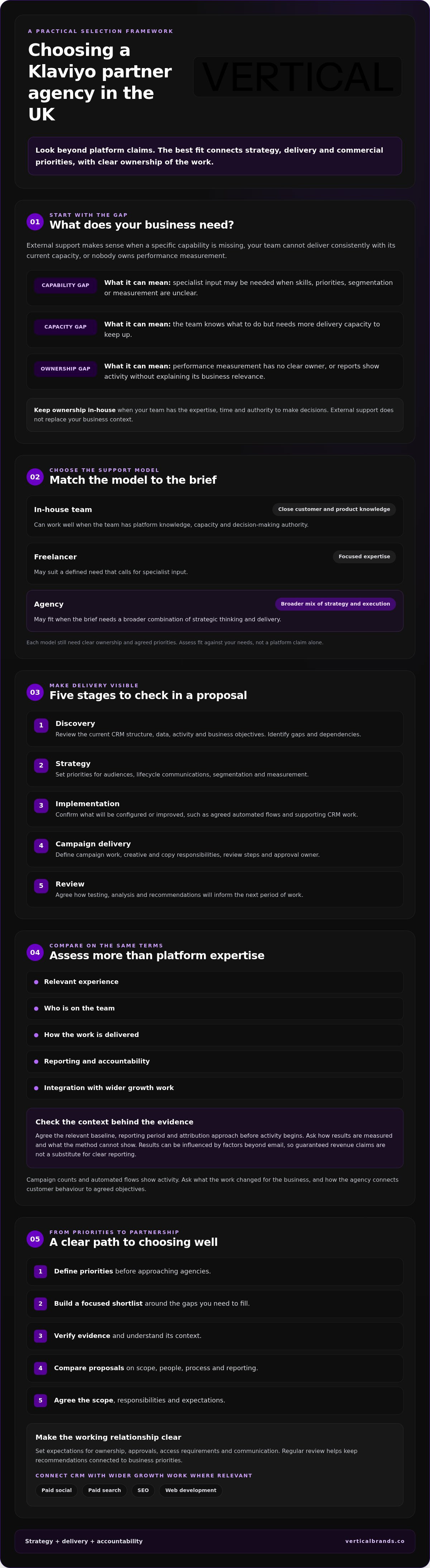
• Choose between in-house, freelance and agency support by identifying where capability, capacity or accountability is missing.
• Set clear expectations for each stage of delivery, including ownership, approvals, access requirements and communication.
• Assess a Klaviyo partner agency UK by comparing relevant experience, team, process, reporting and integration, then check the context behind its evidence.
• Define your priorities before approaching agencies, then shortlist, verify, compare proposals and agree the scope.
• A strong partnership depends on clear ownership and regular review. CRM work can also align with paid social, paid search, SEO and web development where relevant.
Why choose a UK Klaviyo agency over in-house?
External support makes commercial sense when your business is missing a specific capability, your team can’t deliver consistently with its current capacity, or nobody owns performance measurement. These are different problems. A skills gap may call for specialist input; a resourcing gap may need extra delivery capacity. If your team already has the expertise and time, keeping ownership in-house could be the better choice.
The right model depends on the brief. An in-house team brings close knowledge of your products and customers. A freelancer can offer focused expertise for a defined need, while an agency may bring a broader mix of strategy and execution. Each model still needs clear ownership and agreed priorities. Assess a Klaviyo partner agency UK businesses are considering on how well it fits those needs, not on a platform claim alone.
For a useful overview of the channel, see this guide to email marketing. To explore practical ways to identify an agency, watch this video:
When does external Klaviyo support make commercial sense?
Look for operational signs: campaigns are repeatedly delayed, automated flows need attention, the team lacks time to test improvements, or reports show activity without explaining its business relevance. Before bringing in support, identify the cause. If the team knows what to do but can’t keep up, capacity is the issue. If priorities, segmentation or measurement are unclear, the gap is more likely strategic or technical.
In-house ownership can work well when a capable team has the time, platform knowledge and authority to make decisions. External support is not a substitute for business context. Agree who will share customer insight, approve communications and make decisions about priorities.
What should a Klaviyo partner improve beyond campaign delivery?
Strong delivery connects customer data and lifecycle communications to business objectives. That could mean planning relevant communications around customer behaviour, then implementing and reviewing them against agreed measures. Strategy sets the audience, purpose and success criteria. Implementation puts the activity in place; ongoing optimisation tests whether it is working as intended.
Don’t assess the work by send volume alone. Agree how performance will be measured before activity begins, including the relevant baseline, reporting period and attribution approach. Review engagement and customer behaviour alongside commercial indicators that fit the brief. Results can be influenced by factors beyond email, so reporting should explain the method and its limitations rather than promise guaranteed revenue. Clear responsibilities make that review more useful and keep recommendations connected to actions the business can take.
What should a capable Klaviyo partner agency actually deliver?
A capable agency should make the work visible before it begins. The scope needs to show what happens at each stage, who owns it and how progress will be assessed. That matters in a competitive market: Harvard Business School’s discussion of the scale of the ecommerce threat provides context for why customer communication needs considered planning, not just more campaign activity.
Use five stages to check whether a proposal is specific enough:
Discovery
Review the current CRM structure, data, activity and business objectives. Identify gaps and dependencies.
Strategy
Set priorities for audiences, lifecycle communications, segmentation and measurement.
Implementation
Confirm what will be configured or improved, such as agreed automated flows and supporting CRM work.
Campaign delivery
Define the planned campaign work, creative and copy responsibilities, review steps and approval owner.
Review
Agree how testing, analysis and recommendations will inform the next period of work.
A proposal should distinguish confirmed capability from work that can only be scoped after discovery. It should also document access requirements, dependencies on your team, approval steps and communication cadence. Ask agencies how often they review performance and report findings, and how frequently they test. A testing plan should identify what is being tested, why it matters and how the result will inform a decision. Compare the method and cadence, not just a promise to “optimise”.
Which strategic and technical capabilities belong in the brief?
State what you need the agency to assess: CRM structure, customer data, business objectives and existing email activity. Then specify whether the scope includes strategic planning, segmentation, automated flows, campaigns, implementation or ongoing management. Don’t assume every agency proposal covers all of these areas. Ask what is included, what requires further discovery and what remains your team’s responsibility.
How should reporting and collaboration work?
Name the owners for analysis, recommendations, implementation and internal approvals. Agree the review cadence and how findings will become prioritised actions, with a clear decision-maker for each. Document reporting definitions before comparing periods or channels. For example, confirm the attribution approach and the timeframe used to assess an outcome. Keep those definitions consistent, or apparent changes may reflect a reporting difference rather than a change in performance.
Before signing, check that measures connect activity to agreed business priorities and that the limits of attribution are clear. If the work needs to coordinate with other growth activity, clarify how that collaboration fits the scope. Explore Klaviyo email marketing and CRM management as part of defining the support your brief requires.
How can you compare Klaviyo agencies and verify their evidence?
Compare proposals against the same brief, not against each agency’s preferred pitch. A Klaviyo partner agency UK shortlist should make it easy to see what each team can demonstrate, what it proposes to deliver and where its evidence comes from. Score each area against your priorities, then investigate gaps rather than filling them with assumptions.
| Area | What to verify |
|---|---|
| Relevant experience | Examples from businesses with comparable needs, customer journeys or CRM complexity. |
| Scope | Included work, exclusions, dependencies and how proposed activity maps to your brief. |
| Team | Who leads the relationship, who does the day-to-day work and what each person is responsible for. |
| Process | How discovery, approvals, testing, learning and changes to priorities are handled. |
| Reporting | Measures, definitions, attribution assumptions and how findings shape recommendations. |
| Integration | How Klaviyo work coordinates with other relevant channels or internal teams. |
Use the same questions for every agency. Ask who will lead your account and complete the practical work. Request an example of analysis that changed a client’s email or CRM priorities. Then ask how the agency identifies underperforming activity, what it learns from testing and how those learnings affect the next decision. Look for a clear explanation, not a polished claim without a process behind it.
Which evidence deserves closer scrutiny?
A directory listing, testimonial or case study is a starting point, not proof of fit. Check any directory status directly and confirm it is current. Ask for examples relevant to your requirements, with enough context to understand the work. The strongest evidence is specific about the agency’s contribution and measurement method, while respecting any client confidentiality.
How should you assess results without relying on headline figures?
For each reported outcome, ask what the objective was, the timeframe, the starting baseline and the work included. Clarify how results were attributed, which other factors may have contributed and what the agency can substantiate. An outcome credited to email may rely on a particular attribution approach, so check how that method treats other customer touchpoints.
Compare the quality of the reasoning and the transparency of the explanation, not isolated percentages. Strong evidence shows how the agency moved from a business problem to an action, then assessed what happened. If the explanation leaves you unclear about scope or measurement, ask for clarification before treating the claim as relevant to your decision.
How do you choose the right UK Klaviyo agency for your business?
Start with your requirements, not a list of agency names. Define the business problem, what needs to change and what your team can own. Then use the same sequence for each potential Klaviyo partner agency UK: shortlist, verify relevant evidence, compare proposals against your priorities and agree the scope before work begins.
Fit is operational as well as technical. Consider who needs to work with the agency, how quickly your team can make decisions and whether you have people available to provide customer knowledge, content or approvals. A strong proposal can still stall if those internal resources aren’t available. Be realistic about the time and decision-making your business can commit.
What should your agency brief include?
Give every agency the same working brief. Include your business objectives, current platform context, audience needs and known constraints. List required services separately from desirable support, so proposals don’t blur essential work with optional additions. Name stakeholders, approval owners and existing in-house capabilities. If migration is part of the project, consult The Direct Guide to Klaviyo Migration for High-Growth Brands to identify migration-specific planning questions before finalising the brief.
Prioritise requirements before agency conversations begin. For example, decide whether your immediate need is strategy, implementation, campaign delivery or more considered audience segmentation. If segmentation is central, review Advanced CRM Segmentation: Moving Beyond Basic Email Lists to help clarify what your business needs from its data and targeting approach.
How can you compare proposals without being distracted by presentation?
Use consistent criteria for each proposal. Score how well it addresses your objectives, evidence of relevant experience, clarity of deliverables, team responsibilities, reporting and assumptions. A polished deck shouldn’t outweigh gaps in ownership or an unclear explanation of how the work will be measured. Ask each agency to distinguish confirmed scope from recommendations that depend on discovery.
Check the practical details. Who will do the work? What must your team provide, and when? How will recommendations be approved and performance reviewed? Compare how agencies explain these points, not just the length of their proposals. Your priorities are the benchmark, so weight criteria according to what matters most to the business.
Before agreeing terms, confirm the scope, responsibilities, access needs, approval process, communication expectations and reporting definitions in writing. That creates a shared basis for delivery and helps surface mismatched expectations early. If you’re ready to discuss how your requirements connect to Klaviyo and CRM work, explore Klaviyo and CRM support.
What does a strong Klaviyo agency partnership look like in practice?
A strong partnership turns the agreed scope into a working rhythm. Before delivery begins, both sides know who owns decisions, implementation, approvals and reporting. The agency brings recommendations and explains the reasoning behind them. Your team supplies business context, responds to decisions and confirms priorities. Clear ownership and regular reviews keep work moving without making performance promises no agency can guarantee.
Onboarding should establish the practical foundations: required account access, current activity, responsibilities, priorities, dependencies and reporting expectations. Agree how often you’ll review progress and how urgent decisions will be handled. Reviews should end with clear actions, owners and next steps, not simply a recap of completed tasks. For broader CRM planning, use B2C CRM Implementation Services: A Practical Guide for 2026 as a companion resource.
How can Klaviyo work connect with wider growth priorities?
CRM activity doesn’t operate in isolation. Where it fits the brief, customer insights and campaign plans can be coordinated with paid social, paid search, SEO and website design and development. For example, teams can align campaign messaging with relevant acquisition activity or discuss how website changes affect the customer journey. The scope should identify where coordination is needed, who leads it and how decisions are shared. Without those agreements, “integrated” can remain a promise rather than a working process.
When is Vertical Brands worth considering as your Klaviyo partner?
Vertical Brands may be worth considering if your brief calls for Klaviyo email marketing and CRM management, with a need to connect that work to wider growth priorities. Its services also include paid social, paid search, SEO, website design and development, and growth advisory. That breadth may be relevant when the work extends beyond email execution. It won’t be the right fit for every business, so assess its proposed scope, evidence, ownership and approach against your requirements, just as you would with any potential partner.
Before taking the next step, check that your priorities are clear and that the proposed responsibilities and measures match the brief. Then discuss your Klaviyo and growth requirements with Vertical Brands. A focused conversation can establish whether the work and ways of working are a suitable match. The decision should rest on fit, not on the agency label alone.
Choose a growth partner with clear purpose
The right Klaviyo partner agency UK businesses choose should fit the work they need, not simply make the strongest claims. Compare proposals against your priorities. Check relevant evidence, define ownership and agree how reporting will connect activity to business measures. A clear scope and a workable review process help turn recommendations into decisions your team can act on.
Start by identifying what’s missing: Klaviyo expertise, delivery capacity, CRM ownership or coordination with other growth activity. Vertical Brands specialises in Klaviyo email marketing and CRM management, with wider services including paid social, paid search, SEO, web development and growth advisory. That combination may suit briefs where CRM needs to connect with other channels, but fit depends on your requirements and the agreed scope.
Your priorities and internal capacity are the foundation for a useful agency conversation. If you’ve defined what you need and want to explore whether the work is a match, discuss your Klaviyo and growth requirements with Vertical Brands. A considered shortlist puts you in a stronger position to choose a partner with confidence and move forward with purpose.
Frequently Asked Questions
What does a Klaviyo partner agency do?
A Klaviyo agency helps businesses plan and deliver email marketing and CRM activity using the platform. Depending on the agreed scope, this may include reviewing account structure, developing lifecycle strategy, setting up automated flows, managing campaigns, segmenting audiences and reporting on performance. Clarify what the team will own before work begins. The term “partner agency” alone doesn’t confirm a specific service level or prove official directory status.
How do I choose a Klaviyo agency in the UK?
Choose a Klaviyo partner agency UK businesses can assess against a clear brief, not just a strong pitch. Define your objectives, current platform context, audience needs and internal capacity first. Then compare agencies on relevant experience, deliverables, team responsibilities, process and reporting. Ask for evidence with context, including the work completed and how results were measured. Agree scope, approvals, access and communication expectations before appointing an agency.
Is a Klaviyo partner directory listing enough to verify an agency?
No. A directory listing can help you check an agency’s stated relationship with Klaviyo, but it doesn’t establish whether the team suits your requirements or can deliver the proposed work. Confirm that any listing is current, then assess relevant experience, named account responsibilities, scope and reporting methods. Ask for examples that show the agency’s contribution and how outcomes were assessed. Treat directory status as one piece of evidence, not a complete evaluation.
What should a Klaviyo agency proposal include?
A useful proposal should connect your objectives to defined deliverables, responsibilities and measures. It should set out the proposed discovery, strategy, implementation, campaign work and review process, where these are included in scope. Check that it names account ownership, approval steps, access requirements, dependencies on your team and communication cadence. It should also explain reporting definitions and testing plans, and distinguish confirmed work from recommendations that need discovery.
Can a Klaviyo agency help with migration?
Some agencies may support a migration, but don’t assume it’s included in a standard Klaviyo engagement. Ask whether the proposed scope covers data and account review, migration planning, implementation, testing and post-migration checks. Confirm who is responsible for each task, what access or information your team must provide, and how the work will be reviewed. If migration is your priority, request a specific plan and clarify any exclusions before agreeing the scope.
Should I hire a Klaviyo agency or manage email marketing in-house?
Choose in-house management if your team has the platform knowledge, time and clear ownership needed to deliver against your priorities. An agency may suit a skills gap, limited capacity or a need for additional CRM and email marketing support. Freelance support can also fit a more defined requirement. The right choice depends on your objectives, internal resources and required scope. Compare the options against those factors rather than assuming one model is always superior.

Other posts































































Stay ahead with better decisions.
Get business insights today.
