Brand Lift Studies: How They Work and When to Run One

A brand lift study tells you whether your advertising changed what people think of your brand. It splits an audience into people who saw your ads and people who did not, surveys both groups, and treats the difference in their answers as the lift your campaign caused. It measures awareness, ad recall, consideration and purchase intent. Clicks and conversions cannot show you those.
This guide explains how the method works, which platform tools you can use, what makes a result trustworthy, and how to turn a lift report into a budget decision.
TL;DR
- A brand lift study compares survey answers from an exposed group and a control group. The gap is the incremental effect of your ads on perception.
- Google, Meta, Snapchat and Amazon each offer built-in lift tools, but each has its own budget thresholds and survey rules. Check eligibility before you plan the campaign.
- Pre/post comparisons are not lift studies. Seasonality and competitor activity contaminate them, so insist on a simultaneous control group.
- A lift result is a lagging signal of perception. Pair it with attention or creative metrics during the flight, and with sales data afterwards.
- The value is in the decision it informs: which creative, audience and channel mix earns more brand budget.
Table of Contents
- What a brand lift study measures
- Why click data cannot answer this question
- Exposed versus control: the design that makes it valid
- Where you can run one
- Budget and scale: the practical limits
- How to run a study that produces a usable answer
- Pair lift with attention and sales data
- Our perspective
- Working with us on brand and performance measurement
- FAQ
- Sources
What a brand lift study measures
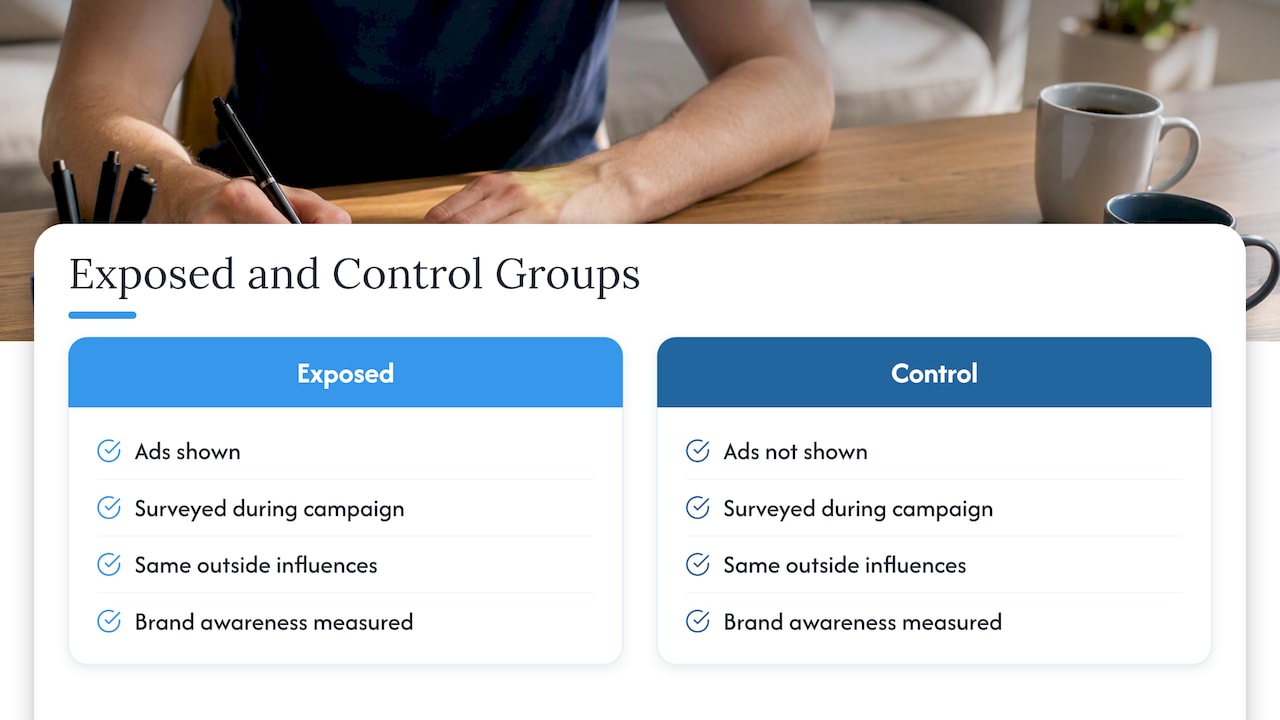
A brand lift study is a controlled experiment. Respondents are sorted into an exposed group, who saw the ads, and a control group, who did not. Both answer the same short survey, and the difference in responses is the lift. Google’s documentation describes the same logic for its own tool and notes that the study is survey-based, not behavior-based. Nobody is tracking purchases here. You are asking people what they remember and what they think.
The metrics usually reported are:
- Ad recall: do people remember seeing your ad?
- Brand awareness: do they know your brand exists when prompted?
- Brand favorability: do they view it positively?
- Consideration: would they think about it when buying in the category?
- Purchase intent: do they say they are likely to buy?
The same Google page lists these metrics. Which ones matter depends on your stage. A new brand usually cares most about awareness and recall. A well-known one fighting for share cares more about consideration and intent.
You will also see this described as a brand lift test, or as brand awareness lift when awareness is the headline metric. The method is the same.
Why click data cannot answer this question
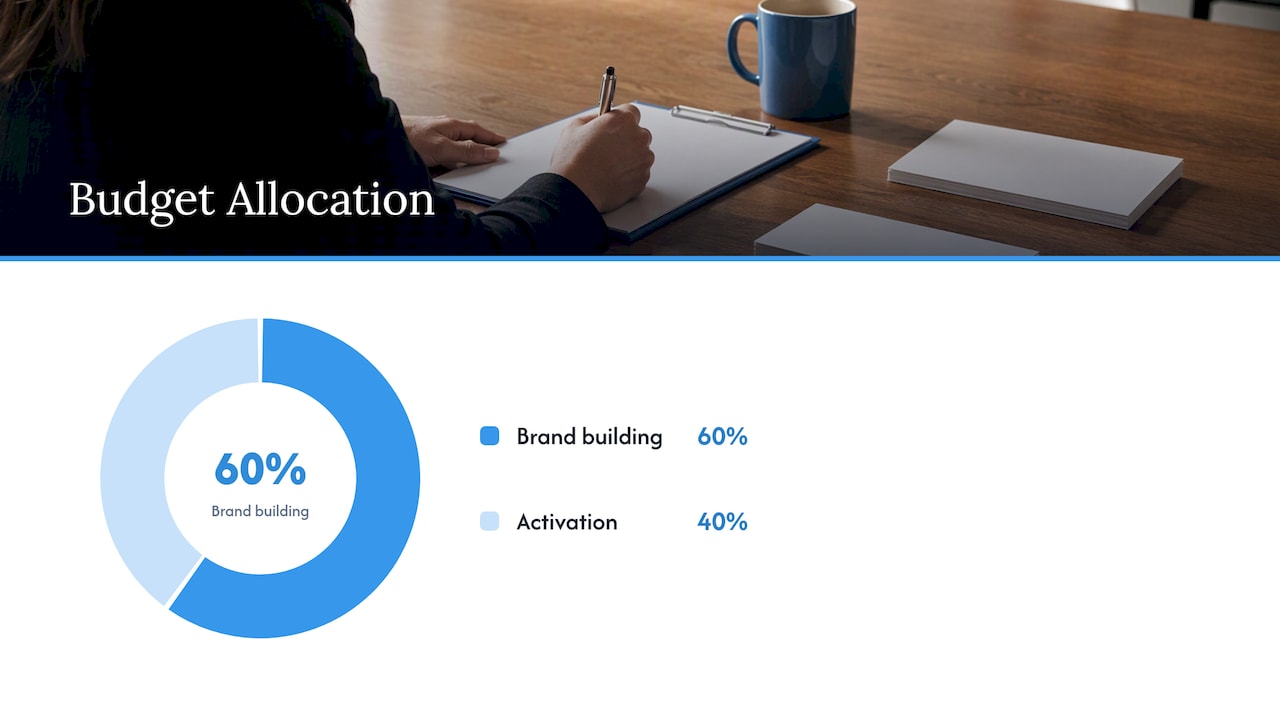
Performance channels are good at capturing demand that already exists. Brand advertising builds the demand that performance later captures. The IPA’s effectiveness research, summarised by AdLibrary, points to the 60/40 rule from Les Binet and Peter Field: roughly 60% of budget on brand building and 40% on activation. The same summary says brand effects compound over 18 to 24 months, while performance campaigns peak in about 6 to 13 weeks.
That timing gap is the measurement problem. If you judge everything on last-click return, brand spend looks weak, because its payoff arrives later and is spread across channels. A lift study gives that spend its own evidence: a measured change in mental availability, before it shows up in revenue.
If you need to defend brand budget to a finance team, lift is one input, not the whole case. Our guide to brand marketing ROI that finance can audit covers how to connect perception metrics to commercial ones.
Exposed versus control: the design that makes it valid
The control group is what separates a lift study from a poll. Without it you cannot tell whether awareness rose because of your ads, because of a heatwave, a competitor’s price cut or a viral moment.
Pre/post is not the same thing
A common shortcut is to survey people before a campaign and again after it. Practitioners warn against treating this as equivalent. Kantar Millward Brown’s work with AOL on a Cadbury Buttons campaign, published through IAB Europe, shows the simultaneous approach: measurement runs alongside the campaign launch, not before and after it. A pre/post gap absorbs everything that changed in between. A simultaneous control group experiences the same weather, news cycle and competitor activity as the exposed group, so those effects cancel out.
Matched controls
The control group also has to resemble the exposed group. If your ads target women aged 25 to 34, a control group skewed towards men over 55 will exaggerate the lift. The same source material describes weighting control respondents to match the exposed group’s demographics and behaviors. When a vendor or platform reports lift, ask how matching was done.
Survey fatigue and overlap
Long-running campaigns create two quieter problems. People get surveyed repeatedly and answer carelessly. And some control respondents get exposed through other channels, which shrinks the measured gap. Keep surveys short, rotate the sample, and treat results from very long flights with some caution.
Where you can run one
There are two broad routes: tools built into the ad platforms, and independent cross-media research providers.
| Route | Typical use | Strength | Watch out for |
|---|---|---|---|
| Platform-native lift | Measuring a single platform’s campaigns | Built into the buying flow, often low or no extra fee | Each platform grades its own work, and results are not like-for-like |
| Independent cross-media research | Comparing channels, including TV and offline | One framework across walled gardens | Cost, setup time, larger budgets |
Platform-native tools
- Google: Brand Lift is a free tool for measuring video ads, and it also supports Demand Gen campaigns. Eligibility depends on meeting a minimum budget across a 10-day window, and that requirement differs by country. The set-up screen shows whether your campaign qualifies before you launch.
- Meta: Meta’s Brand Lift tests use brand polling to estimate the value of your ads. If you buy Facebook and Instagram media, speak to your account team about eligibility early. Our Meta Ads agency page explains how we run those campaigns.
- Snapchat: Brand Lift compares awareness and other perception metrics between people who saw your ads and people who did not.
- Amazon Ads: Amazon Brand Lift is positioned as a quick, privacy-safe way to quantify upper and mid-funnel campaigns.
Independent cross-media research
Research firms offer studies that measure lift across several platforms and traditional media at once, giving a single view of effectiveness. One provider says it measures campaigns across more than 450 publishers. This route makes sense when you run TV, video and social together and need to compare them on one scale. It costs more and takes longer to set up, so it suits larger brands with several channels in play.
Budget and scale: the practical limits
Lift studies need enough survey responses to detect a difference, and responses come from impressions. That is why platforms set minimum budgets, and why they vary by country. A UK-only campaign meets a different threshold from a US one, and a campaign spread over many markets may be held to the highest requirement.
The consequence for smaller brands is straightforward. If your campaign is modest, a platform study may not be eligible, or may return a result too noisy to trust. Your options are to concentrate spend on one platform and audience for a defined window, to run a geo or audience holdout test instead, or to track search interest and direct traffic as indirect signals. Be honest in the report about which one you used.
How to run a study that produces a usable answer
- Write the decision first. Decide what you will do if lift is high, flat or negative. For example: move budget to the winning creative, or cut the channel.
- Pick one or two metrics. Awareness and consideration are common pairings. More questions mean more survey fatigue.
- Check eligibility and budget in the platform before you finalize the media plan, not after.
- Keep the test clean. Avoid changing targeting, creative or budget mid-flight unless you accept that it muddies the read.
- Test creative variants if the tool allows it. Lift by creative is often the most actionable output.
- Read lift by audience and frequency, not just the headline number. A strong average can hide a segment that is not responding.
- Compare against your own history, not a generic benchmark. Category, spend and creative length all change what a good result looks like.
Pair lift with attention and sales data
Brand lift is a lagging indicator. You get the answer after the campaign has run. Attention metrics tell you sooner whether creative is working. As explained in LBB’s report on a Heineken-owned brand campaign, attention time is a lead indicator of mental availability, while survey-based lift confirms the perception shift afterwards.
The same report describes a Cruzcampo campaign in the UK where awareness grew once viewers gave the ad as little as 0.5 to 0.6 seconds of attention. Front-loading the branding helped reach that threshold. The lesson for creative teams is concrete: if your logo or product appears late, you may be asking viewers for more attention than they will give.
A practical measurement stack looks like this:
- During the campaign: attention and creative metrics to adjust in real time.
- At the end: brand lift to validate the perception shift.
- Over the following months: branded search volume, direct traffic and sales, read through an attribution model you trust. Our piece on data-driven attribution models explains how platform changes affect that view.
Our perspective
We see the same pattern with many growth-stage brands. Performance numbers look healthy for a while, then efficiency slips, and nobody can say whether the cause is creative fatigue, a saturated audience or a brand that few people know. A lift study can settle that argument, but only if it is planned alongside the media, not bolted on after.
Three views shape how we approach it:
- Measurement is a design choice. The control group, the survey and the budget have to be decided with the campaign plan. That is easier when strategy, creative and paid media sit in one team rather than across several vendors.
- Lift is not a verdict on its own. A positive result on awareness means little if the creative drives no consideration. We read lift next to attention, search demand and revenue.
- Simple beats elaborate. One clear question, a clean test and a decision agreed in advance are worth more than a long survey nobody acts on.
If your last brand campaign ended with a slide that said “impressions up” and nothing else, a lift study is the first fix.
— Alex
Working with us on brand and performance measurement
We run strategy, creative, paid media and web development as one team, so the people who design your campaign also plan how it will be measured. If you want help deciding whether a lift study fits your budget, or building the brand and performance plan around it, see our services or start with our brand strategy work.
FAQ
What is a brand lift study?
It is a survey-based experiment that compares people exposed to your ads with a similar group who were not. The difference in answers shows the effect of the advertising on awareness, recall, consideration or intent. It measures perception, not purchases.
How is a brand lift test different from a pre/post survey?
A lift test surveys exposed and control groups at the same time, so outside factors such as seasonality or competitor activity affect both equally. A pre/post survey compares two moments in time and cannot separate your ads from everything else that changed. Treat pre/post results as directional only.
Do I need a big budget to run one?
For platform tools, usually yes, relative to a small campaign. Google, for example, sets a minimum budget over a 10-day period, and the amount depends on the country. The eligibility check in the campaign set-up shows you where you stand before you commit.
What is a good lift result?
There is no universal number. Category, spend, creative length and audience all change what is realistic. Compare against your own earlier studies, and look at lift by creative and segment to see what to repeat.
Which should I use: platform lift or an independent study?
Use platform tools when you are judging one platform’s campaigns and want a low-cost read. Choose an independent cross-media study when you need to compare channels, including TV or offline, on a single framework.
Sources
- About Brand Lift, Google Ads Help
- Set up Brand Lift, Google Ads Help
- About Brand Lift, Snapchat Business Help
- Amazon Brand Lift, Amazon Ads
- Brand Lift: Meta, Google & Survey Studies Explained, AdLibrary
- Kantar Millward Brown BrandLift: AOL, Cadbury Buttons Memory Lane, IAB Europe
- Heineken and Playground xyz partner to find optimal attention, LBB
- Brand Lift measurement, Dynata
Recommended

Other posts

























































Stay ahead with better decisions.
Get business insights today.
