How to Calculate an E-commerce Marketing Budget That Can Scale in 2026
An industry percentage is not a growth plan. When calculating e-commerce marketing budget, copying a generic benchmark can put pressure on margins or leave a growth target underfunded. The right figure depends on what the business needs to achieve, what each sale contributes and how much it can affo...

An industry percentage is not a growth plan. When calculating e-commerce marketing budget, copying a generic benchmark can put pressure on margins or leave a growth target underfunded. The right figure depends on what the business needs to achieve, what each sale contributes and how much it can afford to invest.
A clear starting point helps, but comparing channel budgets can be difficult when attribution is incomplete. Performance changes can also make spending decisions reactive. A budget built around commercial targets and contribution margin gives you a stronger basis for deciding what to spend and where.
This article sets out a practical method: work backwards from revenue and profit goals, account for financial constraints, then assign investment according to each channel’s role in acquisition, retention and the customer experience. You’ll also learn how to assess performance using more than one metric and set a regular review process, so you can reallocate spend as evidence and business priorities change. The result is a working model that can scale without relying on a percentage taken from another business.
• Start calculating e-commerce marketing budget from commercial targets, margins and affordable investment, not a generic percentage.
• Divide planned marketing investment by target revenue to calculate your planned marketing-spend ratio.
• Give each channel a clear role, outcome and measure, and account for what it needs to perform.
• A regular review cadence helps separate meaningful performance shifts from seasonality, measurement changes and short-term noise.
• Align paid media, SEO, Klaviyo and CRM, creative and website development around one commercial plan.
Why calculating an e-commerce marketing budget starts with business economics
Calculating e-commerce marketing budget means deciding what the business can commit to pursuing growth, not simply choosing a percentage of sales. The budget covers planned investment across paid channels, creative production, marketing tools and relevant agency support. It sits alongside the revenue target, but it is not the target itself.
A revenue target states the sales outcome the business wants; a marketing budget sets the investment it can responsibly make to pursue that outcome. These figures serve different purposes. Keep them separate, then test whether the investment can support the ambition without exceeding financial limits.
For a concise overview of how to approach a marketing budget, watch this video:
Which financial inputs should shape the starting budget?
Choose the planning period first. A quarterly plan and an annual plan have different cash-flow implications, even if they share the same revenue ambition. Record the period, sales outcome and current trading baseline. Use actual performance as context rather than assuming the business can immediately sustain a new level of demand.
Then examine margin. Gross margin shows what remains after the cost of goods sold is deducted from revenue. Contribution margin goes further by accounting for variable costs associated with selling and fulfilling orders, according to the business’s chosen model. It is a useful measure for judging how much revenue can support acquisition and retention activity.
For example, if an illustrative £100 order leaves £40 in contribution after relevant variable costs, that £40 is not automatically available for marketing. It may also need to cover fixed operating costs and profit expectations. Treat the example as a planning prompt, not a recommended allocation. Map the figure against available cash and the time you have to reach the target. A fast growth plan may require more upfront investment than the business can support over a longer runway.
Why is a generic marketing percentage not a decision?
Sector averages can provide context, but they cannot determine what a particular brand should spend. The SERP calculator referenced in the article describes its result as indicative. Treat that output as a starting reference, not a tailored profitability model.
The same percentage can have very different consequences depending on margin, repeat purchasing and growth stage. A brand with established repeat sales may be able to justify investment in both retention and acquisition. A business still building awareness may need to fund customer discovery and creative testing while managing tighter cash constraints. These are different operating conditions, so the budget should reflect them.
Use a percentage as a question, not an answer: does the implied investment fit the margin, available cash and commercial objective? If it doesn’t, revisit the target, timeframe or channel plan before committing spend.
How to calculate an e-commerce marketing budget step by step
Turn the commercial ambition into a spend plan the team can review and adjust. This makes calculating e-commerce marketing budget a practical exercise in connecting expected sales, available contribution and delivery capacity, rather than selecting a figure in isolation.
Which calculation inputs should an ecommerce team assemble?
Start with a consistent planning period. Record target revenue, current revenue over a comparable period, contribution margin and cash available to invest. Then list the full costs included in the plan: media spend, creative production, platforms and external expertise. Keep these costs visible so the proposed budget doesn’t exclude what’s needed to execute it.
Separate expected sales from the growth the marketing plan must create. Existing customers, returning demand and other established sources may contribute to the revenue target without being generated by new marketing investment. Estimate the incremental sales the plan is intended to support, and state the assumptions behind the estimate. This makes the budget more useful than simply dividing all target revenue by an assumed return.
How should you interpret the calculation result?
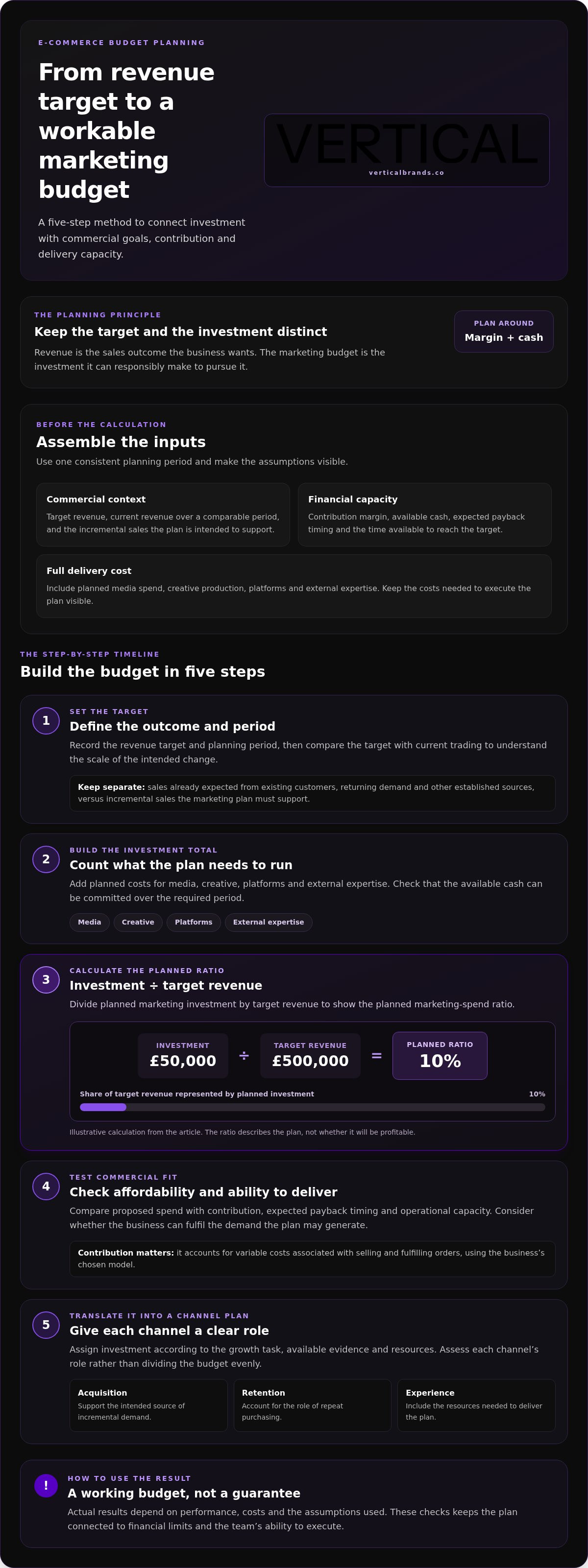
Set the target.
Define the revenue outcome and period, then compare it with current trading to understand the scale of the intended change.
Build the investment total.
Add the planned costs for media, creative, platforms and external expertise. Check that the cash can be committed over the required period.
Calculate the planned ratio.
Divide planned marketing investment by target revenue. For example, an illustrative £50,000 investment against a £500,000 revenue target gives a planned marketing-spend ratio of 10%.
Test commercial fit.
Compare the proposed spend with contribution, expected payback timing and the team’s operational capacity. A plan that generates demand the business can’t fulfil is not a sound plan.
Translate it into a channel plan.
Assign the investment across channels according to the growth task, available evidence and resources. Assess each channel’s role rather than splitting spend evenly.
The ratio describes the plan. It doesn’t demonstrate that the investment will be profitable, because actual results depend on performance, costs and the assumptions used. The calculation produces a working budget, not a guaranteed outcome.
Build cautious, central and ambitious scenarios without relying on unsupported benchmarks. In the cautious case, test what happens if incremental sales are slower or costs weigh more heavily on contribution. The ambitious case should account for the additional creative, stock, fulfilment or team capacity required, rather than assuming demand can scale without constraints.
Document the target, period, inputs and assumptions beside the figures. The assumptions is what lets the team explain why the budget changed when trading, cash availability or campaign evidence shifts. Growth advisory can help connect those financial choices to a joined-up channel plan, including ecommerce growth planning.
How to allocate an e-commerce marketing budget across channels
Allocate spend according to the job each channel must do, not by dividing the total evenly. One channel may create demand, another capture it, and another encourage existing customers to buy again. Set a clear outcome and measure for each investment, then account for the conditions it needs to perform.
| Channel | Role | Intended outcome | Primary measure | Key dependency |
|---|---|---|---|---|
| Paid social | Introduce products and build demand with selected audiences | Reach potential customers and generate qualified visits or sales | Incremental sales, cost per acquisition and creative performance | Relevant creative, audience strategy, landing pages and reliable tracking |
| Paid search | Capture active product or category demand | Convert relevant searches into profitable orders | Contribution after advertising costs and conversion rate | Search intent, product pages, feed quality and available demand |
| SEO | Build visibility for relevant searches over time | Grow qualified organic visits and sales | Organic visibility, qualified traffic and assisted or direct sales | Technical foundations, useful content and ongoing optimisation |
| Email and CRM | Engage existing customers and support retention | Encourage repeat purchases and strengthen customer value | Repeat purchase behaviour, revenue per recipient and engagement | Relevant segmentation, consented data and useful customer communications |
How should acquisition channels earn their share?
Assess paid social and paid search against their distinct objectives, audiences and evidence quality. Paid search can capture existing intent, whilst paid social may introduce an offer to people who weren’t actively looking. Don’t judge either on platform-reported sales alone. Compare performance with business outcomes and note where attribution is incomplete.
SEO is a sustained demand-capture investment, not an instant replacement for paid media. Use an e-commerce SEO framework to connect search opportunities with site structure and content priorities. Paid social management guides can also help teams assess creative testing and campaign execution. Budget for the dependencies: creative production, landing-page performance and tracking all influence what a media allocation can achieve.
Where do email and CRM fit in the budget?
Klaviyo and CRM activity support retention, repeat purchasing and customer value. The budget should reflect the work needed to plan relevant communications, manage customer data and improve the on-site journey. Consider the business’s growth stage too. An e-commerce growth stages framework can help clarify whether the immediate priority is customer acquisition, retention or a better balance between them.
Be careful when interpreting attributed revenue. An email platform may record a sale after a customer clicks a message, but that doesn’t prove the purchase was incremental. Some customers may have bought anyway. Compare attributed sales with repeat-purchase patterns and broader revenue trends; don’t treat every recorded order as a sale caused by email.
Direct comparisons between channel returns can mislead. Attribution systems assign credit using different windows, models and touchpoints, while channels often influence the same customer journey. Compare each channel with its role and intended outcome, then review how the combined plan affects contribution and customer demand. That gives the team a more defensible basis for reallocating spend.
How to review and reallocate your e-commerce marketing budget
A budget stays useful only if the team reviews it against trading conditions and acts on evidence. Set a regular review cadence around campaign cycles and business reporting. Use short operational checks to spot urgent issues, then make material allocation decisions in a fuller review, once there’s enough information to assess a campaign or change.
Agree decision rules before results arrive. Define what would justify holding spend steady, reducing it or increasing it. The rules should reflect the campaign’s purpose, expected timing, contribution and the quality of available evidence. This helps avoid reactive decisions based on a single strong day or temporary dip.
Which signals should trigger a budget review?
Review revenue, contribution margin, acquisition cost and customer value together. A channel may bring in sales whilst putting pressure on contribution, or appear weak on immediate sales while supporting a longer customer journey. Compare results with the original objectives and assumptions, not just the latest platform report.
Before changing spend, check that the numbers are trustworthy and the business can meet demand. Confirm tracking is working, products are in stock and fulfilment has capacity. A drop in recorded conversions could reflect a measurement issue; a sales slowdown could also follow stock constraints. Diagnose the cause before changing the investment.
How can teams reallocate spend without overreacting?
Make controlled changes. If evidence supports moving budget, adjust deliberately and give the change enough time to produce a meaningful read, based on the campaign cycle. Avoid altering several major variables at once, or the team may struggle to identify what drove the result.
Protect a defined share of investment for testing and measurement, even when short-term activity is under pressure. Without testing, a business risks favouring familiar campaigns over opportunities it hasn’t properly assessed. Equally, don’t scale a test simply because its first results look promising. Check whether the outcome holds up against the agreed objective and whether the wider operation can support more demand.
For every material budget change, record the reason, expected outcome and review date. Note the campaign, the evidence behind the decision and any known measurement limits. The reasons for a change is easier to assess when the team can compare the outcome with what it expected. Use that record to keep, reverse or refine the decision at the next review.
This creates a repeatable process for calculating e-commerce marketing budget as conditions change: review the evidence, check operational constraints, make a controlled adjustment and document what happens next. For support connecting budget decisions with commercial targets, explore Vertical Brands’ growth advisory.
How Vertical Brands can align your e-commerce marketing budget with growth
A budget becomes more useful when channel decisions connect to one commercial plan. Vertical Brands is an ecommerce-focused digital growth consultancy, bringing growth advisory together with paid social, paid search, SEO, Klaviyo email marketing and CRM management, UGC and influencer marketing, and website design and development. The aim is to align investment with business priorities, not treat each channel as a separate activity.
This matters when acquisition, retention and the on-site experience depend on one another. Paid media can bring potential customers to the site, but the landing page needs to support their decision. SEO can build visibility over time, whilst CRM and email activity can help engage existing customers. Budget decisions should account for these links and the commercial objective each channel is expected to support.
What does an integrated budgeting conversation cover?
Start with the business’s commercial objectives, current performance and investment constraints. Consider the growth target, financial limits, operational capacity and any known measurement gaps. Then map channel responsibilities across acquisition, retention and the site experience. Clarify which outcomes each activity should influence and where its performance depends on other work, such as creative, landing pages or customer data.
This makes trade-offs easier to see. If a planned increase in paid media relies on a website experience that isn’t converting effectively, the budget discussion should include site improvements. If repeat purchasing is a priority, investment in Klaviyo and CRM activity may need to sit alongside acquisition rather than being treated as an afterthought. Channel responsibilities are clearer when the plan shows how each part supports the others.
When can growth advisory add value to the budget process?
Growth advisory can be useful when commercial targets, channel plans and operational capacity don’t align. For example, the business may aim to increase customer acquisition whilst underinvesting in creative production, or expect retention activity to contribute without a clear CRM plan. An advisory perspective can connect these decisions to financial realities and help structure priorities across marketing and the site.
Vertical Brands’ capabilities span paid media, SEO, Klaviyo email marketing and CRM management, UGC and influencer marketing, and website development. These disciplines can be considered against a shared commercial plan, with budget choices informed by each channel’s role and dependencies. The discussion also surfaces where measurement is too limited to support confident allocation, so the team can account for that uncertainty instead of treating reported results as complete.
Calculating e-commerce marketing budget is more effective when the plan reflects both financial constraints and how the channels work together. To discuss a plan shaped around your commercial objectives, Discuss your e-commerce growth plan with Vertical Brands.
Turn the budget into your next growth decision
Put your budget model to work. Choose a planning period, agree what evidence will guide decisions and set a review date before activity begins. That gives you a clear point to reassess assumptions, respond to trading changes and decide what deserves further investment.
Calculating e-commerce marketing budget isn’t a one-off exercise. It’s a management discipline: keep commercial priorities visible, make decisions based on evidence and update the plan when the business changes. The strongest approach is one your team can explain, measure and adapt without losing sight of profitability.
Vertical Brands can connect growth advisory with the capabilities needed to put a joined-up plan into practice. Start a focused discussion about your objectives and the constraints shaping your next move. Plan your e-commerce growth conversation.
Build the next decision on clear priorities, not assumptions. Your budget can evolve as the evidence does.
Frequently Asked Questions
How much should an e-commerce business spend on marketing?
There’s no universal spend level that suits every e-commerce business. Set an amount by working from the revenue objective, available contribution, cash position and time allowed to achieve the target. When calculating e-commerce marketing budget, test whether the proposed spend remains viable if sales arrive more slowly than planned. Keep committed activity separate from optional investment so the business can see what it could reduce if trading conditions tighten.
Should agency fees be included when calculating an e-commerce marketing budget?
Yes, include agency fees when they support the marketing activity being planned. A full view helps the business understand the cost of executing its channel plan, not just the amount paid to advertising platforms. Show media spend and external expertise as separate lines so the team can see where investment goes. If finance reports agency costs elsewhere, reconcile the figures to avoid double-counting or overlooking the total commitment.
How often should an ecommerce marketing budget be reviewed?
Set a formal review at least in line with the business’s financial reporting cycle, then add campaign checks when timing or risk calls for them. For example, a launch or a major change in stock position may warrant closer monitoring than a stable campaign. These checks helps the team catch operational issues without changing the plan in response to every daily fluctuation. Agree who reviews results and who can approve a material budget change.
Should a startup use the same marketing budget method as an established online retailer?
Use the same financial discipline, but adapt the inputs to the business stage. A startup may have limited trading history, so its plan should distinguish learning spend from investment intended to scale proven activity. An established retailer can draw on historical sales patterns, customer repeat behaviour and channel performance. In either case, set explicit assumptions and a limit for testing, then update the plan as evidence builds.
How do you budget for marketing when attribution is incomplete?
Use several indicators rather than relying on one platform’s attribution report. Compare total sales and contribution with channel trends, customer behaviour and campaign timing. Where practical, run a controlled test, such as pausing or changing a defined activity, and compare the result with a suitable baseline. Record tracking gaps and avoid making precise claims about channel impact when the available evidence supports only a directional judgement.
Should marketing budget include creative production and website improvements?
Yes, if creative or site work is needed to deliver the marketing plan, include it in the relevant investment view. Separate recurring costs, such as ongoing content production, from project-based improvements with a defined scope. For example, if a campaign depends on new product imagery or a redesigned landing page, show those requirements alongside the media plan. Otherwise, the budget may account for traffic generation but miss costs that support conversion.
Can an e-commerce marketing budget change during the year?
Yes. A budget should adapt when trading conditions, business priorities or reliable performance evidence change. A stock constraint, a revised sales target or a sustained shift in customer demand may justify moving investment. Set approval rules for changes, document the reason and expected effect, then check the outcome at an agreed review point. This preserves accountability while allowing the plan to respond to genuine changes rather than short-term noise.

Other posts




























































Stay ahead with better decisions.
Get business insights today.
