How to Scale a D2C Brand in the UK: A Practical Growth Framework for 2026
More acquisition spend won’t fix a growth system that isn’t ready to support it. If you’re working out how to scale a D2C brand in the UK, the next move often depends on what’s constraining growth now, not which channel looks busiest.It’s easy to see rising marketing activity and assume the answer i...

More acquisition spend won’t fix a growth system that isn’t ready to support it. If you’re working out how to scale a D2C brand in the UK, the next move often depends on what’s constraining growth now, not which channel looks busiest.
It’s easy to see rising marketing activity and assume the answer is to invest more. But when profitability is unclear and customer, marketing and operational data sit in disconnected systems, extra demand can add friction instead of building sustainable growth. First, understand how acquisition, conversion, retention and fulfilment work together.
This guide sets out a practical framework for identifying your next growth constraint using business evidence. You’ll learn how to align channel investment with customer retention, choose measures that reflect commercial performance, and sequence priorities with clear decision gates. It also covers the operational readiness to address before increasing spend, so your growth plan fits the capacity of the business, not just its ambitions.
Key Takeaways
• Define scale through sustainable commercial performance, not sales growth alone. Assess whether customer value and delivery capability support the next stage.
• Map how paid media, organic search, the website and CRM contribute at different points in the customer journey.
• Choose how to scale a D2C brand in the UK by matching each growth lever to a clear business need, time horizon and measure.
• Establish a baseline, prioritise the main constraint, then test changes in a controlled sequence with clear review points.
• Align advisory, channel and website work around shared objectives. The strongest next priorities depends on what the evidence reveals.
How to scale a D2C brand in the UK without confusing growth with more spend
More sales can signal demand. They don’t, on their own, prove that a brand is ready to scale. A stronger test is whether growth can be repeated while protecting contribution, customer value and the ability to deliver. If sales rise but acquisition costs absorb the margin, repeat purchasing remains weak or orders strain fulfilment, the business may be getting bigger without becoming more resilient.
D2C scaling is the repeatable growth of customer demand and commercial value, supported by the marketing, customer experience and operational capacity to serve that demand. This definition keeps the focus on the whole business, not just media budgets. The Direct-to-consumer (D2C) business model gives brands a direct relationship with customers, creating opportunities to learn from interactions and purchases. That relationship also brings responsibility for the experience after the first advert or visit.
What does scaling a D2C brand actually involve?
Paid media can increase traffic, but it can’t resolve a confusing product page, weak repeat purchase or a fulfilment process that struggles with volume. Scaling means identifying which part of the customer journey is limiting profitable growth, then strengthening it before asking the next part to carry more demand.
Check the connections between each activity:
Commercial performance
Track sales alongside contribution after relevant variable costs. Compare results by product or customer group, and look at whether customers return or buy across the range.
Customer experience
Review product information, checkout, order updates and post-purchase communication. Note where customers hesitate, ask questions or abandon their purchase.
Delivery capability
Understand how stock, packing, dispatch and customer support respond when order volumes change. Look for recurring delays or questions that could indicate a process needs attention.
These checks make the distinction clear: more advertising is an input; sustainable growth is a business outcome. A brand is better placed to increase demand when its offer converts, its customer relationships develop and its operations can meet expectations consistently.
Why UK market readiness comes before expansion
Before expanding reach, test whether the offer makes sense for the UK audience you intend to serve. Consider how the product is positioned, whether the pricing fits its perceived value, and whether the messaging speaks to that audience’s needs and purchase context. Use customer feedback, conversion patterns and support queries to find gaps. Avoid assuming that one message or buying trigger suits every segment.
Readiness also extends beyond the storefront. Review fulfilment coverage, delivery information, returns processes and the capacity to handle customer questions. Be precise about what customers can expect, and make the information easy to find before purchase. Expectations vary by category, so use evidence from your own customers rather than broad assumptions about UK shoppers.
Use this readiness check before increasing acquisition activity:
• Can the intended audience understand the offer and its value?
• Do pricing and product messaging reflect how customers make decisions?
• Can fulfilment and customer support absorb additional demand without degrading the experience?
If the evidence points to a gap, address it first. The practical answer to how to scale a D2C brand in the UK is not always another campaign. Sometimes the next growth decision is to improve the foundations that make demand valuable and deliverable.
Build a D2C growth engine around acquisition, conversion and retention
A D2C growth engine connects the moments that bring a customer in with the experience that earns their next purchase. Treat discovery, consideration, purchase, repeat purchase and advocacy as one journey, not separate channel targets. A customer might first see a creator’s product demonstration, search for the brand later, compare product details on the website, then return through a relevant email. Each interaction should move the relationship forward.
The UK eCommerce Market Overview offers wider market context, but your own customer journey data should shape channel decisions. Signals from each channel point to a different part of the journey, so compare them against shared commercial outcomes rather than judging each in isolation.
Connect customer acquisition to the on-site experience
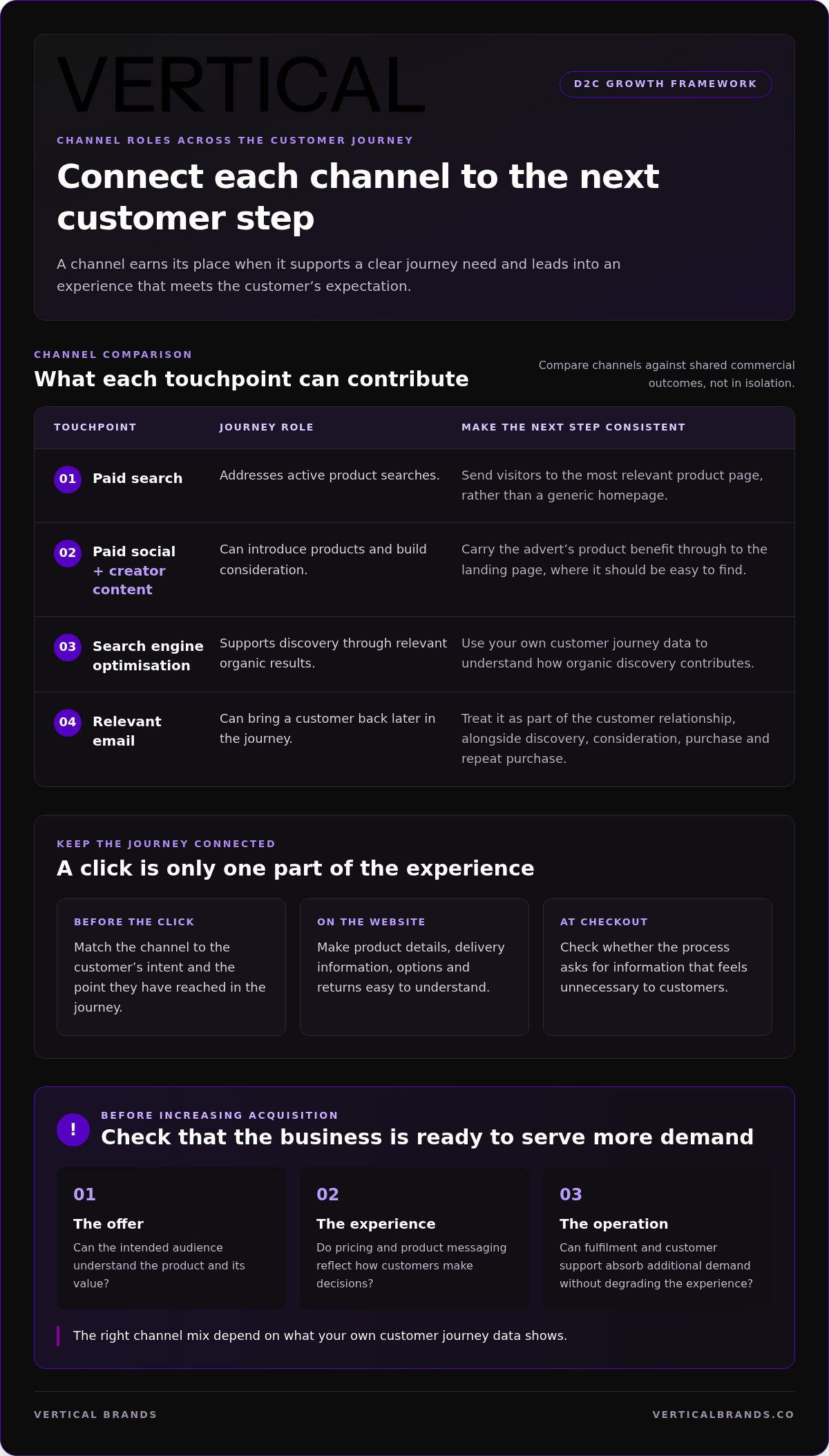
Acquisition creates an expectation. The landing page and product page must fulfil it. If a paid social advert focuses on a product benefit, make that benefit easy to find after the click. If paid search captures a specific product need, send visitors to the most relevant page, not a generic homepage. Keep the transition consistent, with clear product information and a direct route to purchase.
Review the journey on mobile as well as desktop. Can visitors find the right product through navigation or search? Are delivery details, product options and returns information easy to understand? Does checkout ask for information that feels unnecessary? These are useful points to test because friction in the buying journey can weaken the value of otherwise effective media.
Choose channels by intent. Paid search can address active product searches; paid social and creator content can introduce products or build consideration. Search engine optimisation can support discovery through relevant organic results. The right mix depends on what customers need at each stage, not on which channel is currently attracting attention.
Make customer retention part of the growth system
Retention should inform acquisition decisions, not sit in a separate reporting stream. Klaviyo and CRM data can help you understand purchase history, engagement and lifecycle opportunities. Use those signals to shape relevant communications, such as product education after a first order or a timely reminder based on a customer’s relationship with the brand. Relevance matters more than sending more messages.
Efficient acquisition creates the opportunity for growth; retention and repeat revenue help make that growth more valuable over time. Review new and returning customers together. If new-customer volume rises but repeat purchasing stalls, investigate the post-purchase experience and product fit before increasing acquisition activity again.
When fragmented records or a platform change makes lifecycle analysis difficult, a structured Klaviyo migration plan can help protect continuity. Shared reporting gives marketing and commercial teams a common view of performance, with measures such as new-customer acquisition, conversion, repeat purchase and revenue by customer group. A connected plan across paid media, SEO, website experience and CRM is central to how to scale a D2C brand in the UK. If you need support aligning those priorities, integrated D2C growth planning can help connect channel execution to shared objectives.
Choose the next UK D2C growth lever by its economics, not its hype
There’s no requirement to increase every channel budget to scale. The right next investment depends on the constraint you’ve identified, the time available and the value the channel can create across the customer relationship. Compare options by their role and the evidence they can produce, not by popularity or a single headline metric.
Use this comparison to frame the decision. Time to useful evidence will vary with your category, offer, audience and execution.
Paid social
Question: Can creative introduce the offer and generate qualified demand? Consider: responses to creative tests, conversion quality and contribution beyond campaign-level results.
Paid search
Question: Are customers actively looking for the product or solution? Consider: search intent, landing-page relevance and the commercial value of resulting orders.
SEO
Question: Do customers research the category or product before buying? Consider: relevant organic visibility, visits to useful pages and their contribution to purchase over time.
CRM
Question: Can customer behaviour support more relevant repeat purchases? Consider: engagement, returning-customer behaviour and revenue across lifecycle communications.
Creator content
Question: Would product demonstrations or customer-led context help people discover or assess the offer? Consider: content quality, audience response and its role across discovery and conversion.
These are decision prompts, not universal benchmarks. Each channel has a different time horizon and its own measurement limitations. Search intent may capture existing demand; SEO often requires sustained work before its contribution is clear. CRM can act on existing customer relationships, whilst creator content may support discovery and provide material for other marketing activity.
When should a D2C brand increase paid acquisition?
Increase paid activity only when the destination can convert, the contribution assumptions make sense and fulfilment can handle additional orders. Check whether product pages answer likely questions, mobile checkout works smoothly, and delivery and returns information is clear. Then separate campaign signals, such as clicks or attributed orders, from wider business performance, including margin and repeat purchasing. A paid social scaling blueprint can inform channel-specific execution once those foundations are in place.
When should a brand prioritise organic and customer-led growth?
Prioritise SEO when customers compare options or seek category information before purchase. Creator and customer content can help when seeing the product in context answers questions that standard product copy can’t. Both approaches need a clear link to customer intent and a way to assess their contribution over an appropriate period. The D2C influencer marketing playbook explores creator strategy in more depth.
Before committing more resource, review four factors: contribution after relevant variable costs, repeat-purchase potential, available creative capacity and fulfilment readiness. If a channel’s promise depends on strong creative but production is constrained, increasing spend may not solve the bottleneck. The metrics you choose need to reflect the business decision, not just what a platform makes easy to report. This is how to scale a D2C brand in the UK with investment tied to evidence rather than channel fashion.
Use a practical sequence to scale a D2C brand in the UK
A disciplined growth plan turns scattered data into a decision, then a decision into a measured test. Before committing more resource, establish what is limiting progress and what the business can support. This sequence gives teams a shared method for diagnosing constraints, prioritising action and deciding when to expand.
Run a focused growth diagnosis before committing resources
Start with the customer and commercial evidence you already have. Look for the point where intended performance breaks down: insufficient qualified demand, weak conversion, limited repeat purchase or operational capacity. Your baseline should include more than marketing metrics. Add margin assumptions and the practical ability to fulfil orders and support customers.
Set the baseline.
Record current acquisition activity, conversion behaviour, repeat purchasing, margin assumptions and operational capacity. Note the source and date of each measure so the team can distinguish observed performance from estimates.
Locate the constraint.
Compare customer feedback, website behaviour, sales patterns and fulfilment issues. If visitors arrive but don’t purchase, investigate the offer and on-site experience before adding demand. If orders are strong but repeat activity is limited, examine the post-purchase journey and customer communications.
Rank the opportunities.
Select the constraint with the clearest evidence and a practical route to improvement. Consider likely commercial value, customer impact, resources required and dependencies, such as product availability or website changes.
Design a controlled test.
Define the hypothesis, owner, success measure and review point before work begins. Keep the test focused enough to interpret. Record what would justify continuing, changing direction or stopping.
Review and decide.
Assess results alongside contribution, customer quality and delivery performance. Expand only when evidence supports the next step and the business can sustain it. Capture learning, update the baseline and set the next decision gate.
Sequence experiments and scale only what the evidence supports
Keep ownership explicit. A channel lead may manage campaign execution, whilst a commercial owner reviews the effect on contribution and customer value. Agree a reporting cadence that matches the test, rather than relying on isolated platform dashboards. Each experiment have a named decision-maker, so the team knows who can approve an adjustment or further investment.
For UK-focused planning, include product availability, delivery coverage and the accuracy of customer-facing delivery information. A marketing test can appear successful whilst creating pressure on stock, dispatch or customer support. Treat those operational signals as part of the outcome, not as a separate issue to resolve later.
For broader stage-based planning, the e-commerce growth stages framework can help put priorities in context. Once you’ve established the constraint and decision gates, work with Vertical Brands on a sequenced growth plan that connects marketing and website priorities to shared measures.
How Vertical Brands can support a connected D2C growth plan
A diagnosed constraint is only useful if it leads to focused action. Vertical Brands connects growth priorities to digital execution, so channel activity, customer data and website work support the same commercial objectives. Start with the evidence: what is limiting progress, what needs to change, and how the team will assess whether the next action is working.
Bring channel strategy and customer data into alignment
Different channels play different roles, but they should not operate as separate plans. Growth advisory can help sequence priorities across marketing and website work. Paid social can support discovery and demand generation; paid search can respond to active intent; SEO can build relevant organic visibility. The plan should reflect the diagnosed opportunity, rather than assume every channel needs investment at once.
Klaviyo and CRM management connect customer information with lifecycle execution. Purchase and engagement data can inform relevant communications, helping the brand understand how acquisition relates to customer retention. The objective is a more consistent customer journey, not simply more activity across platforms.
Website experience and content connect those efforts to the decision to buy. If a campaign introduces a product benefit, the landing page should make that benefit clear. If customers need more context to assess the offer, website development, influencer marketing or UGC content may support the work. The right combination depends on the brand’s priorities and available evidence. Channel performance improves when the message, destination and customer experience are aligned.
Turn the growth framework into an actionable engagement
Vertical Brands can bring paid social, paid search, SEO, CRM and website work into a connected plan, with shared objectives and reporting that keeps teams focused on commercial performance. For example, a brand addressing a conversion constraint may need its landing-page experience and paid traffic plan considered together. A retention priority may call for CRM activity informed by customer behaviour, alongside a clear view of repeat purchasing.
Where the opportunity calls for additional execution, website design and development, influencer marketing and UGC production can be considered alongside channel planning. The work can be sequenced around the constraint, internal capacity and the measures that matter to the business. Each activity have a defined role, rather than being added because it is available or popular.
Bring your evidence, constraints and priorities into a focused discussion. Vertical Brands can shape a D2C growth strategy around the needs of your brand, then align relevant digital activity to that plan. If you’re deciding how to scale a D2C brand in the UK, start with a clear conversation about what to prioritise and why. Discuss your D2C growth strategy.
Make your next growth decision count
The next stage doesn’t require a perfect forecast. It requires a clear decision about what to test, what evidence will guide you and what the business needs to support the next move. Treat the plan as a working discipline: review what changes, challenge assumptions and adjust investment when customer or operational evidence shifts.
That’s the practical answer to how to scale a D2C brand in the UK. Build confidence through decisions your team can explain and measure, rather than activity that’s difficult to connect to progress. The next decisions are easier when marketing priorities and business capacity are considered together.
Vertical Brands can help turn your priorities into a connected growth plan, with relevant digital activity aligned to your brand’s needs. Discuss your D2C growth strategy and take the next step with a clear view of what you want to achieve.
Frequently Asked Questions
How do you scale a D2C brand in the UK?
Scale by building a repeatable route from customer demand to profitable orders, then expanding what the business can support. Start with a clear commercial question, such as whether a product range attracts new customers who return for related items. Compare performance by product and customer group, rather than relying only on total sales. This helps you decide where to focus next and gives your team a clearer basis for action.
When is a D2C brand ready to scale?
A brand is ready to scale when it can meet demand consistently and explain what makes its current growth work. Look for reliable product availability, a customer experience that converts without extensive manual intervention, and clear insight into which customers return. Check that teams can manage the added workload, too. If each sales increase creates unresolved stock or support issues, strengthen those processes before widening demand.
Can a D2C brand scale without increasing paid advertising spend?
Yes. A brand can pursue growth through stronger organic discovery, improved product merchandising, customer referrals and relevant follow-up communications. For example, improving category pages may help shoppers find products through search, whilst useful post-purchase guidance could encourage customers to explore complementary items. These approaches still require time and capability. They may also take longer to show a clear commercial contribution than an immediate campaign change.
How should a D2C brand balance acquisition and retention?
Balance acquisition and retention according to the product’s natural repurchase pattern and the brand’s current customer mix. For a product bought infrequently, retention might mean education, referrals or interest in another category, rather than frequent repeat orders. Compare newly acquired customers with established customer groups over time. If acquisition rises but returning-customer value stays flat, investigate product experience and post-purchase communication before shifting more resource to reach.
What metrics should a D2C brand track when scaling?
Track measures that reveal commercial health and customer experience together. Alongside sales and acquisition, review contribution by product, conversion by landing page, repeat purchase by customer group, refund patterns and stock availability. A high-performing campaign can conceal a product or fulfilment issue if reporting stops at attributed revenue. Choose a consistent reporting period and define who acts on each measure, so the numbers inform decisions rather than simply fill a dashboard.
How much should a D2C brand invest in marketing to scale?
There’s no single marketing budget that suits every D2C brand. Set an investment level from your cash position, contribution assumptions, capacity to fulfil orders and the evidence behind each channel opportunity. Decide in advance how much uncertainty the business can absorb, then release budget in stages against agreed decision points. This approach limits exposure if an assumption proves wrong. The right allocation depend on what the brand can sustain, not a generic percentage.
What should a UK D2C brand fix before expanding its marketing?
Fix problems that could undermine customer confidence or prevent you from serving additional orders. Check that prices are clear in pounds sterling, product availability is accurate, and delivery coverage and returns information are easy to understand. Test checkout on mobile and make sure customer questions reach an accountable team. If these basics are inconsistent, wider marketing can increase confusion and support demand before the underlying customer experience is ready.

Other posts





























































Stay ahead with better decisions.
Get business insights today.
