Influencer Marketing for D2C: Scalable Growth Playbook
Most creator campaigns burn capital on vanity impressions whilst returning zero commercially attributable revenue. When modern retail operators evaluate influencer marketing for D2C brands, they immediately confront a frustrating operational reality. You are likely tired of wrestling with manual out...

Most creator campaigns burn capital on vanity impressions whilst returning zero commercially attributable revenue. When modern retail operators evaluate influencer marketing for D2C brands, they immediately confront a frustrating operational reality. You are likely tired of wrestling with manual outreach, opaque creator contracts, and post-iOS attribution blind spots that turn paid creator budgets into guesswork. Chasing superficial metrics never built a balance sheet, and managing sporadic gifting runs simply cannot scale your customer acquisition.
Every pound invested must yield disciplined, commercial returns. Influencer marketing only succeeds when operated as an integrated performance ecosystem rather than isolated brand PR. This guide will show you how to build a repeatable creator pipeline, integrate raw user-generated assets directly into paid social testing, and deploy automated Klaviyo retention flows that compound lifetime value. We provide the operational playbook to transform unpredictable partnerships into an engine of predictable bottom-line growth.
Key Takeaways
• Modern influencer marketing for D2C brands requires treating creator collaborations as revenue-generating performance channels rather than isolated PR exercises.
• Establish commercial growth targets and audit customer behaviour across TikTok, Instagram, and YouTube before committing capital to creator talent.
• Prioritise audience affinity, historical engagement, and comment sentiment over gross follower counts when vetting creator tiers.
• Amplify creator assets across paid social campaigns and backend Klaviyo retention flows to avoid wasting raw creative leverage.
• Implement a multi-touch attribution model combining bespoke UTM links, post-purchase surveys, and custom promo codes to measure cash returns accurately.
What Is Performance Influencer Marketing for D2C Brands?
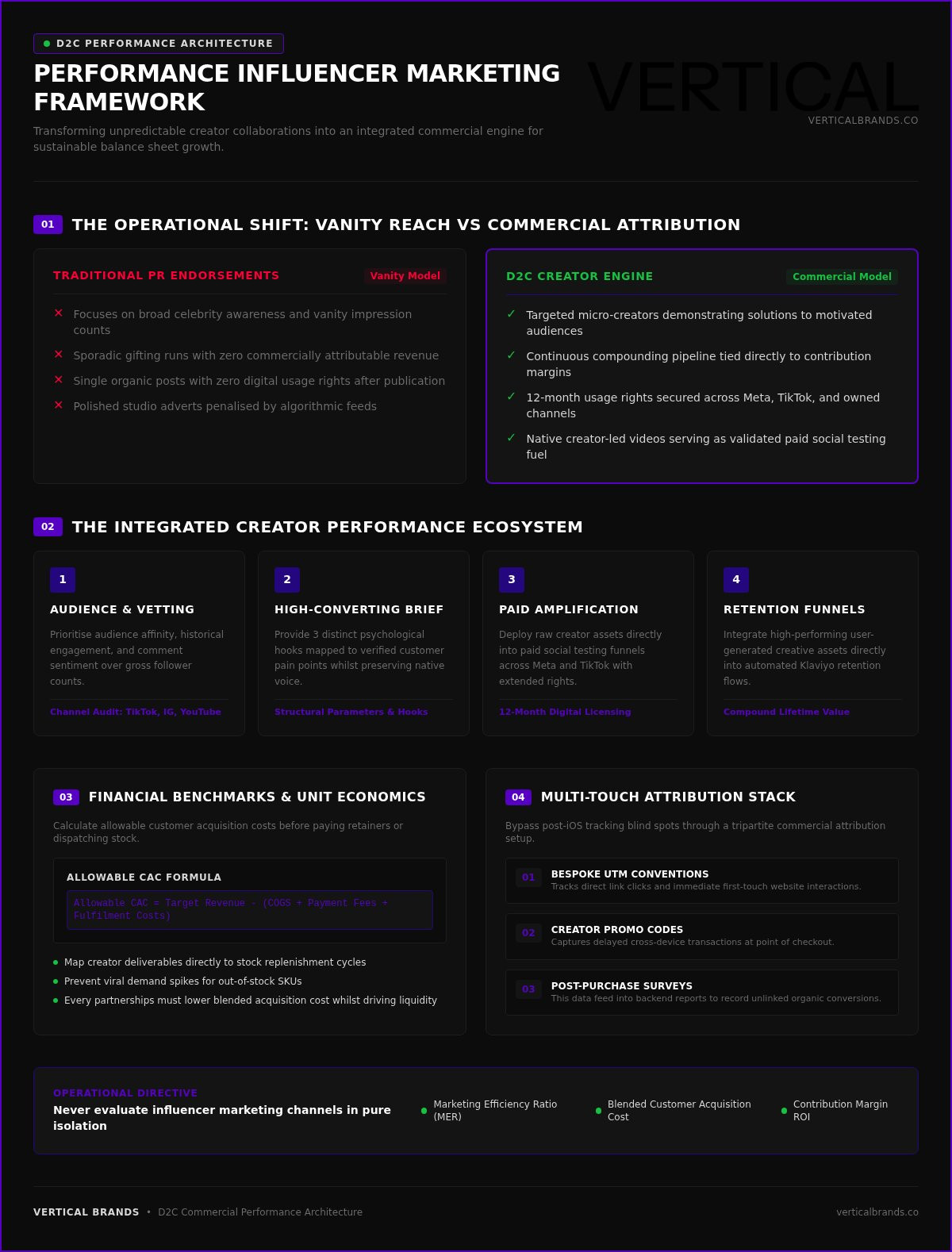
Performance influencer marketing treats creator collaborations as measurable commercial assets rather than brand public relations. In the direct to consumer sector, isolated gifting runs and vague reach estimates no longer justify expenditure. Modern operators require explicit attribution connecting creator spend directly to net margin. This approach abandons sporadic gifting in favour of continuous, compounding partnerships that build verifiable category dominance.
Algorithmic feeds actively penalise polished, traditional studio adverts. Modern platforms reward native, creator-led video that mirror genuine user experiences. When executed correctly, influencer marketing functions as an organic testing ground, validating creative angles before capital is committed to paid scaling.
To better understand how creator strategies impact direct-to-consumer economics, watch this helpful breakdown:
The Evolution from Vanity Reach to Commercial Attribution
Surface metrics such as video views and likes offer zero transparency into cash liquidity. High-growth operators track precise first-touch and multi-touch contributions using distinct UTM tracking parameters paired alongside creator-specific discount codes. This data feed into post-purchase attribution surveys, capturing sales that occur outside direct link clicks.
Evaluating channel efficiency in isolation creates blind spots. Sophisticated teams measure overall marketing efficiency ratios and blended customer acquisition costs alongside platform-reported ROAS. Every partnership must lower blended acquisition costs while driving profitable initial transactions.
Core Differences Between Traditional Brand Endorsements and D2C Creator Engines
Traditional brand endorsements rely on broad celebrity status to generate passive awareness. In contrast, modern influencer marketing for D2C brands deploy targeted micro-creators demonstrating specific product solutions directly to motivated niche audiences. The dynamic is tactical rather than symbolic.
Content ownership terms define overall campaign margins. A single organic post delivers fleeting engagement, yet securing extensive digital usage rights transforms that asset into prolonged paid social fuel. Smart agreements secure twelve-month rights across Meta, TikTok, and owned marketing funnels. Without usage rights, you leave substantial creative equity on the table.
How to Build an Influencer Marketing Strategy for D2C
Execution without clear financial benchmarks burns working capital. Before contacting a single creator, you must define the commercial metrics that govern viability. Modern influencer marketing for D2C brands requires an operational blueprint that aligns creator selection, creative briefs, and content rights with core unit economics.
Begin by auditing channel distribution. A high-consideration product may require long-form education on YouTube, whereas impulse purchases thrive on TikTok and Instagram Reels. Establish your foundational tracking infrastructure first. Dispatching product or paying retainers prior to configuring custom UTM conventions and backend tracking guarantees wasted budget.
Defining Commercial Objectives and Unit Economics
Every campaign must anchor to contribution margin. Calculate your allowable customer acquisition cost by stripping out cost of goods sold, payment processing fees, and fulfillment overheads. When teams attempt to quantify the ROI of influencer marketing, they often misjudge cash flow because they ignore these baseline economics. Map creator deliverables directly to stock replenishment cycles. There is no commercial logic in generating viral spikes for out-of-stock SKUs.
Constructing the High-Converting Creator Brief
Rigid corporate scripts destroy performance. Effective briefs supply strong structural parameters while preserving natural voice. The strongest creative briefs share three core components:
Hook Directives
Provide three distinct psychological hooks based on verified customer pain points, requiring creators to deliver their own visual interpretation.
Mandatory Visuals
Highlight essential product angles, texture displays, or unboxing steps that must appear within the first five seconds.
Technical Constraints
Mandate high-resolution 9:16 vertical framing, clean audio capture, and native safe zones clear of on-screen interface icons.
Contracts, Usage Rights, and Whitelisting Provisions
A contract without paid usage terms is a bad deal. Secure minimum 60 to 90-day digital licensing rights to repurpose assets across paid social accounts. Demand explicit whitelisting provisions for Meta Partnership Ads and TikTok Spark Ads, allowing you to run media directly through creator profiles. Brands looking to streamline these complex commercial workflows often partner with a growth advisory team to build reliable creator contracts and tracking frameworks. Ensure clear approval milestones are agreed upfront, which prevent costly scheduling delays down the line.
Evaluating Creator Tiers: Nano, Micro, and Macro Partnerships
Follower counts are vanity metrics that distort commercial decisions. Sophisticated teams evaluate potential partners by examining audience affinity, historical engagement, and comment sentiment. Specialist agencies such as Advocators focus on identifying authentic messengers who emotionally align with brand values, ensuring creator advocacy resonates on a personal level rather than reading as transactional. A creator boasting two million followers often drives lower net revenue than ten creators with twenty thousand followers each. In the landscape of influencer marketing for D2C brands, your capital allocation must reflect actual conversion intent rather than superficial reach.
Every tier introduces distinct operational trade-offs. Micro-networks demand high coordination overhead but deliver diversified creative assets. Macro partnerships require substantial upfront capital commitments whilst exposing the business to singular performance risk. Balancing these two extremes creates a resilient acquisition engine.
Micro and Nano Creators: The Performance Workhorses
Nano (1,000 to 10,000 followers) and micro-creators (10,000 to 100,000 followers) serve as direct-response workhorses. Their audiences view recommendations as peer-to-peer advice rather than paid endorsements, yielding superior click-through rates. Product seeding programmes allow brands to test dozens of positioning angles simultaneously without committing massive cash retainers.
Operational complexity remains the primary hurdle. Managing correspondence, contract approvals, and shipping logistics across fifty independent creators drains internal hours. Establishing standardised communication pipelines is mandatory to prevent logistical bottlenecks from stalling campaign momentum.
Macro and Hero Talent: Scaling Authority and Market Dominance
Macro talent (500,000+ followers) becomes commercially viable only after unit economics are proven and baseline customer acquisition cost is stable. Deploying macro influencers too early burns runway on unvalidated positioning. Once an offer converts reliably, large-scale talent injects rapid category authority.
Structuring these agreements requires commercial discipline. Avoid transactional, one-off post commitments. Instead, negotiate comprehensive multi-month partnerships that spread financial risk:
Hybrid Compensation Models
Pair a conservative baseline fee with tiered performance bonuses tied directly to gross sales or new customer acquisition.
Mandatory Asset Deliverables
Contract multiple organic posts alongside dedicated raw video files optimised for paid social creative testing.
Exclusivity Windows
Enforce strict sector exclusivity clauses to ensure competitors cannot run parallel campaigns with the same talent.
Neither tier operate in isolation. Micro-creators provide the raw creative volume necessary for weekly testing, whilst macro talent establishes the top-of-funnel prestige that lifts overall brand equity.
Integrating Influencer Content Across the Performance Ecosystem
Restricting creator content strictly to organic social profiles forfeits over eighty percent of its real commercial value. Organic distribution decays within forty-eight hours; structured performance distribution runs indefinitely. The true power of influencer marketing for D2C brands materialises when creator assets are deployed as modular creative building blocks across your entire growth infrastructure.
Every piece of raw footage must serve multiple operational functions. Dissect single creator videos into distinct hooks, demonstration clips, and closing calls to action. These modular cuts form the foundation for aggressive paid testing, dynamic landing pages, and lifecycle retention messaging.
Amplifying Reach Through Paid Social Whitelisting and Partnership Ads
Running creator creative solely through your brand handle suppresses conversion velocity. Deploying whitelisted campaigns via Meta Partnership Ads and TikTok Spark Ads delivers immediate, authentic authority. Audiences view promotions originating from genuine creator handles, completely bypassing traditional advert blindness.
Whitelisting also neutralises creative fatigue. By testing five distinct creator hook variations against one proven product demonstration, you prolong creative lifespan without commissioning entirely new productions. Additionally, running media through creator profiles builds valuable engagement custom audiences that can be retargeted directly into lower-funnel acquisition campaigns.
Enhancing On-Site Conversion and Email Retention Sequences
Performance marketing fails when traffic lands on generic, unaligned landing pages. Embed short creator video snippets above the digital fold on high-traffic product detail pages to validate visitor intent instantly. Seamless continuity between top-of-funnel ad creative and on-site experience protects conversion rates.
Beyond the website, creator assets are exceptional drivers of lifecycle revenue:
Automated Welcome Flows
Insert authentic creator unboxing videos into early Klaviyo email sequences to reassure first-time subscribers.
Abandoned Checkout Messaging
Deploy bite-sized creator reviews addressing specific product objections inside dynamic SMS recovery triggers.
Post-Purchase Sequences
Feature creator styling guides and usage tutorials to accelerate product adoption and drive repeat purchase behaviour.
Aligning top-of-funnel creative assets with automated retention flows creates an acquisition engine that compound over time. If your brand wants to integrate creative production directly with backend revenue, explore how our paid social management transforms raw creator content into scalable acquisition channels.
Measuring Influencer Marketing Success and Sustainable ROI
Vanity figures such as earned media value and cumulative impressions belong in legacy agency presentations, not commercial boardrooms. They generate artificial reassurance without indicating cash liquidity. Sustained execution of influencer marketing for D2C brands requires anchoring measurement directly to bank balance growth. If a metric cannot be reconciled against net margin or repeat customer transactions, discard it.
Attribution is inherently fragmented. Modern buyers consume creator recommendations on mobile devices, research products organically days later, and complete purchases on desktop browsers. Relying strictly on last-click referral links obscures this buyer journey. Successful retail teams implement a triangulated attribution system to capture accurate financial return across all touchpoints.
The Triangulated Measurement Model for Direct to Consumer Brands
Direct tracking links fail to capture the full commercial impact of top-of-funnel creator endorsements. A triangulated infrastructure reconciles three distinct data streams:
First-Party Survey Attribution
Implement zero-friction post-purchase survey modules on your order confirmation page. Asking customers where they first discovered your brand surfaces creator-driven transactions that bypassed tracked links.
Platform Analytics and UTM Integrity
Deploy bespoke tracking links and vanity discount codes to capture direct conversion baselines. Compare these figures against server-side analytics rather than self-reported social ad managers.
Macro Search and Revenue Correlation
Monitor organic search volume lift and direct store traffic during active creator flights. High-performing creators consistently drive measurable spikes across non-branded and branded search queries.
Track your blended Marketing Efficiency Ratio alongside creator-specific figures. The data reveal how creator spend impacts overall customer acquisition efficiency.
Scaling Creator Partnerships from Ad-Hoc Tests to Retainer Systems
Sustainable growth requires identifying the top twenty percent of creator talent driving eighty percent of your commercial sales. Continuing with one-off transactional briefs for proven partners wastes operational leverage. Transition these elite performers into structured monthly retainers.
Retainers secure consistent content deliveries while keeping creator competitors away from your category. Incorporate tiered performance bonuses based on verified customer acquisition targets to maintain mutual commercial incentive. This systematic transition transforms fragmented influencer outreach into a repeatable, revenue-generating machine.
Transform Creator Collabs into Commercial Growth Engines
Vanity reach will never protect your balance sheet. Operating influencer marketing for D2C brands demands operational discipline, structured whitelisting rights, and rigorous attribution tracking. Treating creators as performance partners rather than peripheral PR expenses changes your entire unit economics. Every pound deployed must work across paid social channels, on-site funnels, and automated retention flows.
The gap between stagnant direct to consumer labels and market leaders is execution. When creator assets feed high-performing paid campaigns and trigger sophisticated Klaviyo email automation, customer acquisition costs drop while lifetime value climbs. These integrated mechanisms turns sporadic virality into predictable monthly revenue.
Stop wasting capital on disconnected campaigns. Partner with operators who understand full-funnel media architecture and margin protection. If you are ready to build a profitable creative acquisition engine, scale your brand with integrated performance and influencer marketing today. Predictable commercial growth is entirely within your control.
Frequently Asked Questions
How much should a D2C brand spend on an initial influencer marketing test?
Budget allocation should fund a statistically significant cohort rather than a single partner. Direct to consumer brands should allocate capital across ten to fifteen micro-creators rather than placing one large bet. This volume generates adequate creative iterations for paid social testing while establishing reliable baseline conversion metrics across different audience angles.
Can influencer marketing drive immediate sales or is it purely for brand awareness?
Creator partnerships drive immediate, direct-response transactions when structured with clear commercial intent. Modern influencer marketing for D2C brands succeeds by pairing strong problem-solving angles with direct calls to action. The highest returns occur when top-of-funnel creator endorsements are amplified via paid social channels and captured by automated email retention funnels.
What is creator whitelisting and why is it essential for paid social success?
Creator whitelisting grants brands advertiser permissions to run paid ads directly through a creator's native social profile. Running dark posts from creator handles bypasses ad fatigue and enhances authenticity. This setup lets internal performance teams optimize targeting, adjust bidding strategies, and test diverse hook variations without altering the creator's public profile grid.
How do you track sales from influencers when consumers do not use discount codes?
Deploy a triangulated measurement framework that captures sales beyond simple coupon redemptions. Integrating zero-friction post-purchase surveys on order status pages allows customers to self-report creator discovery. Correlating flight dates with brand search volume lift in Google and server-side conversion data captures attribution that coupon codes consistently miss.
Which platform delivers the best return on investment for direct to consumer products?
Platform efficiency depends entirely on your product category and purchase consideration cycle. TikTok and Instagram Reels dominate impulse, visual consumer goods due to rapid discovery algorithms. YouTube delivers unmatched ROI for technical or high-ticket retail products where buyers require comprehensive demonstrations and long-form authority before checking out.
Is it better to work with micro-influencers or macro-influencers for product launches?
Micro-influencers provide superior commercial efficiency during early launch phases. Deploying multiple micro-creators tests various market positioning angles quickly at low financial risk. Once customer acquisition costs stabilise, selective macro partnerships can then be layered in to build broad brand authority and rapid category momentum.
How do direct to consumer brands prevent ad fatigue with creator content?
Prevent creative burnout by requiring creators to deliver modular raw assets under full licensing agreements. Request three distinct opening hooks alongside alternative problem-focused introductions for every video delivered. Swapping the first three seconds of a top-performing video ad can revive campaign momentum without requiring net-new productions.

Other posts






























































Stay ahead with better decisions.
Get business insights today.
