E-commerce Paid Social Agency: How to Choose a Growth Partner
An ad account can look healthy whilst the business behind it loses ground. Strong click-through rates and low costs per click don’t guarantee profitable customers, repeat purchases or a better customer journey. Choosing an e-commerce paid social agency on platform metrics alone can leave the bigger...

An ad account can look healthy whilst the business behind it loses ground. Strong click-through rates and low costs per click don’t guarantee profitable customers, repeat purchases or a better customer journey. Choosing an e-commerce paid social agency on platform metrics alone can leave the bigger commercial picture out of view.
If performance is difficult to assess, or creative, campaign optimisation and conversion activity seem disconnected, you’re not alone. Platform reporting doesn’t always show whether acquisition is bringing in the right customers or supporting wider growth. The numbers doesn’t tell the whole story.
This guide gives you a practical framework for assessing an agency’s strategy, creative process, measurement and accountability. You’ll learn what to look for in campaign execution, how paid social can connect with landing pages and customer retention, and how to assess whether activity supports your commercial priorities. We’ll also look at why paid social works best as part of a connected growth system, where media, creative, website experience and CRM can inform one another. The aim is to find a partner who joins up the work, not just reports on the ad account.
Key Takeaways
• Assess an e-commerce paid social agency on how it connects campaign delivery with product economics, customer journeys and repeat purchasing.
• Look for a structured approach to creative testing and measurement, with learning that informs the next campaign decisions.
• Compare agencies using evidence, not promises. Case studies are more useful when they explain the objective, timeframe, channel and business context.
• Agree shared priorities and inputs from the start. Regular reviews keeps campaign decisions connected to the work and wider commercial goals.
• Consider how paid social can work alongside paid search, SEO, Klaviyo, CRM and website development to support connected e-commerce growth.
What an e-commerce paid social agency should solve beyond campaign delivery
Campaign delivery is the visible output. The real job is to connect social advertising investment with an online store’s commercial priorities. An e-commerce paid social agency turns business objectives into a structured plan for audience strategy, campaign execution, creative learning and commercial measurement. That means understanding what the brand needs to sell, who it needs to reach and what happens after someone clicks.
Impressions, clicks and platform-reported conversions describe activity within an advertising account. On their own, they don’t show whether sales are profitable, customers return or paid social is supporting the wider business. To answer those questions, teams need to consider store performance and the full customer journey alongside platform data.
What does an e-commerce paid social agency do?
The work begins with business priorities, then turns them into campaign objectives, account structure and audience hypotheses. The agency manages campaigns, reviews creative and analyses performance to identify what to test or adjust next. These activities sit within broader social media marketing strategies, but e-commerce needs a clear connection between advertising and the online store. Clicks should lead to relevant product pages and a coherent buying experience.
Why e-commerce brands need more than media buying
Product range, margins, stock position and purchase behaviour all shape what a campaign should promote and how results should be interpreted. A high-volume product may attract attention, but sales need to be considered in the context of the business’s economics and objectives.
Creative and landing pages form one customer journey. An advert may introduce a product or offer, whilst the destination page needs to carry that message through clearly. If the promise and page don’t align, campaign data may point to friction beyond the media itself.
Acquisition also connects to retention. New customers may respond differently from returning ones, and the value of a first purchase can’t always be judged in isolation. Email marketing and CRM activity can provide context about what happens after the initial sale, helping teams understand how paid social fits into customer growth. This doesn’t mean treating every campaign as a retention programme. It means understanding the role acquisition plays in the wider customer relationship.
The useful question isn’t simply how many conversions a platform reports. It’s whether campaign decisions reflect product economics, the experience customers receive and the business priorities the activity is meant to support.
How an e-commerce paid social agency builds strategy, creative and measurement
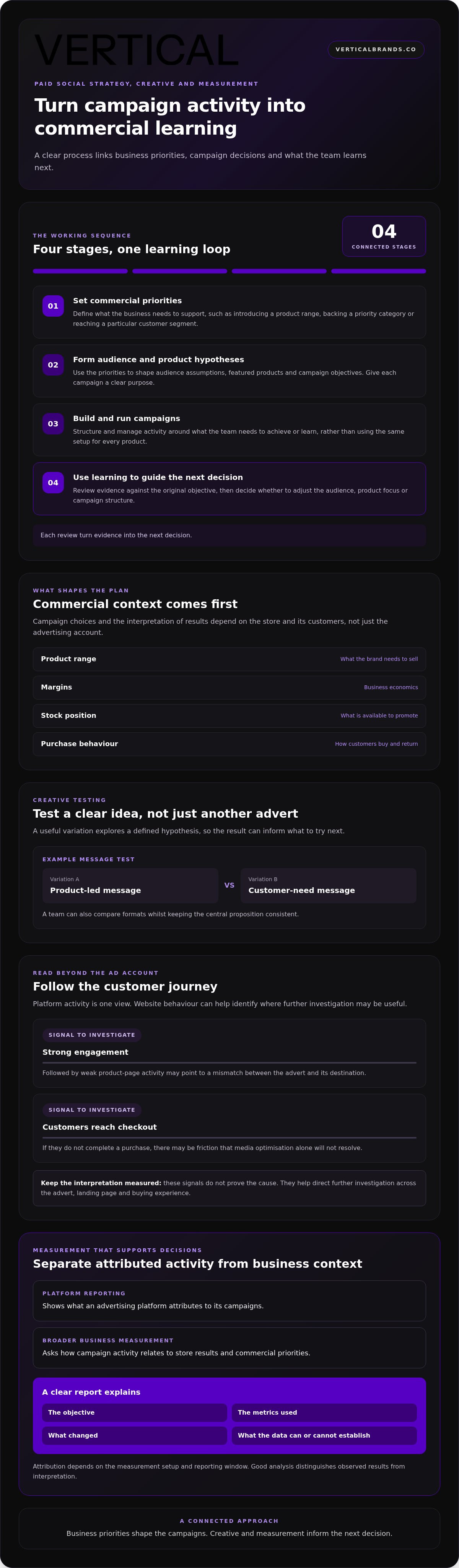
Effective campaign management follows a clear sequence: set commercial priorities, form audience and product hypotheses, build campaigns, then use what you learn to guide the next decision. An e-commerce paid social agency should make that process visible, so each activity has a defined purpose rather than becoming a cycle of launching adverts and checking platform dashboards.
How strategy connects campaign objectives with e-commerce priorities
Planning starts with the business objective. A brand may need to introduce a product range, support a priority category or reach a particular customer segment. Those priorities shape audience assumptions, featured products and campaign objectives. The team can then structure campaigns around what it needs to learn or achieve, rather than applying the same setup to every product.
Execution and review work as a loop. The team assesses performance against the original objective, considers what the evidence supports and adjusts the next phase of activity. A change in audience, product focus or campaign structure should have a clear reason. Strategy provides direction, whilst analysis helps refine the approach. Neither can guarantee a fixed outcome.
How creative testing and measurement improve decision-making
Creative testing is most useful when each variation explores a clear hypothesis. For example, a team might test whether a product-led message resonates more than one focused on a customer need, or compare formats whilst keeping the central proposition consistent. This creates learning about the message and its presentation, rather than a blanket claim that one format always performs best.
Campaign data also needs to be read alongside what happens on the website. Strong engagement followed by weak product-page activity could point to a mismatch between the advert and its destination. If people reach checkout but don’t complete a purchase, that may indicate friction that media optimisation alone won’t resolve. These signals don’t prove the cause, but they help direct further investigation.
Platform-reported performance shows what an advertising platform attributes to its campaigns; broader business measurement asks how that activity relates to store results and commercial priorities. The distinction matters because attribution depends on the measurement setup and reporting window. A clear report explains the objective, the metrics used, what changed and what the data can or can’t establish. It should distinguish observed results from interpretation.
This discipline turns reporting into a decision tool. Teams can see which hypotheses gained support, where the journey may need attention and what to test next. For brands looking to connect campaign execution with wider growth priorities, integrated paid social strategy can bring media, creative and store experience into the same plan.
How to compare e-commerce paid social agencies on evidence, not promises
Choose an e-commerce paid social agency by looking at how it thinks, works and explains its decisions, not by selecting the boldest performance claim. A useful comparison focuses on the process behind the results and whether the agency makes its work visible, so you understand what is being done and why.
| Area | What to look for |
|---|---|
| Strategic fit | A clear link between business priorities, product focus, audiences and campaign objectives. |
| Creative process | A structured approach to developing and testing concepts, messages and formats, with learning informing later work. |
| Measurement | Reporting that distinguishes platform metrics from store performance and explains the limits of attribution. |
| Communication | Clear ownership of decisions, regular updates and reporting that explains actions, not just numbers. |
| Channel integration | Evidence that paid social is considered alongside creative, the website experience and other relevant marketing activity. |
What evidence should an e-commerce agency provide?
A useful case study explains the objective, approach, timeframe, channel and business context. It should make clear whether a result came from paid social specifically or from paid search, SEO or a wider marketing programme. Without that distinction, a headline figure can’t show what the agency’s paid social work contributed.
Look beyond a percentage or platform metric. A result from one account doesn’t establish what will happen for another brand with different products, margins, audiences or customer behaviour. Examples can show how an agency approaches a problem, but they can’t guarantee future performance.
Which operating practices indicate a strong fit?
Look for a visible rhythm of planning, creative development, testing, reporting and review. Recommendations should relate to what the team has observed, and responsibilities should be clear. Who develops the creative? Who reviews the landing-page experience? Who makes or approves campaign changes? When ownership is explicit, activity is easier to follow and questions are less likely to fall between teams.
Reporting should support decisions. A dashboard full of impressions, clicks and conversions may summarise platform activity, but it won’t necessarily explain what changed or what happens next. Strong reporting interprets the numbers, flags uncertainty and records agreed actions. This transparency gives the client a clear view of the work, the reasoning behind it and the next steps, without overstating what the data proves.
What to expect when working with an e-commerce paid social agency
A productive engagement moves through clear stages: align on business priorities, plan the work, execute campaigns, review the evidence and decide what to refine. An e-commerce paid social agency should make those stages and responsibilities visible from the outset. That gives both teams a shared basis for decisions, rather than leaving activity to run without context.
The first stages of a paid social engagement
Start with the business picture. The agency needs to understand current marketing activity, priorities, products, customer segments and relevant customer information. The brand brings knowledge of its range, stock position, trading priorities and customer questions. The agency brings paid social planning and campaign expertise. Together, they can agree what the activity should focus on and how it fits the wider marketing plan.
Before campaigns go live, align on objectives, audiences, creative needs and the store experience customers will reach. Agree who provides product information and assets, who reviews creative, who approves campaign decisions and how access to relevant accounts is handled. Clear responsibilities reduce delays and make it easier to resolve questions as the work progresses.
Agree the review cadence and decision points around the project, campaign activity and available data. A new test may need a different review approach from established activity. The key is to set expectations early, so each review has a purpose and enough context to support a decision.
How campaign reviews turn learning into action
Reviews should connect campaign signals with the customer journey. If an advert attracts attention but visitors don’t engage with the product page, the team can examine the message, audience assumptions and page relevance. If shoppers reach a later stage but don’t complete a purchase, that may point to friction worth investigating. These are clues, not proof of a single cause.
From there, the team can agree a focused next step. That might mean refining a creative concept, revisiting an audience hypothesis or examining whether the landing page delivers on the advert’s promise. Changing everything at once makes it harder to understand what influenced the result. A clear record of the question, action and subsequent learning keeps optimisation disciplined.
Insights can also inform wider e-commerce planning. Customer responses to creative may help shape future content, whilst recurring questions or page friction can flag areas for the website team to review. Paid social management works best when these observations reach the people responsible for the connected customer experience, including retention activity.
To put this joined-up approach into practice, work with Vertical Brands on paid social growth, connecting campaign activity with wider e-commerce priorities.
How Vertical Brands connects e-commerce paid social with wider growth
Paid social has more impact when its role is clear within the wider growth plan. Vertical Brands is an independent digital growth consultancy, bringing strategic direction and execution together across paid social and related e-commerce activity. The aim isn’t to add channels for their own sake. It’s to connect the work that supports the brand’s priorities and customer journey.
A connected paid social and e-commerce growth model
Campaign decisions can inform, and be informed by, the experience around them. Creative that attracts attention needs a relevant landing page. Website behaviour can highlight questions for the team to explore in future messaging. Customer data and retention activity can provide useful context about what happens after acquisition.
Paid social can also sit alongside paid search and SEO, helping teams consider how customers discover products across channels. Klaviyo email marketing and CRM management can support retention activity, whilst website design and development can improve the experience customers encounter after clicking an advert. The right combination depends on the brand’s objectives, capabilities and current priorities. Not every business needs every channel active at once.
Creative is part of that system, too. UGC production and influencer marketing can contribute creator-led material for campaign work, whilst paid social insights can help inform which messages or product angles merit further exploration. These capabilities connect media and creative planning without assuming that one format or channel will suit every audience.
When Vertical Brands is the right growth partner
Vertical Brands supports e-commerce teams looking for strategic direction alongside campaign execution. Paid social sits within a wider offering that includes paid search, SEO, Klaviyo email marketing and CRM management, website design and development, UGC, influencer marketing and growth advisory. These capabilities allow the work to connect around shared commercial priorities, rather than treating each channel as a separate activity.
This joined-up approach is useful when campaign decisions raise questions beyond media buying. A landing-page issue may involve the website experience. A customer journey question may call for input from CRM activity. A creative requirement may benefit from UGC or influencer content. The right combination depends on the brand’s goals, and recommendations should follow those goals rather than a fixed channel mix.
If your team wants paid social connected to its broader e-commerce priorities, discuss your e-commerce paid social strategy with Vertical Brands.
Choose a partner built around your growth priorities
The right e-commerce paid social agency should do more than manage campaigns. It should connect strategy, creative testing and measurement to your business’s commercial priorities. Look for clear evidence, transparent reporting and a working process that links acquisition with the store experience and customer retention.
Paid social is stronger when it works alongside the channels and capabilities that matter to your growth plan. Vertical Brands brings paid search, SEO, CRM, creative and website capabilities together with growth advisory, linking strategic direction to digital marketing execution. The right combination depends on your priorities, not a fixed channel formula.
If your next step is to bring more focus to acquisition and wider growth, discuss your e-commerce growth priorities with Vertical Brands. A clear plan gives your team a stronger basis for decisions, and the right partner helps turn that direction into coordinated action.
Frequently Asked Questions
How do I choose an e-commerce paid social agency?
Choose an e-commerce paid social agency by assessing its strategic approach, creative process, measurement and communication. Look for relevant case studies that explain the objective, channel, timeframe and business context. Ask how the agency separates paid social results from activity across paid search, SEO or other channels. A clear planning and review process, with defined responsibilities and transparent reporting, helps you understand what the team is doing and why.
Is paid social effective for e-commerce brands?
Paid social can support e-commerce growth by helping brands introduce products, reach relevant audiences and bring potential customers to their online store. Its effectiveness depends on factors such as the product, creative, audience, landing-page experience and commercial objectives. Assess results against business measures, not clicks or impressions alone. Campaigns can generate useful learning, but performance varies and no channel or agency can guarantee a particular outcome.
How much does an e-commerce paid social agency cost?
The cost depends on the scope of work, campaign complexity and level of support required. Agency management fees and advertising spend are separate considerations, so clarify what the service covers and how media costs are handled. Creative production, reporting and related strategic work may also affect the engagement’s scope. Compare proposals based on responsibilities and deliverables, rather than choosing on price alone or assuming every agency includes the same work.
What should an e-commerce paid social agency report on?
Reporting should connect campaign activity to agreed objectives. Depending on the plan, it may include spend, reach, clicks, conversions and relevant store performance, alongside the creative or campaign changes made. A useful report explains what the figures indicate, what they can’t establish and what action follows. Platform-reported conversions should be distinguished from wider business results, since attribution and reporting methods influence how activity is credited.
Can paid social work alongside email marketing and CRM?
Yes. Paid social can support customer acquisition whilst email marketing and CRM activity help brands understand and engage customers beyond their first visit or purchase. For example, campaign learning about product interest may inform wider marketing discussions, whilst retention data can add context to acquisition performance. The channels should have connected objectives and clear roles. Not every brand needs the same combination, so planning should reflect its customer journey and priorities.
How long does it take to see results from paid social?
There’s no fixed timeframe for seeing meaningful results. Timing depends on the campaign objective, available data, creative, audience, product and how customers move through the store. Early activity can provide signals for testing, but those signals may not establish longer-term commercial impact. Agree what will be reviewed and which decisions the data can support. The review cadence depends on the project and the amount of usable evidence available.

Other posts





























































Stay ahead with better decisions.
Get business insights today.
