Conversion Copywriting for Growth Teams: Test Voice of Customer Wins

Conversion copywriting is copy written and tested to increase the percentage of visitors who take one specific action, whether that’s starting a trial, completing a purchase, or booking a demo. It’s accountable writing: every headline, CTA, and value proposition ties back to a metric you can measure and improve. This guide breaks down the process, the frameworks, and the testing discipline that separate copy that performs from copy that just reads well.
TL;DR:
- Proper voice-of-customer research using actual customer language is the most effective way to craft persuasive, high-converting copy.
- Testing headlines against the main hesitation and using clear, outcome-focused language typically yields better results than optimizing minor page elements.
- Reliable A/B testing requires tracking primary and guardrail metrics with sufficient sample size and changing only one element at a time.
- Successful conversion copywriting is a full, structured discipline that includes wireframing, validation, and combining copy with design and tracking for measurable improvements.
- Focusing on specific, measurable goals and directly addressing customer objections substantially increases conversion rates over generic or assumptions-based messaging.
Table of Contents
- What Is Conversion Copywriting, and What Does It Produce?
- How Do You Build Conversion-Focused Copy From Scratch?
- Which Persuasion Framework Should You Use?
- How Do You Turn a Framework Into Testable Variants?
- What Makes an A/B Test Actually Trustworthy?
- What Do Real Conversion Copy Rewrites Look Like?
- What Are the Most Common Conversion Copy Mistakes?
- How Has This Approach Worked in Practice?
- What Would You Test First if You Were Starting Today?
- Ready to Put This Process to Work?
- Sources
What Is Conversion Copywriting, and What Does It Produce?
Conversion copywriting is copy engineered to maximize the percentage of readers who complete a defined action, built from voice-of-customer research, persuasion frameworks, and structured testing. That last part is what separates it from ordinary marketing writing. A brand copywriter can produce work that’s elegant and on-message and still never move a conversion rate. A conversion copywriter is judged by whether the number moved.
The discipline splits goals into two tiers. Macro conversions are the big outcomes: a purchase, a signed contract, a completed application. Good conversion copywriting maps every page to one primary macro or micro goal, then writes toward it without diluting the ask.
The outputs of this work are concrete, not conceptual. A conversion copywriter typically delivers:
- Landing pages built around a single conversion goal, with headline, subhead, and CTA aligned to that goal
- Hero sections that state the value proposition and the next step in the first screen
- Email sequences that carry a reader from interest to decision across several touches
- Ad copy variants written to match specific audience segments and funnel stages
- Product descriptions that answer objections instead of just listing features
- Microcopy: button labels, form field hints, checkout reassurances
- Testable hypotheses: written statements of what’s expected to change and why
The difference from SEO or brand copy comes down to orientation. SEO copy optimizes for search visibility and often measures success in rankings or organic traffic. Brand copy optimizes for how a company sounds and measures success in sentiment or recall. Conversion copywriting optimizes for one thing: a defined conversion metric, and every stylistic choice gets weighed against whether it helps or hurts that number. This doesn’t mean conversion copy ignores brand voice or search intent. It means those considerations lose the argument when they conflict with what actually gets tested and proven to convert.
How Do You Build Conversion-Focused Copy From Scratch?
The strongest conversion copywriting follows a sequence, not a burst of inspiration. Skipping straight to writing is the single most common reason copy underperforms, because the writer is guessing at what matters to the reader instead of finding out.
- Research the customer’s actual words. Pull language from support tickets, sales call transcripts, product reviews, survey responses, and social comments. Voice-of-customer research is the highest-leverage activity in this whole process because the phrases customers use to describe their problem almost always outperform anything a copywriter invents from scratch. Message mining works best when you sort what you find into three buckets: the cost of staying stuck, the outcome they actually want, and the objections that make them hesitate to trust you.
- Synthesize the research into a value proposition. Take the recurring phrases and distill them into one sentence that states who the product is for, what it does, and why it beats the alternative. This sentence becomes the spine for the headline, the subhead, and the first line of body copy.
- Wireframe before you polish. Decide what goes above the fold before choosing the exact words. The hero should carry the value proposition, a single primary CTA, and one piece of proof (a number, a name, a guarantee). Everything else, FAQs, secondary features, long-form explanation, belongs further down the page.
- Validate before you ship at scale. Run a preference test (show two headline options to a small panel and ask which one they’d click), a usability check (watch five people try to complete the action), or a live A/B experiment if you have enough traffic to reach a reliable sample.
Pro Tip: Before drafting a single headline, open your last twenty support tickets or app reviews and highlight every sentence where a customer describes their problem in their own words. Those sentences are your first draft, not your inspiration.
The research-to-writing gap is where most teams lose the most value. Skilled writers can make weak insights sound persuasive, but message mining from tickets, calls, and reviews reliably surfaces the exact phrasing that converts in a way clever copywriting alone can’t replicate.

Which Persuasion Framework Should You Use?
Frameworks exist to organize the order of persuasion, not to replace judgment. Pick the one that matches how urgently your reader already knows they have a problem.
- AIDA (Attention, Interest, Desire, Action) works for cold traffic that doesn’t know it needs you yet. Use it for top-of-funnel ads and landing pages tied to broad audiences.
- PAS (Problem, Agitate, Solution) works when the reader already feels the pain but hasn’t found a solution. It’s strong for landing pages arriving from problem-aware search queries.
- The 4 Ps (Picture, Promise, Prove, Push) work for mid-funnel pages where the reader is comparing options and needs a vivid before/after plus evidence before committing.
- A direct-response framework (state the offer, state the deadline or scarcity, state the risk reversal) works for bottom-funnel pages where the reader just needs a reason to act now instead of later.
Headlines deserve outsized attention because they act as a filter. The headline carries a disproportionate share of a page’s conversion performance, and if traffic is limited, test the headline before touching anything else on the page. A strong headline names the outcome, not the category: “Get Your First 100 Customers in 90 Days” beats “The Customer Acquisition Platform” almost every time, because it tells the reader what changes for them.
CTAs follow their own set of rules, and most sites break every one of them:
- Be specific about the action, not vague about the category (“Start My Free Trial” beats “Submit”)
- State exactly what happens next (“Get My 15-Minute Audit” removes the ambiguity of “Get Started”)
- Remove friction from the surrounding copy, not just the button label, by clarifying price, time commitment, or cancellation terms nearby
Where you place proof matters as much as what the proof says. Put a credibility signal (client logos, a specific stat, a review) immediately after the primary CTA in the hero, then build a second, deeper proof section further down the page for readers who need more convincing before they commit. Emotional appeal earns attention, proof earns trust, and clarity removes the friction that stops someone from finishing the action. Arranging those three elements deliberately by funnel stage is what turns a good paragraph into a page that converts.
How Do You Turn a Framework Into Testable Variants?
Frameworks tell you what persuasion looks like. This is how you turn that into copy you can actually put in front of real traffic and measure.
- Write the goal and the hesitation in one sentence. Something like: “We want visitors to start a free trial, but they hesitate because they think setup will take too long.” This single sentence becomes the seed for both your headline and your primary proof element, because it forces you to address the real objection instead of a generic one.
- Generate two or three competing hypotheses. Each should target a different lever: one built on emotional urgency, one built on social proof, one built on removing a specific friction point (price, time, risk). Don’t write five versions of the same idea with synonyms swapped in.
- Draft variants with one controlled difference each. Change the headline in variant A, the CTA copy in variant B, the placement of a testimonial in variant C. If you change three things at once, you’ll never know which one moved the number.
- Prep the page for implementation. Confirm tracking is firing correctly, run a QA pass across mobile and desktop, and check that form submissions and events are hitting the right destination before launch.
- Write the test plan before you launch, not after. Log the hypothesis, the primary metric, the guardrail metric, the audience segment, and the expected runtime.
Pro Tip: Keep a running test log, date, traffic source, segment, hypothesis, primary metric, guardrail metric, result, so you stop re-testing ideas that already failed six months ago. A simple log format turns one team’s failed test into every team’s shortcut.
The biggest mistake in this stage isn’t writing bad variants, it’s writing variants that are too similar to produce a meaningful signal. If your three hypotheses all lean on the same lever with different words, you’re not testing ideas, you’re testing noise. Force real variation between hypotheses, then let controlled, single-variable changes tell you which specific element within the winning hypothesis actually did the work.
What Makes an A/B Test Actually Trustworthy?
Most A/B tests that get reported as wins aren’t statistically sound, and the failure almost always traces back to sample size or multiple simultaneous changes. Trustworthy testing rests on a few non-negotiable rules.
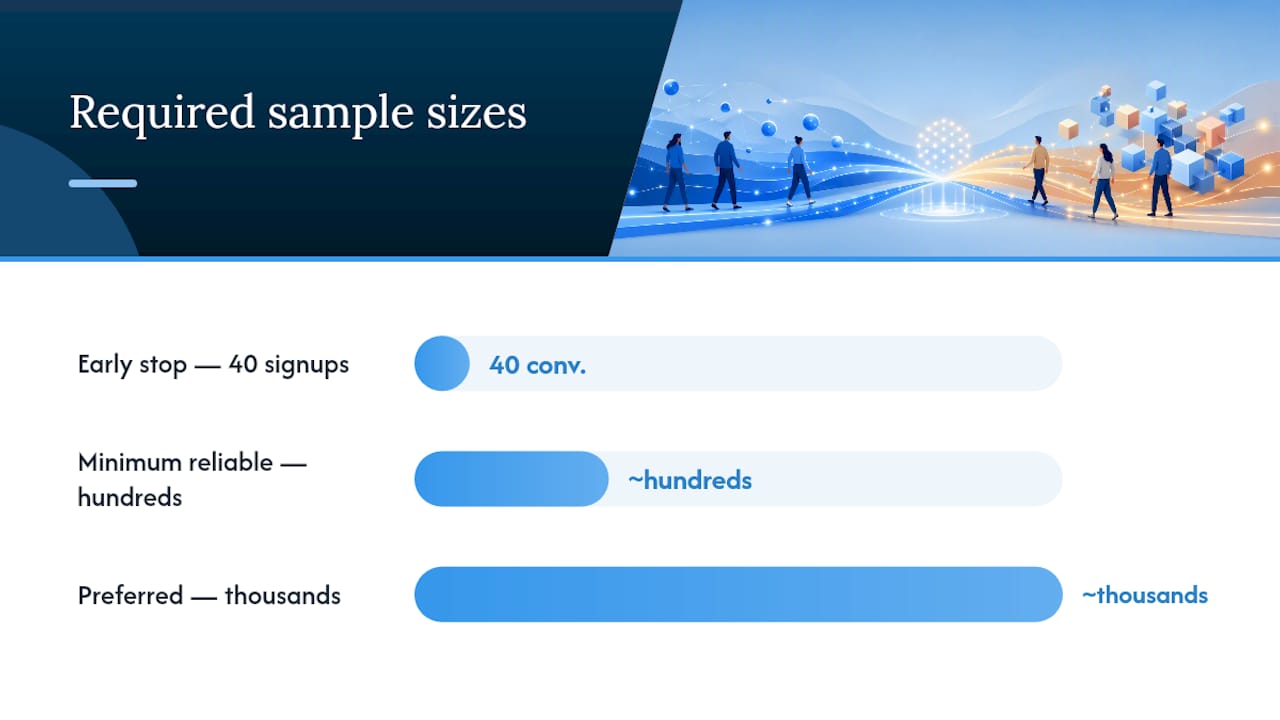
Track a primary metric and at least one guardrail metric. Conversion rate is the obvious primary metric, but qualified lead rate and revenue per visitor matter just as much, since a variant can lift raw conversion rate while quietly dragging in lower-quality leads or lower average order value. A test needs hundreds to thousands of conversions per variant before you can trust the result, which rules out declaring a winner after 40 signups on a low-traffic page.
Change one variable at a time. A test that swaps the headline and the CTA color simultaneously can’t tell you which change caused the lift, which means you’ll repeat the same mistake in your next redesign without knowing it.
Metrics to track and what they guard against:
| Metric | What it measures | Why it matters |
|---|---|---|
| Conversion rate | Percentage completing the primary action | Core performance signal |
| Qualified lead rate | Percentage of conversions matching your ideal customer profile | Prevents chasing volume over quality |
| Revenue per visitor | Total revenue divided by total visitors | Catches variants that win on quantity but lose on order value |
| Guardrail metric (varies) | A secondary outcome you don’t want to damage (refund rate, churn, support tickets) | Stops a “winning” test from causing hidden damage |
- Keep a written test log with date, traffic source, audience segment, hypothesis, primary metric, guardrail metric, and result
- Don’t call a winner early just because the trend line looks good after two days
- When a variant wins on conversion rate but loses on revenue per visitor or qualified lead rate, treat it as inconclusive, not as a win
What Do Real Conversion Copy Rewrites Look Like?
Abstract advice is easy to nod along to and hard to apply. These annotated rewrites show the actual before and after, along with the reasoning behind each change.
Example 1: SaaS trial page headline. Before: “The Smarter Way to Manage Your Team.” After: “Cut Onboarding Time From 3 Weeks to 3 Days.” The original describes a category; the rewrite states an outcome pulled directly from customer language found in support tickets about onboarding frustration. The hypothesis: specificity beats abstraction when the reader already knows they have a time problem.
Example 2: E-commerce product description. Before: “Premium materials, expertly crafted for lasting comfort.” After: “Stitched by hand, tested to survive 50,000 flexes without cracking.” The original is generic adjective stacking that could describe almost any product in the category. The rewrite replaces vague quality claims with a specific, checkable proof point, directly addressing the durability objection customers raised in reviews.

Example 3: Lead-gen CTA button. Before: “Submit.” After: “Get My Free Pricing Estimate.” The original creates no picture of what happens next and adds a small moment of friction (submitting feels like giving something up). The rewrite names the exact deliverable and reframes the click as a gain, not a request.
A short checklist to run against your own pages:
- Does the headline state an outcome, or just a category?
- Does the CTA name the next specific step, or use a generic verb?
- Does the proof point include a real number or name, or just an adjective?
- Can you trace each rewrite back to language a real customer used?
What Are the Most Common Conversion Copy Mistakes?
Fake urgency is the mistake that causes the most long-term damage, because it works once and then erodes trust every time after. A countdown timer that resets when the page reloads, or “only 3 left” language that never changes, teaches customers to distrust everything else on the page. Urgency needs to be objective and reversible to hold up over repeat visits, tied to something real like an actual inventory count or a genuine deadline.
Other recurring mistakes:
- Overclaiming benefits the product can’t consistently deliver, which spikes returns and support volume
- Burying the offer in jargon that sounds impressive but tells the reader nothing concrete
- Presenting too many choices on one page, which increases hesitation instead of resolving it
- Using loss framing dishonestly instead of tying it to a real, verifiable consequence
Before publishing, run a five-question trust audit: Is every claim on this page something we can prove if a customer asks? Is the urgency element real and would it hold up to scrutiny? Does the CTA promise exactly what happens next? Would our own team be comfortable if a customer read this out loud to us? Does removing the emotional language still leave a true, useful sentence behind?
Pro Tip: Loss framing works, but only when it’s tied to a real, specific cost. “You’ll miss this week’s onboarding cohort” is honest if it’s true. “Don’t miss out” is filler that reads as pressure without substance.
How Has This Approach Worked in Practice?
Vertical Brands is a growth marketing agency that integrates strategy, creative, performance marketing, and web development under one roof, which matters here because conversion copywriting rarely succeeds in isolation. Copy that ignores design, tracking, or paid media targeting tends to underperform even when the words are strong.
The FACEGYM engagement shows what the full workflow looks like when every stage gets executed instead of skipped. Working from real customer language and funnel data rather than assumptions, the team applied the same sequence outlined above:
- Voice-of-customer research surfaced the specific objections and desired outcomes driving purchase and booking decisions
- Hypotheses were built around those objections rather than generic best practices
- Copy, design, and landing page structure were tested together rather than copy being tested in a vacuum
- Results were measured against defined conversion metrics, not vanity traffic numbers
The outcome: significant increases in purchases and bookings. Those numbers didn’t come from a clever headline alone. They came from following the research-to-test sequence consistently, on real pages, with real customer language driving every decision.
What Would You Test First if You Were Starting Today?
If I had one testable hypothesis to run first on almost any underperforming page, it would target the hero headline against the dominant hesitation, not the CTA button color or a background image. Most teams optimize the smallest, least consequential elements first because they’re easy to change, while the sentence doing the real persuasive work sits untouched. Headlines filter traffic before anything else gets a chance to work.
A 30-day checklist worth running on any page you own:
- Pull twenty real customer quotes from support tickets or reviews this week
- Write one sentence naming the goal and the dominant hesitation
- Draft two headline variants built on different levers (proof vs. outcome)
- Confirm tracking and guardrail metrics before launching anything
- Run the test for a full business cycle, not three days
- Log the result, win or lose, so the next test starts smarter
— Alex
Ready to Put This Process to Work?
Reading about voice-of-customer research and controlled testing is one thing. Running it consistently across every landing page, email sequence, and ad account while also managing design, tracking, and paid media is another. Vertical Brands runs the entire workflow described here as one connected engagement instead of handing you a document and leaving you to execute it alone.
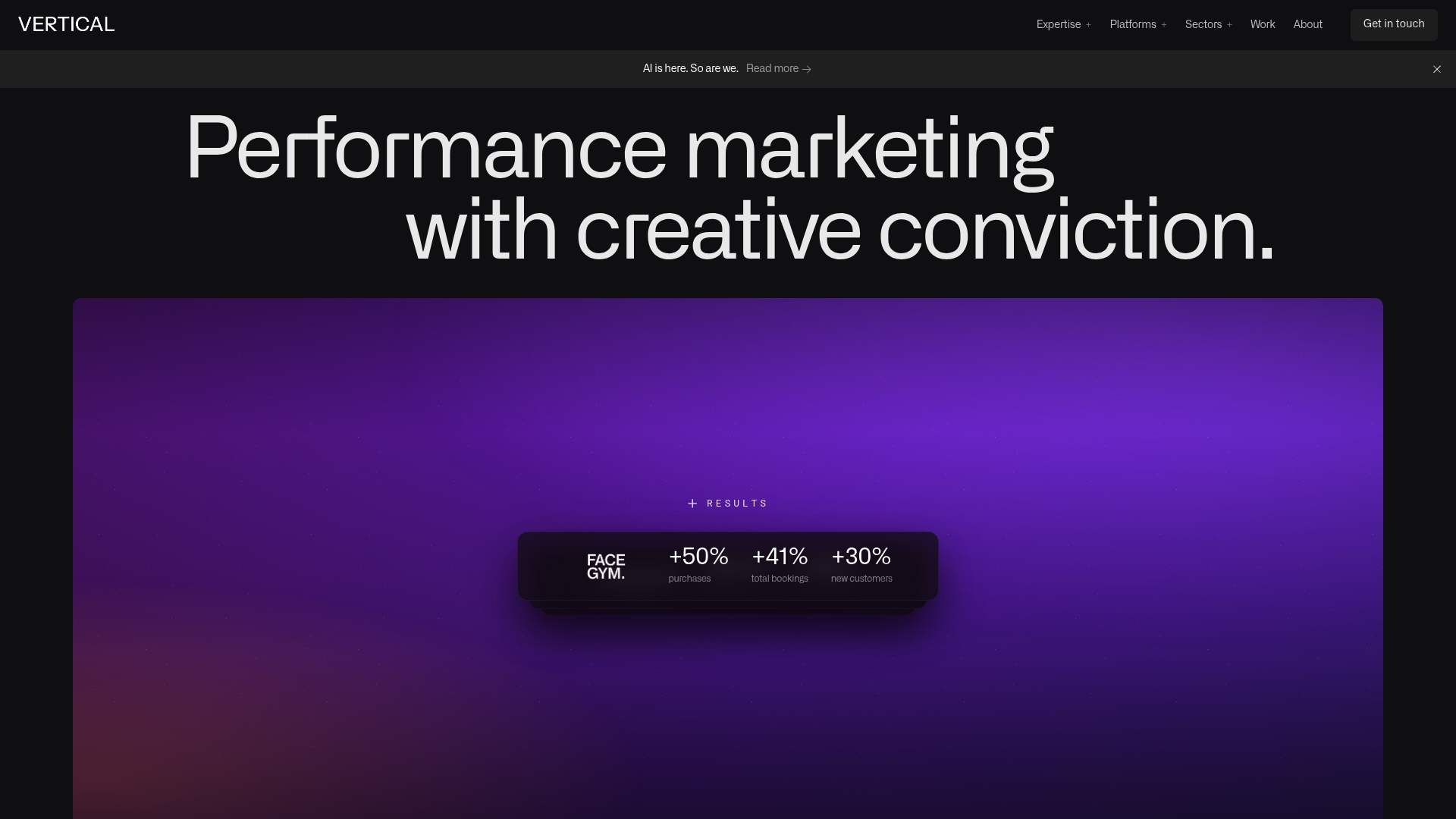
The service list maps directly to what this guide covers: voice-of-customer research and message mining, copywriting paired with design and wireframing, structured A/B testing with proper sample sizes and guardrail metrics, and analytics setup that tells you which variant actually won. If you’re already comfortable running your own tests and just need sharper frameworks, the persuasive copy techniques and ad copy testing guidance referenced throughout this guide are solid starting points for DIY work. But if you’re managing this alongside a dozen other priorities and the tests keep stalling before they reach a reliable sample, that’s usually the moment to bring in a team that runs this process daily. Start by reviewing your current pages with Vertical Brands and get a clear read on where the biggest conversion gains are sitting untested.
Sources

Other posts


























































Stay ahead with better decisions.
Get business insights today.
