Six Phase Rebrand Checklist to Avoid the Inventory Trap

Start with a diagnosis, not a logo brief: a rebrand only works when the strategy is fixed before anyone touches design. Run a gated checklist across six phases: Decide, Strategy, Identity, Build & Migrate, Launch, and Measure. Use a touchpoint inventory with Priority 0/1/2 flags to catch the assets everyone forgets, so launch day doesn’t turn into cleanup week.
TL;DR:
- Confirm your rebrand’s scope by locking strategy, governance, and success metrics before moving into design work to avoid costly mistakes.
- Lock your positioning, target audience, and messaging early, and test these concepts with real clients and competitors to prevent rework later.
- Ensure all assets, including URLs, micro-sites, and internal tools, are identified and prioritized for fixing before launch to prevent overlooked errors.
- Communicate with employees, customers, and partners well in advance to reduce resistance and confusion during the transition period.
- Rely on expert support for a faster, more coordinated process when internal resources are stretched or speed is critical.
Table of Contents
- Rebrand Checklist by Phase: A Quick-Start Reference
- Should You Rebrand or Just Refresh?
- Phase 2: Building a Rebranding Strategy That Actually Holds Up
- Phase 3: Identity and Creative System Checklist
- Rebranding Process Steps for Domain Migration and Legal Updates
- Phase 5: Sequencing Your Rebrand Launch and Briefing Your Team
- What to Measure After You Rebrand
- The Touchpoint Audit: Finding Every Hidden Asset Before Launch
- Getting Employees, Customers, and Partners on Board Early
- Anticipating What Can Go Wrong During a Rebrand
- Talking to the Outside World About Your Rebrand
- Vertical Brands’ Perspective: When a Rebrand Needs Outside Help
- How Vertical Brands Supports Your Rebrand From Strategy to Launch
- Sources
Rebrand Checklist by Phase: A Quick-Start Reference
Print this and assign an owner to each line before your kickoff meeting. Every phase gates into the next. Do not let identity work start before strategy signs off, and do not launch before your redirects have been tested.
- Decide — Confirm rebrand vs. refresh, name a decision owner, set budget and timeline brackets. Owner: founder or CMO. Priority 0.
- Strategy — Lock the audience profile, competitive audit, and positioning statement. Owner: marketing lead or agency strategist. Priority 0.
- Identity — Finalize logo system, palette, typography, and brand guidelines. Owner: creative director. Priority 0.
- Build & Migrate — Map URLs, set 301 redirects, update legal records, migrate analytics. Owner: technical lead plus legal counsel. Priority 0 for anything customer-facing; Priority 1 for internal tools.
- Launch — Brief employees, sequence external announcements, activate customer messaging. Owner: comms lead. Priority 0 on launch day, Priority 1 for the following two weeks.
- Measure — Track KPIs, run a feedback loop, triage fixes. Owner: analytics lead. Priority 2, ongoing.
Leave a column next to each task for the sign-off date and the name of whoever approved it. That single habit, a date and a name, does more to prevent scope drift than any project management tool. Short-term post-launch items (updated email signatures, refreshed sales decks) can sit at Priority 1 since they matter but won’t break the customer experience if they slip a week.
Should You Rebrand or Just Refresh?
Ask three questions before you spend a dollar on design. First: has your positioning actually changed, or does your current brand just look dated? Second: are you entering a new market, merging with another company, or repositioning after a reputation problem? Third: can your current name and logo still carry the business you’re becoming?
If the answers point to “the strategy hasn’t changed, it just looks old,” you want a refresh, not a rebrand. A refresh typically costs less and takes weeks; a full rebrand takes months and costs substantially more, so choosing the wrong path is an expensive mistake.
Once you’ve confirmed a rebrand is warranted, lock governance immediately:
- Name one decision owner, not a committee, who has final sign-off authority.
- Form a small steering group (four to six people) spanning marketing, sales, product, and finance.
- Set a budget bracket and a timeline bracket before strategy work starts, even if both move later.
- Define two or three success metrics now, not after launch, so you know what “working” looks like.
Pro Tip: Write your success metrics down before you see a single logo concept. Once people fall in love with a visual direction, they retrofit the metrics to justify it. Lock the numbers first.
Before moving to Phase 2, you need three deliverables signed off: a documented reason for the rebrand, an approved budget range, and a named decision owner. Skip any of these and you’re building on sand.
Phase 2: Building a Rebranding Strategy That Actually Holds Up
Identity work built on a shaky strategy gets rebuilt within months. Lock your positioning before a single mockup gets made, because strategy typically takes two to four weeks for a small to mid-size business and every hour spent here saves days of design rework later.
Start with your audience profile. Pull your five best clients, the ones who buy the most, refer others, and rarely churn, and write down what they have in common: their job title, their trigger for buying, and the objection they almost didn’t get past. That’s your real audience, not a generic demographic slide.
Next, run a competitive audit. For each direct competitor, note their stated positioning, their visual tone, and their weakest messaging gap. The goal is whitespace: a claim your competitors aren’t making that your audience actually cares about.
From there, draft a one-sentence positioning statement: “For [audience], [brand] is the [category] that [unique benefit], because [reason to believe].” Build a short messaging hierarchy underneath it, one primary message and three supporting proof points.
- Interview five to ten current clients about how they’d describe you today versus what you’re proposing.
- Test the positioning statement against your competitive audit for overlap.
- Run a simple concept test (even five conversations) before committing budget to design.
- Document a “what to keep” list, since validating with real client conversations catches problems a design review never will.
Phase 3: Identity and Creative System Checklist
Your identity system needs to survive a hundred different applications, not just look good on a pitch deck. Before production starts, lock these components:
- Logo system: primary mark, secondary mark, and a simplified icon for small-space use like app icons or social avatars.
- Color palette: primary and secondary colors with exact hex, RGB, and CMYK values, so print vendors and web developers use identical colors.
- Typography rules: headline font, body font, and fallback web-safe fonts for email clients that block custom fonts.
- Imagery direction: photography style, illustration style if any, and specific examples of what to avoid.
- Voice principles: three to five adjectives with a real sentence example of what each sounds like in practice.
Your brand guidelines document needs to cover more ground than most teams plan for: web components, print collateral, packaging if you’re a physical product, and social media templates sized for each platform. If you skip packaging specs, expect a supplier to ask for them the week before a print run, at the worst possible time.
Build in accessibility from the start, not as an afterthought: confirm your primary palette meets contrast standards for text on backgrounds, and specify a fallback font stack for every platform that doesn’t support your primary typeface.
Finally, decide deliberately what you’re keeping versus retiring. A recognizable icon, a tagline with real equity, or a color associated with your category might be worth preserving even inside a full rebrand. Retiring everything at once can cost you the recognition you spent years building.
Rebranding Process Steps for Domain Migration and Legal Updates
This is where rebrands quietly fall apart. The creative work is finished and everyone wants to launch, but the technical and legal groundwork is what protects your search rankings and keeps you compliant.
- Map every URL on your current site and assign a 301 redirect for each one to its new equivalent, prioritizing your highest-traffic pages first.
- Update canonical tags on migrated pages so search engines don’t index duplicate content during the transition.
- Resubmit your sitemap to search engines the day you go live, not a week later.
- Migrate analytics and tracking, including a full review of your cookie consent and tagging setup, since a broken consent framework can quietly wipe out weeks of data.
- Update Companies House records, revise your terms and conditions and privacy policy, and confirm your trademark filings and IP registrations reflect the new name.
- Notify your bank, update account names where required, and flag the change to any lender or insurer tied to your legal entity.
- Notify suppliers and partners of the new name, updated invoicing details, and any new bank information for payments.
- Update operational assets: email addresses, invoice templates, signage, packaging, and any partner portal that displays your old branding.
- Test everything before launch: click through every redirect, fire every analytics event manually, and run a real transaction through your payment flow.
Legal and admin tasks are easy to miss because they’re rarely urgent, but they’re low effort relative to the delays they cause if you skip them.
Phase 5: Sequencing Your Rebrand Launch and Briefing Your Team
Employees who find out about the new name from a customer, instead of from you, become your weakest brand ambassadors on day one. Brief your internal team before anything goes external.
Build an internal launch kit: a short briefing deck explaining the “why” behind the change, a one-page playbook answering likely customer questions, and sales enablement materials so your team isn’t fumbling for the new pitch mid-call.
Sequence your external rollout deliberately. Update your website and core digital assets first, then send customer and partner emails, then go live on social media and any press outreach, all within the same 24 to 48 hour window to avoid a fragmented rollout where some channels show the old brand and others show the new one.
- Draft customer and partner messages in advance, ready to send the moment redirects go live.
- Set up a short escalation path (one named person, one shared inbox) for anyone confused by the change.
- Brief customer support with a script for “why did you change your name?” before launch, not after the first call comes in.
- Expect some brand confusion in the first 30 days and plan a follow-up email or social post reinforcing the new identity rather than assuming one announcement is enough.
Pro Tip: Give your support team the answer to “are you still the same company?” in writing before launch. That single question comes up more often than any other in the first two weeks.
What to Measure After You Rebrand
The first eight weeks tell you if something broke. The first six months tell you if the rebrand worked commercially. Track both timelines separately, because early noise (a redirect error, a confused support ticket) is not the same signal as a real conversion trend.
Primary KPIs worth watching: brand awareness and recall, conversion rate, engagement across your core channels, Net Promoter Score, and support ticket volume tied to brand confusion. Measurement should include a conversion rate baseline comparison across 8 to 12 weeks, with a follow-up review of commercial KPIs at the 3 to 6 month mark once the dust has settled.
- Run rapid checks in weeks 0 through 8: redirect errors, analytics gaps, support ticket spikes.
- Review commercial KPIs at months 3 through 6: conversion trends, retention, and repeat purchase rate.
- Assign an owner and a response SLA to every fix, so issues don’t sit in a shared doc unaddressed.
- Report to leadership on a fixed cadence (biweekly for the first two months, then monthly) using the same template each time so trends are easy to spot.
Tools built for AI-driven brand awareness tracking can help surface sentiment shifts faster than a quarterly survey would.
The Touchpoint Audit: Finding Every Hidden Asset Before Launch
The biggest rebrand risk isn’t the logo. It’s the old landing page, the partner portal, or the internal dashboard nobody remembered still displays your previous name. This is the Inventory Trap, and a priority-classified registry is the fix.
Run a three-hour discovery workshop with representatives from sales, support, and IT. Crawl your own domain, search old email threads for forgotten microsites, and ask partners directly what links to you they still have live. Log everything into a registry with an owner and a priority field.
| Asset | Location Found | Priority |
|---|---|---|
| Legacy pricing microsite | Google site search | 0 |
| Partner co-branded portal | Partner outreach email | 0 |
| Internal sales dashboard | IT team interview | 1 |
| Archived case study PDF | Old email thread | 2 |
- Priority 0: must be fixed before launch (customer-facing, high traffic).
- Priority 1: fix within two weeks of launch (internal tools, low-traffic pages).
- Priority 2: fix within the quarter (archived content, low-risk assets).
Getting Employees, Customers, and Partners on Board Early
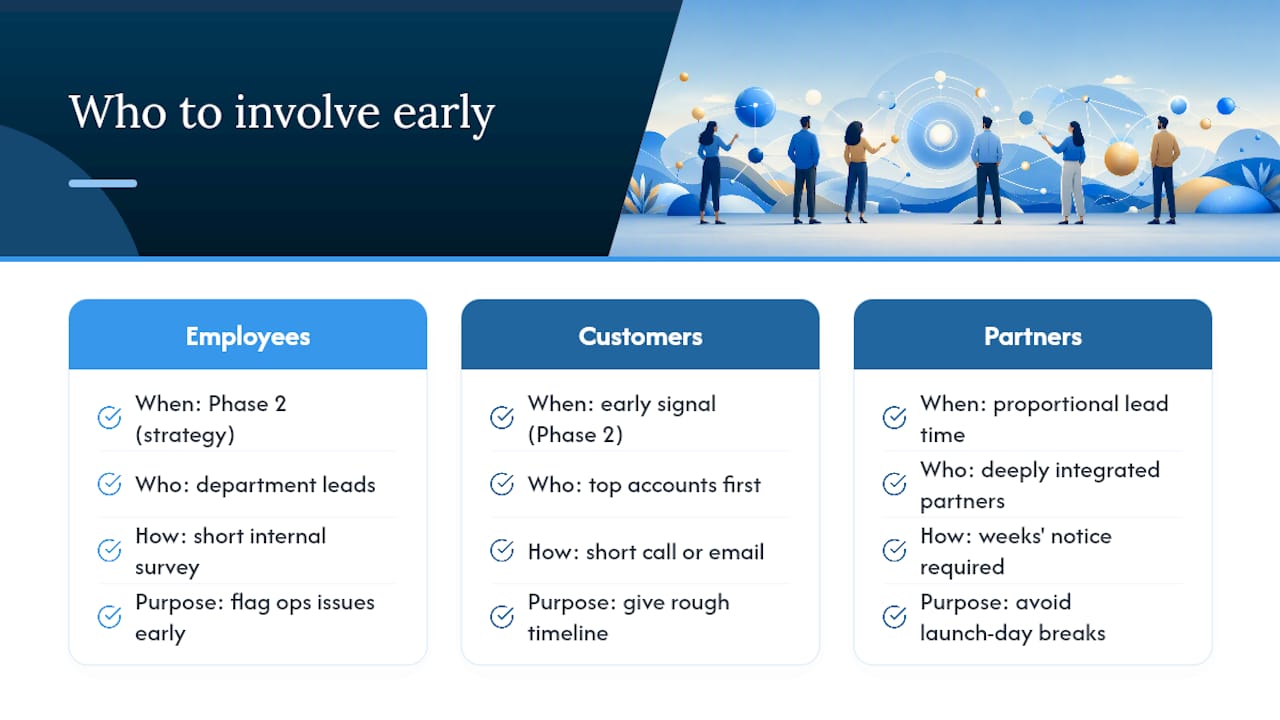
A rebrand designed in isolation and revealed as a surprise invites resistance, even when the work is good. Bring your stakeholders in during Phase 2, not Phase 5.
Employees notice a name or logo change before anyone explains why. Loop in department leads during the strategy phase so they can flag operational issues, an internal tool that hard-codes your old name, a sales deck that took months to build, before those become launch-week fires. A short internal survey asking “what do you think we stand for today” often surfaces language your strategy work can use directly.
Customers deserve the same early signal, especially your highest-value accounts. A short call or email to your top clients explaining the change is coming, with a rough timeline, prevents the jarring experience of logging in one day to a different name with no warning. This is also where the client interviews from Phase 2 pay double duty: the same five to ten conversations that shape your positioning also become your earliest internal champions for the new brand.
Partners and suppliers need a lead time proportional to how deeply integrated you are. A payment processor or a co-branded reseller needs weeks of notice, not a same-day email. Build a simple stakeholder map early: who needs to know, how much notice they need, and who owns telling them. Skipping this step doesn’t just create friction, it creates the exact kind of confused, defensive reaction that makes a well-planned rebrand look chaotic from the outside.
Anticipating What Can Go Wrong During a Rebrand
Every rebrand carries predictable risks, and naming them in advance is cheaper than discovering them mid-launch. Build a short risk register alongside your project plan, not after something breaks.
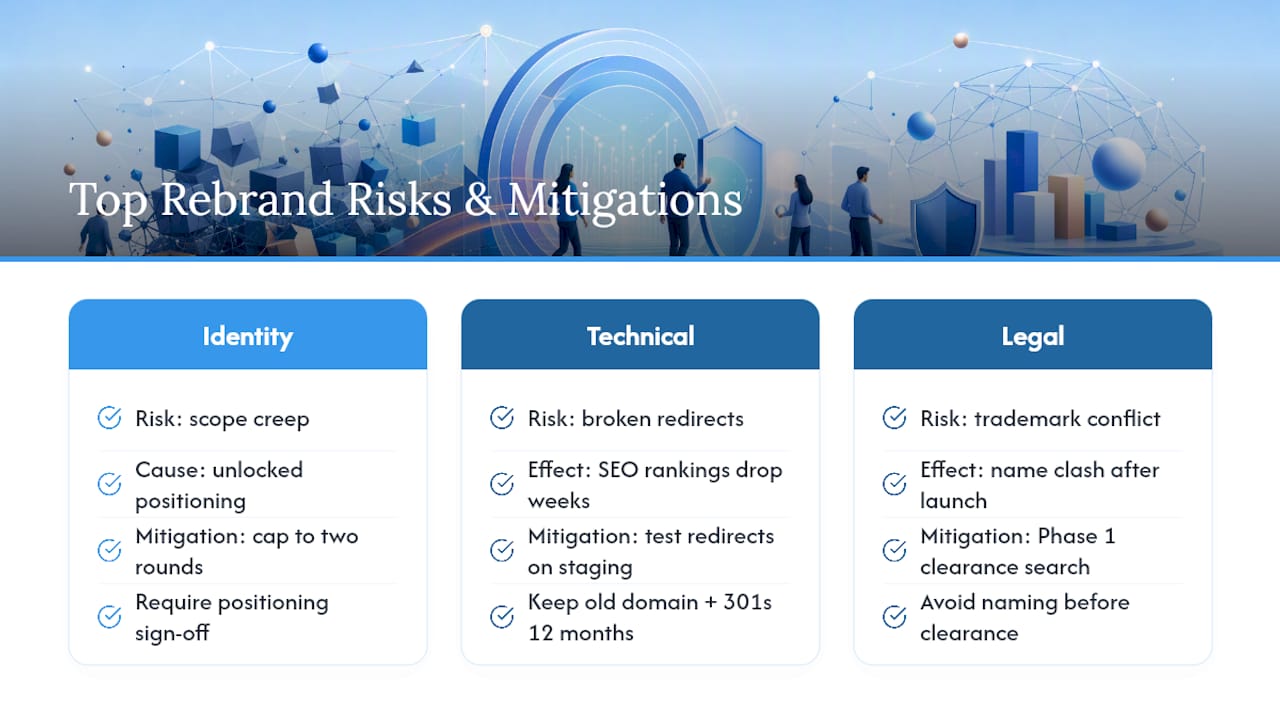
The most common failure point is scope creep in the identity phase: stakeholders keep requesting “one more direction” because the positioning underneath was never locked. The mitigation is procedural, not creative. Cap concept rounds at two, and require any new direction request to go back through the approved positioning statement first.
The second risk is technical: a botched redirect map that tanks search rankings for weeks. Mitigate this by testing every redirect on a staging environment before the domain change goes live, and keep your old domain active with 301s in place for at least twelve months rather than letting it lapse.
The third risk is legal exposure: launching a new name before confirming trademark availability, then discovering a conflict after your signage is printed. Run a trademark clearance search during Phase 1, before any creative work starts, so a naming conflict doesn’t surface after you’ve already spent the budget.
Build a simple contingency plan for each: who decides if a redirect fails, who approves an emergency messaging pivot if a name conflict surfaces late, and how much budget is held in reserve for exactly this kind of problem.
Talking to the Outside World About Your Rebrand
Internal alignment means nothing if your external announcement is scattered across channels with inconsistent messaging. Treat this as its own workstream with a single person accountable for the calendar.
A short press release works best when it leads with the reason for the change, not the visual details. Journalists and industry outlets care about the strategic story, a merger, a repositioning, a new market, far more than the new color palette. Send it to relevant trade press and any journalist who has covered you before, timed to go out within the same window as your website switch.
Social media needs a sequence, not a single post. Announce the change on your primary channel first, then follow with a short explainer post within 48 hours addressing the “why,” then a longer-form piece (blog post or video) within the first week that gives customers the full context. Pin the announcement post so it’s the first thing new visitors see during the transition period.
PR management during this window means designating one person to monitor mentions and respond quickly to confusion, whether that’s a customer asking “did you get bought out?” or a journalist getting a fact wrong. A prepared FAQ document, shared internally, keeps every response consistent whether it comes from support, sales, or the founder’s own social account.
Vertical Brands’ Perspective: When a Rebrand Needs Outside Help
We’ve watched enough rebrands stall for the same reason: internal teams are stretched thin, and a rebrand competes with everyone’s day job. Vertical brings brand strategy, creative, web development, and performance marketing under one roof specifically because rebrands touch all four at once, and coordinating separate vendors for each slows everything down.
When we worked with FACEGYM, the results showed what happens when strategy, creative, and performance marketing move together: a 50% increase in purchases and a 41% rise in bookings.
[Author’s note: insert Alex’s professional background and credentials.]
Hire agency support when you lack internal bandwidth to run six phases in parallel, need speed your team can’t match alone, or need one team accountable for strategy through execution.
— Alex
How Vertical Brands Supports Your Rebrand From Strategy to Launch
Running six phases with a lean internal team is possible, but it’s slower and riskier without someone who has done it before watching every gate. Vertical Brands handles strategy, creative, web development, and performance marketing as one connected process, so your positioning, identity, and launch campaign are built by the same team instead of getting reinterpreted at every handoff.

That integration is the difference for a rebrand specifically: no waiting on a separate design vendor to interpret a strategy doc, no disconnect between the new brand identity and the paid media campaign meant to introduce it.
If you’re weighing whether to run this checklist internally or bring in support, the next step is a straightforward one: book a discovery call with Vertical Brands to talk through your scope, timeline, and budget before you commit to either path.
Sources

Other posts






























































Stay ahead with better decisions.
Get business insights today.
