E-commerce CRM Consultant: How to Find the Right Growth Partner
What if your next growth opportunity is already in your customer data, but your teams can’t act on it? An e-commerce CRM consultant should do more than plan campaigns. The right partner connects customer insight, retention priorities and delivery, so CRM supports the wider growth strategy instead of...

What if your next growth opportunity is already in your customer data, but your teams can’t act on it? An e-commerce CRM consultant should do more than plan campaigns. The right partner connects customer insight, retention priorities and delivery, so CRM supports the wider growth strategy instead of operating as a disconnected email channel.
If customer data and marketing activity feel fragmented, retention programmes aren’t tied to commercial priorities, or your team lacks the time to manage CRM effectively, the issue may be structural. Customer signals become useful when they inform clear decisions and consistent execution. More campaigns won’t fix a system that lacks direction.
This article explains what a well-scoped CRM consultancy engagement should cover and how to assess strategic thinking, technical delivery and measurement together. You’ll see how specialist Klaviyo email marketing, automated flows and broader CRM management can turn customer data into a practical retention system aligned with your e-commerce goals. The focus is on choosing a growth partner who can connect the plan to the work, and the work to meaningful business priorities.
Key Takeaways
• An e-commerce CRM consultant should connect customer data, lifecycle marketing and commercial priorities, not simply produce one-off emails.
• Assess customer journeys, systems, data quality and consent practices before deciding which CRM activity to prioritise.
• More campaigns won’t resolve every issue. Identify whether the real gap is strategic direction, technical implementation or team capacity.
• Evaluate a consultant’s strategic fit, technical capability, operating model and approach to measurement together.
• A useful CRM roadmap connects prioritised activity with execution and ongoing learning, making CRM part of a wider growth system.
What an e-commerce CRM consultant does beyond sending emails
An e-commerce CRM consultant connects customer data, lifecycle marketing and commercial priorities. The role is broader than producing a campaign or configuring a platform. It involves understanding how customer relationships develop, then shaping relevant activity around the business’s goals.
A CRM consultant turns customer insight into a coordinated plan for attracting, converting and retaining customers, with progress measured against business priorities.
That means considering the full customer journey. Acquisition brings people to the brand. Conversion turns interest into a purchase. Retention gives customers reasons to return, while customer value helps a business understand the contribution of those relationships over time. CRM can support each stage through relevant communications and joined-up planning, but it doesn’t guarantee commercial results.
What does CRM mean for an e-commerce business?
Customer Relationship Management (CRM) describes the practices and systems used to manage customer relationships over time. The Customer Relationship Management (CRM) overview provides useful context on the broader concept. For an e-commerce business, CRM activity might draw on purchase history, marketing engagement and other customer context to make communications more relevant.
The strategy is not the software. A platform provides tools to organise data and deliver activity, but it doesn’t decide which customer journeys matter, what the business should prioritise or how performance should be assessed. Those decisions require commercial context. A welcome email, for instance, can introduce the brand to a new subscriber, while post-purchase communications can guide a customer through what comes next.
Which problems should a CRM consultant help solve?
A consultant can help address disconnected customer data, inconsistent communications and uncertainty about where retention effort should go. Lifecycle planning makes the customer journey more coherent by setting out how the business communicates at different stages, rather than treating every email as a separate task.
For example, a customer who has just purchased may need a different message from a subscriber who has yet to buy. A clear plan can help teams coordinate those touchpoints and avoid irrelevant or conflicting communications. A useful lifecycle plan help turn customer context into purposeful activity, supported by automated flows and ongoing management.
CRM has limits. A consultant can help organise marketing activity around customer needs, but cannot resolve underlying product, pricing or fulfilment problems alone. Strong CRM management works alongside those business decisions. At Vertical Brands, Klaviyo email marketing and broader CRM management connect data-driven marketing and automated flows with wider growth priorities.
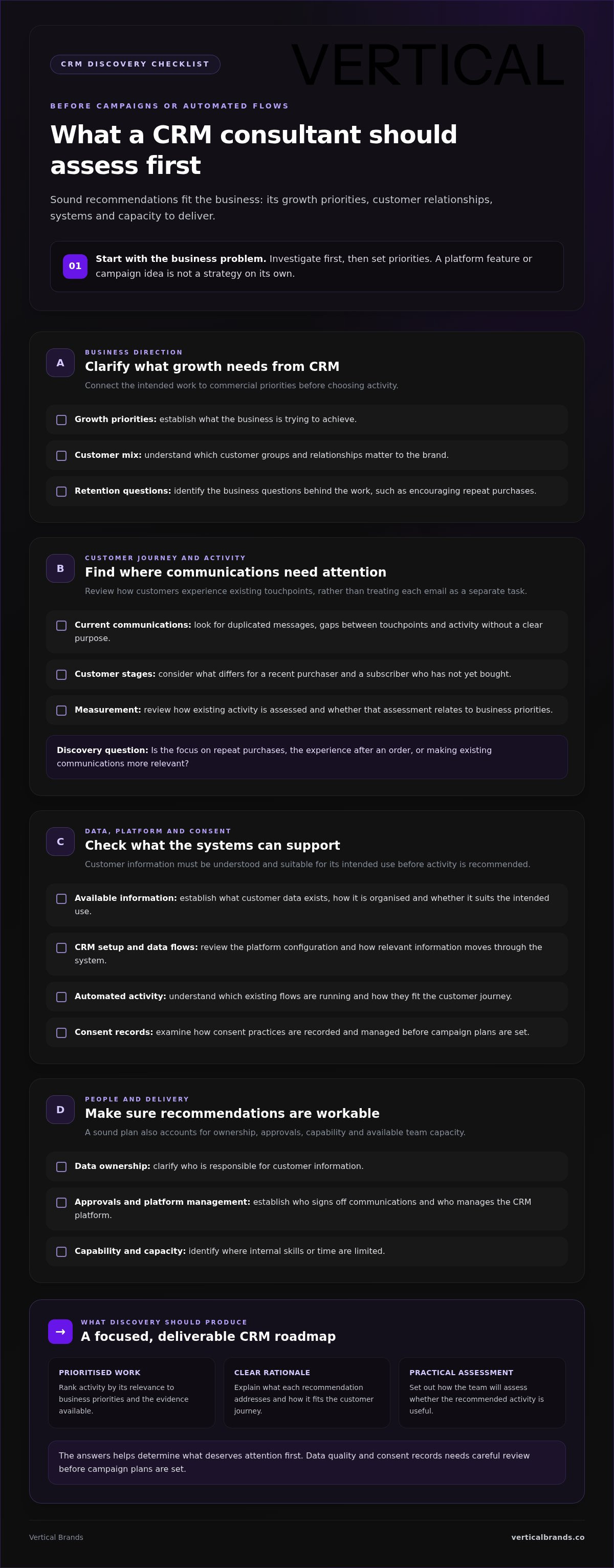
What an e-commerce CRM consultant should assess before recommending activity
Recommendations are only useful when they fit the business. Before proposing campaigns or automated flows, an e-commerce CRM consultant should understand what the brand is trying to achieve, how customers currently interact with it, what its systems can support and who will manage the work.
Strong CRM recommendations connect evidence about customers with the brand’s commercial priorities and the practical realities of delivery. That means investigating first, then setting priorities. A programme that works for one retailer may not suit another with different products, customer behaviour, systems or internal capacity.
How should discovery connect CRM activity to business goals?
Discovery should begin with the growth priorities, customer mix and retention questions that matter to the business. Is the focus on encouraging repeat purchases, improving the customer experience after an order, or making existing communications more relevant? The answers help determine which parts of the customer journey deserve attention first.
A consultant should also review current communications and measurement. This can reveal duplicated messages, gaps between customer touchpoints or activity that’s running without a clear purpose. The aim isn’t to create the longest possible task list. It’s to shape a focused roadmap that ranks work by its relevance to business priorities and the evidence available.
This is a pragmatic, disciplined approach to CRM: start with the business problem, not the platform feature or campaign idea. Each recommendation should explain what it addresses, how it fits the customer journey and how the team will assess its usefulness.
Why do data, platform and team context matter?
Before recommending activity, a consultant needs to understand what customer information is available, how it is organised and whether it is suitable for the intended use. They should review the CRM setup, relevant data flows, existing automated activity and how consent practices are recorded and managed. Data quality and consent records need careful review before campaign plans are set.
Team responsibilities matter just as much. The assessment should clarify who owns customer data, who approves communications, who manages the platform and where internal capability or capacity is limited. Without that context, even a sound recommendation can be difficult to deliver consistently.
For more detail on the practical considerations involved in setting up CRM, read the B2C CRM implementation guide. Vertical Brands connects Klaviyo expertise and broader CRM management with growth advisory, linking strategic priorities to practical delivery. Learn more about Klaviyo and CRM management.
Do you need an e-commerce CRM consultant or only more campaigns?
More campaign activity can look like progress. But if customer groups, timing and purpose are unclear, sending more messages may simply add noise. The first question isn’t how often to email. It’s whether the business knows which customer need each communication should address and how that activity supports its priorities.
A low-performing campaign alone doesn’t prove you need consultancy. It may need a clearer offer, a different message or a straightforward adjustment. Look for a pattern across the programme, then identify the type of support that fits:
Strategic problem
lifecycle priorities are unclear, customer information sits in disconnected systems, or no one owns decisions across the customer journey.
Technical implementation need
a defined platform change, data connection or migration is blocking planned activity.
Execution capacity gap
the strategy is understood, but the team can’t consistently build, manage or review the work alongside other responsibilities.
When is strategic CRM support the better starting point?
Start with strategy when the business can’t explain which customer journeys matter most, why particular communications are being sent or who is responsible for them. In that situation, adding automation or campaign production risks scaling activity before its purpose is clear. An e-commerce CRM consultant can help organise priorities and align the work with customer needs and commercial goals.
That doesn’t mean every weak result needs an external partner. If the strategy is sound and a single campaign underperforms, review its audience, message and timing first. Strategy should come before more activity when the uncertainty is about what to do, not simply how to execute it.
When might a focused implementation or migration be enough?
A defined technical requirement can call for a narrower project. For example, a business may need to move its CRM platform or address a specific data setup before continuing with its existing programme. If migration is the primary need, the Klaviyo migration guide covers that work in more detail.
A one-off project centres on completing the defined change. Ongoing optimisation is different: it involves reviewing activity, adjusting priorities and managing CRM as customer needs and business goals evolve. Choose the scope that matches the actual gap, rather than assuming every business needs continuous consultancy.
When is execution support the main gap?
If priorities are clear but the team lacks capacity to deliver them, additional campaign and CRM management may be the practical answer. The signals points to a delivery gap, not necessarily a strategic one. In-house teams can retain ownership of direction while specialist support helps manage execution and maintain momentum.
How to evaluate an e-commerce CRM consultant’s strategy and delivery
Assess the thinking and the execution together. An e-commerce CRM consultant should connect commercial priorities to customer journeys, explain how the platform supports the plan, and show how activity will be managed and measured. Use this sequence to structure your evaluation:
Strategic fit
Do recommendations address your business priorities and customer context, or are they a standard list of campaigns?
Technical capability
Can the consultant work with your CRM setup, data and automation requirements?
Operating model
Is it clear who owns decisions, delivery, approvals and ongoing management?
Measurement
Does reporting connect activity to agreed business questions, rather than relying on surface-level engagement figures alone?
What should a credible CRM strategy make clear?
A useful roadmap links priorities to customer journeys, data requirements, platform activity and ownership. It should explain why each recommendation matters, what needs to be in place to deliver it and how the team will review its relevance. Strategy, technical setup and ownership need to work together, not sit in separate documents.
Look for sensible sequencing. Some opportunities may be actionable with the current setup, while others depend on stronger data foundations or changes to how teams work. The roadmap should distinguish between immediate opportunities and longer-term improvements without prescribing a fixed number of segments, flows or tasks for every business.
How should performance and collaboration be assessed?
Reporting should start with the objectives agreed for the CRM programme. Depending on those priorities, relevant measures might include repeat purchase behaviour, revenue associated with CRM activity or engagement with lifecycle communications. The point is not to track every available metric. It’s to understand what the data can and can’t show, then use that evidence to guide decisions.
Review how the consultant will share progress, explain performance and turn findings into practical next steps. Clear reporting gives internal teams a view of what’s working, what needs attention and why. It also creates a basis for collaboration, rather than leaving the CRM function isolated from the rest of marketing.
CRM activity can connect with paid media, search engine optimisation and the website experience. For instance, insights from customer engagement may inform how teams approach audiences or improve relevant website journeys. Coordination matters, but each channel still needs a defined role and appropriate measures. At Vertical Brands, Klaviyo and CRM management can sit alongside broader digital growth capabilities, helping align customer retention with wider commercial priorities.
For more on how strategy, delivery and measurement fit together, see Vertical Brands’ e-commerce CRM services.
How an e-commerce CRM consultant can turn the plan into sustained growth
A CRM plan only creates value when it moves into delivery, review and refinement. An e-commerce CRM consultant can help translate priorities into platform activity, such as automated flows and targeted communications, then use customer behaviour and performance evidence to inform what happens next. The process is iterative: implement the agreed work, assess what it shows and adjust activity as business needs evolve.
What does ongoing CRM management involve?
Ongoing management keeps CRM activity connected to current customer context and business priorities. It can include reviewing the quality and usefulness of customer data, checking whether lifecycle activity still reflects the intended journey, and identifying where communications may need refinement. As priorities change, the programme should be revisited rather than left to run on assumptions.
Optimisation should have a clear rationale. If customers aren’t engaging with a particular message, the response might involve reviewing its relevance, audience or place in the journey. If data shows a customer group responds differently, that insight may inform future activity. Performance is one input, not the whole decision. Commercial context and the customer experience matter too.
The review should help teams understand what the evidence suggests and what action is appropriate. There’s no universal cadence or set of changes that suits every business. The work should reflect the programme’s objectives, the available data and the organisation’s capacity to act on findings.
Why connect CRM with the wider growth system?
Customer relationships don’t sit within one channel. CRM insights can inform relevant activity across paid social, paid search, search engine optimisation and the website experience. For example, patterns in customer engagement may help teams tailor audience activity or improve the path from a marketing message to a useful website page. Each channel has its own role, but coordination can help reduce disconnected experiences.
Vertical Brands brings Klaviyo email marketing and broader CRM management together with growth advisory and wider digital growth capabilities, including paid media, SEO and website development. This connects customer retention activity with other commercial priorities, while keeping decisions grounded in evidence rather than assuming every channel needs to do the same job.
A sustained CRM programme isn’t a fixed set of emails. It’s a managed system that links customer understanding to purposeful execution and ongoing learning. Explore CRM and growth support to see how these capabilities work together.
Turn customer insight into your next growth priority
The right e-commerce CRM consultant does more than increase campaign output. They connect customer data and lifecycle activity to business priorities, assess whether strategy, technology or team capacity is the real constraint, then link delivery to meaningful measurement.
Look for a partner who can move from clear priorities to practical execution. Specialist Klaviyo email marketing, automated flows and data-driven CRM management can support that work, while paid media, SEO, web development and growth advisory help connect retention with the wider e-commerce growth system. Strategy, delivery and measurement need to work together, not as separate activities.
Vertical Brands brings CRM expertise and wider growth capabilities together to help businesses build a more coordinated approach to customer relationships. Discuss your e-commerce CRM requirements to identify a practical next step for your business. With clear priorities and the right support, customer data can become a stronger foundation for sustained growth.
Frequently Asked Questions
What does an e-commerce CRM consultant do?
An e-commerce CRM consultant helps connect customer data, lifecycle marketing and commercial priorities. The work may include reviewing the current CRM setup, identifying gaps in customer journeys, shaping a strategy and supporting implementation or ongoing management. For example, a consultant might help a retailer plan communications for new customers and existing buyers. The precise scope depends on the business, with the aim of making CRM activity more relevant, measurable and aligned with wider growth plans.
When should an e-commerce business hire a CRM consultant?
Consider specialist support when disconnected data, unclear retention priorities or inconsistent CRM ownership are limiting progress. It may also be useful when planning a platform change or building a more coherent customer lifecycle programme. First, define the business problem. If the challenge is simply one underperforming campaign, review its audience and message before expanding the scope. A consultant is most useful when the work supports an agreed priority, not just more activity.
How do I choose an e-commerce CRM consultant?
Assess strategic understanding, platform capability, implementation approach, reporting and collaboration with your team. Ask how recommendations relate to customer journeys and business objectives. A useful answer should make priorities clear and explain how the work will be delivered and assessed. Look for transparent measurement and practical reasoning, not unsupported promises. The right fit can explain complex CRM decisions in plain language and show how strategy translates into useful day-to-day activity.
Is a CRM consultant different from an email marketing agency?
The terms can overlap, but the proposed scope matters more than the label. Email marketing often focuses on campaign planning and delivery. CRM consultancy can take a wider view of customer data, lifecycle strategy, platform use and retention priorities. Some businesses need campaign execution; others need help connecting systems and customer journeys. Compare the proposed work with the problem you need to solve, including who will manage implementation and how progress will be measured.
Can a CRM consultant work with Klaviyo?
Yes. A consultant with Klaviyo expertise can help assess the account, plan customer communications and manage relevant CRM activity. The platform should support a clear customer and commercial strategy, rather than dictate it. Vertical Brands specialises in Klaviyo email marketing and CRM management, including automated flows and data-driven marketing. This work can sit alongside broader digital growth services, connecting customer retention activity with wider business priorities.
How much does an e-commerce CRM consultant cost?
The cost depends on the project scope, level of strategic support and whether implementation or ongoing management is required. A defined assessment differs from a broader CRM programme. The scope depend on your objectives, current setup and internal capacity, so a generic market estimate may not reflect the work involved. Clarify the business problem and what you need delivered first. That gives you a more useful basis for assessing the proposed work and its value.

Other posts





























































Stay ahead with better decisions.
Get business insights today.
