Gorgias vs Zendesk: Which Helpdesk Fits Your Store?

For most Shopify and other online stores, Gorgias is the better fit. It is built around order data, it bills by ticket volume, and agents can act on an order without leaving the ticket. Zendesk is the better fit when support is a large, multi-channel operation with strict routing, SLA and governance needs. The right answer depends on where your support bottleneck sits, and this guide shows you how to find it.
We are a growth marketing agency, not a helpdesk vendor. We see support tools from the side that matters to revenue: repeat purchase, email performance, reviews and retention all depend on how fast and accurately customers get answers. All prices below are quoted in US dollars, as the vendors publish them, so expect currency conversion and VAT on a UK invoice.
TL;DR
- Gorgias is an ecommerce helpdesk priced by monthly ticket volume. It suits order-centred support on Shopify, BigCommerce or Magento.
- Zendesk is a general-purpose omnichannel platform priced per agent per month. It suits larger teams with complex routing, SLAs and multiple product lines.
- Gorgias is faster to learn: practitioners report 1 to 3 days for agents, against 1 to 2 weeks for Zendesk.
- AI is charged on top of base plans at both vendors, so model the full bill, not the headline price.
- Choose by bottleneck: returns, refunds and shipping queries point to Gorgias; complexity and compliance point to Zendesk.
Table of Contents
- The core difference: who each tool was built for
- Pricing: ticket volume against seats
- Order actions: where the work actually happens
- Features that favour Zendesk
- Features that favour Gorgias
- Setup time and learning curve
- AI agents and what they really cost
- A note on Zendesk Sell and the CRM question
- Which one should you choose?
- Our perspective
- Where we can help
- FAQ
- Sources
The core difference: who each tool was built for
Both platforms are mature. The gap is in who they were designed for. Gorgias is a purpose-built ecommerce helpdesk centred on order data and priced by tickets per month. Zendesk is a general-purpose, enterprise-grade platform for omnichannel support, priced per agent.
That single choice shapes everything else:
- Data model. Gorgias treats the customer and their orders as the centre of the ticket. Zendesk treats the ticket and the agent queue as the centre, and customer commerce data is something you connect.
- Pricing logic. Gorgias cost grows when customers write in more. Zendesk cost grows when you hire more agents.
- Typical buyer. Gorgias is aimed at direct-to-consumer brands. Zendesk is engineered for operations that need advanced routing, SLAs and complex governance.
Neither is better in general. Each is better for a specific kind of business, which is why a feature checklist alone rarely settles the question.
Pricing: ticket volume against seats

This is where most comparisons start, and where most buyers get surprised.
How Gorgias charges
Gorgias plans scale with the number of billable tickets per month. One published breakdown lists Starter at $10 a month for 50 tickets, Basic at $60 for 300, Pro at $360 for 2,000 and Advanced at $900 for 5,000, with Enterprise on custom terms. The same source notes that unlimited users are included, and that automation and AI usage are billed separately and can raise your monthly total. Zendesk’s own comparison page cites the Gorgias Advanced tier at $750 a month for 5,000 tickets on annual billing, which shows that monthly and annual rates differ. Always check the current rate on the vendor’s page before you budget.
How Zendesk charges
Zendesk Suite is priced per agent per month. One 2026 review lists Suite Team at $55, Professional at $115 and Enterprise at $169 per agent per month on annual billing, before AI, voice add-ons and setup costs. Another review puts the entry Support Team plan at $19 per agent. Zendesk’s own comparison confirms Professional at $115 per agent per month on annual billing.
What this means in practice
The two models cross over at different points depending on your shape. Consider two illustrative stores. These are our own arithmetic on the list prices above, not vendor quotes.
| Scenario | Gorgias (list price) | Zendesk Suite Professional (list price) |
|---|---|---|
| 3 agents, about 1,500 tickets a month | Pro plan at $360 a month (2,000 tickets) | 3 x $115 = $345 a month, annual billing |
| 10 agents, about 1,500 tickets a month | Still Pro at $360 a month, users are unlimited | 10 x $115 = $1,150 a month, annual billing |
| 3 agents, about 5,000 tickets a month | Advanced at $900 a month (monthly billing) | 3 x $115 = $345 a month, annual billing |
The pattern is clear. A small team handling very high ticket volume often pays less under Zendesk’s seat model. A larger team handling moderate volume often pays less under Gorgias. Ticket volume and headcount are the two numbers you need before any price comparison means anything.
Two cautions apply. First, Zendesk’s base price is only part of the cost once AI, telephony and implementation are added. Second, Gorgias overage and AI charges can lift the bill above the plan price. Ask both vendors for a quote based on your last three months of real volume.
Order actions: where the work actually happens
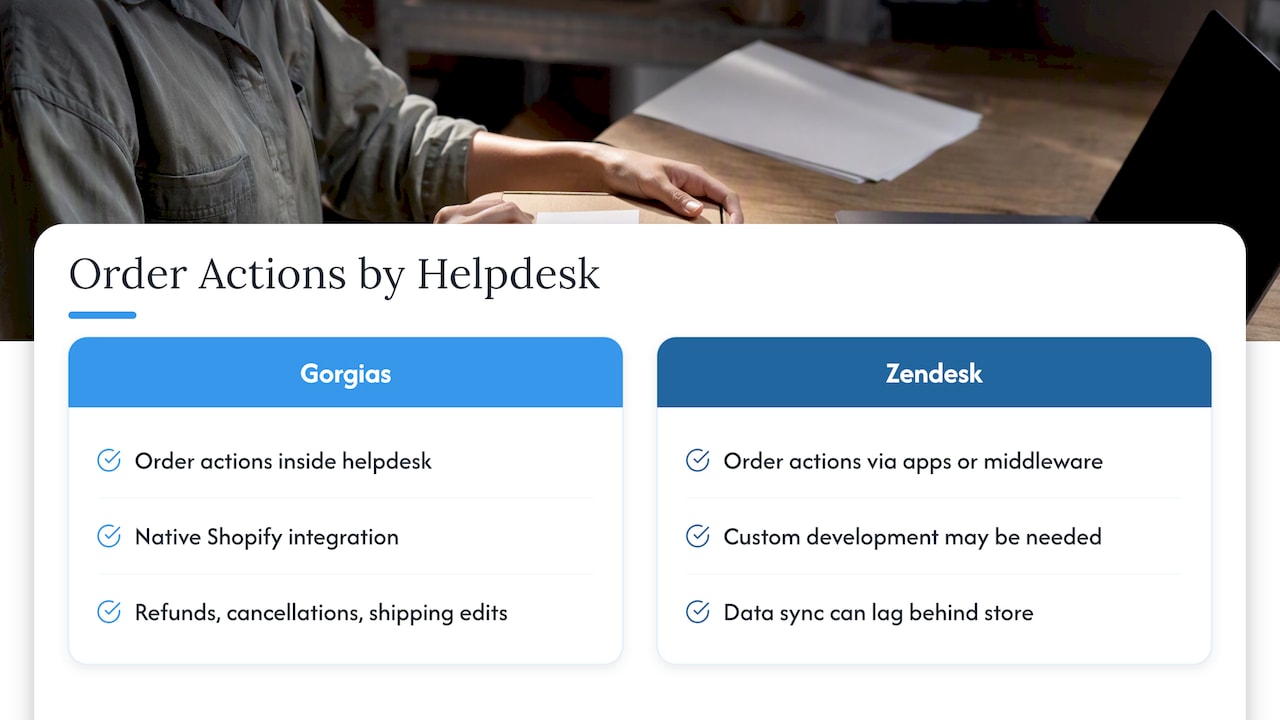
For an ecommerce brand, the most important difference is where order actions take place. Gorgias lets agents issue refunds, cancel orders or edit shipping details inside the helpdesk, because of its native integration with platforms such as Shopify. That is the vendor’s own description, so treat it as a claim to test in a trial. A Shopify-focused comparison reaches the same view: Gorgias lets agents refund, cancel and edit orders inside the ticket.
Zendesk can reach the same result, but typically through apps, middleware or custom development. That works, but each extra layer is something to maintain, and data sync can lag behind the store.
For a team where most tickets are “where is my order”, “I want to return this” or “change my address”, saving 30 seconds per ticket adds up quickly. At 1,500 tickets a month, 30 seconds is about 12 hours of agent time. That is our own arithmetic, but it shows why order actions matter more than a long feature list.
Features that favour Zendesk
Zendesk has real strengths, and an honest comparison should name them.
- Omnichannel routing. Email, chat, phone and social, with skills-based routing on higher tiers.
- SLA management and governance. Useful for regulated sectors and teams with contractual response times.
- Workflow depth. Action Builder for multi-step workflows and the Copilot agent assist suit complex operations.
- Ecosystem. The same source points to a marketplace of more than 1,800 apps.
- Multi-region scale. One 2026 comparison says Zendesk wins clearly for brands running multiple storefronts across regions, and for those managing B2B alongside consumer sales.
If you sell through several storefronts, handle phone support at volume, or must prove SLA compliance, these matter more than native Shopify actions.
Features that favour Gorgias
- Ecommerce macros. Replies that pull in order status, tracking and product details.
- Revenue from support. A dashboard that shows sales influenced by support conversations.
- Autonomous order actions. The native AI can take order-related actions without a developer building the integration.
- Unlimited users. No per-seat cost as your team grows, per the pricing breakdown above.
For a brand where support doubles as a sales channel, with pre-purchase questions about sizing, stock or delivery times, revenue attribution is useful. It connects to work we do on conversion, which we cover in our guide to beating a 2.2% ecommerce conversion rate.
Setup time and learning curve
Practitioners report that Zendesk agent onboarding typically takes 1 to 2 weeks, compared with 1 to 3 days for Gorgias. The same comparison shows a higher G2 satisfaction rating for Gorgias on ease of use in small and mid-sized businesses, 4.6 out of 5 against 4.3 for Zendesk Support Suite. Another comparison says Gorgias typically takes about a week to install in some set-ups, though that source dates from 2024, so confirm current timelines.
Onboarding time is a hidden cost. If you hire seasonal agents for peak trading, a tool agents can use in days is worth more than a tool with more features that takes two weeks to teach.
AI agents and what they really cost
Both vendors now sell AI that resolves tickets without a human. Pricing differs. Gorgias bills per automated resolution, and Zendesk bills AI per resolution on top of the base plan, according to one 2026 Zendesk review. The consequence is the same at both: your bill rises with the number of tickets AI closes.
Before you switch on automation, decide what “resolved” means and how you will check it. An AI agent that closes tickets but gives wrong refund advice or fails to escalate an upset customer costs you more than it saves. A guide on ticketing integration for AI agents explains what to connect and audit, which is useful when you compare Gorgias’s per-ticket model with Zendesk’s per-agent one. A sensible rule is to sample a set number of AI-closed tickets every week for the first two months and read them.
A note on Zendesk Sell and the CRM question
If you are weighing Zendesk for both service and sales, note that Zendesk announced on 9 September 2025 that Zendesk Sell will be retired on 31 August 2027. Another review advises that no new team should deploy Sell in 2026. Existing customers keep full access until the retirement date.
This does not affect Zendesk’s support products. It does mean you should not plan a sales CRM around Sell. Zendesk is also not a Salesforce clone: it is focused primarily on AI-driven customer service and ticket management, while Salesforce remains the leader for end-to-end sales and enterprise commerce workflows.
For most online stores, the helpdesk and the CRM are separate decisions. Your customer data should flow between support, email and your store, and we explain how to shortlist for that in our guide to CRM for ecommerce.
Which one should you choose?
Use the bottleneck approach. One Shopify-focused comparison frames it this way: if support is order-centric and your problem is returns, shipping and refunds, Gorgias fits best. If your bottleneck is complexity, such as several global product lines, regulated compliance or strict SLA and routing rules, Zendesk is the necessary, if heavier, choice.
Choose Gorgias if
- You run a Shopify, BigCommerce or Magento store.
- Most tickets concern orders, returns, delivery or product questions.
- You have a small or changing team and want fast onboarding.
- You prefer cost tied to customer demand rather than headcount.
Choose Zendesk if
- You operate several storefronts or regions, or mix B2B and consumer support.
- You need phone, social and email in one routed queue.
- You must meet formal SLAs or governance requirements.
- You have the technical resource to configure and maintain it.
A five-step way to decide
- Export your last three months of tickets and count volume per month.
- Tag the top ten ticket reasons and note how many need an order action.
- Count agents, including seasonal cover, and the channels you must support.
- Ask both vendors for a quote that includes AI, voice and set-up.
- Run a two-week trial with real tickets and time how long a refund takes in each tool.
The trial matters most. Vendor pages, including the ones we cite, describe their own product. Your own tickets are the only neutral test.
Our perspective
We do not sell helpdesks, so we have no preferred tool. We do see what happens after the decision. The pattern we notice is that brands choose support software as a cost question and then discover it is a retention question. Fast, accurate answers protect repeat purchase. Slow, inconsistent ones show up weeks later as lower email engagement, weaker reviews and higher paid acquisition costs to replace lost customers.
Our advice is simple. Pick the tool your team will use properly. A simpler tool configured well beats a powerful one configured halfway. Keep your support data connected to your email and CRM so that a customer who has just had a delivery problem is not sent a promotional campaign the same afternoon. Then use support conversations as research: the questions customers ask most often are the questions your product pages, ads and post-purchase emails should already answer. We cover one way to capture that in our post-purchase survey pilot.
That is also why we prefer one team across strategy, creative, performance and web. Support, site and lifecycle messaging affect each other, and they work best when one group sees all of them.
— Alex
Where we can help
Choosing a helpdesk is one step. The growth around it, from email and CRM to paid media and the store itself, is where we work. Our eCommerce management service brings strategy, creative, performance marketing and web development under one roof, so you work with a single senior team instead of several vendors. If you would like to see the full range, start with our services overview.
FAQ
Is Gorgias cheaper than Zendesk?
It depends on your ticket volume and headcount. Gorgias charges by monthly tickets and includes unlimited users, so it tends to be cheaper for larger teams with moderate volume. Zendesk charges per agent, so it can be cheaper for a small team with very high volume. Add AI and voice costs before you compare.
Is Zendesk similar to Salesforce?
Not really. Zendesk is mainly a customer service and ticketing platform. Salesforce is the leader in sales automation and enterprise commerce workflows. Both hold customer data, but they are built for different jobs.
Is Zendesk Sell shutting down?
Yes. Zendesk has announced that Sell will be retired on 31 August 2027, and existing customers keep access until then. Zendesk’s support products are not affected. New teams should not build a sales process on Sell.
Which is easier to set up for a Shopify store?
Gorgias is generally quicker. Its Shopify integration is native, and practitioners report 1 to 3 days for agent onboarding against 1 to 2 weeks for Zendesk. Zendesk can match the capability, but usually needs apps or custom work.
Sources
- Gorgias vs Zendesk 2026: Shopify Support Compared, Talk Shop
- Gorgias vs Zendesk for Shopify (2026), Macha
- Gorgias vs Zendesk, Zendesk
- Gorgias vs Zendesk comparison, Gorgias
- Gorgias vs Zendesk Support Suite, G2
- Gorgias Pricing 2026, Lindy
- Zendesk Pricing 2026, Bossbot
- Zendesk review 2026, Botapolis
- Gorgias vs Zendesk: Which CX Platform Wins, Online Store News
- Gorgias vs Zendesk: Pricing and Features Compared, Tidio
- Base CRM vs Salesforce 2026 comparison, ZoomInfo
- Zendesk Sell Review 2026
- Best Sales Pipeline Software in 2026, Rework
Recommended

Other posts























































Stay ahead with better decisions.
Get business insights today.
